Unit 3 Monetary Policy International Financial System 1192010
- Slides: 32
Unit 3: Monetary Policy International Financial System 11/9/2010
Exchange Rate Regimes fixed exchange rate – a currency's value is matched to the value of another single currency or to a commodity (e. g. , gold) floating exchange rate – a currency's value is allowed to fluctuate to the foreign exchange market
Exchange Rate Regimes Fixed exchange rates make trade and investment between two countries on the same peg easy (minimize exchange rate risk). Floating exchange rates have a more flexible monetary policy and don’t have to waste resources defending the peg.
Exchange Rate Regimes The United States and most other countries were on a fixed exchange rate regime until 1971 (first the gold standard, then Bretton Woods). At Milton Friedman’s urging, the U. S. moved to a floating exchange rate regime, though it is actually a managed float, not a pure float.
Exchange Rate Regimes managed float (dirty float) – floating exchange rate: but government sometimes intervenes (buying or selling foreign assets to influence exchange rates)
Exchange Rate Regimes gold standard – fixed exchange rate: currencies pegged to gold Bretton Woods – (1944 -1971) fixed exchange rate: dollar pegged to gold, other currencies pegged to dollar
Exchange Rate Regimes currency board – fixed exchange rate: domestic currency backed 100% by a foreign currency with a permanent peg (or so they claim)
Exchange Rate Regimes dollarization – fixed exchange rate: adoption of a foreign currency as the domestic currency (e. g. , the dollar)
Exchange Rate Regimes currency union – fixed exchange rate (inside): countries join together for a common currency, which operates like a fixed regime (dollarization) among member countries and either fixed or floating with the rest of the world
Exchange Rate Regimes Exchange rate regimes • gold standard (fixed) • currency union (fixed inside) • dollarization (fixed) • currency board (fixed) • traditional fixed (fixed) • managed float (floating) • pure float (floating)
Capital Controls capital controls – restrictions on foreign investment; restrictions regulating the flow in and out of the capital account perfect capital mobility – no capital controls
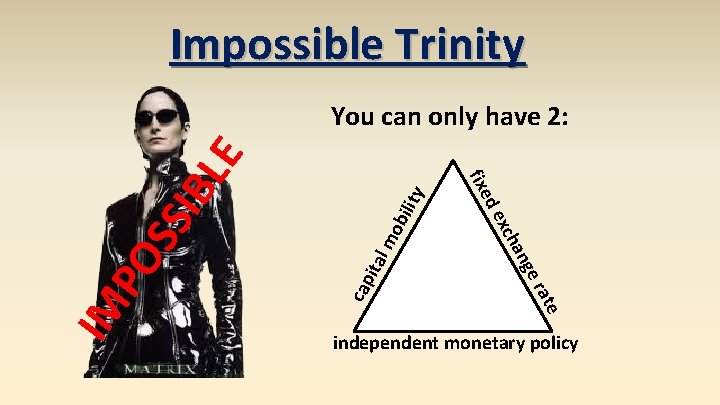
IM PO SS IBL E Impossible Trinity impossible trinity – a country cannot have all 3 of the following at the same time: • fixed exchange rate • capital mobility • independent monetary policy
Impossible Trinity SS mo bil ity ita l cap e rat PO ge an h exc ed IM fix IBL E You can only have 2: independent monetary policy
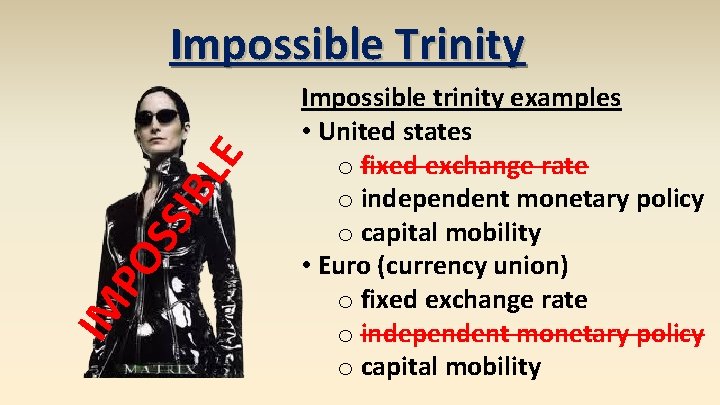
IM PO SS IBL E Impossible Trinity Impossible trinity examples • United states o fixed exchange rate o independent monetary policy o capital mobility • Euro (currency union) o fixed exchange rate o independent monetary policy o capital mobility
Sterilization international reserves (foreign exchange reserves) – central bank holdings of assets denominated in a foreign currency foreign exchange interventions – central bank international financial transactions made to influence foreign exchange rates
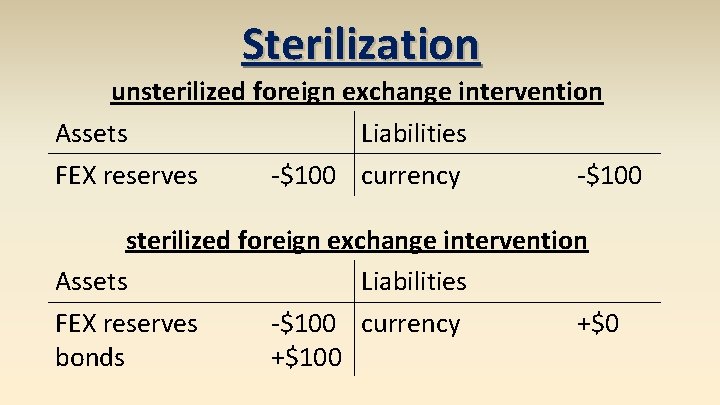
Sterilization unsterilized foreign exchange intervention – foreign exchange intervention that effects the monetary base sterilized foreign exchange intervention – FEI with an offsetting open market operation that leaves the monetary base unchanged
Sterilization unsterilized foreign exchange intervention Assets Liabilities FEX reserves -$100 currency -$100 sterilized foreign exchange intervention Assets Liabilities FEX reserves -$100 currency +$0 bonds +$100
Fixed Exchange Rate In order to defend a fixed exchange rate, the central bank must intervene when the exchange rate fluctuates. Note: These slides use the popular definition of exchange rather than Mishkin’s. e ≡ exchange rate (in $/€)
Fixed Exchange Rate devaluation – setting the exchange rate peg (e) to a higher level (e. g. , more $/€) revaluation – setting the exchange rate peg (e) to a lower level
Fixed Exchange Rate When the domestic currency depreciates (e↑), the central bank must sell foreign assets (international reserves) to restore the old exchange rate. If it runs out of reserves, it must either devalue or switch to a floating regime.
Fixed Exchange Rate When the domestic currency appreciates (e↓), the central bank must buy foreign assets (international reserves) to restore the old exchange rate. Central banks may accumulate a lot of international reserves (e. g. , China has > $2 trillion).
Speculative Attack speculative attack – the massive selling (shorting) of a country’s currency assets, with the hope of a devaluation, which would net a huge profit
Speculative Attack Investors can engage in a speculative attack selling off the currency, then buy back the currency after the devaluation. As more and more speculators sell the currency, the central bank drains its international reserves defending the peg. Eventually it must devalue.
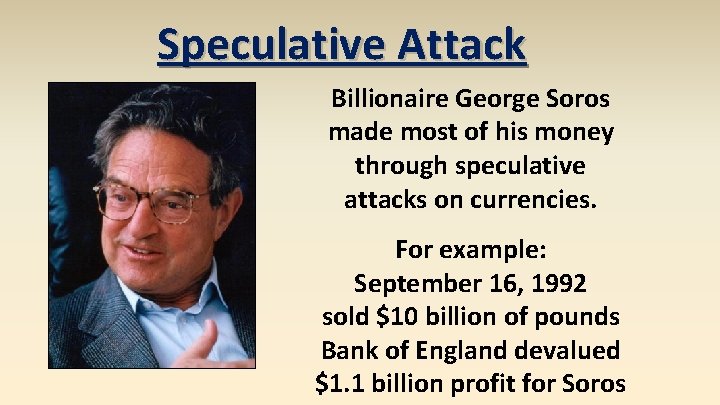
Speculative Attack Billionaire George Soros made most of his money through speculative attacks on currencies. For example: September 16, 1992 sold $10 billion of pounds Bank of England devalued $1. 1 billion profit for Soros
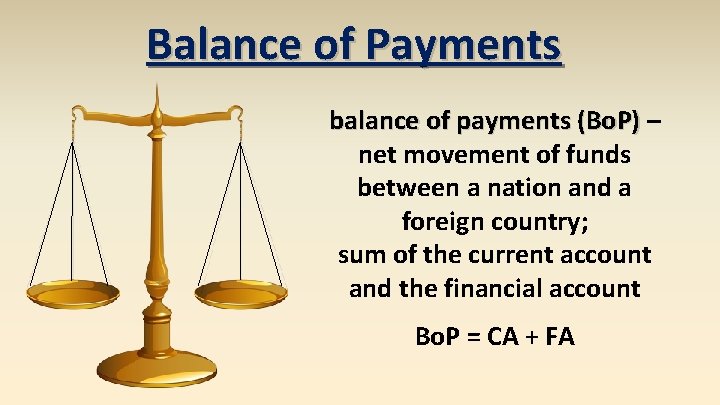
Balance of Payments balance of payments (Bo. P) – net movement of funds between a nation and a foreign country; sum of the current account and the financial account Bo. P = CA + FA
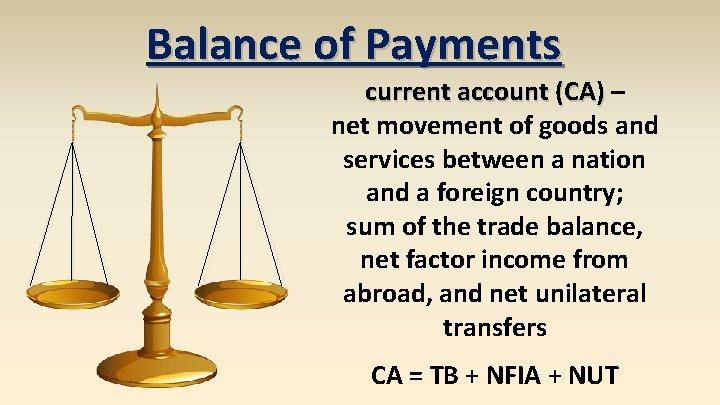
Balance of Payments current account (CA) – net movement of goods and services between a nation and a foreign country; sum of the trade balance, net factor income from abroad, and net unilateral transfers CA = TB + NFIA + NUT
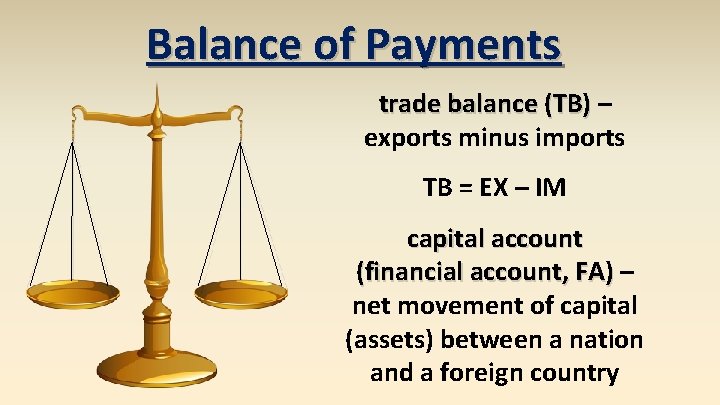
Balance of Payments trade balance (TB) – exports minus imports TB = EX – IM capital account (financial account, FA) – net movement of capital (assets) between a nation and a foreign country
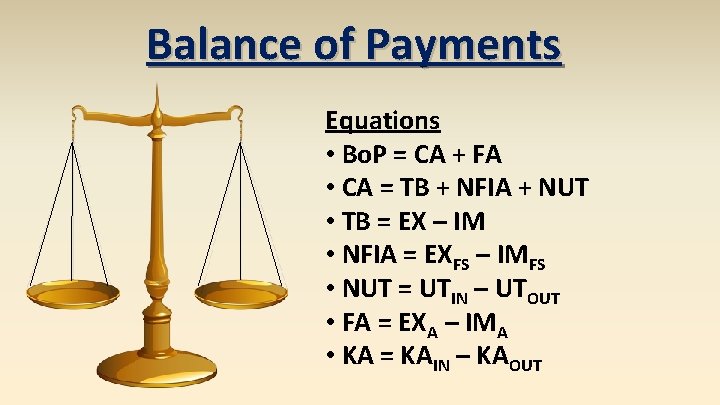
Balance of Payments Equations • Bo. P = CA + FA • CA = TB + NFIA + NUT • TB = EX – IM • NFIA = EXFS – IMFS • NUT = UTIN – UTOUT • FA = EXA – IMA • KA = KAIN – KAOUT
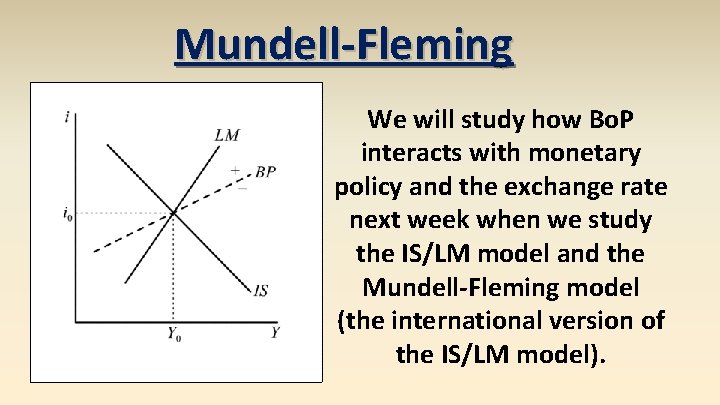
Mundell-Fleming We will study how Bo. P interacts with monetary policy and the exchange rate next week when we study the IS/LM model and the Mundell-Fleming model (the international version of the IS/LM model).
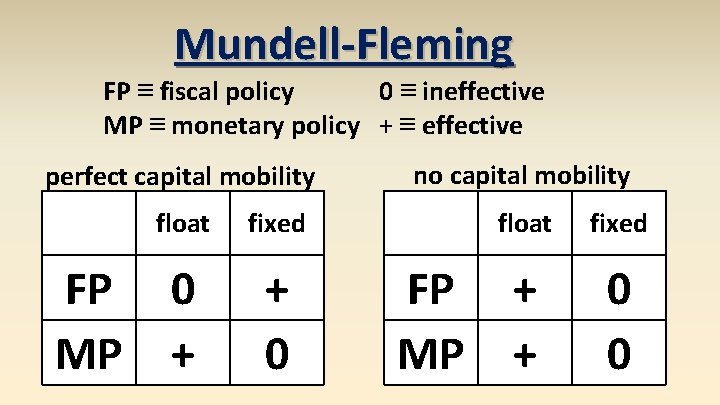
Mundell-Fleming FP ≡ fiscal policy 0 ≡ ineffective MP ≡ monetary policy + ≡ effective perfect capital mobility no capital mobility float fixed 0 + + 0 0 FP MP
International Monetary Fund – the IMF was setup under Bretton Woods to help countries maintain their fixed exchange rates (loans to countries with Bo. P problems); now it acts as an international lender of last resort (LOLR) during financial crises
World Bank (International Bank for Reconstruction and Development) – provides long-term loans to developing countries for economic development projects (e. g. , dams, roads, etc. ); setup by Bretton Woods