Unit 14 Careers Lesson 2 Interviews Lead in
- Slides: 28
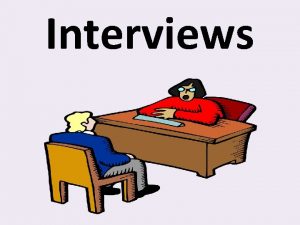
Unit 14 Careers Lesson 2 Interviews 北京十一学校 刘英
Lead in T: Last period, you found the right job which suits you, and the most important thing is how to apply for your ideal job successfully. What should you pay attention to when you conduct an interview? Let’s see more advice on job interview.
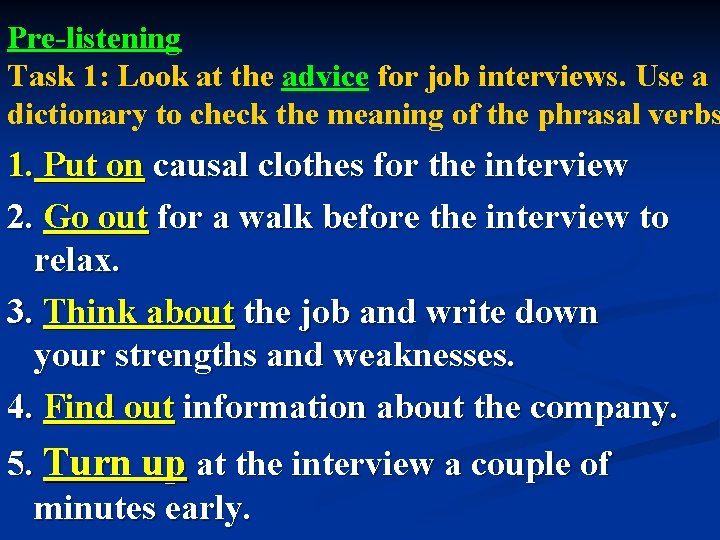
Pre-listening Task 1: Look at the advice for job interviews. Use a dictionary to check the meaning of the phrasal verbs 1. Put on causal clothes for the interview 2. Go out for a walk before the interview to relax. 3. Think about the job and write down your strengths and weaknesses. 4. Find out information about the company. 5. Turn up at the interview a couple of minutes early.
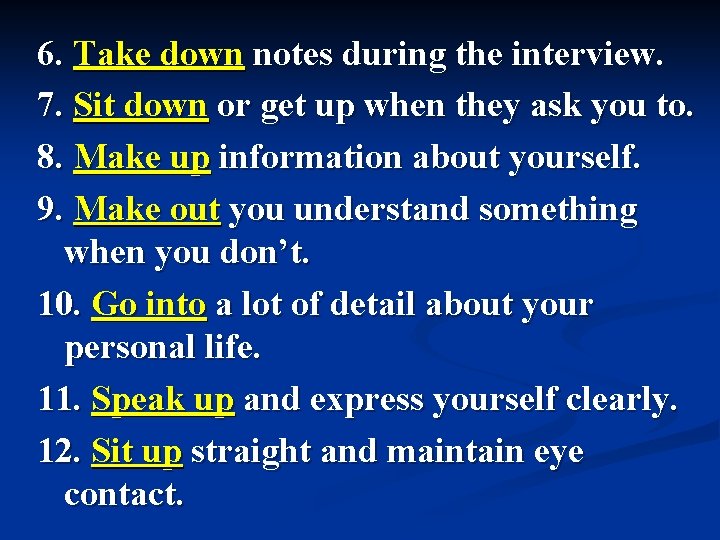
6. Take down notes during the interview. 7. Sit down or get up when they ask you to. 8. Make up information about yourself. 9. Make out you understand something when you don’t. 10. Go into a lot of detail about your personal life. 11. Speak up and express yourself clearly. 12. Sit up straight and maintain eye contact.
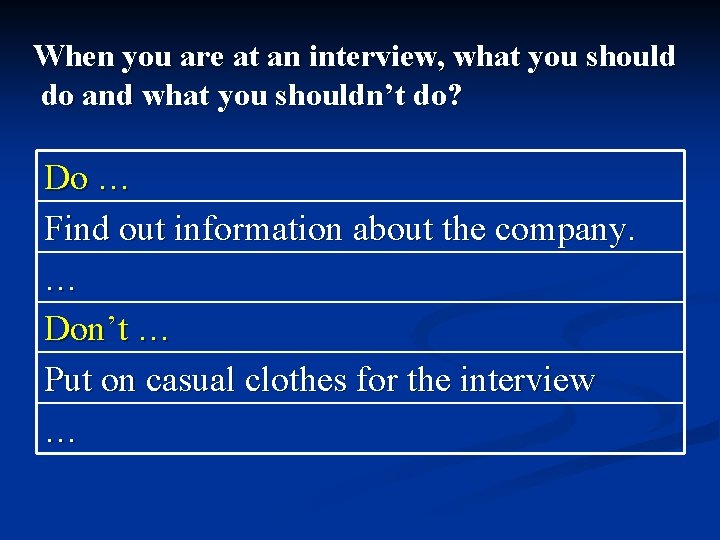
When you are at an interview, what you should do and what you shouldn’t do? Do … Find out information about the company. … Don’t … Put on casual clothes for the interview …
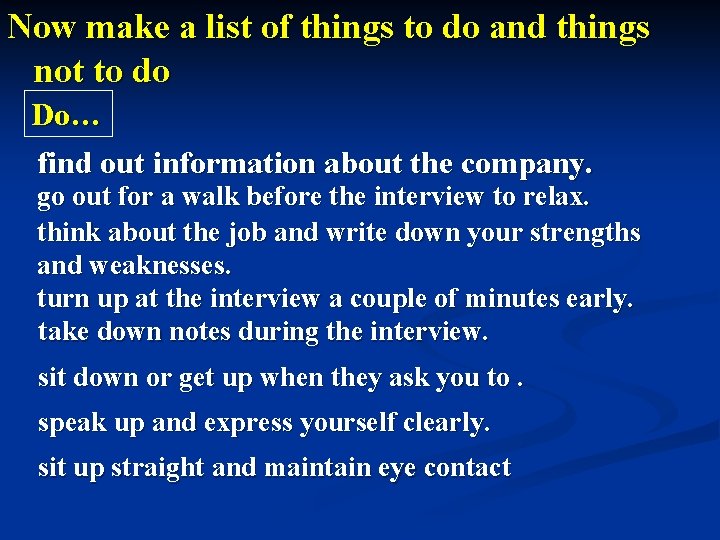
Now make a list of things to do and things not to do Do… find out information about the company. go out for a walk before the interview to relax. think about the job and write down your strengths and weaknesses. turn up at the interview a couple of minutes early. take down notes during the interview. sit down or get up when they ask you to. speak up and express yourself clearly. sit up straight and maintain eye contact
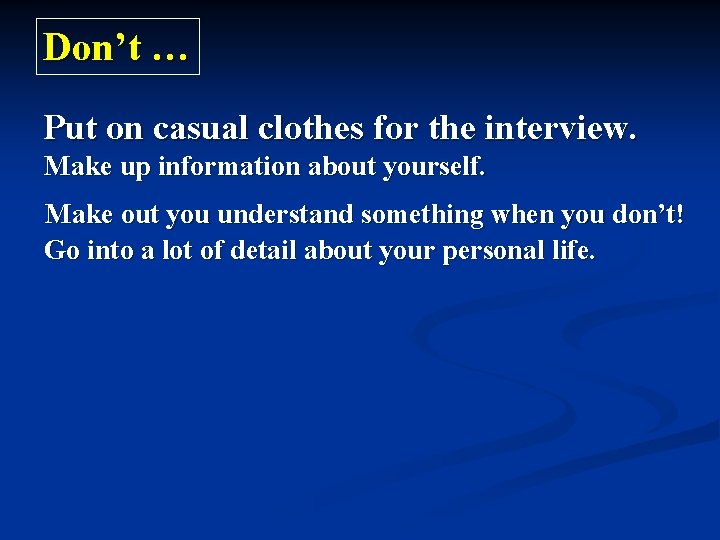
Don’t … Put on casual clothes for the interview. Make up information about yourself. Make out you understand something when you don’t! Go into a lot of detail about your personal life.
Task 2: Learn some new words n nursery n appointment n instant n battle (见学案)
Exercise 2: Complete Mandy’s account of an interview with verbs from Exercise
n Do you think Mandy got the job? Why or why not? Could you give him some advice? n Teachers’ advice: When you answer questions in a job interview, please remember the golden rule: Always give the monkey exactly what he wants.
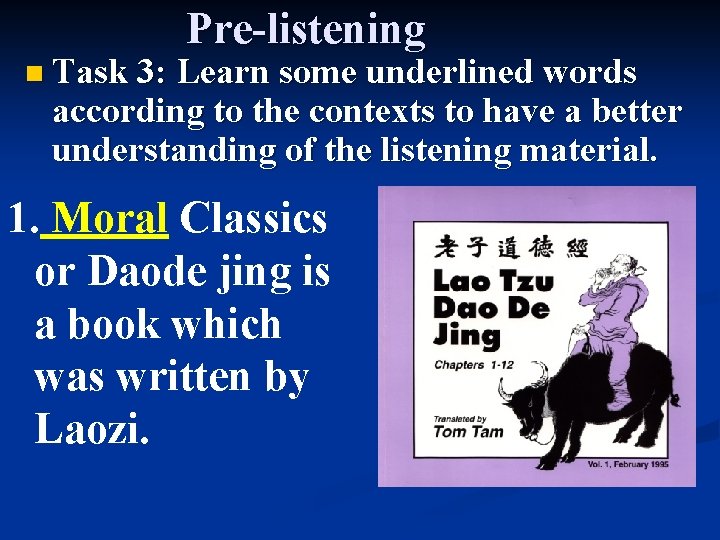
Pre-listening n Task 3: Learn some underlined words according to the contexts to have a better understanding of the listening material. 1. Moral Classics or Daode jing is a book which was written by Laozi.
Pre-listening 2. Personal interviews will often be on a one to one basis but can also be done as a group exercise. The basis of this drink is orange juice.
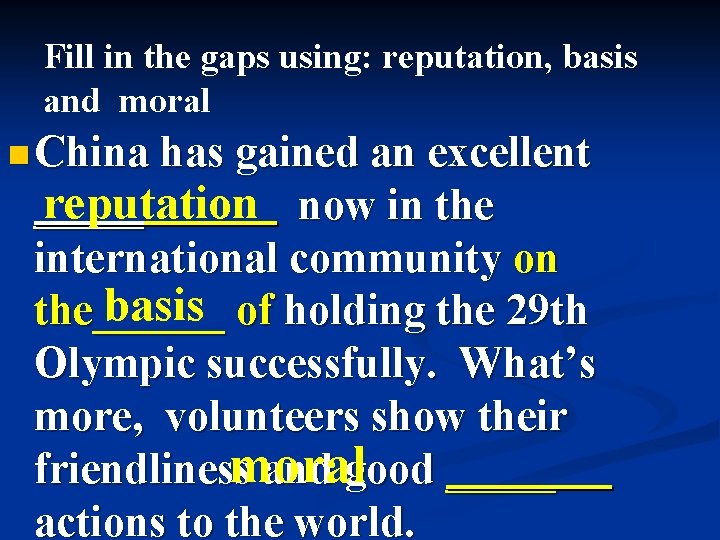
Fill in the gaps using: reputation, basis and moral n China has gained an excellent reputation now in the _____ international community on basis of holding the 29 th the______ Olympic successfully. What’s more, volunteers show their moral friendliness and good _____ actions to the world.
While-listening Task 1: listen and answer n n What does the interviewee do? Was the interviewee successful?
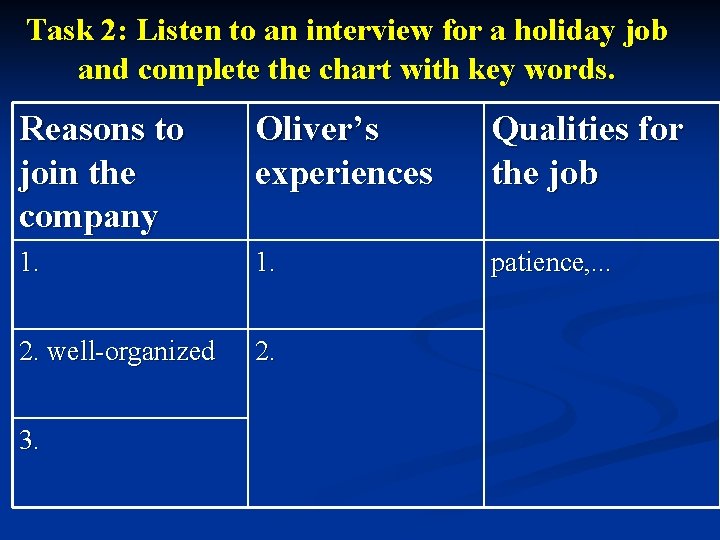
Task 2: Listen to an interview for a holiday job and complete the chart with key words. Reasons to join the company Oliver’s experiences Qualities for the job 1. patience, . . . 2. well-organized 2. 3.
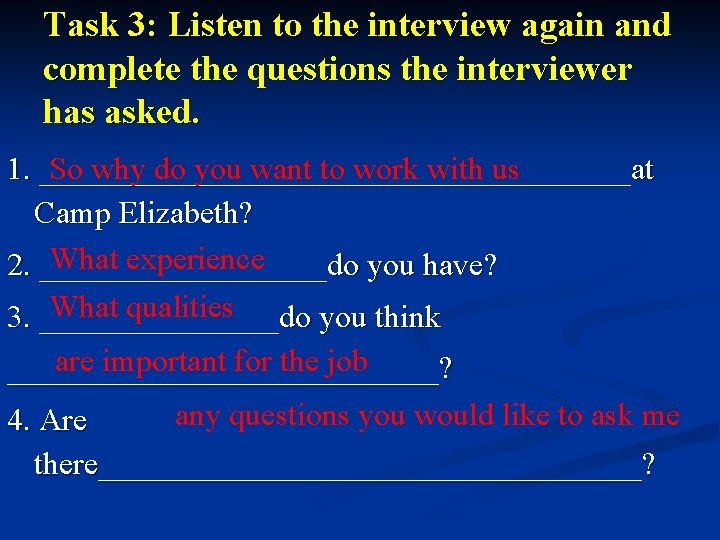
Task 3: Listen to the interview again and complete the questions the interviewer has asked. So why do you want to work with us 1. ___________________at Camp Elizabeth? What experience 2. _________do you have? What qualities 3. ________do you think are important for the job ______________? any questions you would like to ask me 4. Are there_________________?
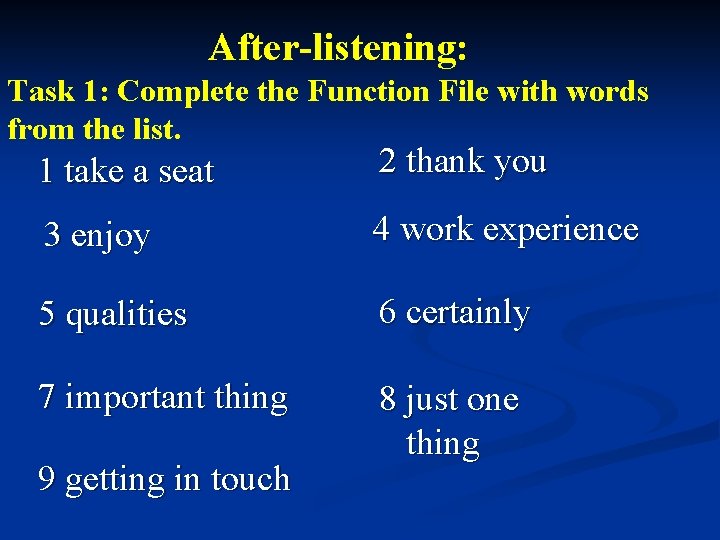
After-listening: Task 1: Complete the Function File with words from the list. 1 take a seat 2 thank you 3 enjoy 4 work experience 5 qualities 6 certainly 7 important thing 8 just one thing 9 getting in touch
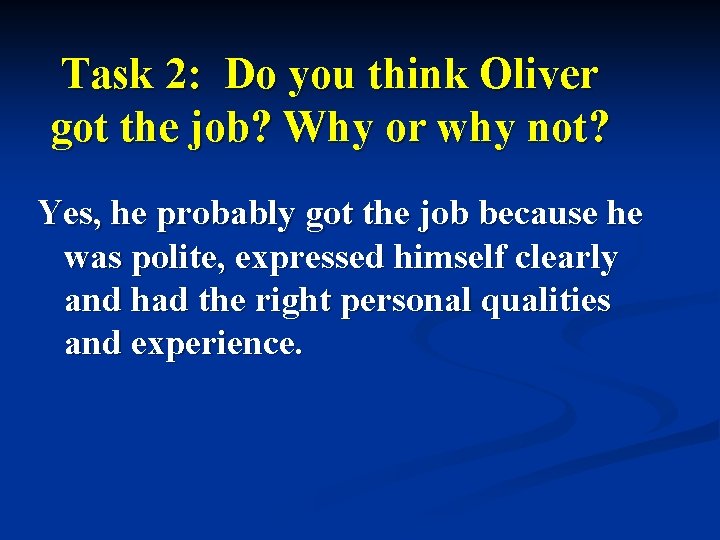
Task 2: Do you think Oliver got the job? Why or why not? Yes, he probably got the job because he was polite, expressed himself clearly and had the right personal qualities and experience.
Assignment n Change the interview into an account based on exe 2, using some phrasal verbs from the exe 1.
Period Two Objectives: 1. Review the previous interview 2. Learn some listening strategies Step 1: Work with your partners. One acts as an interviewer, the other works as an interviewee. (P 25 Exe 7) n Act out your interview. Use expressions from the Function File.
Step 2: Pronunciation exercise (Exe 10 and 11 ) In a job interview when you don’t catch what he says what should you say? How do you show you are polite? n Ask students to express their own ideas. n Listen to people asking the interview to repeat or explain something. Judge which of them are polite and which are not? n
Pre-listening Read the listening Strategies with the class
Lean some new words before listening (Exe 12)
idioms n Out of sight, out of mind. 眼不见,心为静。 n Observation is the best teacher. 观察是最好的老师。 n Old friends and old wines are best. 陈酒味醇,老友情深。
While-listening Listen for the first time and get the general idea.
listen for the second time and find the problems with farming Only write done key words and use abbreviations.
After-listening n In pairs, use the notes to tell each other the information you found out, using complete sentences. n For example, student can state their sentence like: One of the problems with farming is that disease can ruin a harvest.
Have a summary of the period n Sandra: How are things going with your new job? Lisa: Not bad. But not as wonderful as I’d expected before I secured it. Sandra: Well, I understand that. You know, the grass is always greener. n The golden rule of a job interview: Always give the monkey exactly what he wants.