
Unit 4 Researching PR Careers Using Technology Skills

- Slides: 42
Unit 4 Researching PR Careers Using Technology
Skills focus Reading • identifying topic development within a paragraph • using the Internet effectively • Evaluating Internet search results Writing • reporting research findings Vocabulary focus • computer jargon • abbreviations and acronyms • discourse and stance markers • verb and noun suffixes
4. 1 Vocabulary 4. 2 Reading 4. 3 Extending skills 4. 4 Extending skills
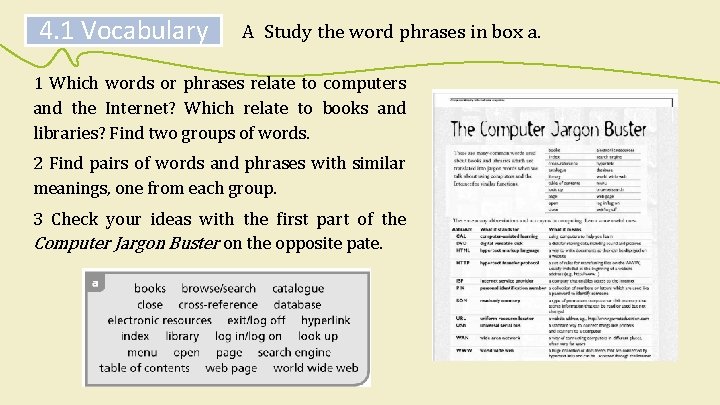
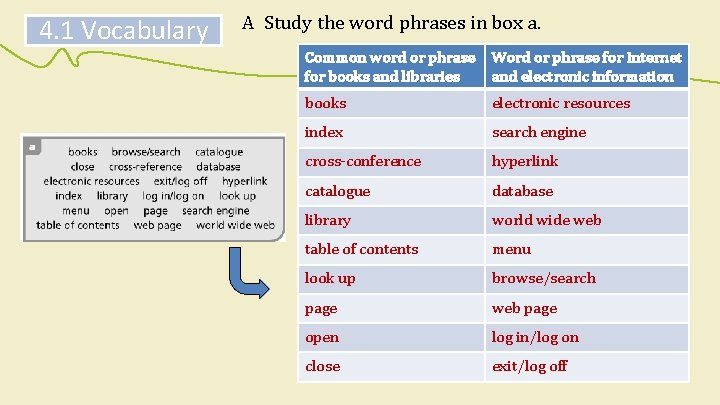
4. 1 Vocabulary A Study the word phrases in box a. 1 Which words or phrases relate to computers and the Internet? Which relate to books and libraries? Find two groups of words. 2 Find pairs of words and phrases with similar meanings, one from each group. 3 Check your ideas with the first part of the Computer Jargon Buster on the opposite pate.
4. 1 Vocabulary A Study the word phrases in box a. Common word or phrase for books and libraries Word or phrase for Internet and electronic information books electronic resources index search engine cross-conference hyperlink catalogue database library world wide web table of contents menu look up browse/search page web page open log in/log on close exit/log off
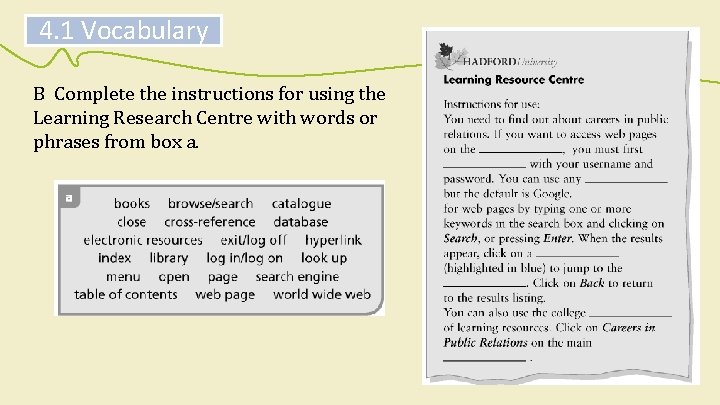
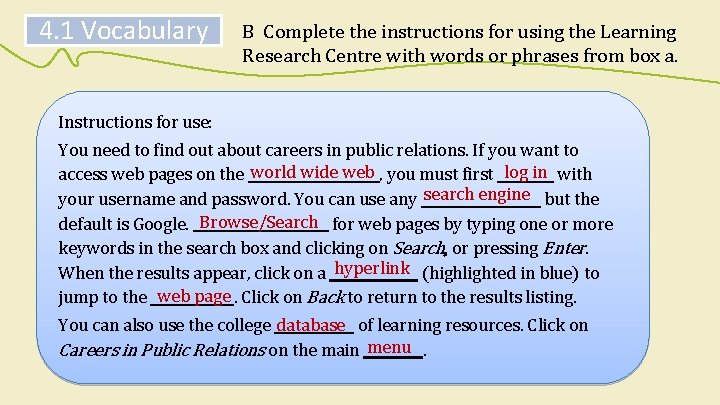
4. 1 Vocabulary B Complete the instructions for using the Learning Research Centre with words or phrases from box a.
4. 1 Vocabulary B Complete the instructions for using the Learning Research Centre with words or phrases from box a. Instructions for use: You need to find out about careers in public relations. If you want to access web pages on the world wide web , you must first log in with your username and password. You can use any search engine but the default is Google. Browse/Search for web pages by typing one or more keywords in the search box and clicking on Search, or pressing Enter. When the results appear, click on a hyperlink (highlighted in blue) to jump to the web page. Click on Back to return to the results listing. You can also use the college database of learning resources. Click on Careers in Public Relations on the main menu.
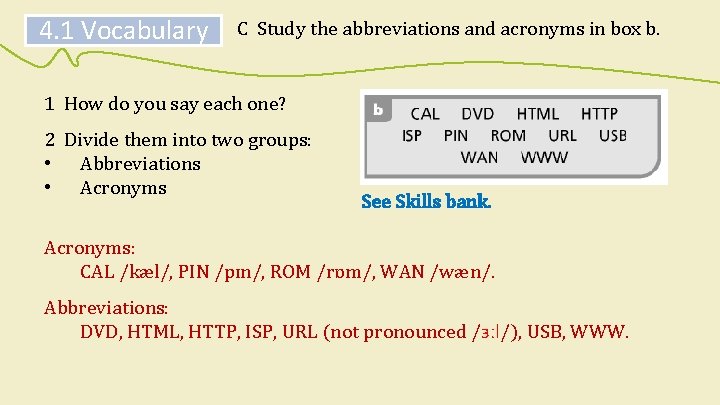
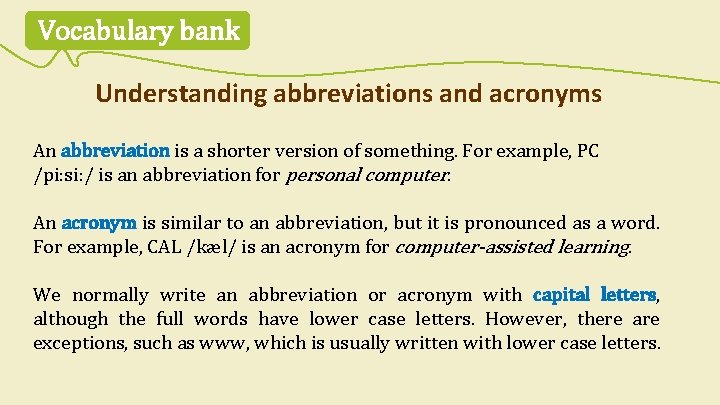
4. 1 Vocabulary C Study the abbreviations and acronyms in box b. 1 How do you say each one? 2 Divide them into two groups: • Abbreviations • Acronyms See Skills bank. Acronyms: CAL /kæl/, PIN /pɪn/, ROM /rɒm/, WAN /wæn/. Abbreviations: DVD, HTML, HTTP, ISP, URL (not pronounced /ɜːl/), USB, WWW.
Vocabulary bank Understanding abbreviations and acronyms An abbreviation is a shorter version of something. For example, PC /pi: si: / is an abbreviation for personal computer. An acronym is similar to an abbreviation, but it is pronounced as a word. For example, CAL /kæl/ is an acronym for computer-assisted learning. We normally write an abbreviation or acronym with capital letters, although the full words have lower case letters. However, there are exceptions, such as www, which is usually written with lower case letters.
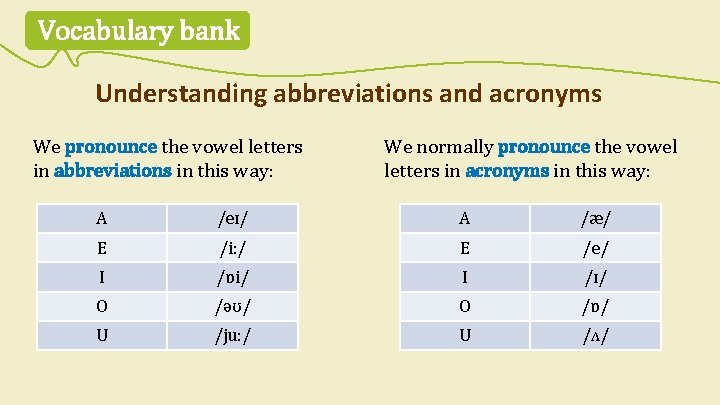
Vocabulary bank Understanding abbreviations and acronyms We pronounce the vowel letters in abbreviations in this way: We normally pronounce the vowel letters in acronyms in this way: A /eɪ/ A /æ/ E /i: / E /e/ I /ɒi/ I /ɪ/ O /əʊ/ O /ɒ/ U /ju: / U /ʌ/
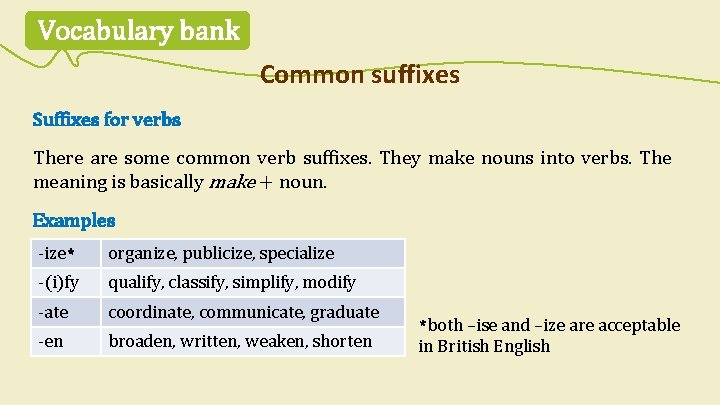
Vocabulary bank Common suffixes Suffixes for verbs There are some common verb suffixes. They make nouns into verbs. The meaning is basically make + noun. Examples -ize* organize, publicize, specialize -(i)fy qualify, classify, simplify, modify -ate coordinate, communicate, graduate -en broaden, written, weaken, shorten both –ise and –ize are acceptable in British English *
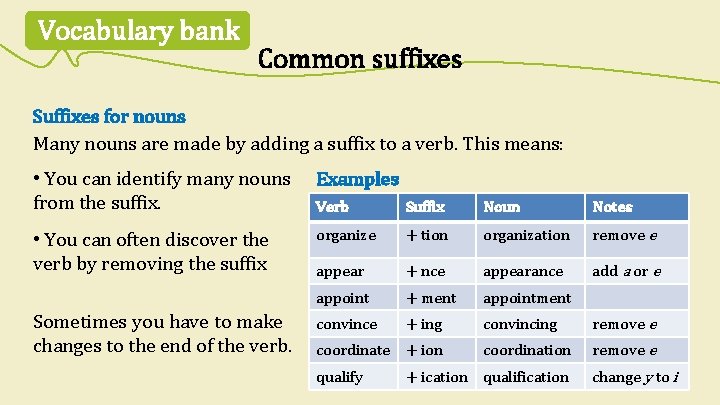
Vocabulary bank Common suffixes Suffixes for nouns Many nouns are made by adding a suffix to a verb. This means: • You can identify many nouns from the suffix. • You can often discover the verb by removing the suffix Sometimes you have to make changes to the end of the verb. Examples Verb Suffix Noun Notes organize + tion organization remove e appear + nce appearance add a or e appoint + ment appointment convince + ing convincing remove e coordination remove e coordinate + ion qualify + ication qualification change y to i
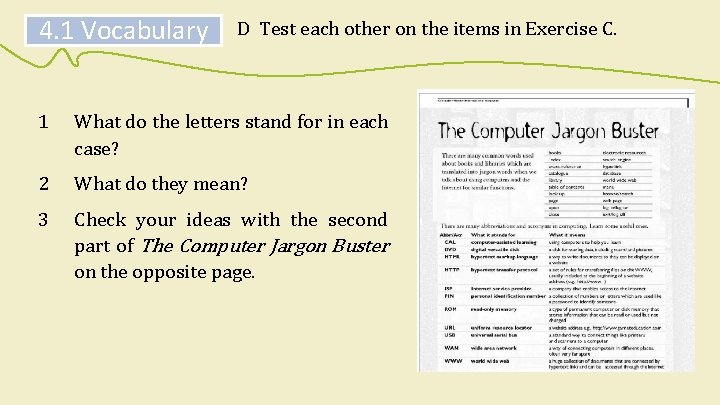
4. 1 Vocabulary D Test each other on the items in Exercise C. 1 What do the letters stand for in each case? 2 What do they mean? 3 Check your ideas with the second part of The Computer Jargon Buster on the opposite page.
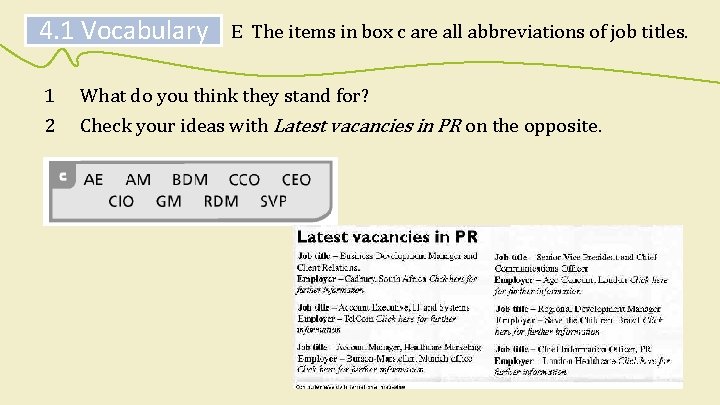
4. 1 Vocabulary 1 2 E The items in box c are all abbreviations of job titles. What do you think they stand for? Check your ideas with Latest vacancies in PR on the opposite.
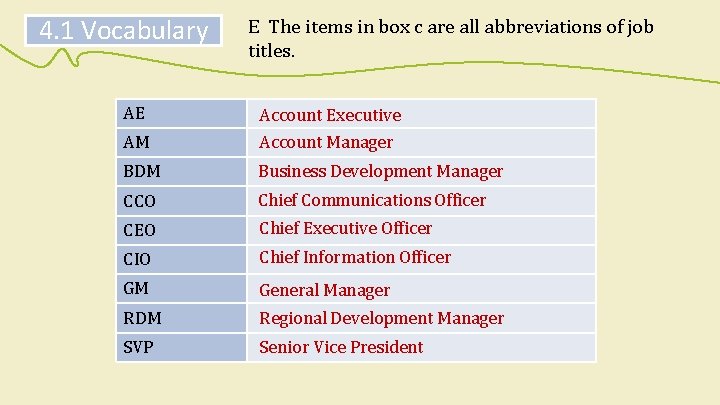
4. 1 Vocabulary E The items in box c are all abbreviations of job titles. AE Account Executive AM Account Manager BDM Business Development Manager CCO Chief Communications Officer CEO Chief Executive Officer CIO Chief Information Officer GM General Manager RDM Regional Development Manager SVP Senior Vice President
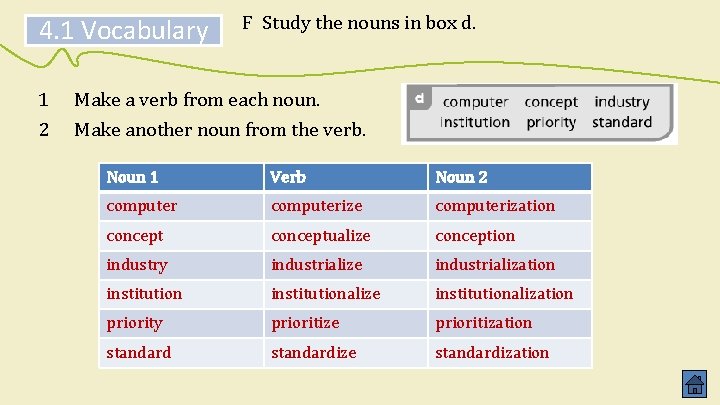
4. 1 Vocabulary 1 2 F Study the nouns in box d. Make a verb from each noun. Make another noun from the verb. Noun 1 Verb Noun 2 computerize computerization conceptualize conception industry industrialize industrialization institutionalize institutionalization priority prioritize prioritization standardize standardization
4. 2 Reading 1 A Discuss these questions What careers do you associate with the public relations industry? 2 There are more jobs in this industry now than 20 years ago. What development in society has caused this? 3 Describe a successful career in this industry.
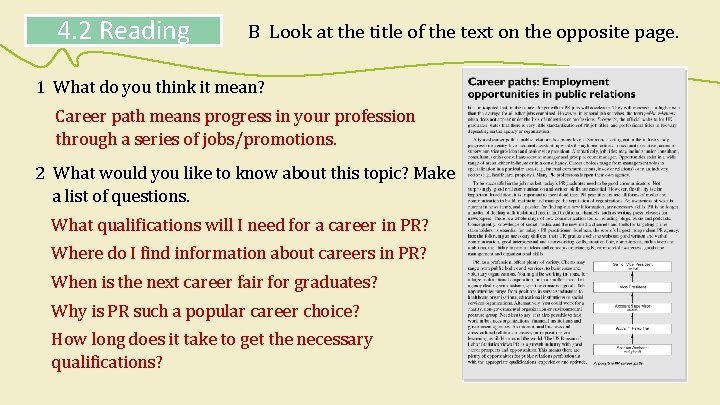
4. 2 Reading B Look at the title of the text on the opposite page. 1 What do you think it mean? Career path means progress in your profession through a series of jobs/promotions. 2 What would you like to know about this topic? Make a list of questions. What qualifications will I need for a career in PR? Where do I find information about careers in PR? When is the next career fair for graduates? Why is PR such a popular career choice? How long does it take to get the necessary qualifications?
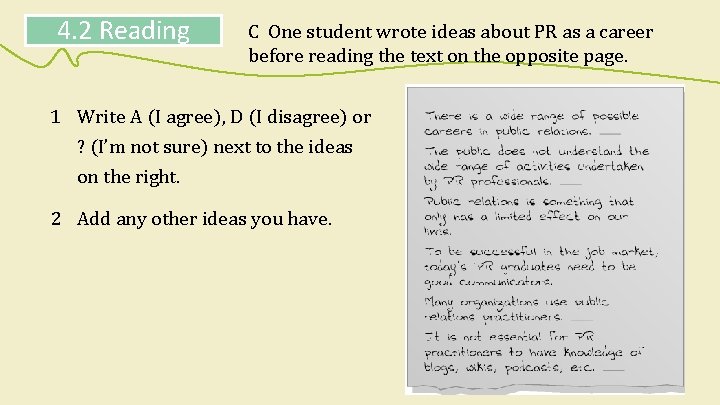
4. 2 Reading C One student wrote ideas about PR as a career before reading the text on the opposite page. 1 Write A (I agree), D (I disagree) or ? (I’m not sure) next to the ideas on the right. 2 Add any other ideas you have.
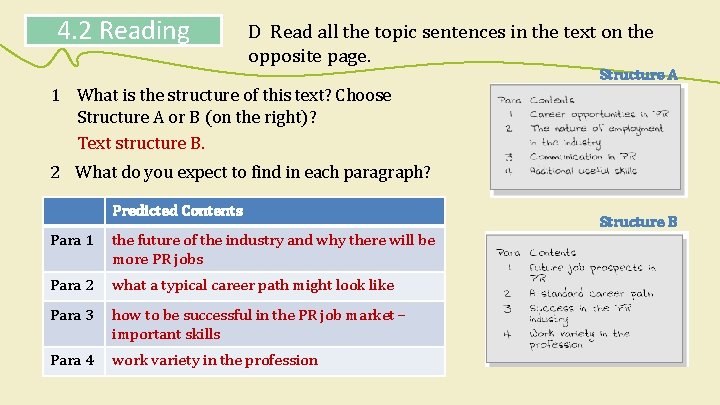
4. 2 Reading D Read all the topic sentences in the text on the opposite page. Structure A 1 What is the structure of this text? Choose Structure A or B (on the right)? Text structure B. 2 What do you expect to find in each paragraph? Predicted Contents Para 1 the future of the industry and why there will be more PR jobs Para 2 what a typical career path might look like Para 3 how to be successful in the PR job market – important skills Para 4 work variety in the profession Structure B
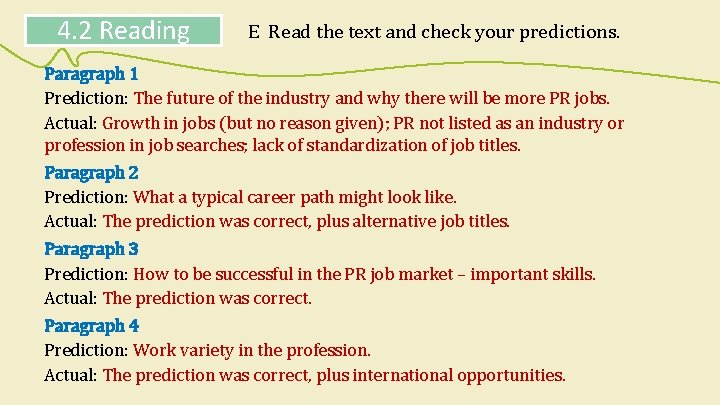
4. 2 Reading E Read the text and check your predictions. Paragraph 1 Prediction: The future of the industry and why there will be more PR jobs. Actual: Growth in jobs (but no reason given); PR not listed as an industry or profession in job searches; lack of standardization of job titles. Paragraph 2 Prediction: What a typical career path might look like. Actual: The prediction was correct, plus alternative job titles. Paragraph 3 Prediction: How to be successful in the PR job market – important skills. Actual: The prediction was correct. Paragraph 4 Prediction: Work variety in the profession. Actual: The prediction was correct, plus international opportunities.
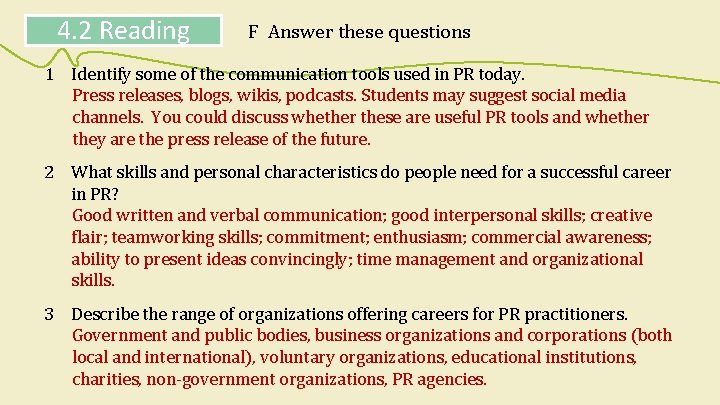
4. 2 Reading F Answer these questions 1 Identify some of the communication tools used in PR today. Press releases, blogs, wikis, podcasts. Students may suggest social media channels. You could discuss whether these are useful PR tools and whether they are the press release of the future. 2 What skills and personal characteristics do people need for a successful career in PR? Good written and verbal communication; good interpersonal skills; creative flair; teamworking skills; commitment; enthusiasm; commercial awareness; ability to present ideas convincingly; time management and organizational skills. 3 Describe the range of organizations offering careers for PR practitioners. Government and public bodies, business organizations and corporations (both local and international), voluntary organizations, educational institutions, charities, non-government organizations, PR agencies.
4. 2 Reading G Topics sometimes develop inside a paragraph. 1 Does the topic develop in each paragraph of the text? If so, underline the word or words which introduce the change. 2 What is the effect of the word or words on the development of the topic? See Skills bank.
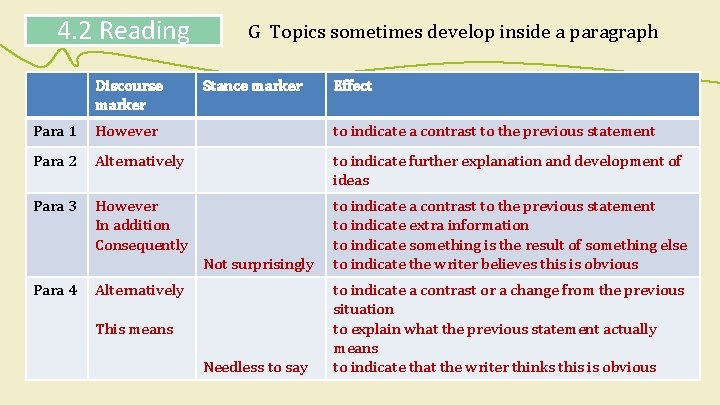
4. 2 Reading Discourse marker G Topics sometimes develop inside a paragraph Stance marker Effect Para 1 However to indicate a contrast to the previous statement Para 2 Alternatively to indicate further explanation and development of ideas Para 3 However In addition Consequently Not surprisingly to indicate a contrast to the previous statement to indicate extra information to indicate something is the result of something else to indicate the writer believes this is obvious Needless to say to indicate a contrast or a change from the previous situation to explain what the previous statement actually means to indicate that the writer thinks this is obvious Para 4 Alternatively This means
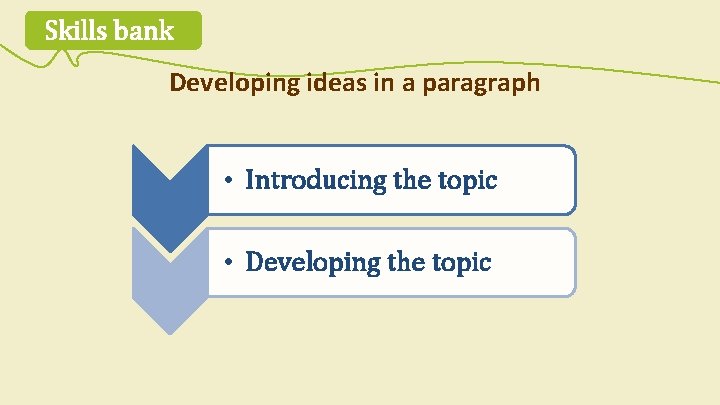
Skills bank Developing ideas in a paragraph • Introducing the topic • Developing the topic
Skills bank Developing ideas in a paragraph Introducing the topic In a text, a new paragraph indicates the start of a new topic. The topic is given in the topic sentence, which is at or near the beginning of the paragraph. The topic sentence gives the topic, and also makes a comment about the topic.
Skills bank Developing ideas in a paragraph Example: It is anticipated that, in the future, the growth in PR jobs will accelerate. The topic is PR jobs and in particular their future growth. The comment is this growth will accelerate. The sentences that follow then expand or explain the topic sentence. Example: They will increase at a higher rate than the average for all other jobs combined.
Skills bank Developing ideas in a paragraph Developing the topic A paragraph is normally about the same basic topic (the “unity” principle). However within a paragraph, ideas often develop beyond the initial comment. This development is often shown by • a discourse marker: but, however, etc. • a stance marker: thankfully, unfortunately, etc.
Skills bank Developing ideas in a paragraph Discourse markers generally make a connection between the previous information and what comes next. They mainly introduce contrasts or additional information. Example: Good communication and written skills are essential. However, flexibility is also important.
Skills bank Developing ideas in a paragraph Stance markers show the attitude of the writer to the information, i. e. , whether he/she is surprised, pleased, unhappy, etc. , about the information. Example: Needless to say, it is also possible to find work in business organization, financial institutions and government agencies. Not surprisingly, good oral communication and written skills are essential.
Skills bank Recording and reporting findings When you do research, record information about the source. Refer to the source when you report your findings. Examples: As Petersen and Martin suggest in their 1996 article in the Journal of Public Relations Research … According to Heath in his book the Handbook of public relations (2000) … As the writer of the article on The Guardian Unlimited (March 4, 2008) says … You should give the full information about the source in your reference list or bibliography. For more information about this, see Unit 10 Skills bank.
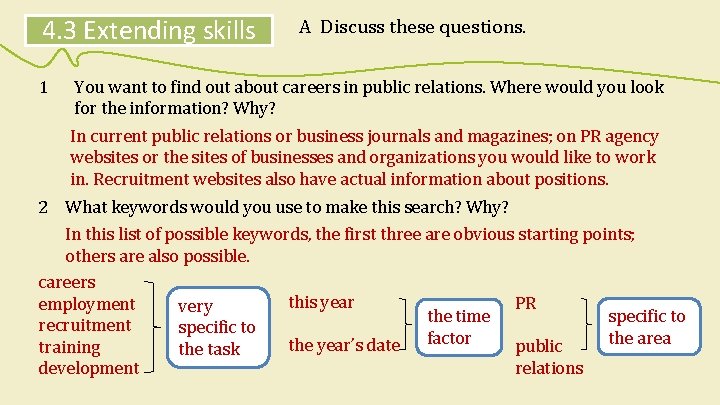
4. 3 Extending skills 1 A Discuss these questions. You want to find out about careers in public relations. Where would you look for the information? Why? In current public relations or business journals and magazines; on PR agency websites or the sites of businesses and organizations you would like to work in. Recruitment websites also have actual information about positions. 2 What keywords would you use to make this search? Why? In this list of possible keywords, the first three are obvious starting points; others are also possible. careers this year PR employment very specific to the time recruitment specific to the area the year’s date factor public training the task relations development
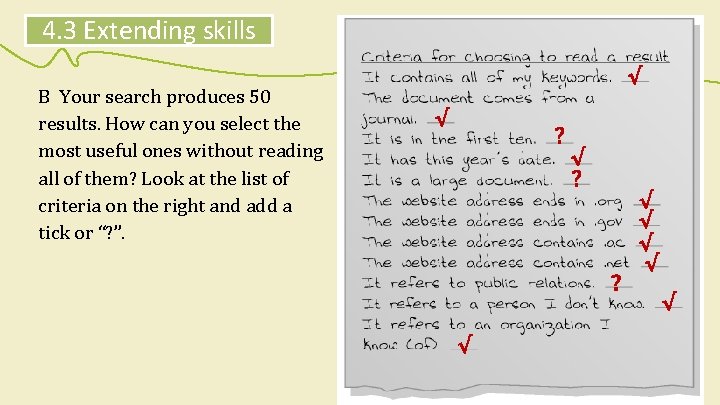
4. 3 Extending skills B Your search produces 50 results. How can you select the most useful ones without reading all of them? Look at the list of criteria on the right and add a tick or “? ”. √ √ ? ? √ √ √
4. 3 Extending skills C You want to research the following. Choose up to four keywords or phrases for each search. 1 2 3 Which country employs the most people in the PR industry? How many people are employed in the UK PR industry? What public relations careers are available in Washington DC? D Go to a computer and try out your chosen keywords.
4. 3 Extending skills The following is an indication of possibilities at the time of writing: 1 public relations country employment statistics will generate a few useful links to reports with either worldwide or country-specific data. Leaving out the word statistics leads to more general results. 2 Searching UK public relations employment statistics leads to many sites, including those in other countries. Leaving out statistics will lead to many recruitment agency sites that give useful information about types of jobs and employment in the industry. 3 PR careers Washington DC leads to many recruitment websites featuring PR jobs nationally, as well as in Washington DC. There also listings for PR agencies advertising vacancies on their own websites, and for internship opportunities.
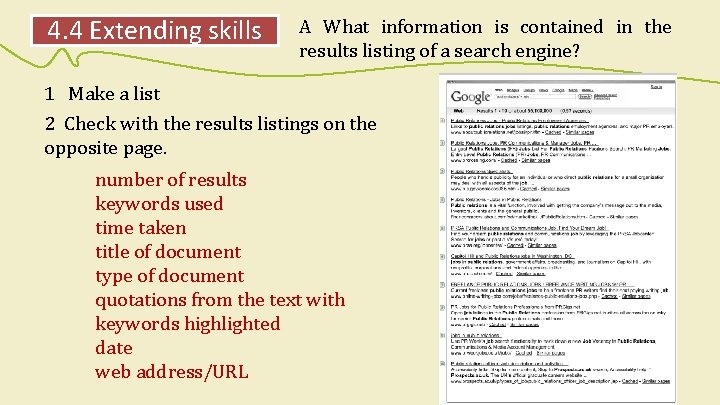
4. 4 Extending skills A What information is contained in the results listing of a search engine? 1 Make a list 2 Check with the results listings on the opposite page. number of results keywords used time taken title of document type of document quotations from the text with keywords highlighted date web address/URL
4. 4 Extending skills 1 B Scan the results listings. Answer these questions. What keywords were entered? “public relations”, jobs 2 Why was the phrase public relations entered with inverted commas? Inverted commas are put round a phrase to indicate that it is all a meaningful lexical item. This ensures that public relations will appear as a phrase in the results listings and not as separate words.
4. 4 Extending skills C Answer these questions 1 Which results contain abbreviations or acronyms? Acronyms/abbreviations: Result 1: PR, htm Result 2: PR Result 3: htm Result 4: htm Result 5: PRSA Result 6: DC Result 7: PR, php Result 8: PR Result 9: PR Result 10: UK, jsp 2 Where is each website address? At the end. 3 Which results have all the keywords? All ten results.
4. 4 Extending skills C Answer these questions 4 Which results come from non-profit organizations? Results 3, 5 and 10. 5 Which results come from commercial sites? Results 2, 4, 6 and 7. 6 What does similar pages mean? There were other very similar results, so the search engine ignored them. They are available if you click on the words. 7 What does cached mean? It is a more efficient way of storing information. (It means that you can go to a copy of the page stored by Google, in case the actual website happens to be down at the time of the search; of course, it could be a little out of date. )
4. 4 Extending skills D Continue your research on jobs in PR by entering the keywords into a search engine and accessing three of the results. 1 Make notes. 2 Compare your findings with other students. E Choose the most interesting result. Write a paragraph about the information you discovered. Develop the topic within the paragraph with discourse markers and stance markers.