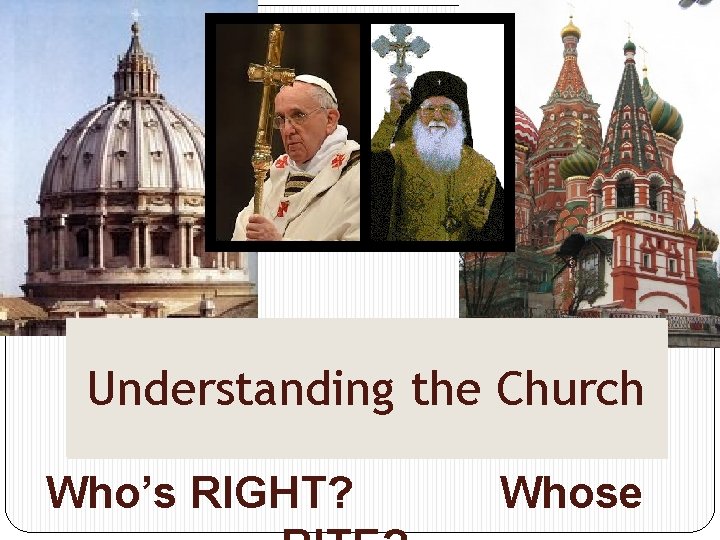
Understanding the Church Whos RIGHT Whose The Direction

- Slides: 23
Understanding the Church Who’s RIGHT? Whose
The Direction of Intention Prayer My God, give me the grace to perform this action with you and through love for you. In advance, I offer to you all the good that I will do and accept all the difficulty I may meet therein. St. Ann, Pray for us. St. Francis de Sales, Pray for us
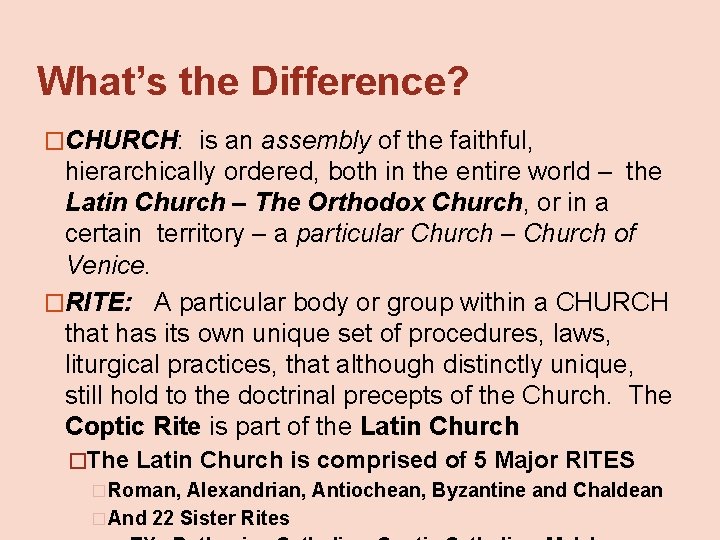
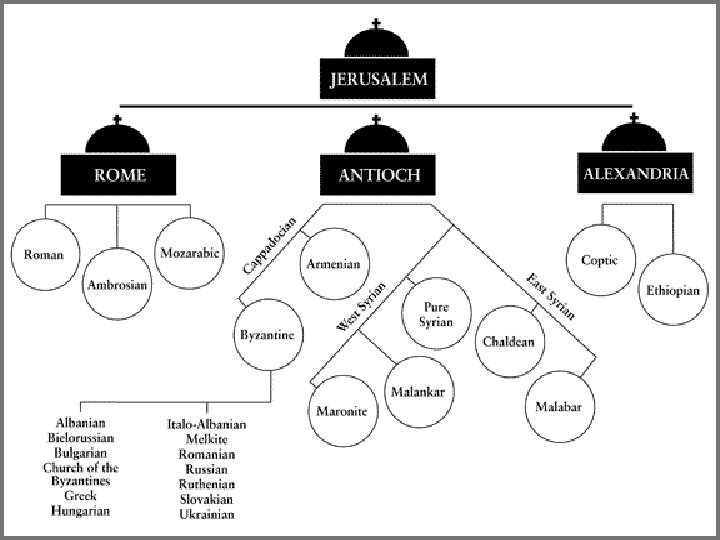
What’s the Difference? �CHURCH: is an assembly of the faithful, hierarchically ordered, both in the entire world – the Latin Church – The Orthodox Church, or in a certain territory – a particular Church – Church of Venice. �RITE: A particular body or group within a CHURCH that has its own unique set of procedures, laws, liturgical practices, that although distinctly unique, still hold to the doctrinal precepts of the Church. The Coptic Rite is part of the Latin Church �The Latin Church is comprised of 5 Major RITES �Roman, Alexandrian, Antiochean, Byzantine and Chaldean �And 22 Sister Rites
What’s the Difference between a RITE and a DENOMINATION? � RITES are Churches that are in communion with the Roman Catholic Church. To be in communion with the Roman Catholic Church one must accept Roman Catholic doctrine. � DENOMINATIONS � Term used for Protestant Churches � united under a common faith and name and organized under a single administrative and legal hierarchy. � Denominations are not in Communion with the Catholic Church
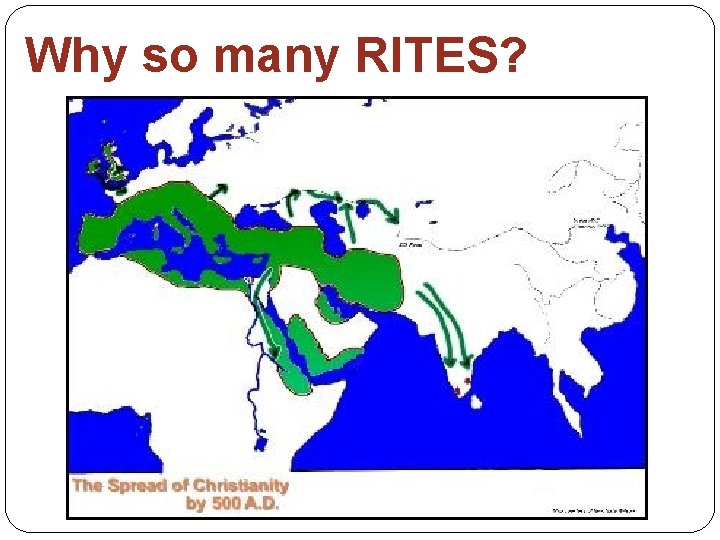
Why so many RITES?
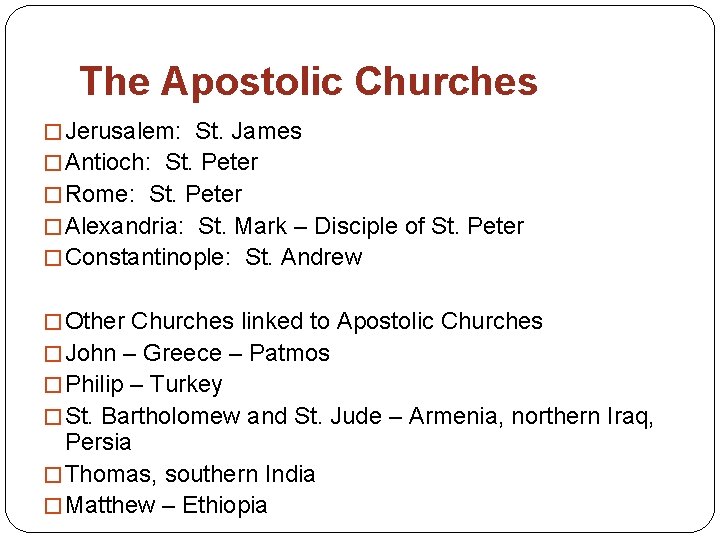
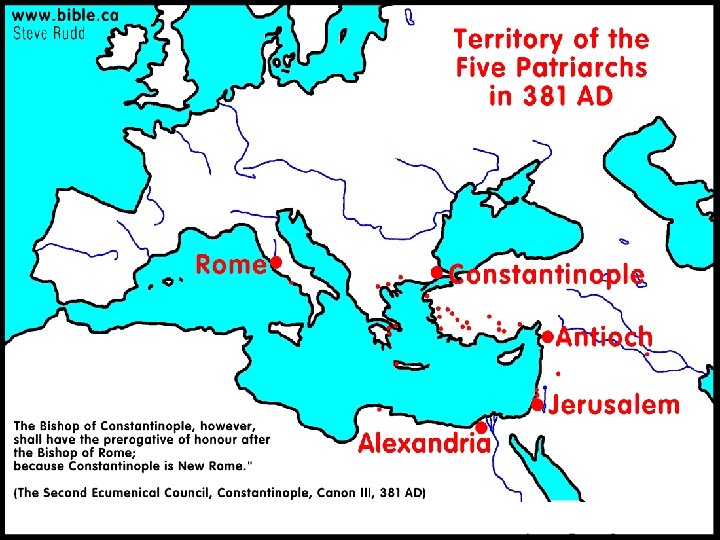
The Apostolic Churches � Jerusalem: St. James � Antioch: St. Peter � Rome: St. Peter � Alexandria: St. Mark – Disciple of St. Peter � Constantinople: St. Andrew � Other Churches linked to Apostolic Churches � John – Greece – Patmos � Philip – Turkey � St. Bartholomew and St. Jude – Armenia, northern Iraq, Persia � Thomas, southern India � Matthew – Ethiopia
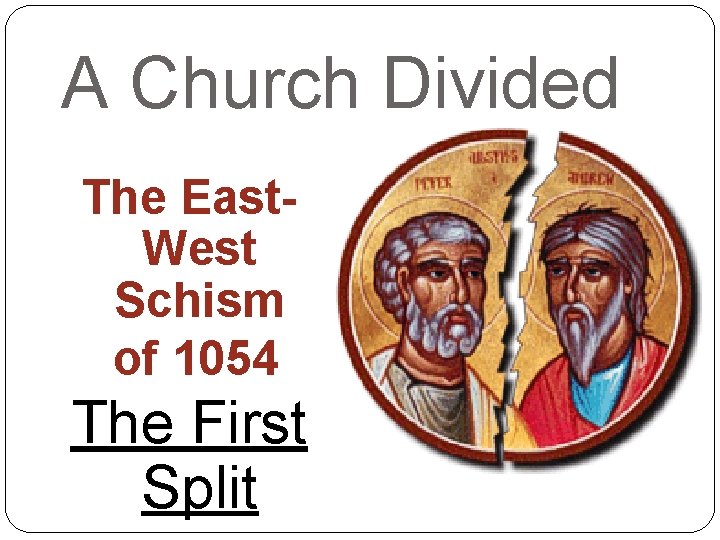
A Church Divided The East. West Schism of 1054 The First Split
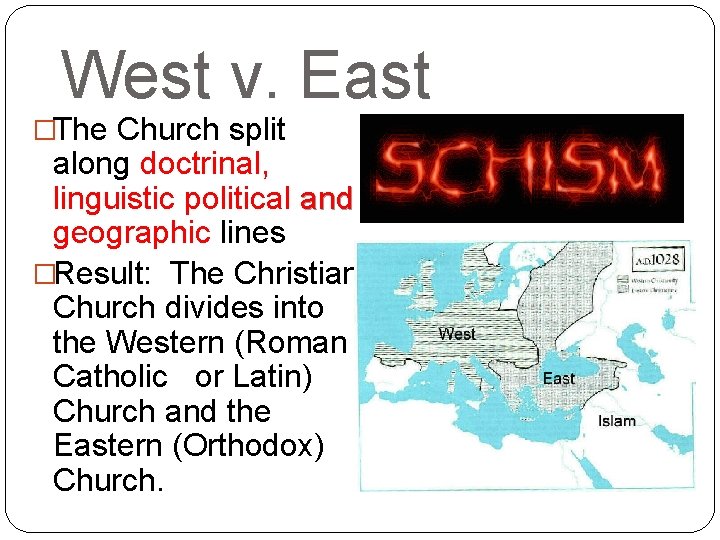
West v. East �The Church split along doctrinal, linguistic political and geographic lines geographic �Result: The Christian Church divides into the Western (Roman Catholic or Latin) Church and the Eastern (Orthodox) Church.
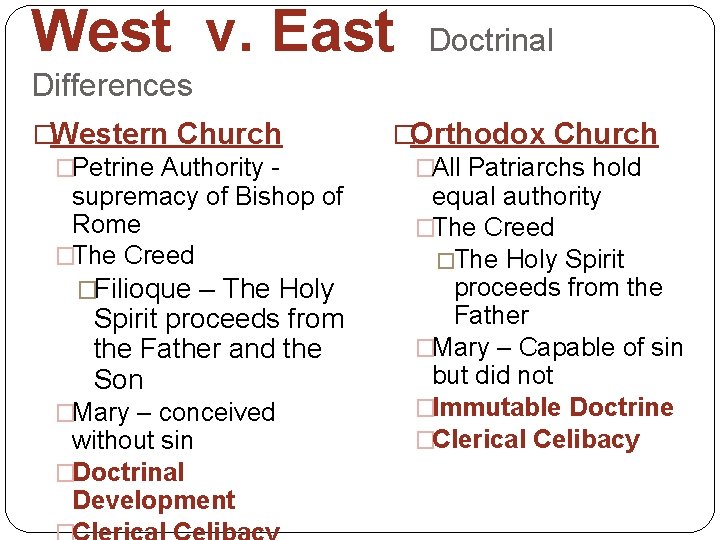
West v. East Doctrinal Differences �Western Church �Petrine Authority - supremacy of Bishop of Rome �The Creed �Filioque – The Holy Spirit proceeds from the Father and the Son �Mary – conceived without sin �Doctrinal Development �Orthodox Church �All Patriarchs hold equal authority �The Creed �The Holy Spirit proceeds from the Father �Mary – Capable of sin but did not �Immutable Doctrine �Clerical Celibacy
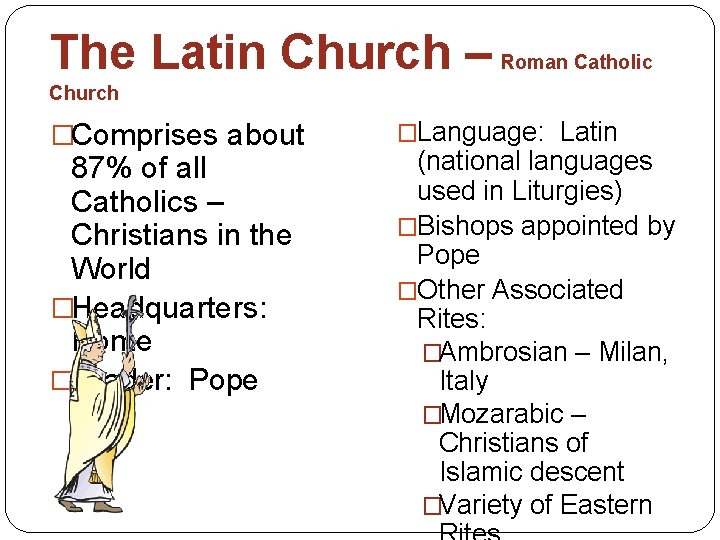
The Latin Church – Roman Catholic Church �Comprises about 87% of all Catholics – Christians in the World �Headquarters: Rome �Leader: Pope �Language: Latin (national languages used in Liturgies) �Bishops appointed by Pope �Other Associated Rites: �Ambrosian – Milan, Italy �Mozarabic – Christians of Islamic descent �Variety of Eastern
The Orthodox Church The term “Orthodox” translates from the Greek to mean “correctly believing” �Comprises about 15% Christians in the World �Headquarters: Varies Istanbul, Moscow �Leader(s): Patriarch �Language: Greek (national languages used in Liturgies) �Bishops elected by peers or by patriarch �Other Associated Rites: �Greek Orthodox �Russian orthodox �Variety of smaller Rites
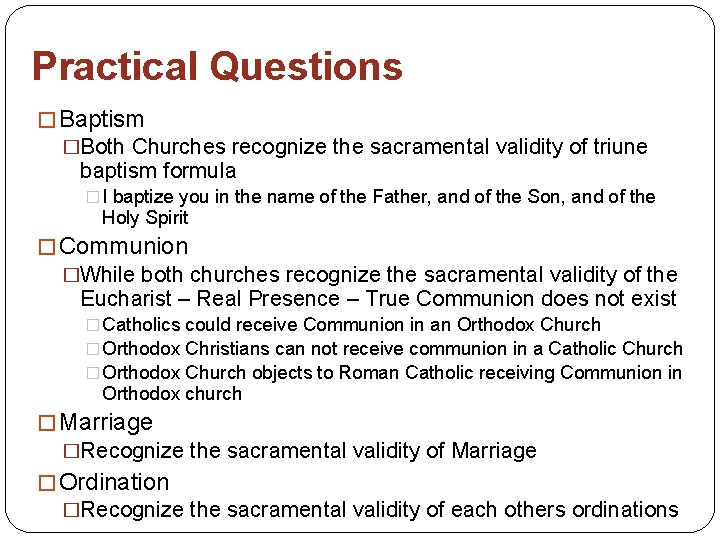
Practical Questions � Baptism �Both Churches recognize the sacramental validity of triune baptism formula � I baptize you in the name of the Father, and of the Son, and of the Holy Spirit � Communion �While both churches recognize the sacramental validity of the Eucharist – Real Presence – True Communion does not exist � Catholics could receive Communion in an Orthodox Church � Orthodox Christians can not receive communion in a Catholic Church � Orthodox Church objects to Roman Catholic receiving Communion in Orthodox church � Marriage �Recognize the sacramental validity of Marriage � Ordination �Recognize the sacramental validity of each others ordinations
The Protestant Reformation 1517 The Second Split
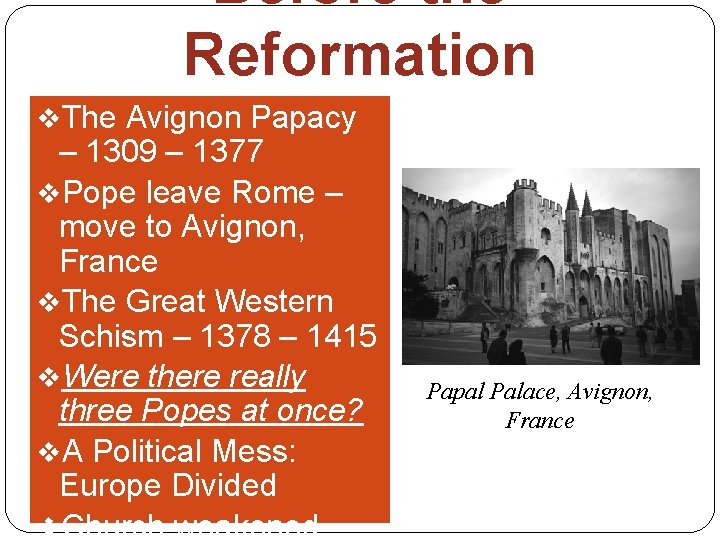
Before the Reformation v. The Avignon Papacy – 1309 – 1377 v. Pope leave Rome – move to Avignon, France v. The Great Western Schism – 1378 – 1415 v. Were there really three Popes at once? v. A Political Mess: Europe Divided v. Church weakened Papal Palace, Avignon, France
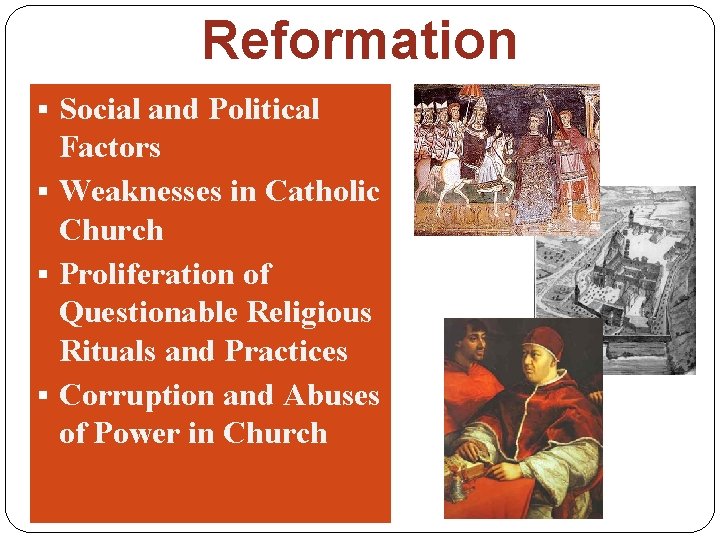
Reformation § Social and Political Factors § Weaknesses in Catholic Church § Proliferation of Questionable Religious Rituals and Practices § Corruption and Abuses of Power in Church
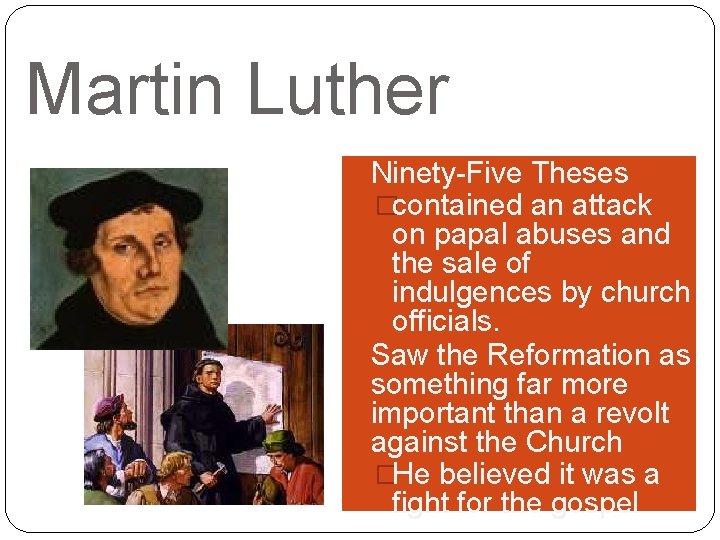
Martin Luther �Ninety-Five Theses �contained an attack on papal abuses and the sale of indulgences by church officials. �Saw the Reformation as something far more important than a revolt against the Church �He believed it was a fight for the gospel
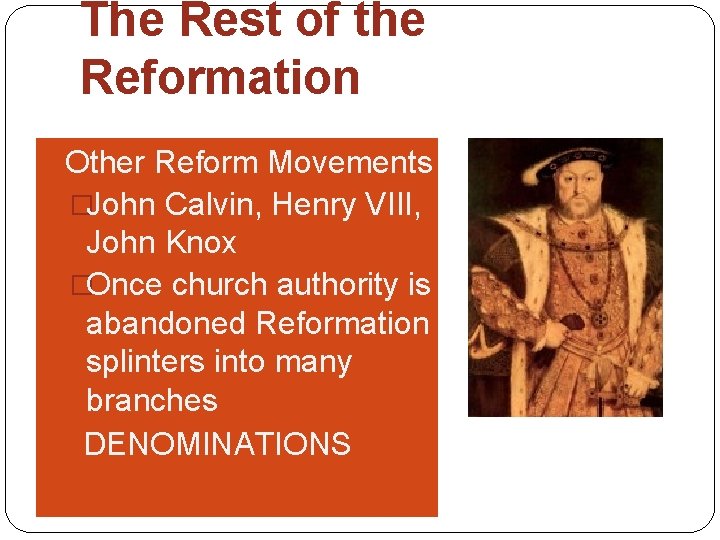
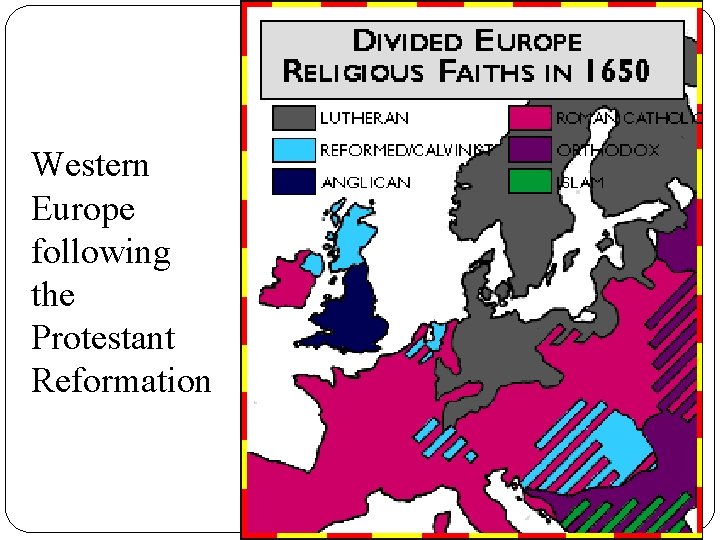
The Rest of the Reformation �Other Reform Movements �John Calvin, Henry VIII, John Knox �Once church authority is abandoned Reformation splinters into many branches � DENOMINATIONS
Western Europe following the Protestant Reformation
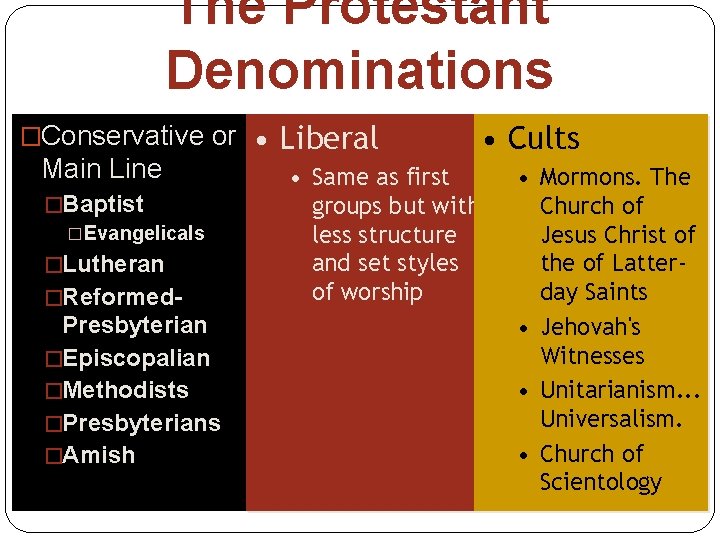
The Protestant Denominations �Conservative or Main Line �Baptist �Evangelicals �Lutheran �Reformed- Presbyterian �Episcopalian �Methodists �Presbyterians �Amish • Liberal • Same as first groups but with less structure and set styles of worship • Cults • Mormons. The Church of Jesus Christ of the of Latterday Saints • Jehovah's Witnesses • Unitarianism. . . Universalism. • Church of Scientology
The Newest Catholic Rite
Roman Catholics in the United States • There are 70, 259, 769 Catholics in the United States (24. 3% of the U. S. pop. ), • 1, 121, 315, 000 Catholics worldwide. • New Church Members • Infant Baptisms: 985, 141 • Adult Baptisms: 76, 829 • Received into Full Communion: 75, 429