UNCLASSIFIED Study of the Quark Gluon Plasma with







- Slides: 14
UNCLASSIFIED Study of the Quark Gluon Plasma with Hadronic Jets • What: the Quark Gluon Plasma • Where: the Relativistic Heavy Ion Collider at BNL • How: hadronic jets • Summary • Outlook: the Large Hadron Collider at CERN UNCLASSIFIED Operated by the Los Alamos National Security, LLC for the DOE/NNSA 0
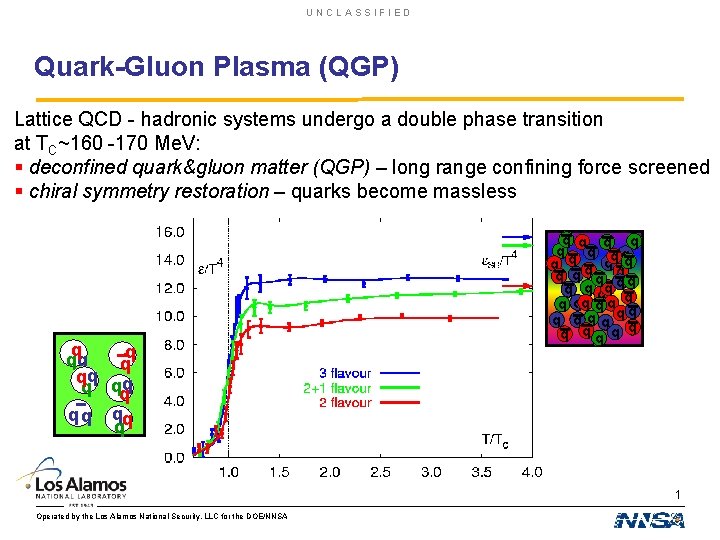
UNCLASSIFIED Quark-Gluon Plasma (QGP) Lattice QCD - hadronic systems undergo a double phase transition at TC~160 -170 Me. V: § deconfined quark&gluon matter (QGP) – long range confining force screened § chiral symmetry restoration – quarks become massless q q q qq q q q q qq q q qq q UNCLASSIFIED Operated by the Los Alamos National Security, LLC for the DOE/NNSA 1
UNCLASSIFIED QCD Phase Diagram Temperature (Me. V) However, the QGP hadronizes very quickly: one can observe only signatures of its existence (jet quenching, J/ suppression, strangeness enhancement, large collective flow, thermal electromagnetic radiation, etc. ) 250 QGP (hot&baryon free) 200 RHIC SPS 150 100 deconfinement chiral restauration thermal freeze-out. AGS 50 00 hadron gas SIS nuclei 200 400 600 neutron stars 800 1000 1200 Baryonic Potential B (Me. V) UNCLASSIFIED Operated by the Los Alamos National Security, LLC for the DOE/NNSA 2
UNCLASSIFIED The Relativistic Heavy Ion Collider (RHIC) at BNL Runs 1 - 6 (2000 – 2006): Au+Au @ 200, 130, 62, 22 Ge. V Cu+Cu @ 200, 62 Ge. V d+Au @ 200 Ge. V p+p @ 200, 62, 22 Ge. V (polarized) PHENIX UNCLASSIFIED Operated by the Los Alamos National Security, LLC for the DOE/NNSA 3
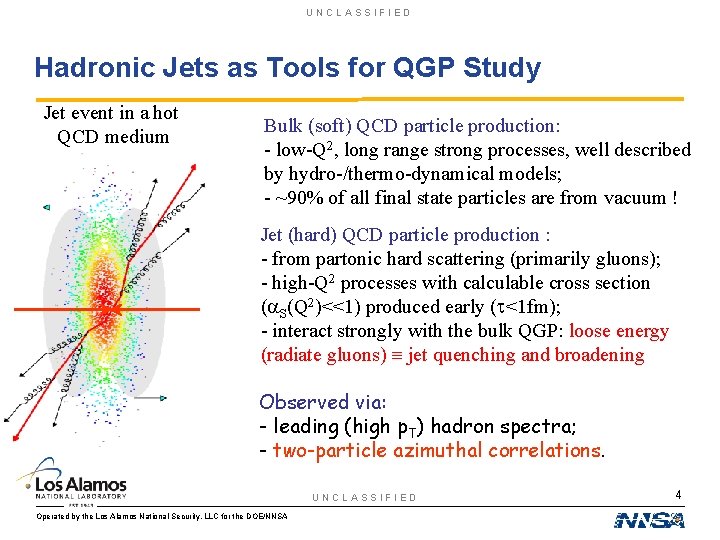
UNCLASSIFIED Hadronic Jets as Tools for QGP Study Jet event in a hot QCD medium Bulk (soft) QCD particle production: - low-Q 2, long range strong processes, well described by hydro-/thermo-dynamical models; - ~90% of all final state particles are from vacuum ! Jet (hard) QCD particle production : - from partonic hard scattering (primarily gluons); - high-Q 2 processes with calculable cross section ( S(Q 2)<<1) produced early ( <1 fm); - interact strongly with the bulk QGP: loose energy (radiate gluons) jet quenching and broadening Observed via: - leading (high p. T) hadron spectra; - two-particle azimuthal correlations. UNCLASSIFIED Operated by the Los Alamos National Security, LLC for the DOE/NNSA 4
UNCLASSIFIED Hadronic Jet Suppression – Partonic Energy Loss nuclear modification factor Explained by (and only by) final state partonic energy loss models: Vitev & Gyulassy, PRL 89 (2002) 252301 d. Ngluon/dy ~ 1100 ε ~ 15 Ge. V/fm 3 (consistent with value from d. Nch/dη meas. ) UNCLASSIFIED Operated by the Los Alamos National Security, LLC for the DOE/NNSA 5
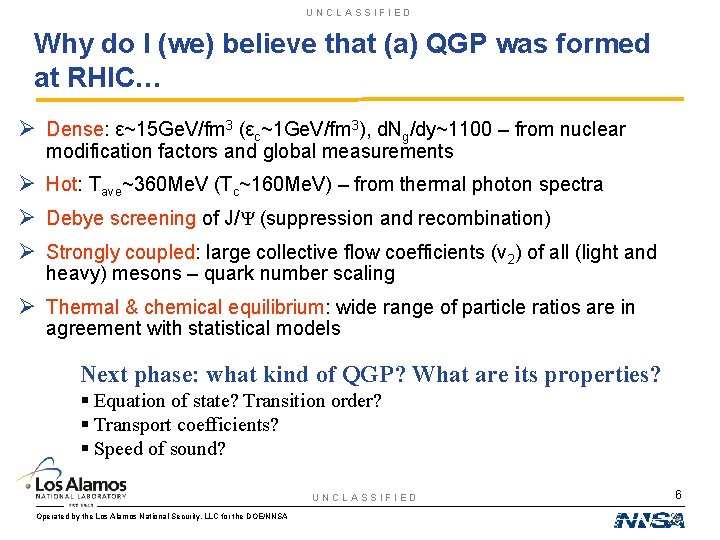
UNCLASSIFIED Why do I (we) believe that (a) QGP was formed at RHIC… Ø Dense: ε~15 Ge. V/fm 3 (εc~1 Ge. V/fm 3), d. Ng/dy~1100 – from nuclear modification factors and global measurements Ø Hot: Tave~360 Me. V (Tc~160 Me. V) – from thermal photon spectra Ø Debye screening of J/Ψ (suppression and recombination) Ø Strongly coupled: large collective flow coefficients (v 2) of all (light and heavy) mesons – quark number scaling Ø Thermal & chemical equilibrium: wide range of particle ratios are in agreement with statistical models Next phase: what kind of QGP? What are its properties? § Equation of state? Transition order? § Transport coefficients? § Speed of sound? UNCLASSIFIED Operated by the Los Alamos National Security, LLC for the DOE/NNSA 6
UNCLASSIFIED Back to (Di-)Jets: What happens with the dissipated energy? § Hard partons loose energy. What happens to the lost energy? § Look at angular distributions of lower p. T fragments… § Dijets in pp and d. Au: near side (Δφ~0) from parton fragmentation; away side (Δφ~π) from fragmentation of opposite parton § Dijets in Au. Au are expected to be strongly modified by the medium d-Au p-p PHENIX Preliminary I. Vitev Phys. Lett. B 630 (2005) 78 UNCLASSIFIED Operated by the Los Alamos National Security, LLC for the DOE/NNSA 7
UNCLASSIFIED Di-Jet Shape Modification in Heavy Ion Collisions Away-side peak is displaced from Δφ = π: away Mach shock wave: D D D A supersonic parton will generate a conic shock wave at a D Mach angle near away D = acos(cs) Shuryak J. Phys. G 31 (2005) L 19 Displacement is dependent on collision centrality and independent on collision energy. IF it is indeed a Mach cone, D measures directly the speed of sound in the plasma! UNCLASSIFIED Operated by the Los Alamos National Security, LLC for the DOE/NNSA 8
UNCLASSIFIED Summary: Probing partonic state of dense matter • RHIC has produced a dense, hot, strongly interacting, partonic state of matter at thermal and chemical equilibrium • We now have started probing the properties of the matter – energy density e >15 Ge. V/fm 3 – gluon density d. Ng/dy > 1100 – initial state temperature T 0 ave = 300 -400 Me. V • More differential measurements, like angular particle correlations, are employed to gain deeper information about the properties of this state of matter UNCLASSIFIED Operated by the Los Alamos National Security, LLC for the DOE/NNSA 9
UNCLASSIFIED Outlook: RHIC II at BNL and LHC at CERN • RHIC II: improved luminosity, new/upgraded detectors • LANL is an important part of it: a large part of our team builds a new forward silicon vertex PHENIX detector; prototype funded through a LDRD-DR grant • LHC at CERN (starts 2008): longer lived, hotter plasma • LANL is also involved: a smaller part of our team is funded through a LDRD-ER grant to study the feasibility of using dileptons to tag the hadronic jets UNCLASSIFIED Operated by the Los Alamos National Security, LLC for the DOE/NNSA 10
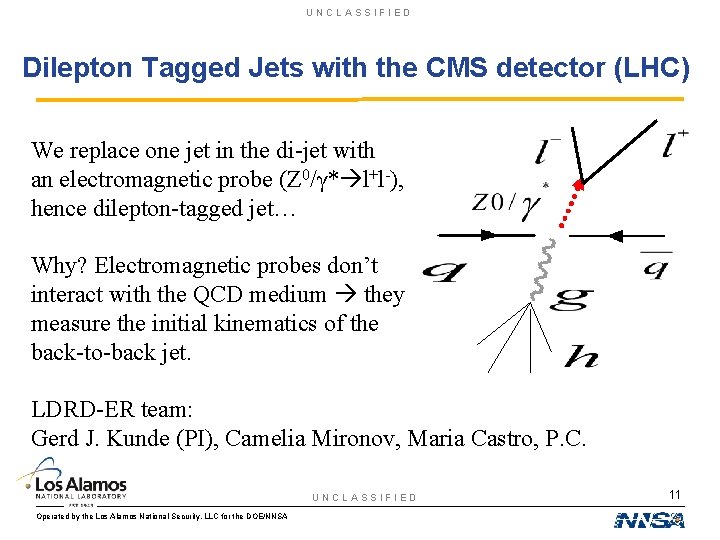
UNCLASSIFIED Dilepton Tagged Jets with the CMS detector (LHC) We replace one jet in the di-jet with an electromagnetic probe (Z 0/γ* l+l-), hence dilepton-tagged jet… Why? Electromagnetic probes don’t interact with the QCD medium they measure the initial kinematics of the back-to-back jet. LDRD-ER team: Gerd J. Kunde (PI), Camelia Mironov, Maria Castro, P. C. UNCLASSIFIED Operated by the Los Alamos National Security, LLC for the DOE/NNSA 11
UNCLASSIFIED Operated by the Los Alamos National Security, LLC for the DOE/NNSA 12
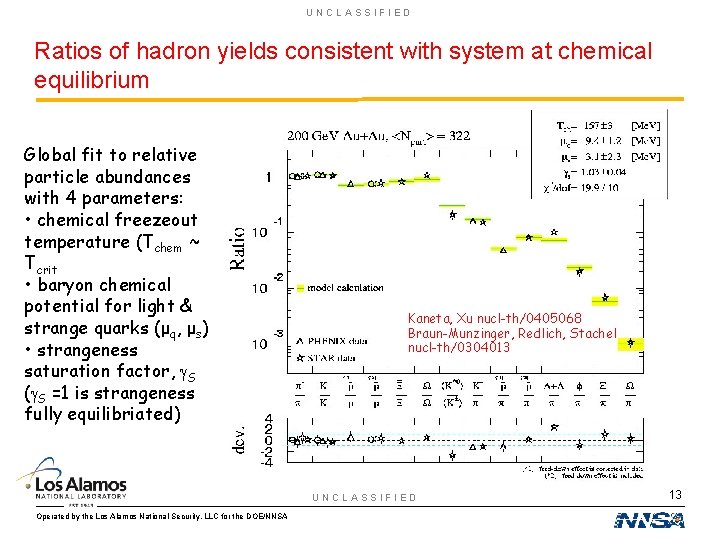
UNCLASSIFIED Ratios of hadron yields consistent with system at chemical equilibrium Global fit to relative particle abundances with 4 parameters: • chemical freezeout temperature (Tchem ~ Tcrit • baryon chemical potential for light & strange quarks (μq, μs) • strangeness saturation factor, S ( S =1 is strangeness fully equilibriated) Kaneta, Xu nucl-th/0405068 Braun-Munzinger, Redlich, Stachel nucl-th/0304013 UNCLASSIFIED Operated by the Los Alamos National Security, LLC for the DOE/NNSA 13