Type2 Fuzzy Sets and Systems Outline Introduction Type2














- Slides: 42
Type-2 Fuzzy Sets and Systems
Outline • • Introduction Type-2 fuzzy sets. Interval type-2 fuzzy sets Type-2 fuzzy systems.
History
What is a T 2 FS and How is it Different From a T 1 FS? • T 1 FS: crisp grades of membership • T 2 FS: fuzzy grades of membership, a fuzzy-fuzzy set.
Type-2 fuzzy sets • Blur the boundaries of a T 1 FS • Possibility assigned – could be non-uniform • Clean things up • Choose uniform possibilities – interval type-2 FS
Where Does a T 2 FS Come From? • Consider a FS as a model for a word • Words mean different things to different people. • So, we need a FS model that can capture the uncertainties of a word. • A T 2 FS can do this. • Let’s see how.
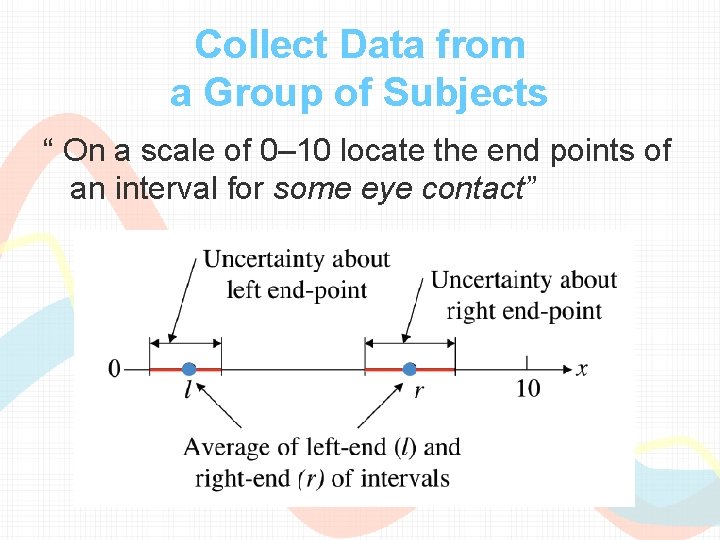
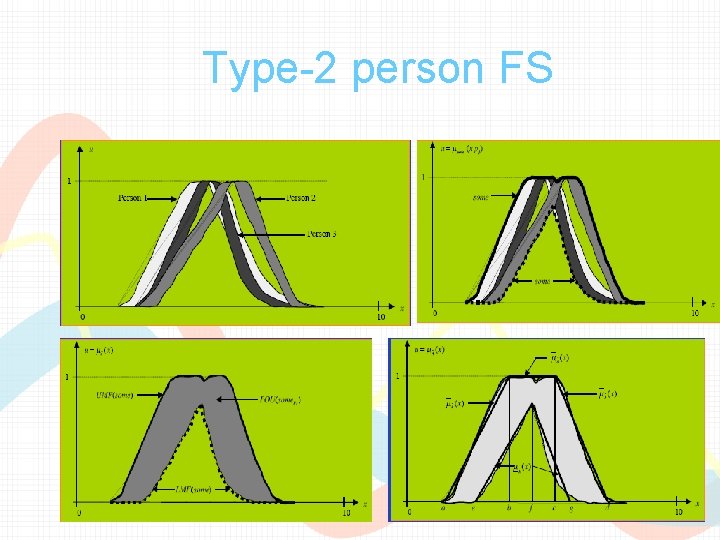
Collect Data from a Group of Subjects • “ On a scale of 0– 10 locate the end points of an interval for some eye contact”
Collect Data from a Group of Subjects “ On a scale of 0– 10 locate the end points of an interval for some eye contact”
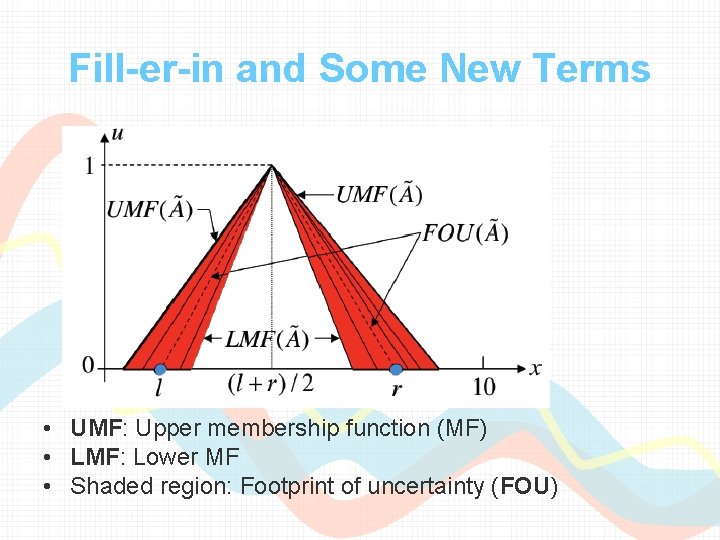
Create a Multitude of T 1 FSs • Choose the shape of the MF, as we do for T 1 FSs, e. g. symmetric triangles • Create lots of such triangles that let us cover the two intervals of uncertainty
Fill-er-in and Some New Terms • UMF: Upper membership function (MF) • LMF: Lower MF • Shaded region: Footprint of uncertainty (FOU)
Weighting the FOU • Non-uniform secondary MF: General T 2 FS • Uniform secondary MF: Interval T 2 FS
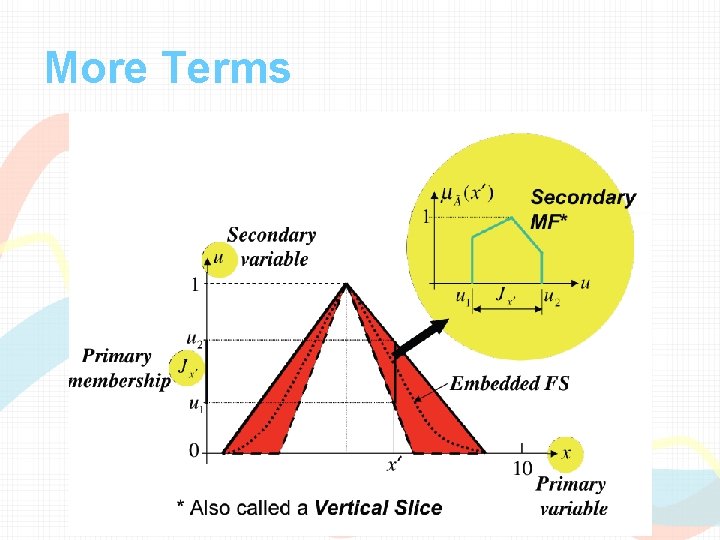
More Terms
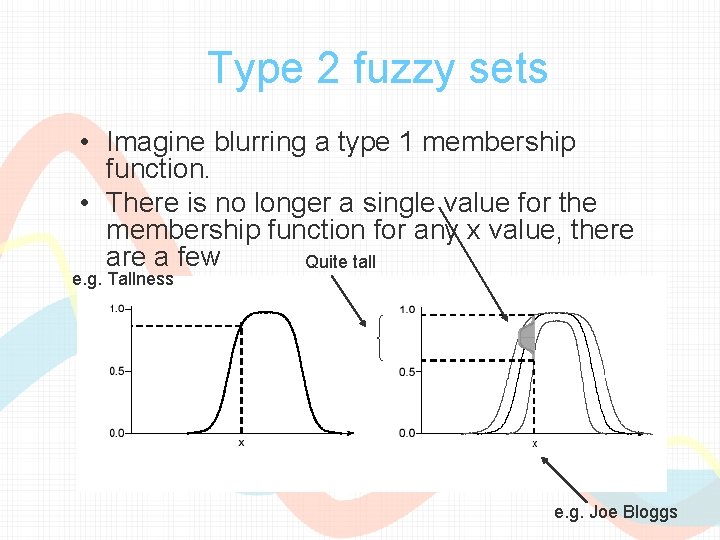
Type 2 fuzzy sets • Imagine blurring a type 1 membership function. • There is no longer a single value for the membership function for any x value, there a few Quite tall e. g. Tallness e. g. Joe Bloggs
We are only interested Type-n Fuzzy Sets In type 2 for now • A fuzzy set is of type n, n = 2, 3, . . . if its membership function ranges over fuzzy sets of type n-1. The membership function of a fuzzy set of type-1 ranges over the interval [0, 1]. Zadeh, L. A. , The Concept of a Linguistic Variable and its Application to Approximate Reasoning - I, Information Sciences, 8, 199– 249, 1975
Type 2 fuzzy sets • These values need not all be the same • We can therefore assign an amplitude distribution to all of the points • Doing this creates a 3 -D membership function i. e. a type 2 membership function • This characterises a fuzzy set
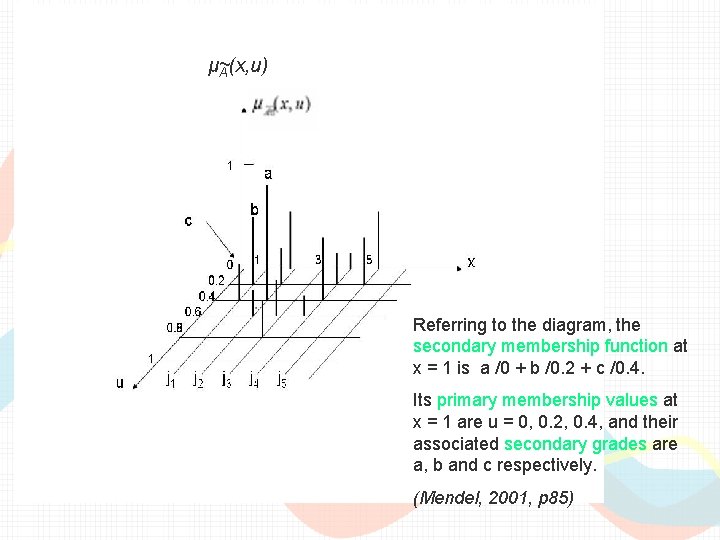
Example of a type 2 membership function. The shaded area is called the ‘Footprint of Uncertainty’ (FOU) μA~(x, u) jx is the set of possible u values, i. e. j 3 = [0. 6, 0. 8] Jx is called the primary membership of x and is the domain of the secondary membership function. The amplitude of the ‘sticks’ is called a secondary grade
μA~(x, u) Referring to the diagram, the secondary membership function at x = 1 is a /0 + b /0. 2 + c /0. 4. Its primary membership values at x = 1 are u = 0, 0. 2, 0. 4, and their associated secondary grades are a, b and c respectively. (Mendel, 2001, p 85)
FOU continued • The FOU is the union of all primary memberships • It is the region bounded by all of the ‘j’ values i. e. the red shaded region on the earlier slide. • FOU is useful because: – Focuses our attention on uncertainties (blurriness!) – Allows us to depict a type 2 fuzzy set graphically in 2 dimensions instead of 3. – The shaded FOUs imply the 3 rd dimension on top of it.
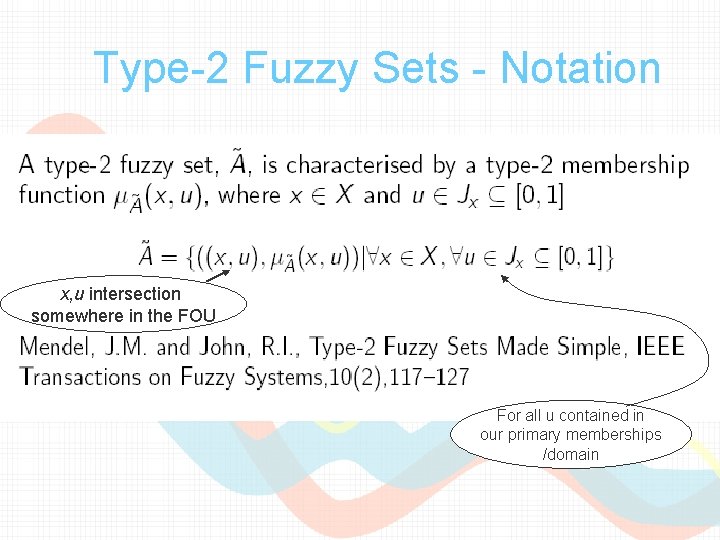
Type-2 Fuzzy Sets - Notation x, u intersection somewhere in the FOU For all u contained in our primary memberships /domain
Type-2 Fuzzy Sets - Notation
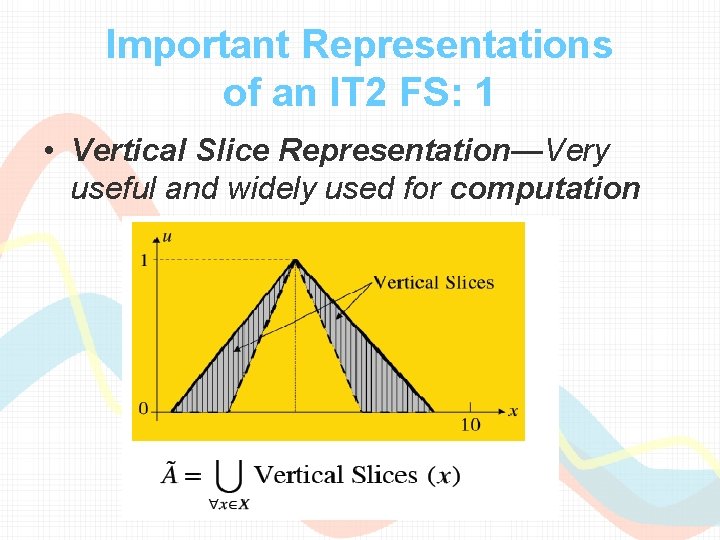
Important Representations of an IT 2 FS: 1 • Vertical Slice Representation—Very useful and widely used for computation
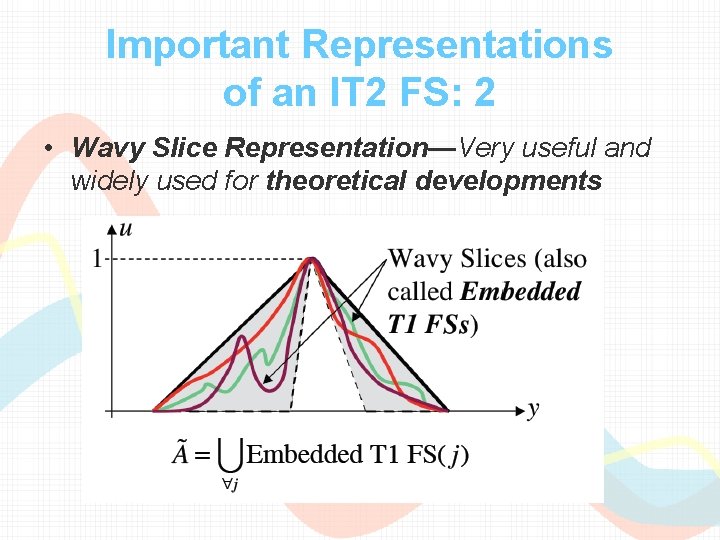
Important Representations of an IT 2 FS: 2 • Wavy Slice Representation—Very useful and widely used for theoretical developments
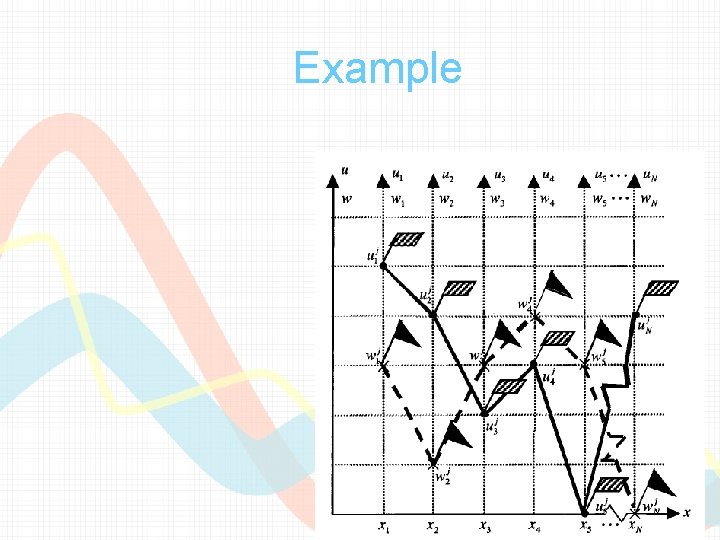
Example
Calculating the number of embedded sets In the above example there would be: 5 x 2 x 5 = 1250 So there are 1250 embedded sets
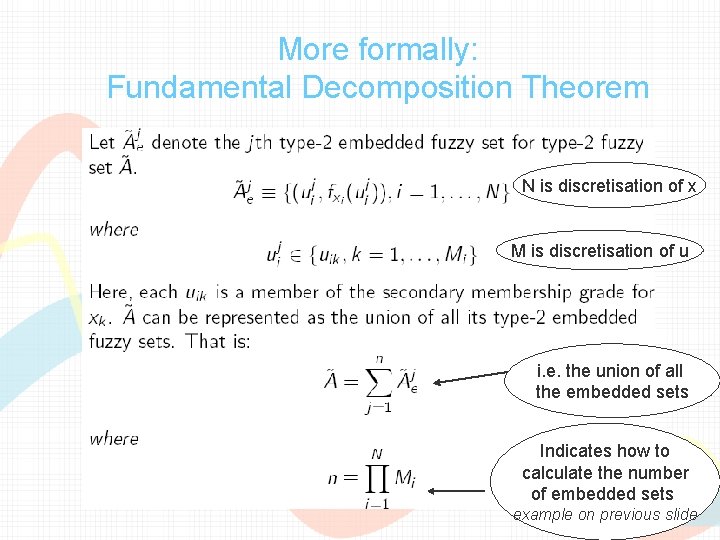
More formally: Fundamental Decomposition Theorem N is discretisation of x M is discretisation of u i. e. the union of all the embedded sets Indicates how to calculate the number of embedded sets example on previous slide
Important Representations of an IT 2 FS • Wavy Slice: Also known as “Mendel- John Representation Theorem (RT)” – Importance: All operations involving IT 2 FSs can be obtained using T 1 FS mathematics • Interpretation of the two representations: Both are covering theorems, i. e. , they cover the FOU
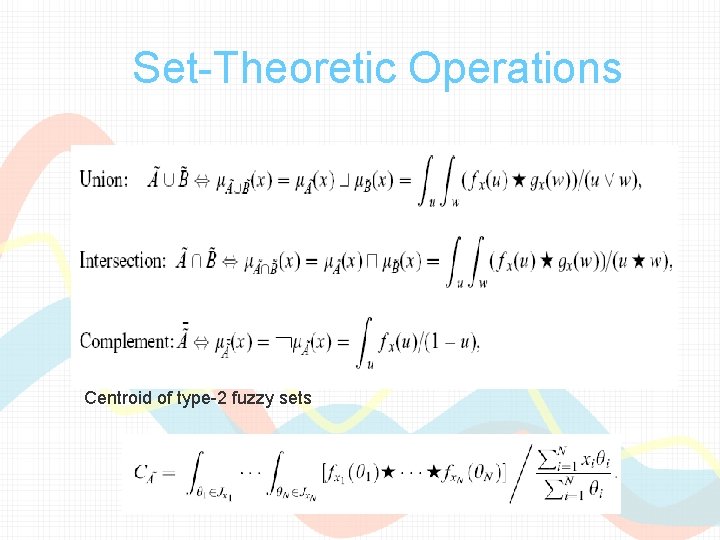
Set-Theoretic Operations Centroid of type-2 fuzzy sets
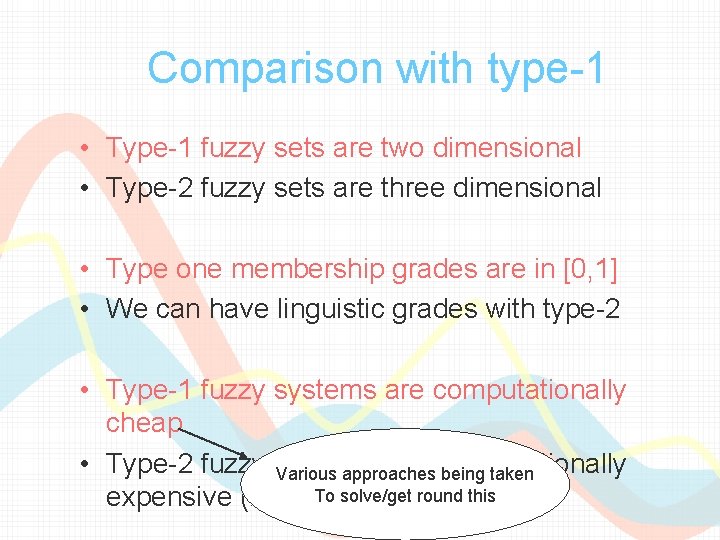
Comparison with type-1 • Type-1 fuzzy sets are two dimensional • Type-2 fuzzy sets are three dimensional • Type one membership grades are in [0, 1] • We can have linguistic grades with type-2 • Type-1 fuzzy systems are computationally cheap • Type-2 fuzzy systems are computationally Various approaches being taken expensive (but. . ) To solve/get round this
Interval T 2 FSs • Rest of tutorial focuses exclusively on IT 2 FSs – Computations using general T 2 FSs are very costly – Many computations using IT 2 FSs involve only interval arithmetic – All details of how to use IT 2 FSs in a fuzzy logic system have been worked out – Software available – Lots of applications have already occurred
Other FOUs
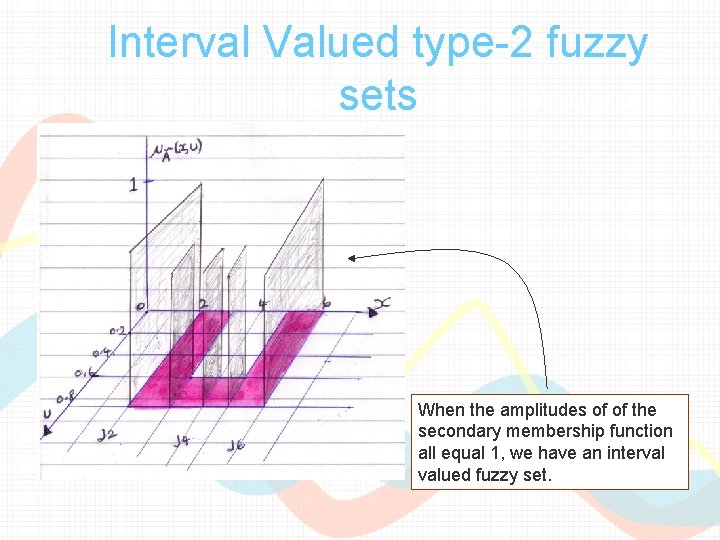
Interval Valued type-2 fuzzy sets When the amplitudes of of the secondary membership function all equal 1, we have an interval valued fuzzy set.
Interval valued type-2 fuzzy sets i. e. =1
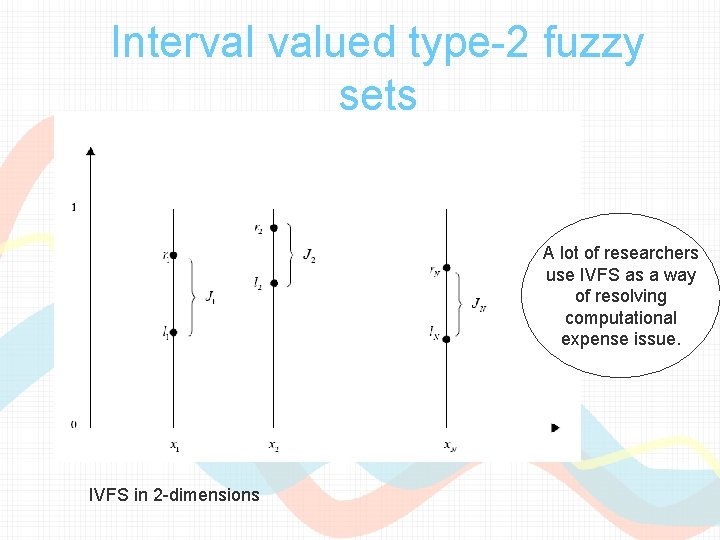
Interval valued type-2 fuzzy sets A lot of researchers use IVFS as a way of resolving computational expense issue. IVFS in 2 -dimensions
Type-2 person FS
Type-2 person FS
Type-2 fuzzy system overview So this is extra Compared to type-1
Fuzzification Fuzzifying in type-1 (fairly easy) Fuzzifying in type-2 (not so easy)
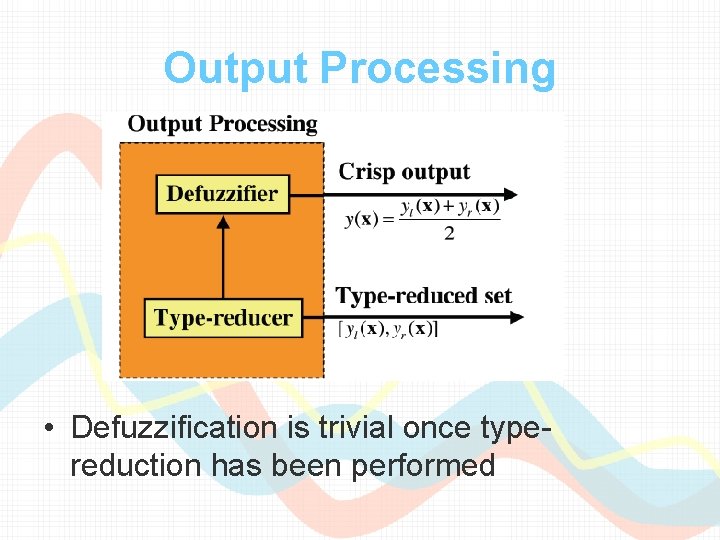
Interval Type-2 FLS • Rules don’t change, only the antecedent and consequent FS models change • Novel Output Processing: Going from a T 2 fuzzy output set to a crisp output—type-reduction + defuzzification
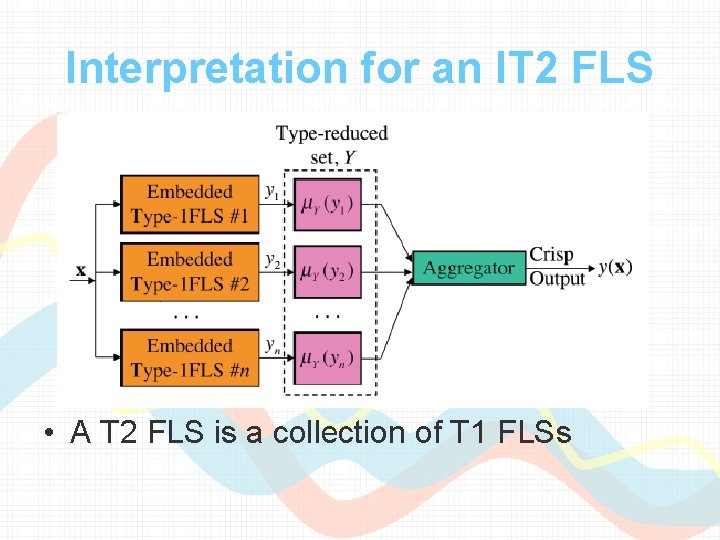
Interpretation for an IT 2 FLS • A T 2 FLS is a collection of T 1 FLSs
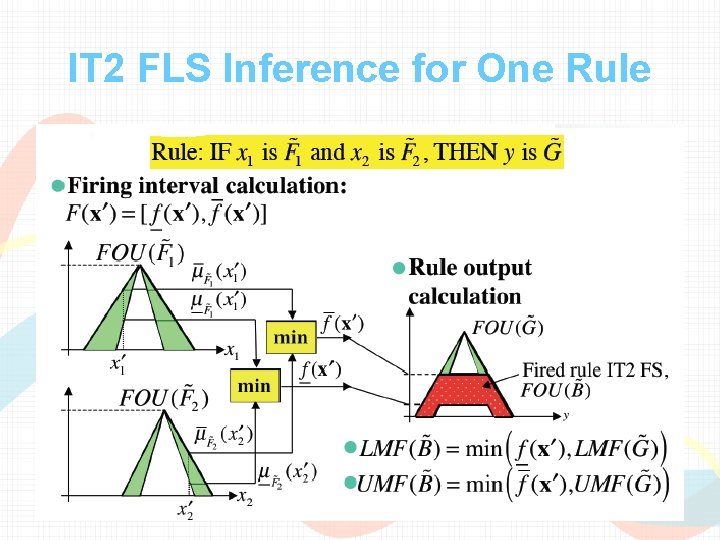
IT 2 FLS Inference for One Rule
IT 2 FLS Inference to Output for Two Fired Rules
Output Processing • Defuzzification is trivial once typereduction has been performed