Transition Metals show great similarities within a given
- Slides: 15
Transition Metals. . . show great similarities within a given period as well as within a given vertical group. Key reason: last electrons added are inner electrons (d’s, f’s). Copyright© 2000 by Houghton Mifflin Company. All rights reserved. 1
Complex Ions. . . species where the transition metal ion is surrounded by a certain number of ligands. Co(NH 3)63+ Pt(NH 3)3 Br+ Copyright© 2000 by Houghton Mifflin Company. All rights reserved. 2
A Coordination Compound . . . typically consists of a complex ion and counter ions (anions or cations as needed to produce a neutral compound). [Co(NH 3)5 Cl]Cl 2 [Fe(en)2(NO 2)2]2 SO 4 Copyright© 2000 by Houghton Mifflin Company. All rights reserved. 3
A Ligand. . . a neutral molecule or ion having a lone electron pair that can be used to form a bond to a metal ion. coordinate covalent bond: metal-ligand bond monodentate ligand: one bond to metal ion polydentate ligand: can form more than two bonds to a metal ion Copyright© 2000 by Houghton Mifflin Company. All rights reserved. 4
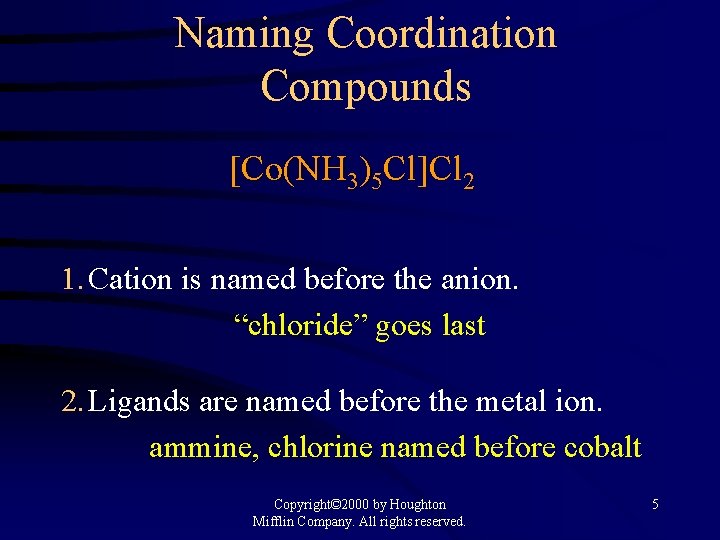
Naming Coordination Compounds [Co(NH 3)5 Cl]Cl 2 1. Cation is named before the anion. “chloride” goes last 2. Ligands are named before the metal ion. ammine, chlorine named before cobalt Copyright© 2000 by Houghton Mifflin Company. All rights reserved. 5
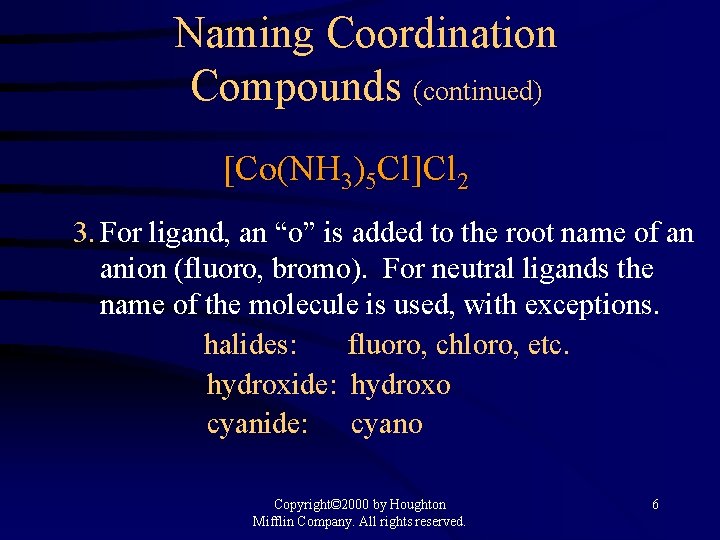
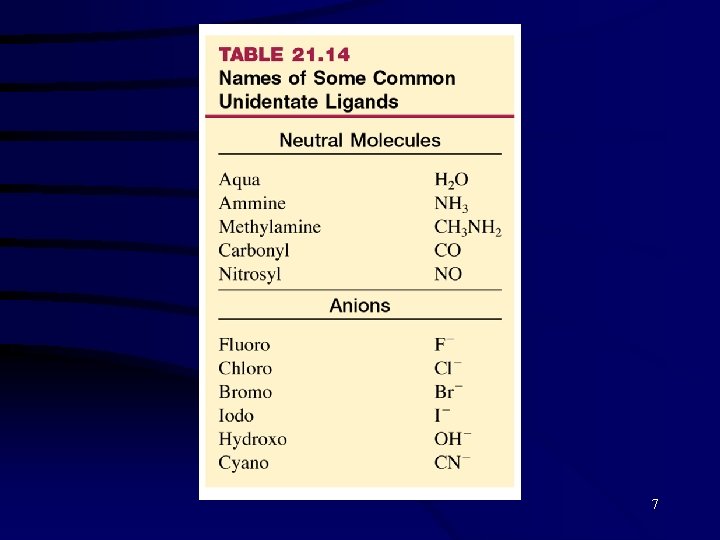
Naming Coordination Compounds (continued) [Co(NH 3)5 Cl]Cl 2 3. For ligand, an “o” is added to the root name of an anion (fluoro, bromo). For neutral ligands the name of the molecule is used, with exceptions. halides: fluoro, chloro, etc. hydroxide: hydroxo cyanide: cyano Copyright© 2000 by Houghton Mifflin Company. All rights reserved. 6
7
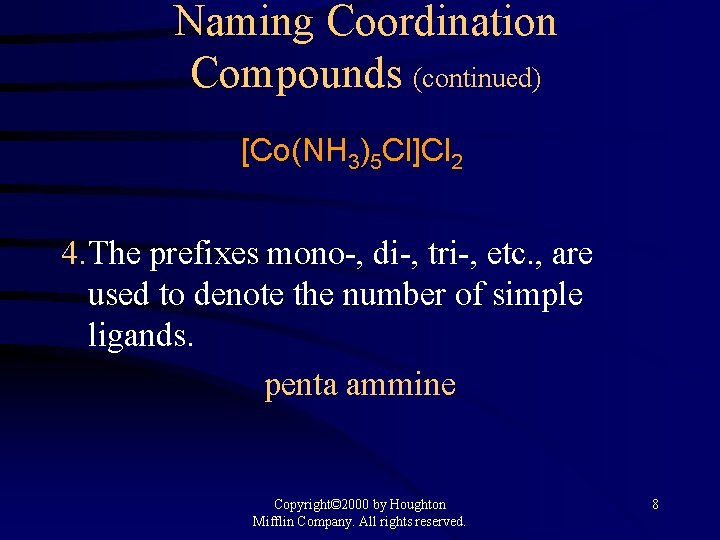
Naming Coordination Compounds (continued) [Co(NH 3)5 Cl]Cl 2 4. The prefixes mono-, di-, tri-, etc. , are used to denote the number of simple ligands. penta ammine Copyright© 2000 by Houghton Mifflin Company. All rights reserved. 8
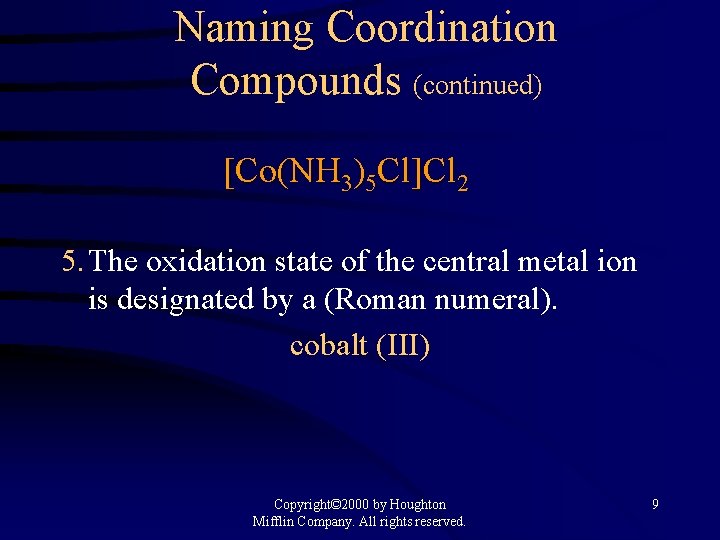
Naming Coordination Compounds (continued) [Co(NH 3)5 Cl]Cl 2 5. The oxidation state of the central metal ion is designated by a (Roman numeral). cobalt (III) Copyright© 2000 by Houghton Mifflin Company. All rights reserved. 9
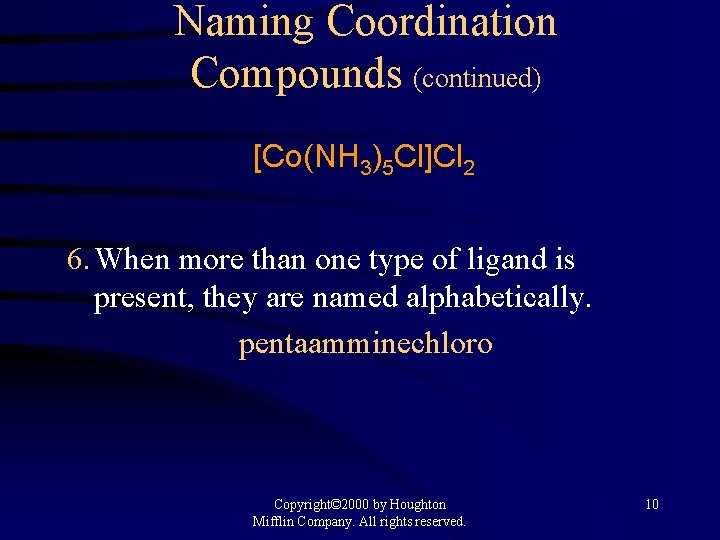
Naming Coordination Compounds (continued) [Co(NH 3)5 Cl]Cl 2 6. When more than one type of ligand is present, they are named alphabetically. pentaamminechloro Copyright© 2000 by Houghton Mifflin Company. All rights reserved. 10
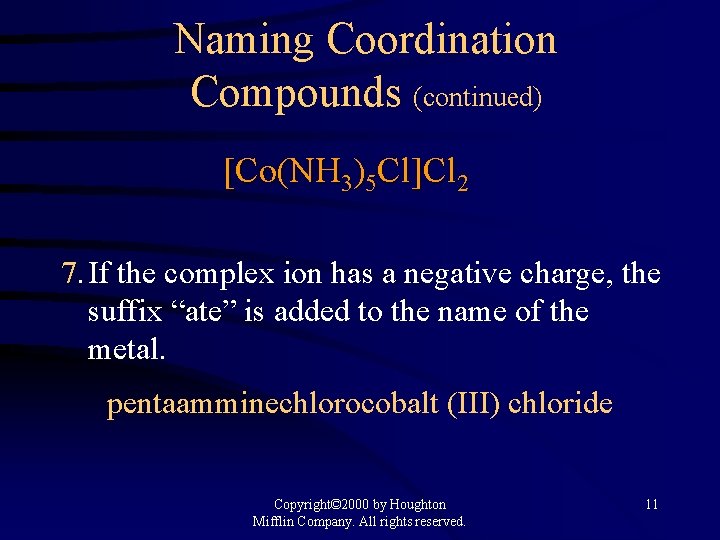
Naming Coordination Compounds (continued) [Co(NH 3)5 Cl]Cl 2 7. If the complex ion has a negative charge, the suffix “ate” is added to the name of the metal. pentaamminechlorocobalt (III) chloride Copyright© 2000 by Houghton Mifflin Company. All rights reserved. 11
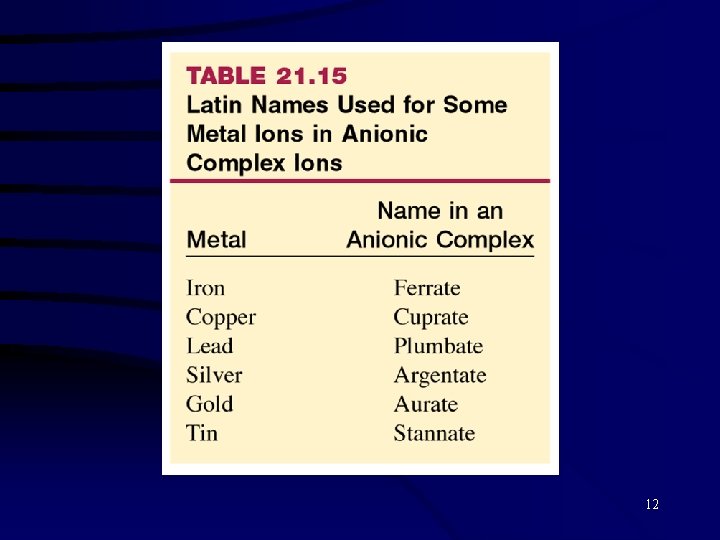
12
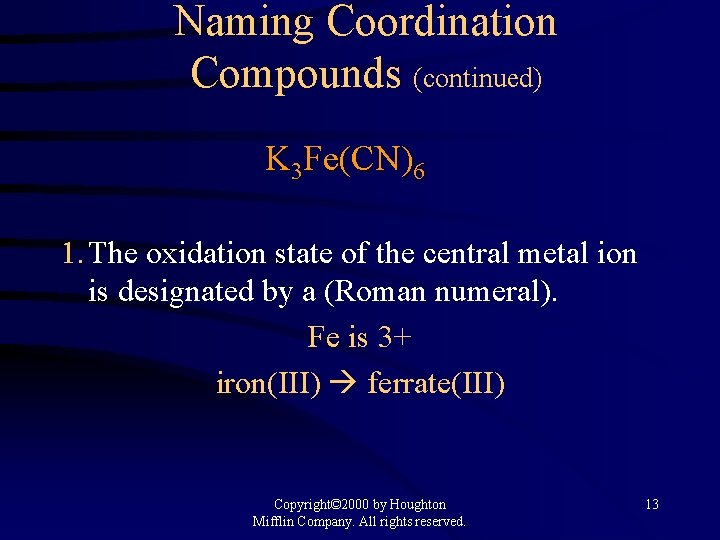
Naming Coordination Compounds (continued) K 3 Fe(CN)6 1. The oxidation state of the central metal ion is designated by a (Roman numeral). Fe is 3+ iron(III) ferrate(III) Copyright© 2000 by Houghton Mifflin Company. All rights reserved. 13
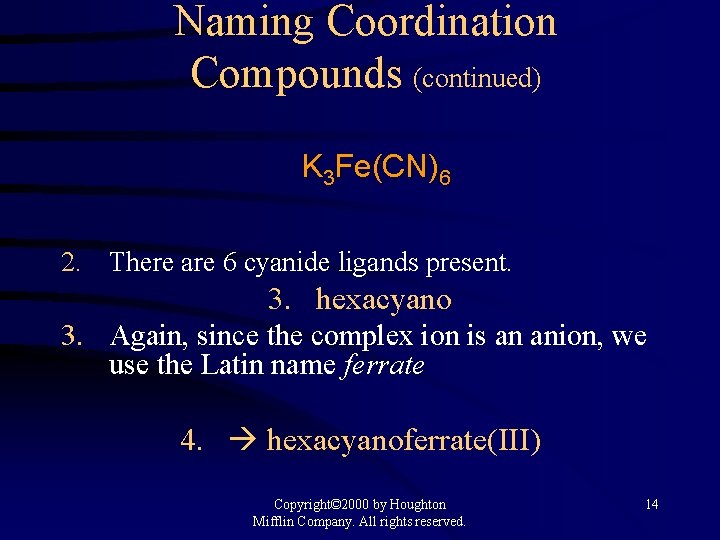
Naming Coordination Compounds (continued) K 3 Fe(CN)6 2. There are 6 cyanide ligands present. 3. hexacyano 3. Again, since the complex ion is an anion, we use the Latin name ferrate 4. hexacyanoferrate(III) Copyright© 2000 by Houghton Mifflin Company. All rights reserved. 14
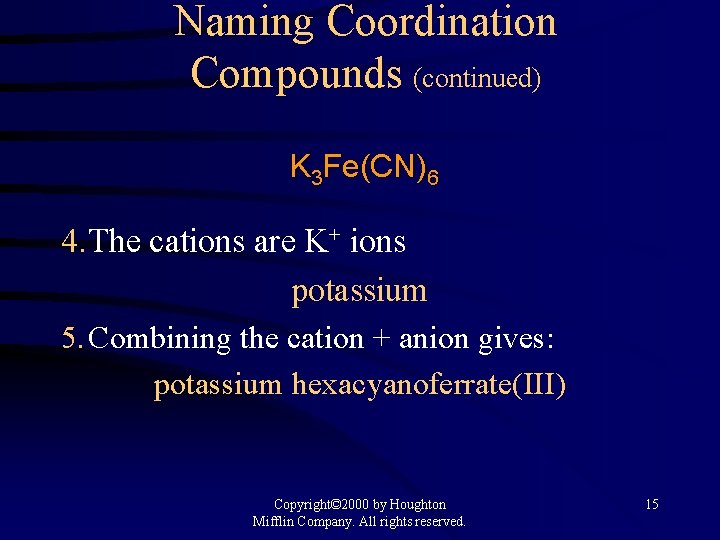
Naming Coordination Compounds (continued) K 3 Fe(CN)6 4. The cations are K+ ions potassium 5. Combining the cation + anion gives: potassium hexacyanoferrate(III) Copyright© 2000 by Houghton Mifflin Company. All rights reserved. 15