Transcatheter Mitral Valve Replacement Howard C Herrmann MD

- Slides: 12
Transcatheter Mitral Valve Replacement Howard C. Herrmann, MD University of Pennsylvania Philadelphia Grant/Research Support: Edwards Lifesciences, Inc. Evalve, Inc. Consulting, Equity Interest: Endovalve, Inc.
Background • • • Efficacy and risks of surgical mitral valve replacement are well understood • Better reduction in MR than repair • Not all patient populations, disease etiologies, anatomical variations will be compatible with repair • Risks equivalent to repair in functional etiology, higher-risk, older patients with current generation of bioprostheses and complete valve-sparing operations • However surgical MVR has significant morbidity and mortality due to risks of incision and CPB Percutaneous repair is nicer than surgery, but it isn’t surgery • “Modified” surgical techniques • Annular ring approaches have unclear efficacy and risks of erosion, perforation, coronary artery thrombosis • Edge-to-edge repair is technically demanding, limited to a subset of patients, and long-term durability still under investigation • Combinations of repair technologies may be necessary • Surgeons have a more robust toolbox when deciding how to repair a valve • Increasing evidence that percutaneous approaches are more limited than surgical techniques and unlikely to achieve equal efficacy For these reasons we believe it is important to offer clinicians and patients a less invasive, valve-sparing means of performing a MV replacement
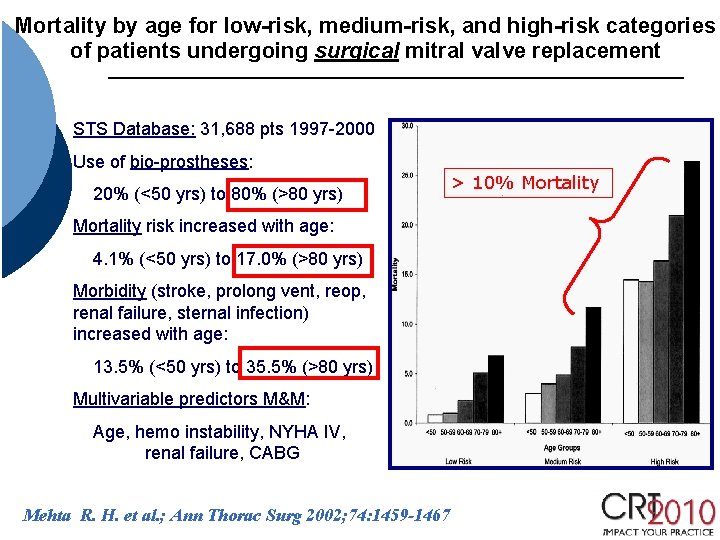
Mortality by age for low-risk, medium-risk, and high-risk categories of patients undergoing surgical mitral valve replacement STS Database: 31, 688 pts 1997 -2000 Use of bio-prostheses: 20% (<50 yrs) to 80% (>80 yrs) Mortality risk increased with age: 4. 1% (<50 yrs) to 17. 0% (>80 yrs) Morbidity (stroke, prolong vent, reop, renal failure, sternal infection) increased with age: 13. 5% (<50 yrs) to 35. 5% (>80 yrs) Multivariable predictors M&M: Age, hemo instability, NYHA IV, renal failure, CABG Mehta R. H. et al. ; Ann Thorac Surg 2002; 74: 1459 -1467 > 10% Mortality
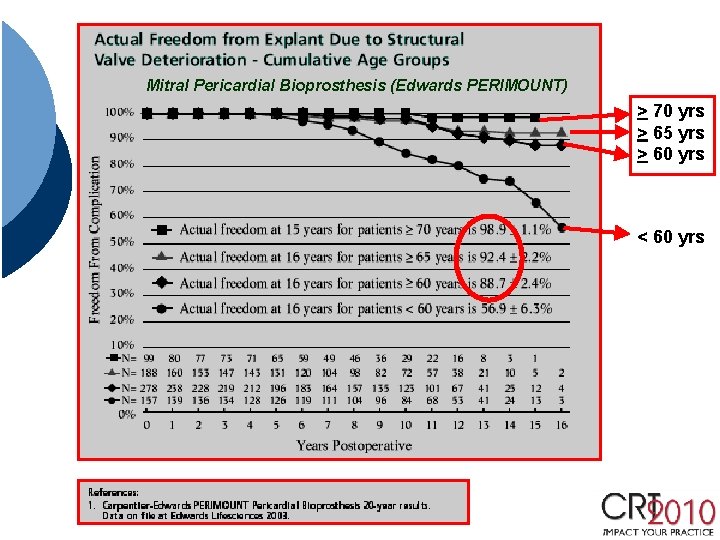
Mitral Pericardial Bioprosthesis (Edwards PERIMOUNT) > 70 yrs > 65 yrs > 60 yrs < 60 yrs
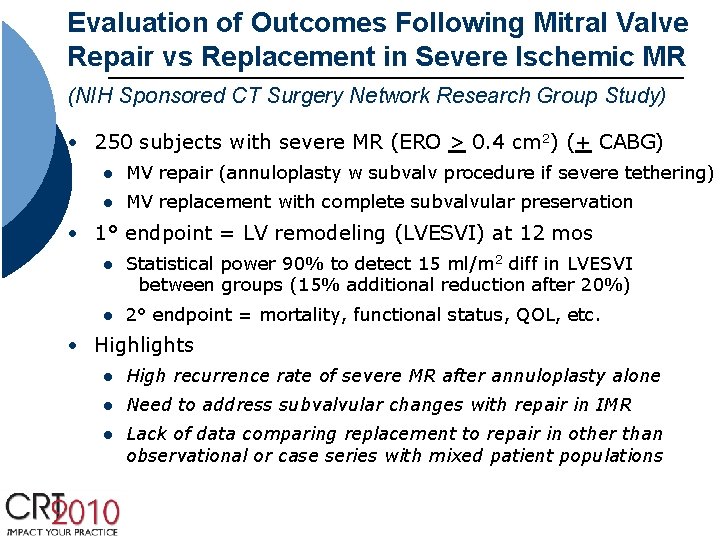
Evaluation of Outcomes Following Mitral Valve Repair vs Replacement in Severe Ischemic MR (NIH Sponsored CT Surgery Network Research Group Study) • 250 subjects with severe MR (ERO > 0. 4 cm 2) (+ CABG) l MV repair (annuloplasty w subvalv procedure if severe tethering) l MV replacement with complete subvalvular preservation • 1° endpoint = LV remodeling (LVESVI) at 12 mos l Statistical power 90% to detect 15 ml/m 2 diff in LVESVI between groups (15% additional reduction after 20%) l 2° endpoint = mortality, functional status, QOL, etc. • Highlights l High recurrence rate of severe MR after annuloplasty alone l Need to address subvalvular changes with repair in IMR l Lack of data comparing replacement to repair in other than observational or case series with mixed patient populations
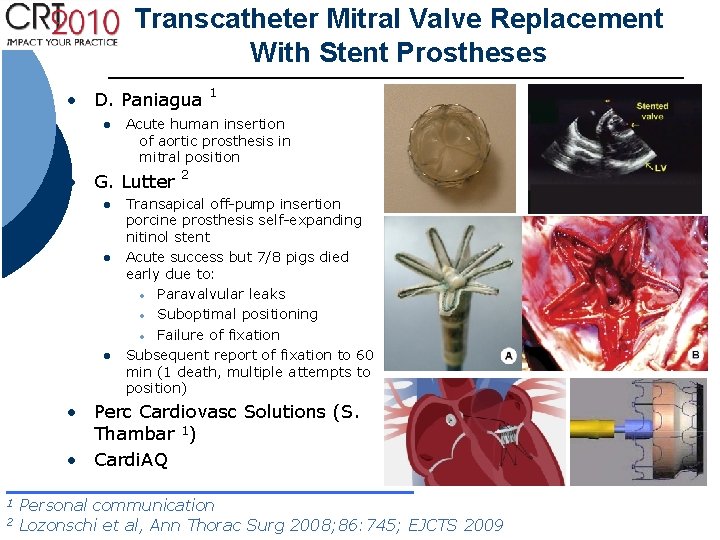
Transcatheter Mitral Valve Replacement With Stent Prostheses • D. Paniagua l Acute human insertion of aortic prosthesis in mitral position • G. Lutter l l l 1 2 Transapical off-pump insertion porcine prosthesis self-expanding nitinol stent Acute success but 7/8 pigs died early due to: • Paravalvular leaks • Suboptimal positioning • Failure of fixation Subsequent report of fixation to 60 min (1 death, multiple attempts to position) • Perc Cardiovasc Solutions (S. Thambar 1) • Cardi. AQ 1 2 Personal communication Lozonschi et al, Ann Thorac Surg 2008; 86: 745; EJCTS 2009
Transcatheter MVR: Challenges • Delivery l Fold/compress, size (larger than aortics) • Fixation l l More complex structure No calcium to grab radially Not a round valve Orientation may be important • Seal l Paravalvular leak likely less well tolerated than aortic (hemolysis) • Function l l LVOT obstruction a concern Need to preserve the subvalvular apparatus
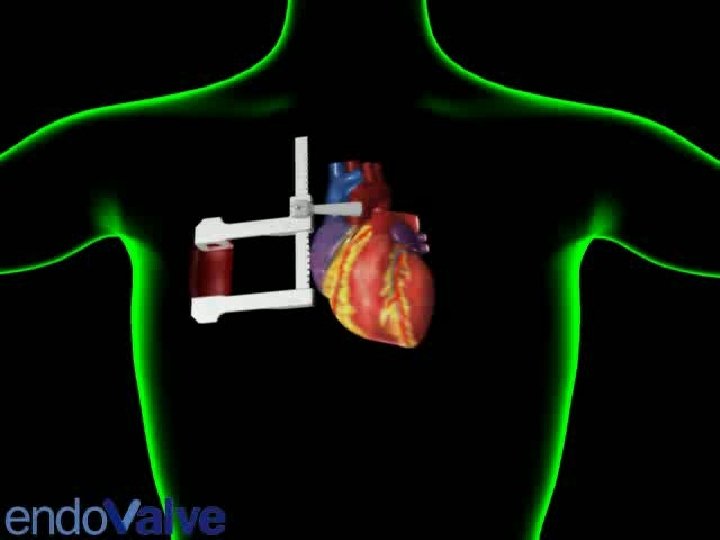
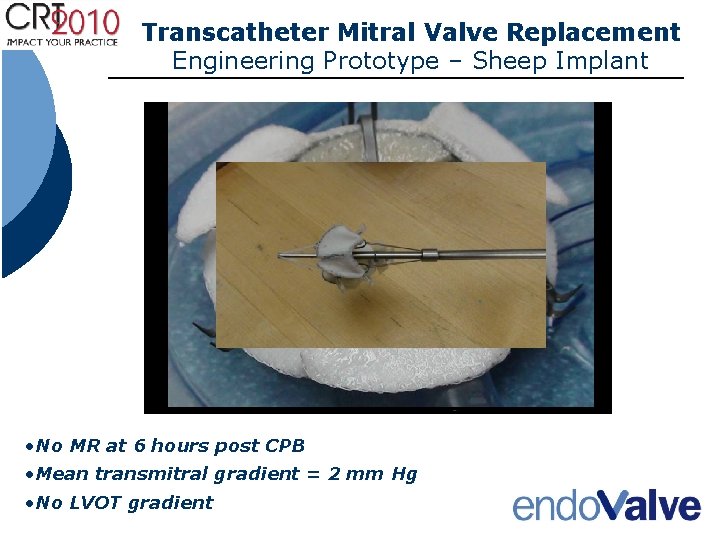
Endovalve Inc. • Endovalve Inc is a cardiovascular device company developing a mitral valve replacement system designed for insertion during a minimally invasive surgical (MIS) procedure • The proprietary Endovalve system is designed to allow for a complete mitral valve replacement without the risks and complications usually associated with open-heart surgery, avoiding both sternotomy and cardio-pulmonary bypass. l Clinical advantages of this approach include: • Reduction in MR as good as surgery • Takes advantage of improving durability of bioprosthetic leaflets • Fully valve-sparing (similar to repair) • Initially based on patented technology from the Univ of PA, our platform will allow for later development of a percutaneous system utilizing the same valve design.
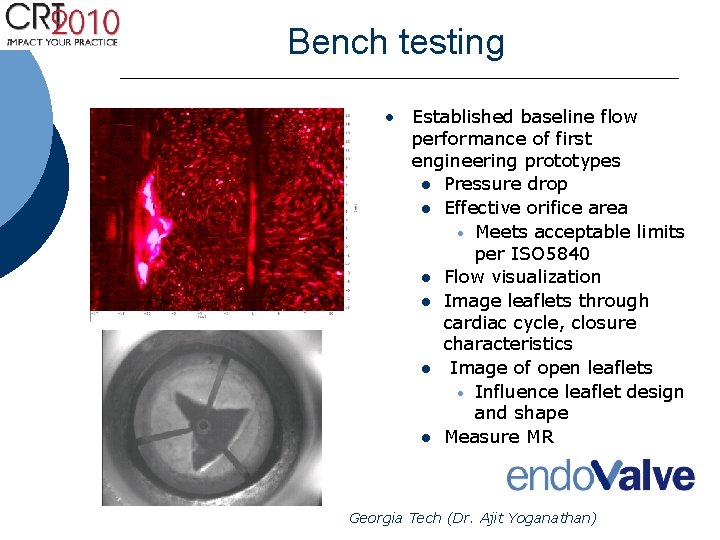
Bench testing • Established baseline flow performance of first engineering prototypes l Pressure drop l Effective orifice area • Meets acceptable limits per ISO 5840 l Flow visualization l Image leaflets through cardiac cycle, closure characteristics l Image of open leaflets • Influence leaflet design and shape l Measure MR Georgia Tech (Dr. Ajit Yoganathan)
Transcatheter Mitral Valve Replacement Engineering Prototype – Sheep Implant • No MR at 6 hours post CPB • Mean transmitral gradient = 2 mm Hg • No LVOT gradient
Conclusions • Minimally-invasive surgical insertion of a foldable bio -prosthetic mitral valve is feasible • Advantages of this approach include: l Avoidance of the complications of conventional cardiac surgery • Cardiopulmonary bypass • Sternotomy l Fully valve sparing l MR reduction equivalent to surgical valve replacement • Product development in process ü Detailed design l Verification l Clinical validation