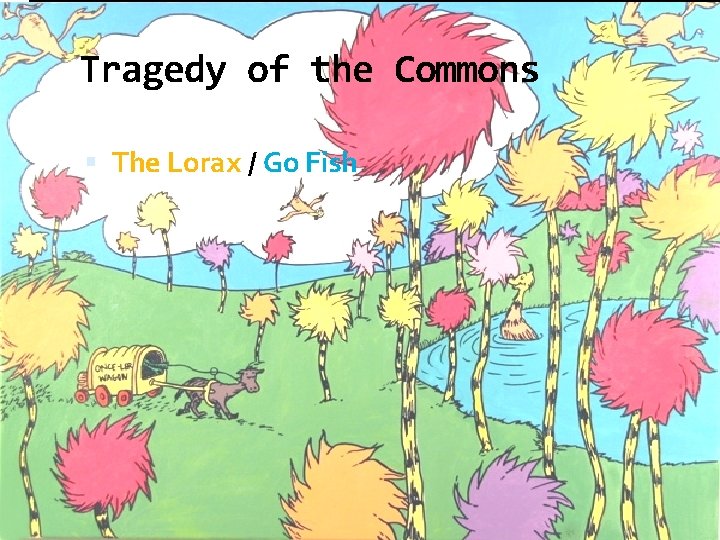
Tragedy of the Commons The Lorax Go Fish

- Slides: 6
Tragedy of the Commons The Lorax / Go Fish
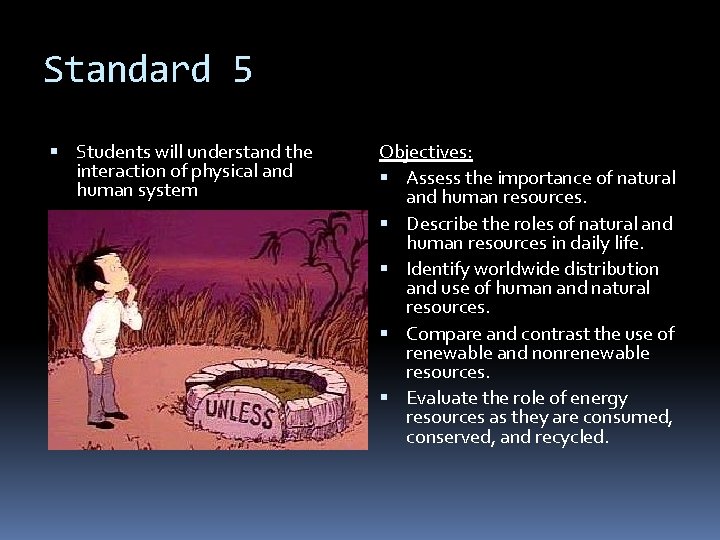
Standard 5 Students will understand the interaction of physical and human system Objectives: Assess the importance of natural and human resources. Describe the roles of natural and human resources in daily life. Identify worldwide distribution and use of human and natural resources. Compare and contrast the use of renewable and nonrenewable resources. Evaluate the role of energy resources as they are consumed, conserved, and recycled.
The Lorax http: //video. google. com/videoplay? docid=66 50219631867189375
Introduction In colonial days, there was usually an area of land set aside in each town called a “commons, ” upon which all townspeople could graze their livestock. In Ecology, this concept is employed to understand the use of resources that are shared, or held in “common. ” In this activity, you will learn what often happens to such commonly-held resources.
Play Time! Each one of you represents the head of a hungry family. In order for your family to survive, you must catch enough fish for them to eat. The only food source is a small local lake which can hold up to 16 fish. Once a year you will get a chance to fish and each time you fish you may take 0, 1, 2, 3, or 4 fish from the lake. It is your choice how many fish you take! One fish: Your family starves. Two fish: Your family survives. More than 2 fish: You can sell them for a profit. You will fish for 5 years. After each “year” of fishing, fill in the Data Table for Game #1. The fish in your lake will reproduce once a year. Keep the fish that you “catch” in front of you. (You will be able to eat them later!) At the end of each “year, ” your teacher will add more fish to the lake to simulate reproduction. The number of fish left in the lake will double! If any family has starved then you cannot fish this year. You are not allowed to talk or communicate while fishing. Do not begin until the teacher says start fishing. After 5 years, answer the discussion questions
Questions… 1. Did anyone in your group take too many fish? What was the consequence? 2. How did it make you feel if anyone did take too many fish? 3. Did everyone in your group try to take as many as possible? Why or Why not? 4. Does our society reward those with the “most”? 5. Did anyone sacrifice the number of fish they caught for the good of the community? Why or why not? 6. Does society ever reward that type of person? 7. Is it possible to maximize the number of fish caught person AND the number of fish remaining in the lake? Explain. 8. Think of a local “commons” that you are familiar with. (e. g. parking lots, public bathrooms, parks, the school cafeteria, the hallway, etc. ) Do similar situations arise? Explain. 9. How might those problems be solved? Be specific! 10. What are some natural resources that are common resources? 11. What are the global commons? Are these being used wisely? Explain. 12. What can people do to use these resources more wisely?