Trade in Intermediate Goods and Services Rainer Lanz

- Slides: 12
Trade in Intermediate Goods and Services Rainer Lanz, Sébastien Miroudot, Alexandros Ragoussis Trade Policy Linkages and Services Division OECD Trade and Agriculture Directorate WPTGS, 18 November 2009
Trade and activities of multinational enterprises: Programme of work of the OECD Trade Committee • “Vertical Trade, Trade Costs and FDI” (TAD/TC/WP(2008)23/FINAL) • “Trade in Intermediate Goods and Services” (TAD/TC/WP(2009)1/FINAL) • • Next year: – Intra-firm trade and investment – Trade in tasks Next Programme of Work and Budget (2011 -2012): analysis of trade flows in value-added? OECD Trade & Agriculture 2
Trade in intermediate goods and services • Objectives of the study: – To assess trade flows of intermediate goods and services among OECD countries and with their main trade partners – To analyse the determinants of trade in intermediate inputs – To look at the relationship between productivity and trade in intermediates at the industry level OECD Trade & Agriculture 3
Intermediate goods in trade data • OECD International Trade by Commodity Statistics (ITCS) database • UN Broad Economic Categories (BEC) classification – Based on the Standard International Trade Classification (SITC Rev. 3) • Grouping of commodities according to main end use: – capital goods – intermediate goods – consumption goods – not classified (motor spirit, passenger motor cars, goods n. e. s. ) OECD Trade & Agriculture 4
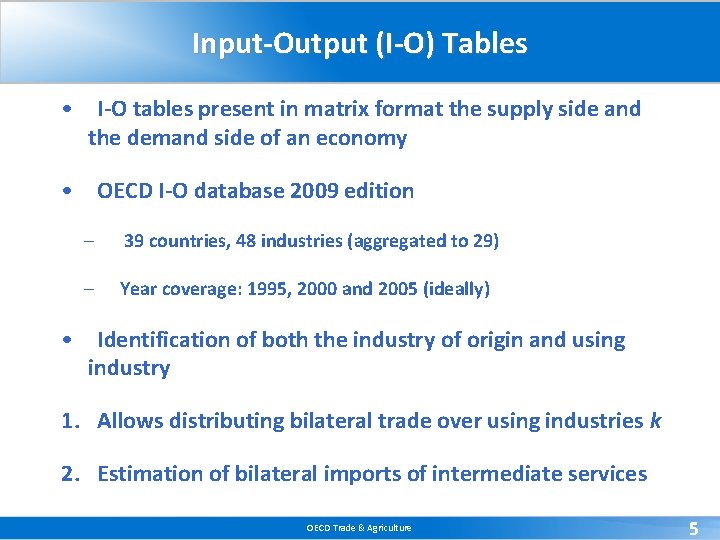
Input-Output (I-O) Tables • I-O tables present in matrix format the supply side and the demand side of an economy • OECD I-O database 2009 edition – 39 countries, 48 industries (aggregated to 29) – Year coverage: 1995, 2000 and 2005 (ideally) • Identification of both the industry of origin and using industry 1. Allows distributing bilateral trade over using industries k 2. Estimation of bilateral imports of intermediate services OECD Trade & Agriculture 5
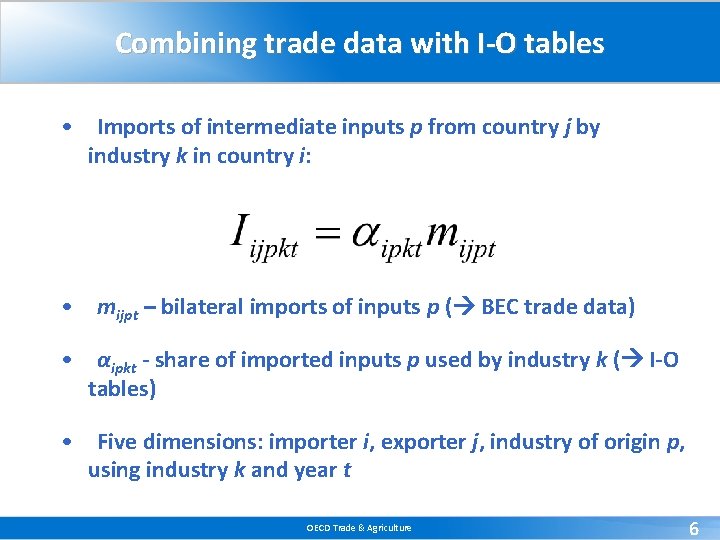
Combining trade data with I-O tables • Imports of intermediate inputs p from country j by industry k in country i: • mijpt – bilateral imports of inputs p ( BEC trade data) • αipkt - share of imported inputs p used by industry k ( I-O tables) • Five dimensions: importer i, exporter j, industry of origin p, using industry k and year t OECD Trade & Agriculture 6
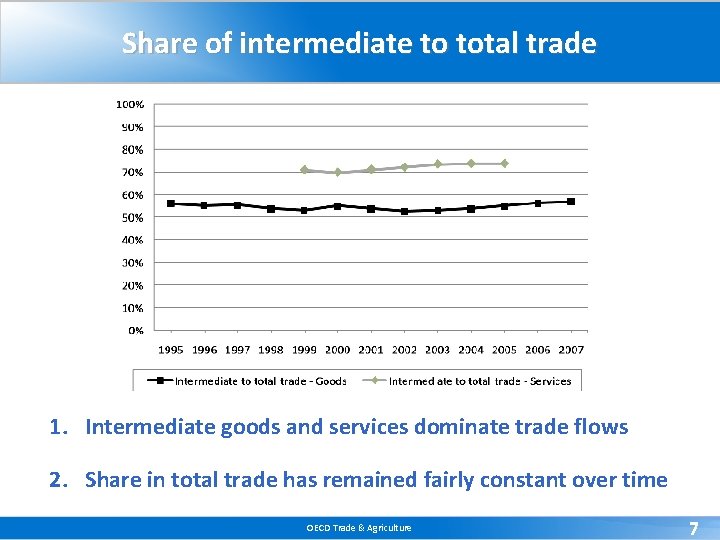
Share of intermediate to total trade 1. Intermediate goods and services dominate trade flows 2. Share in total trade has remained fairly constant over time OECD Trade & Agriculture 7
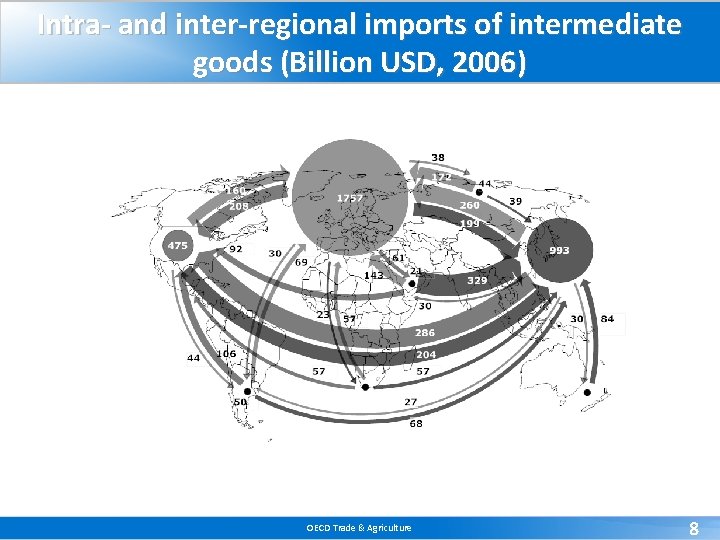
Intra- and inter-regional imports of intermediate goods (Billion USD, 2006) OECD Trade & Agriculture 8
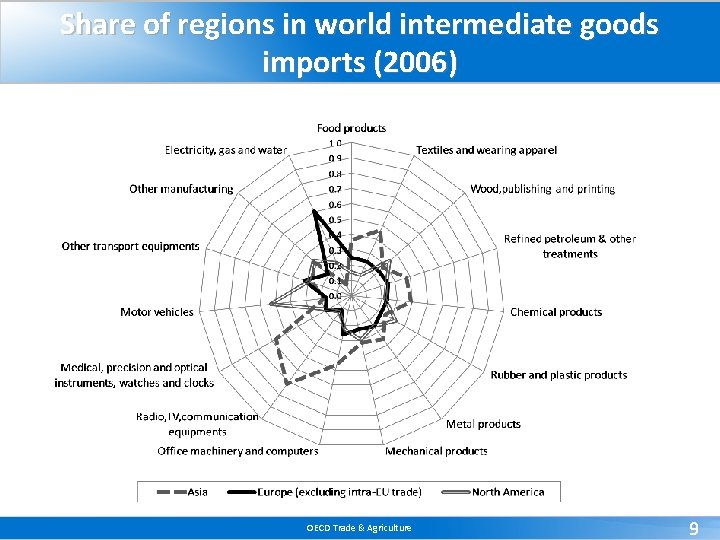
Share of regions in world intermediate goods imports (2006) OECD Trade & Agriculture 9
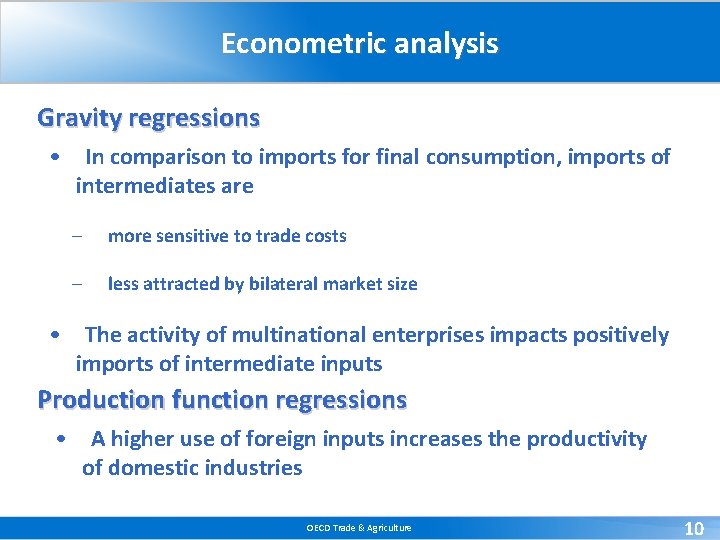
Econometric analysis Gravity regressions • In comparison to imports for final consumption, imports of intermediates are – more sensitive to trade costs – less attracted by bilateral market size • The activity of multinational enterprises impacts positively imports of intermediate inputs Production function regressions • A higher use of foreign inputs increases the productivity of domestic industries OECD Trade & Agriculture 10
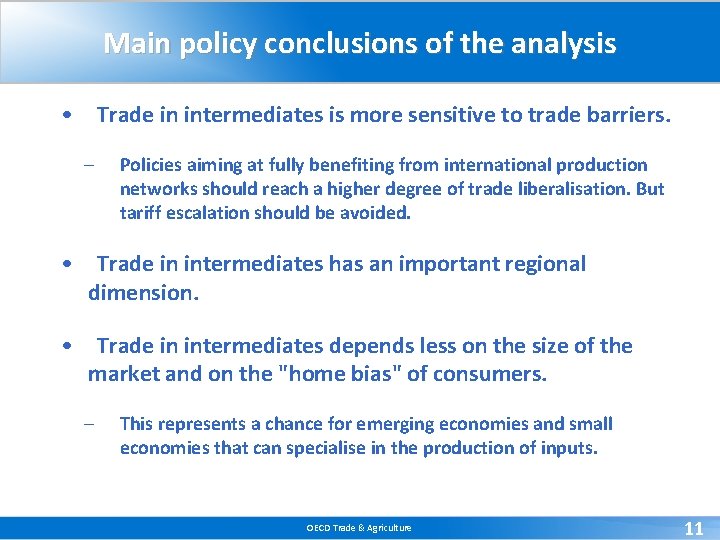
Main policy conclusions of the analysis • Trade in intermediates is more sensitive to trade barriers. – Policies aiming at fully benefiting from international production networks should reach a higher degree of trade liberalisation. But tariff escalation should be avoided. • Trade in intermediates has an important regional dimension. • Trade in intermediates depends less on the size of the market and on the "home bias" of consumers. – This represents a chance for emerging economies and small economies that can specialise in the production of inputs. OECD Trade & Agriculture 11
Thank you for your attention! sebastien. miroudot@oecd. org OECD Trade & Agriculture rainer. lanz@oecd. org 12