Topic 17 assertions and program logic As soon

- Slides: 20
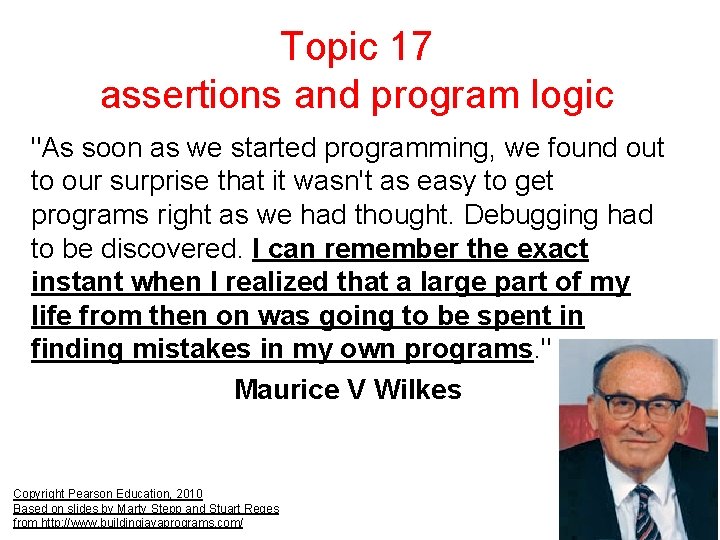
Topic 17 assertions and program logic "As soon as we started programming, we found out to our surprise that it wasn't as easy to get programs right as we had thought. Debugging had to be discovered. I can remember the exact instant when I realized that a large part of my life from then on was going to be spent in finding mistakes in my own programs. " Maurice V Wilkes Copyright Pearson Education, 2010 Based on slides by Marty Stepp and Stuart Reges from http: //www. buildingjavaprograms. com/
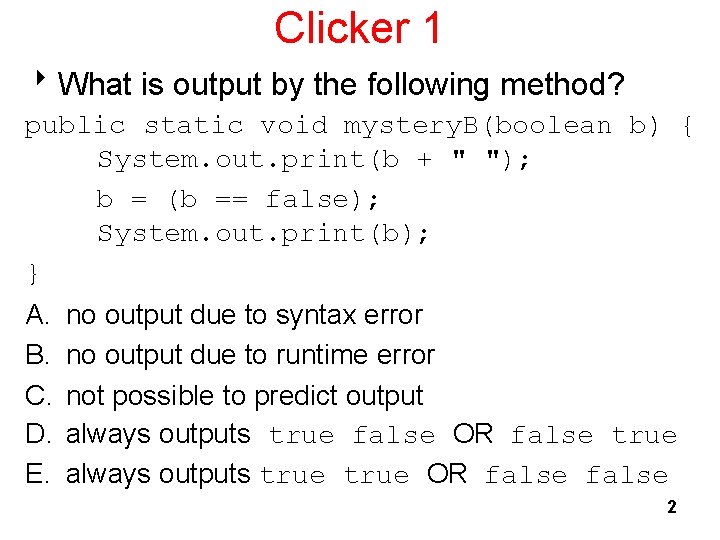
Clicker 1 8 What is output by the following method? public static void mystery. B(boolean b) { System. out. print(b + " "); b = (b == false); System. out. print(b); } A. B. C. D. E. no output due to syntax error no output due to runtime error not possible to predict output always outputs true false OR false true always outputs true OR false 2
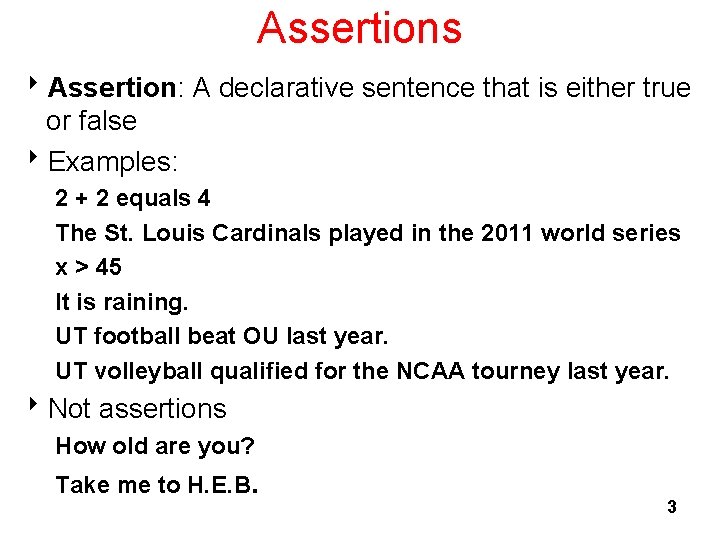
Assertions 8 Assertion: A declarative sentence that is either true or false 8 Examples: 2 + 2 equals 4 The St. Louis Cardinals played in the 2011 world series x > 45 It is raining. UT football beat OU last year. UT volleyball qualified for the NCAA tourney last year. 8 Not assertions How old are you? Take me to H. E. B. 3
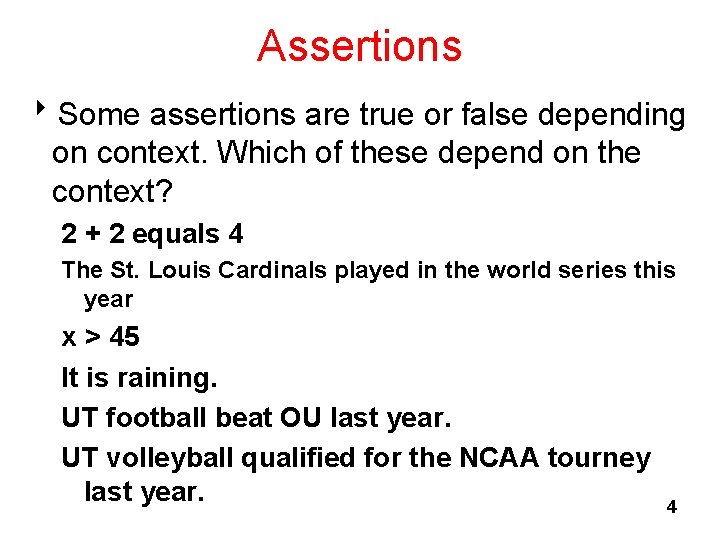
Assertions 8 Some assertions are true or false depending on context. Which of these depend on the context? 2 + 2 equals 4 The St. Louis Cardinals played in the world series this year x > 45 It is raining. UT football beat OU last year. UT volleyball qualified for the NCAA tourney last year. 4
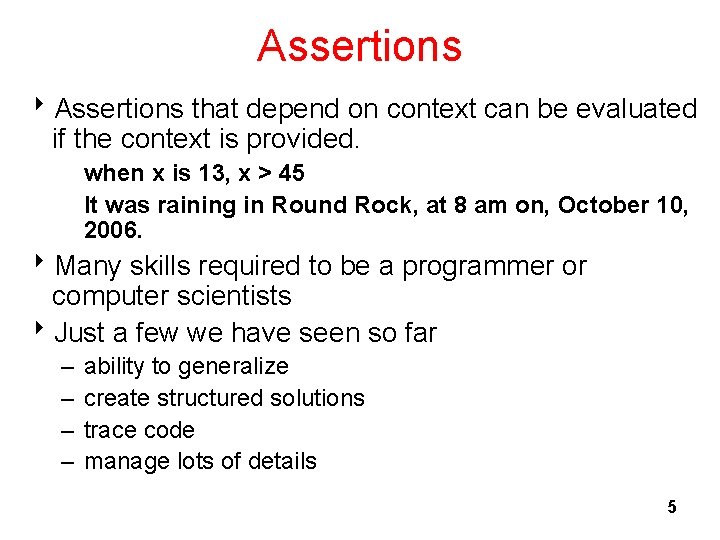
Assertions 8 Assertions that depend on context can be evaluated if the context is provided. when x is 13, x > 45 It was raining in Round Rock, at 8 am on, October 10, 2006. 8 Many skills required to be a programmer or computer scientists 8 Just a few we have seen so far – – ability to generalize create structured solutions trace code manage lots of details 5
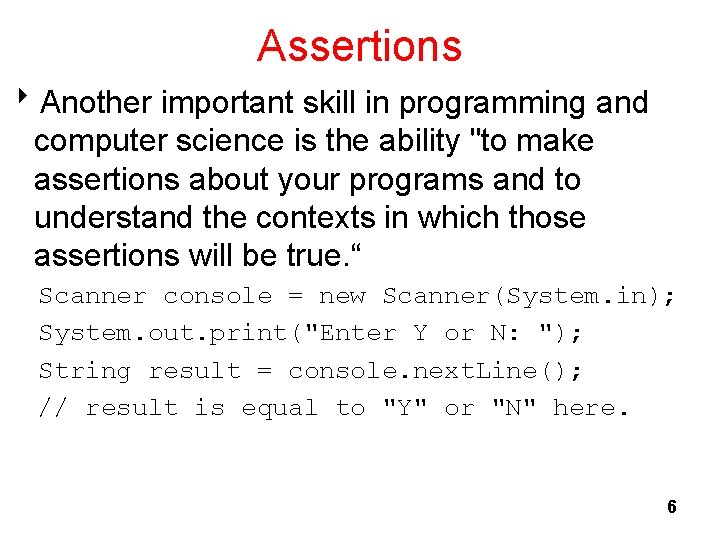
Assertions 8 Another important skill in programming and computer science is the ability "to make assertions about your programs and to understand the contexts in which those assertions will be true. “ Scanner console = new Scanner(System. in); System. out. print("Enter Y or N: "); String result = console. next. Line(); // result is equal to "Y" or "N" here. 6
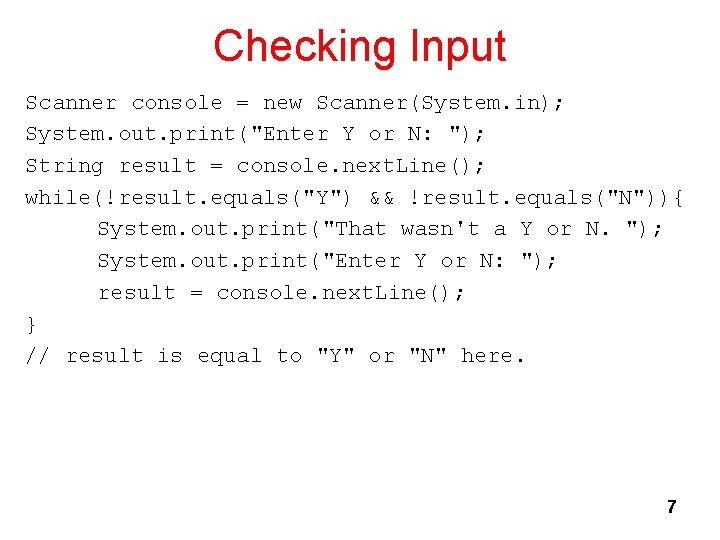
Checking Input Scanner console = new Scanner(System. in); System. out. print("Enter Y or N: "); String result = console. next. Line(); while(!result. equals("Y") && !result. equals("N")){ System. out. print("That wasn't a Y or N. "); System. out. print("Enter Y or N: "); result = console. next. Line(); } // result is equal to "Y" or "N" here. 7
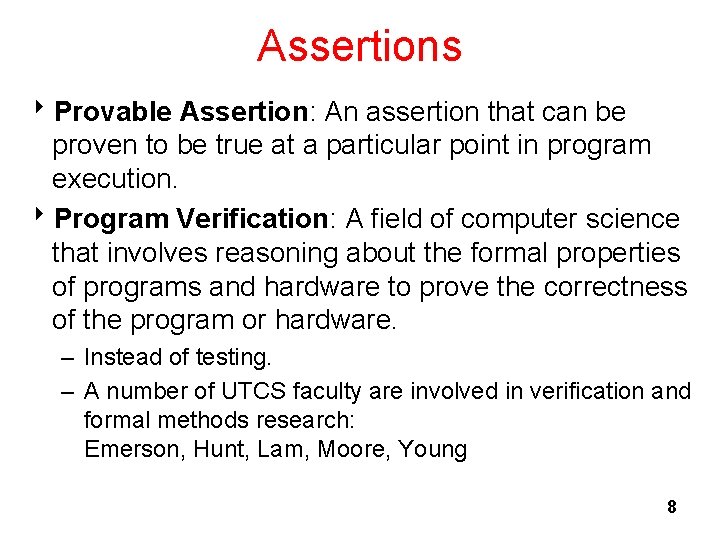
Assertions 8 Provable Assertion: An assertion that can be proven to be true at a particular point in program execution. 8 Program Verification: A field of computer science that involves reasoning about the formal properties of programs and hardware to prove the correctness of the program or hardware. – Instead of testing. – A number of UTCS faculty are involved in verification and formal methods research: Emerson, Hunt, Lam, Moore, Young 8
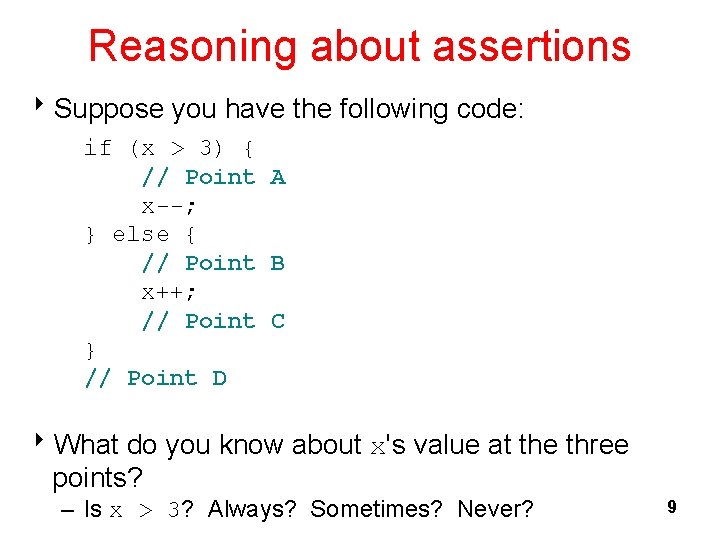
Reasoning about assertions 8 Suppose you have the following code: if (x > 3) { // Point A x--; } else { // Point B x++; // Point C } // Point D 8 What do you know about x's value at the three points? – Is x > 3? Always? Sometimes? Never? 9
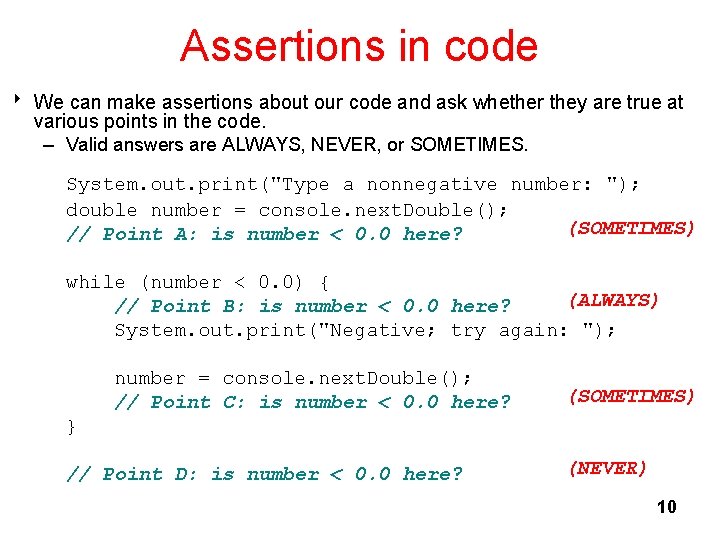
Assertions in code 8 We can make assertions about our code and ask whether they are true at various points in the code. – Valid answers are ALWAYS, NEVER, or SOMETIMES. System. out. print("Type a nonnegative number: "); double number = console. next. Double(); (SOMETIMES) // Point A: is number < 0. 0 here? while (number < 0. 0) { (ALWAYS) // Point B: is number < 0. 0 here? System. out. print("Negative; try again: "); number = console. next. Double(); // Point C: is number < 0. 0 here? (SOMETIMES) } // Point D: is number < 0. 0 here? (NEVER) 10
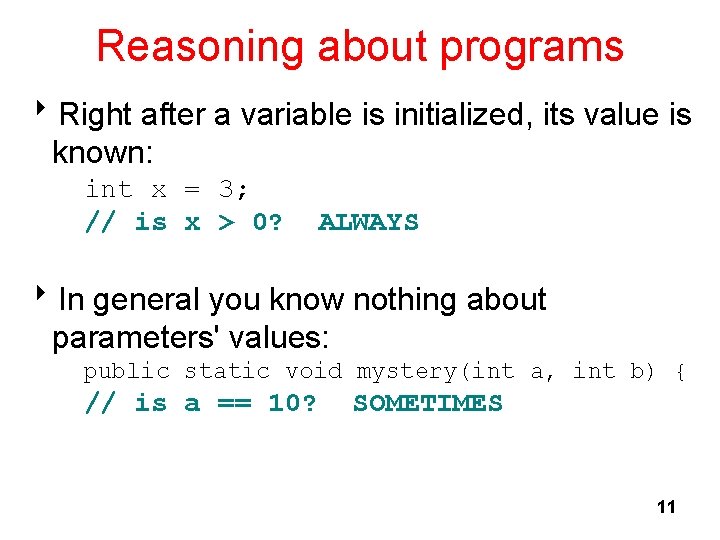
Reasoning about programs 8 Right after a variable is initialized, its value is known: int x = 3; // is x > 0? ALWAYS 8 In general you know nothing about parameters' values: public static void mystery(int a, int b) { // is a == 10? SOMETIMES 11
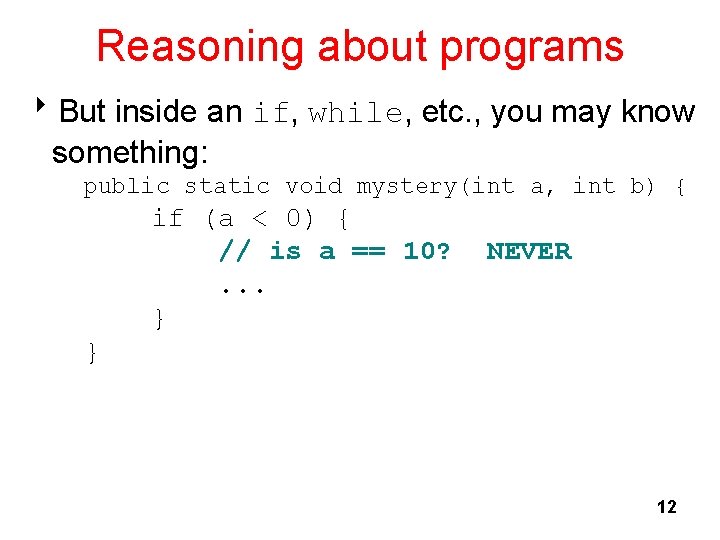
Reasoning about programs 8 But inside an if, while, etc. , you may know something: public static void mystery(int a, int b) { if (a < 0) { // is a == 10? . . . } NEVER } 12
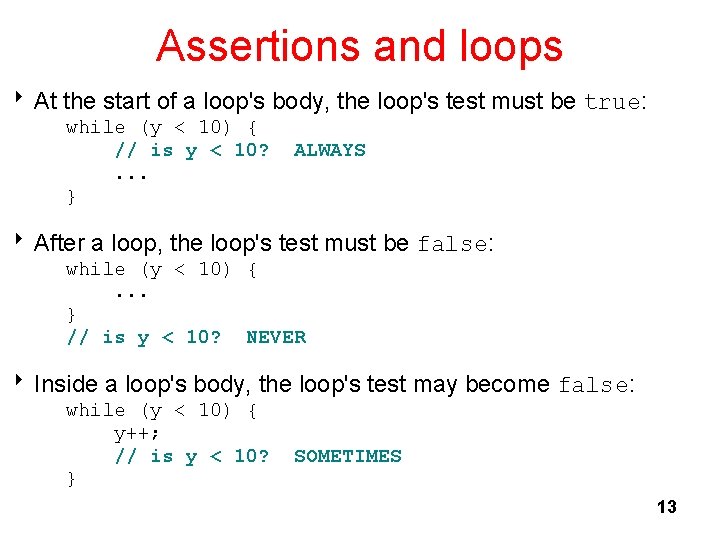
Assertions and loops 8 At the start of a loop's body, the loop's test must be true: while (y < 10) { // is y < 10? . . . } ALWAYS 8 After a loop, the loop's test must be false: while (y < 10) {. . . } // is y < 10? NEVER 8 Inside a loop's body, the loop's test may become false: while (y < 10) { y++; // is y < 10? } SOMETIMES 13
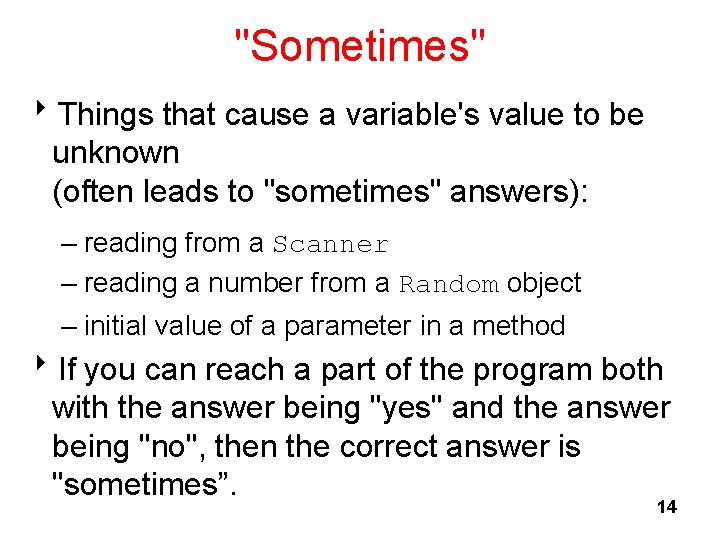
"Sometimes" 8 Things that cause a variable's value to be unknown (often leads to "sometimes" answers): – reading from a Scanner – reading a number from a Random object – initial value of a parameter in a method 8 If you can reach a part of the program both with the answer being "yes" and the answer being "no", then the correct answer is "sometimes”. 14
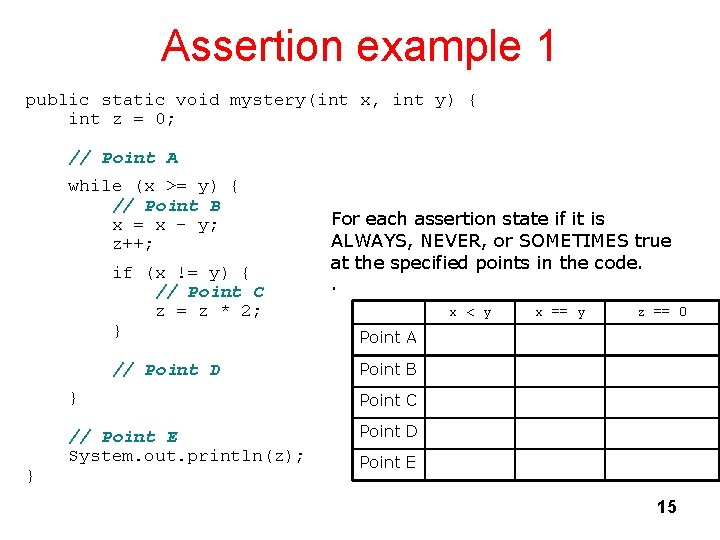
Assertion example 1 public static void mystery(int x, int y) { int z = 0; // Point A while (x >= y) { // Point B x = x - y; z++; if (x != y) { // Point C z = z * 2; } // Point D } For each assertion state if it is ALWAYS, NEVER, or SOMETIMES true at the specified points in the code. . x < y x == y z == 0 Point A Point B } Point C // Point E System. out. println(z); Point D Point E 15
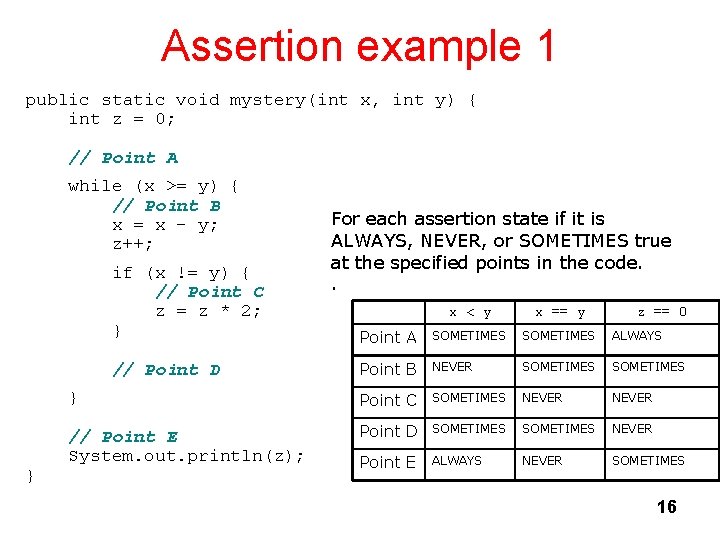
Assertion example 1 public static void mystery(int x, int y) { int z = 0; // Point A while (x >= y) { // Point B x = x - y; z++; if (x != y) { // Point C z = z * 2; } x < y x == y Point A SOMETIMES ALWAYS Point B NEVER SOMETIMES } Point C SOMETIMES NEVER // Point E System. out. println(z); Point D SOMETIMES NEVER Point E ALWAYS NEVER SOMETIMES // Point D } For each assertion state if it is ALWAYS, NEVER, or SOMETIMES true at the specified points in the code. . z == 0 16
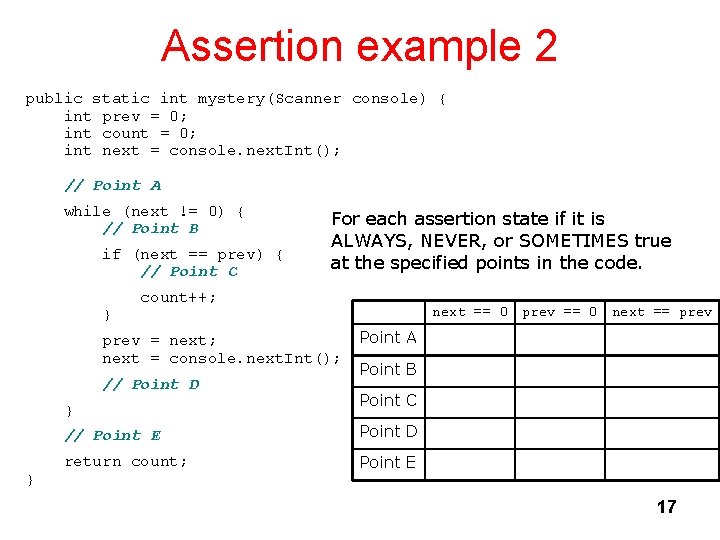
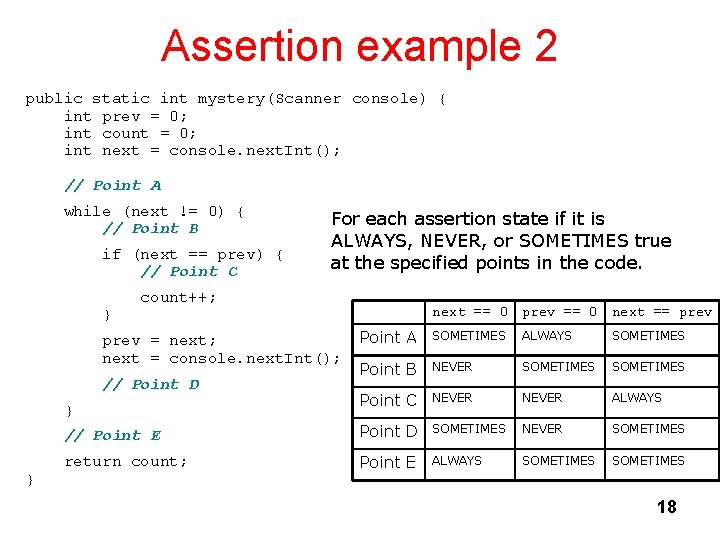
Assertion example 2 public static int mystery(Scanner console) { int prev = 0; int count = 0; int next = console. next. Int(); // Point A while (next != 0) { // Point B if (next == prev) { // Point C } For each assertion state if it is ALWAYS, NEVER, or SOMETIMES true at the specified points in the code. count++; prev = next; next = console. next. Int(); // Point D } } next == 0 prev == 0 next == prev Point A Point B Point C // Point E Point D return count; Point E 17
Assertion example 2 public static int mystery(Scanner console) { int prev = 0; int count = 0; int next = console. next. Int(); // Point A while (next != 0) { // Point B if (next == prev) { // Point C For each assertion state if it is ALWAYS, NEVER, or SOMETIMES true at the specified points in the code. count++; next == 0 prev == 0 next == prev Point A SOMETIMES ALWAYS SOMETIMES Point B NEVER SOMETIMES Point C NEVER ALWAYS // Point E Point D SOMETIMES NEVER SOMETIMES return count; Point E ALWAYS SOMETIMES } prev = next; next = console. next. Int(); // Point D } } 18
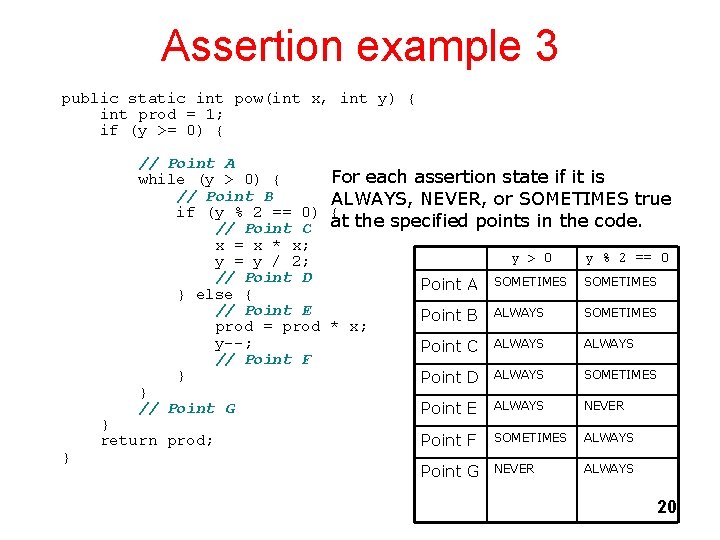
Assertion example 3 public static int pow(int x, int y) { int prod = 1; if (y >= 0) { // Point A while (y > 0) { // Point B if (y % 2 == 0) // Point C x = x * x; y = y / 2; // Point D } else { // Point E prod = prod y--; // Point F } } // Point G } } return prod; For each assertion state if it is ALWAYS, NEVER, or SOMETIMES true { at the specified points in the code. y > 0 y % 2 == 0 Point A * x; Point B Point C Point D Point E Point F Point G 19
Assertion example 3 public static int pow(int x, int y) { int prod = 1; if (y >= 0) { // Point A while (y > 0) { // Point B if (y % 2 == 0) // Point C x = x * x; y = y / 2; // Point D } else { // Point E prod = prod y--; // Point F } } // Point G } } return prod; For each assertion state if it is ALWAYS, NEVER, or SOMETIMES true { at the specified points in the code. y > 0 * x; y % 2 == 0 Point A SOMETIMES Point B ALWAYS SOMETIMES Point C ALWAYS Point D ALWAYS SOMETIMES Point E ALWAYS NEVER Point F SOMETIMES ALWAYS Point G NEVER ALWAYS 20