Threatening Stereotypes Purpose and Audience I Activity 1

- Slides: 25
Threatening Stereotypes
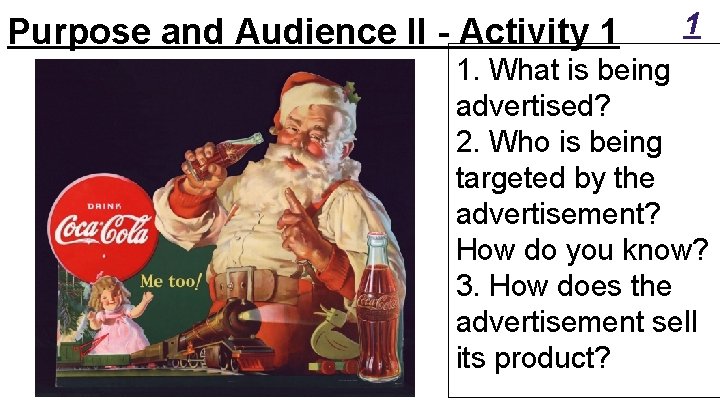
Purpose and Audience I - Activity 1 1. What is being advertised? 2. Who is being targeted by the advertisement? How do you know? 3. How does the advertisement sell its product? 1
Purpose and Audience II - Activity 1 1 1. What is being advertised? 2. Who is being targeted by the advertisement? How do you know? 3. How does the advertisement sell its product?
Exploring Key Concepts - Activity 2 Define each concept. How are they related? • Purpose • Audience • Message • Technique 2
List Examples of Purposes and Audiences Purposes Audiences 2
Multiple Audiences; Multiple Purposes 1. When have you seen texts written for more than one audience? 2. What texts have you seen that seem to meet multiple purposes? What purposes have you noticed? Does one purpose dominate? 2
Surveying the Text 3 Look at the text of the article, “How a Self-Fulfilling Stereotype Can Drag Down Performance, ” by Shankar Vedantam. Consider the following questions: 1. Where and when was the article published? 2. What does that tell you about the information in the article? 3. What do you notice about the length of the article and its paragraphs? 4. What does that suggest to you about what you will be reading? 5. The article was published in the science news section of the newspaper. What does that tell you about the article?
Making Predictions and Asking Questions I 4 Look at the title, “How a Self-Fulfilling Stereotype Can Drag Down Performance. ” 1. What is a stereotype? 2. What kinds of stereotypes have you heard about different people? 3. What does self-fulfilling mean? 4. What might make a stereotype self-fulfilling? 5. What kinds of performance might the author be talking about according to the title? 6. What do you think the author will say about the relationship between stereotypes and performance? 7. Who do you think is the audience for this piece? How do you know? 8. What do you think will be the purpose of the piece?
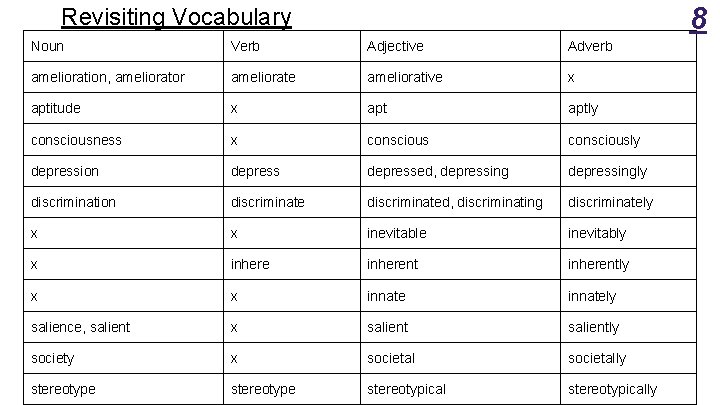
Vocabulary Record these words and their definitions in your vocabulary logs, leaving room to copy the sentences in which the words appear in the article. Then write answers to the following questions: • What does the use of these words in the article suggest to you about the tone of the article? • What does the use of these words tell you about the author’s perspective on the issue? • What do they tell you about the audience of the piece? 5 1. ameliorate 2. aptitude 3. conscious 4. depress 5. discriminat e 6. inevitable 7. inherent 8. innate 9. salient
Reading as a “Believer” - Understanding the author’s point of view Each person should read a paragraph or two of the article, then stop and say something to her partner. Examples of ways to start your sentences. After reading and commenting write a one sentence summary of the article. Making Connections • This reminds me of. . . • I experienced this once when. . . • I can relate to this because. . . Forming Interpretations • What this means to me is. . . • I think this represents. . . • The idea I’m getting is… Summarizing • The basic gist… • The key information is… Asking Questions • I wonder why. . . • What if. . . • How come. . . • In a nutshell, this says that… Revising Meaning • At first I thought, but now I. . . • My latest thought about this is. . . • I’m getting a different picture here because. . . 6
Considering the Structure of the Text: The Introduction and Conclusion 7 1. Draw a line across the page where the introduction ends. Is it after the first paragraph, or are there several introductory paragraphs? How do you know? 2. Draw a line across the page where the conclusion begins. Is it the last paragraph, or are there several concluding paragraphs? How do you know? 3. Discuss in groups or as a class why the lines were drawn where they were. In this activity, thinking and reasoning about organizational structure is more important than agreeing on where the lines should be drawn.
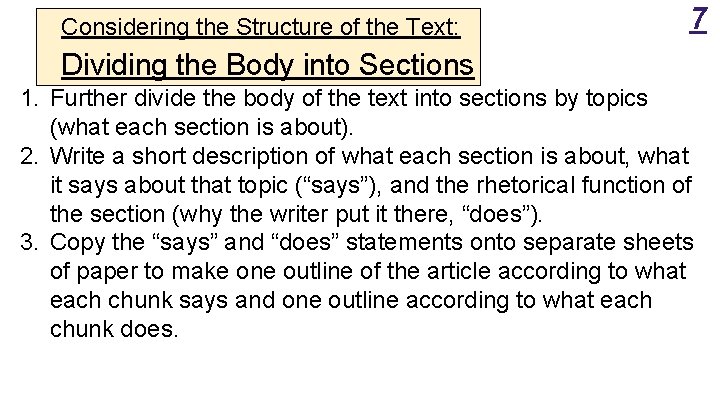
Considering the Structure of the Text: 7 Dividing the Body into Sections 1. Further divide the body of the text into sections by topics (what each section is about). 2. Write a short description of what each section is about, what it says about that topic (“says”), and the rhetorical function of the section (why the writer put it there, “does”). 3. Copy the “says” and “does” statements onto separate sheets of paper to make one outline of the article according to what each chunk says and one outline according to what each chunk does.
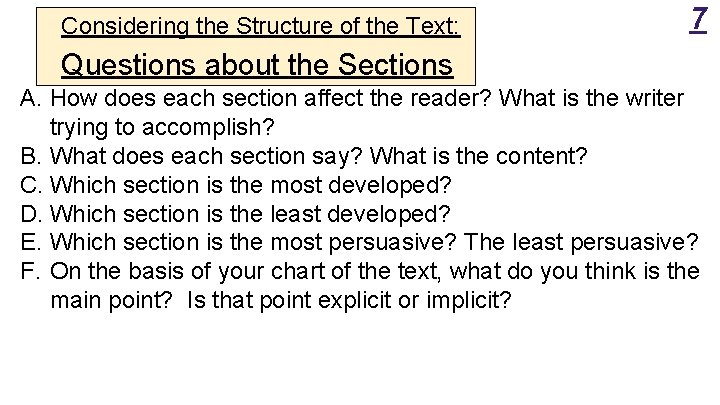
Considering the Structure of the Text: 7 Questions about the Sections A. How does each section affect the reader? What is the writer trying to accomplish? B. What does each section say? What is the content? C. Which section is the most developed? D. Which section is the least developed? E. Which section is the most persuasive? The least persuasive? F. On the basis of your chart of the text, what do you think is the main point? Is that point explicit or implicit?
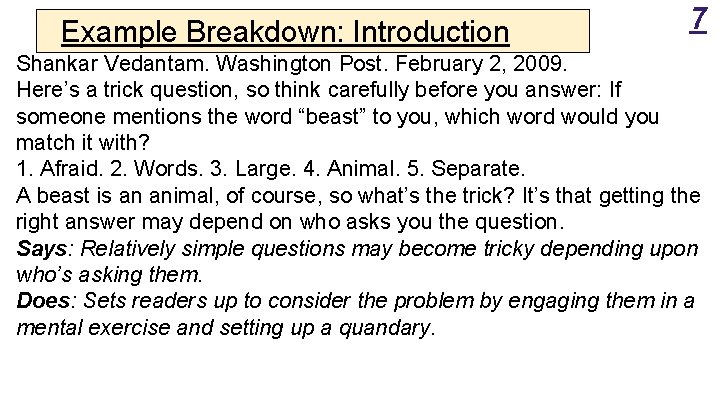
Example Breakdown: Introduction 7 Shankar Vedantam. Washington Post. February 2, 2009. Here’s a trick question, so think carefully before you answer: If someone mentions the word “beast” to you, which word would you match it with? 1. Afraid. 2. Words. 3. Large. 4. Animal. 5. Separate. A beast is an animal, of course, so what’s the trick? It’s that getting the right answer may depend on who asks you the question. Says: Relatively simple questions may become tricky depending upon who’s asking them. Does: Sets readers up to consider the problem by engaging them in a mental exercise and setting up a quandary.
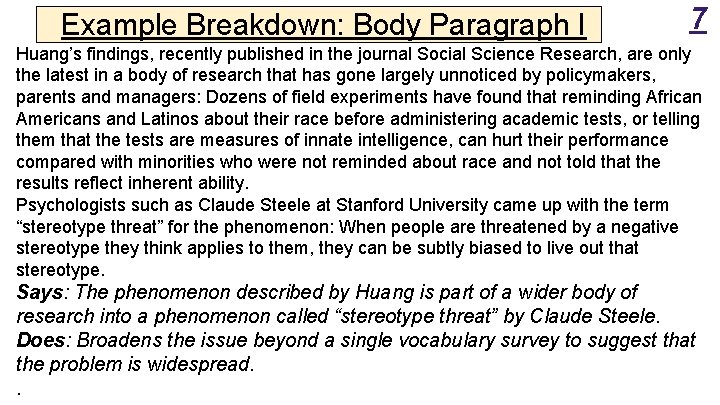
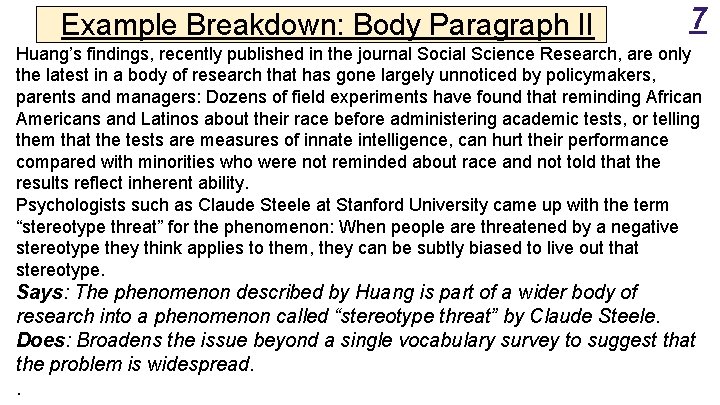
Example Breakdown: Body Paragraph I 7 Huang’s findings, recently published in the journal Social Science Research, are only the latest in a body of research that has gone largely unnoticed by policymakers, parents and managers: Dozens of field experiments have found that reminding African Americans and Latinos about their race before administering academic tests, or telling them that the tests are measures of innate intelligence, can hurt their performance compared with minorities who were not reminded about race and not told that the results reflect inherent ability. Psychologists such as Claude Steele at Stanford University came up with the term “stereotype threat” for the phenomenon: When people are threatened by a negative stereotype they think applies to them, they can be subtly biased to live out that stereotype. Says: The phenomenon described by Huang is part of a wider body of research into a phenomenon called “stereotype threat” by Claude Steele. Does: Broadens the issue beyond a single vocabulary survey to suggest that the problem is widespread. .
Example Breakdown: Body Paragraph II 7 Huang’s findings, recently published in the journal Social Science Research, are only the latest in a body of research that has gone largely unnoticed by policymakers, parents and managers: Dozens of field experiments have found that reminding African Americans and Latinos about their race before administering academic tests, or telling them that the tests are measures of innate intelligence, can hurt their performance compared with minorities who were not reminded about race and not told that the results reflect inherent ability. Psychologists such as Claude Steele at Stanford University came up with the term “stereotype threat” for the phenomenon: When people are threatened by a negative stereotype they think applies to them, they can be subtly biased to live out that stereotype. Says: The phenomenon described by Huang is part of a wider body of research into a phenomenon called “stereotype threat” by Claude Steele. Does: Broadens the issue beyond a single vocabulary survey to suggest that the problem is widespread. .
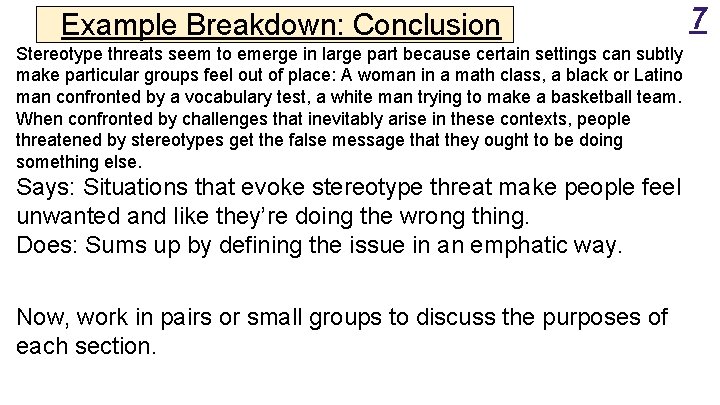
Example Breakdown: Conclusion Stereotype threats seem to emerge in large part because certain settings can subtly make particular groups feel out of place: A woman in a math class, a black or Latino man confronted by a vocabulary test, a white man trying to make a basketball team. When confronted by challenges that inevitably arise in these contexts, people threatened by stereotypes get the false message that they ought to be doing something else. Says: Situations that evoke stereotype threat make people feel unwanted and like they’re doing the wrong thing. Does: Sums up by defining the issue in an emphatic way. Now, work in pairs or small groups to discuss the purposes of each section. 7
8 Revisiting Vocabulary Noun Verb Adjective Adverb amelioration, ameliorator ameliorate ameliorative x aptitude x aptly consciousness x consciously depression depressed, depressingly discrimination discriminated, discriminating discriminately x x inevitable inevitably x inherently x x innately salience, salient x saliently society x societally stereotype stereotypically
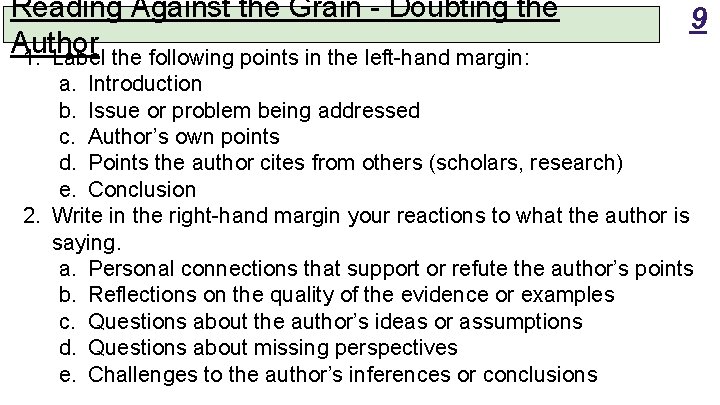
Reading Against the Grain - Doubting the Author 1. Label the following points in the left-hand margin: 9 a. Introduction b. Issue or problem being addressed c. Author’s own points d. Points the author cites from others (scholars, research) e. Conclusion 2. Write in the right-hand margin your reactions to what the author is saying. a. Personal connections that support or refute the author’s points b. Reflections on the quality of the evidence or examples c. Questions about the author’s ideas or assumptions d. Questions about missing perspectives e. Challenges to the author’s inferences or conclusions
The Author’s Main Purpose and Other Purposes 1. What is the author’s apparent main purpose? 2. What clues indicate this purpose? 3. What other purposes do you see the author pursuing? 4. What clues suggest these other purposes? 9
1 Analyzing Stylistic Choices Refer to the handout with the specific questions for each aspect. 0 Jigsaw answering the questions for each aspect of the author’s technique. Report your answers to the whole class or send members from each group to other groups. 1. Relationship Between the Writer and the Reader 2. Content Choices 3. Expansion of Topics Use this analysis to come to a class claim about the author’s stance toward the topic 4. Choice of Evidence and to outline or draft a class rhetorical 5. Use of Reference analysis of the piece. The rhetorical analysis 6. Level of Precision will support a claim about main and 7. Sentence Structure subordinate purposes of the article and how 8. Word Choice the author accomplishes those purposes.
1 Summarizing and Responding—Rhetorical 1 Précis Write a brief analysis of the content, purpose, and persuasive strategies of a text using the pattern below: 1. Sentence 1: Note the name of the author, the genre and title of the work, and the publication date in parentheses; a rhetorically accurate verb; and a that clause containing the major assertion or thesis statement in the work. 2. Sentence 2: An explanation of how the author develops and supports thesis, usually in chronological order. 3. Sentence 3: A statement of the author’s apparent purpose, followed by an “in order to” phrase. 4. Sentence 4: A description of the intended audience, the relationship the author establishes with the audience, or both.
Rhetorical Précis Example In the science article, “How a Self-Fulfilling Stereotype Can Drag Down 1 1 Performance, ” published in the Washington Post (2009), Shankar Vedantam describes a body of research he claims “has gone largely unnoticed” on a phenomenon called “stereotype threat. ” He focuses most of his attention on two recent studies, one demonstrating that the race of an interviewer affects the likelihood that African Americans will answer vocabulary questions correctly and one on the academic success of women and minorities based on SAT scores that finds, “when schools and colleges go out of their way to ameliorate stereotype threats, ” framing these elaborate descriptions with summaries of other research on the phenomenon. The author reports on this research in order to raise awareness about the phenomenon, perhaps to overcome its absence from consideration by business leaders and policy makers. He writes as an expert on social science research informing a general audience.
Reflecting on Your Reading 1 2 Quickwrite: Freewrite for a short time about one or more of the following questions. When you have finished, prepare to share your ideas with the class. 1. What have you learned from joining this conversation? What do you want to learn next? 2. What reading strategies did you use or learn in this module? 3. Which strategies will you use in reading other texts? How will these strategies apply in other classes? 4. In what ways has your ability to read and discuss texts like this one improved?
Reading Test Given an unannotated copy of the article answer the following in complete sentences: 1. What is the central idea of the text? 2. What is the author’s purpose? 3. Explain how the author develops and supports the central idea. 4. Note three pieces of evidence from three different sections that support the central idea.