THE SUPERVISORY RELATIONSHIP Anjula Gupta Kate Rayner 13

- Slides: 20
THE SUPERVISORY RELATIONSHIP Anjula Gupta & Kate Rayner 13 th March 2019
LEARNING OUTCOMES To think about what is meant by the “supervisory relationship”? To look at what research tells us To reflect upon and practice ways of being in supervision To consider issues of power and difference in the relationship
RELATIONSHIPS Our patterns of relating, especially our more personal and informal ones are based on procedural knowledge and ways of reciprocating, laid down in our earliest years of life In every relationship we are in we play out relational patterns some of which may be more or less helpful at different times and with different people Relational patterns are influenced by societal discourses, class, ethnicity (Brown, 2010) Important also to acknowledge and develop relationships with people that keep them connected to what they value.
THE SUPERVISORY RELATIONSHIP Core conditions for a supervisory relationship –what do we want to provide? Importance of provision of a secure base – what we bring to the relationship as supervisors and what trainees are bringing to the relationship - each of us have our own attachment and relationship history/patterns that need to be negotiated Need an awareness of what early relational patterns may be played out?
THE SUPERVISORY RELATIONSHIP CONT… Exercise: ‘The Helper’s Dance’ - On your own please complete one form each. - In pairs discuss completing the form – share as much or as little as you feel comfortable with
POWER, DIFFERENCE AND PRIVILEGE IN RELATIONSHIPS Social Constructionist lens – Taken for granted knowledge and experience of relationships, power and privilege More likely to spend time with people perceived as being similar – values, culture, beliefs – provides safety and sense of belonging Differences and similarity in all relationships – seek out both in our relationships which can be inaccurate or accurate/helpful or unhelpful to a relationship Only a few human differences are neutral with respect to power - gender, ethnicity, class, age, income, sexuality, ability are signifiers of rank.
POWER, DIFFERENCE AND PRIVILEGE IN RELATIONSHIPS Difference in rank affects people – re-enacted and reinforced in future relationships Whether rank is earned or inherited your rank, it organises our communication behaviour Visual information about, for example, gender or ethnicity enables people to quickly consciously or unconsciously, read each other’s relative rank with all its implications for relative power, e. g. majority and minority groups/empowered and disempowered groups If in empowered group may be unconscious of rank and privilege which can affect relationships – transformative effects of awareness (Totton, 2006) Complexity of different types and levels of privilege
POWER, DIFFERENCE AND PRIVILEGE IN THE SUPERVISORY RELATIONSHIP Importance of paying attention to difference and similarity in the supervisory relationship Role of supervisor to model talking about this safely Power intrinsic in the supervisory relationship with trainee Ryde, 2000 identified: Role Power – inherent power differential between supervisor and supervisee Cultural Power – power specific to a perceived dominant ethnic grouping Individual Power – associated with the characteristics / “personality” of the supervisor
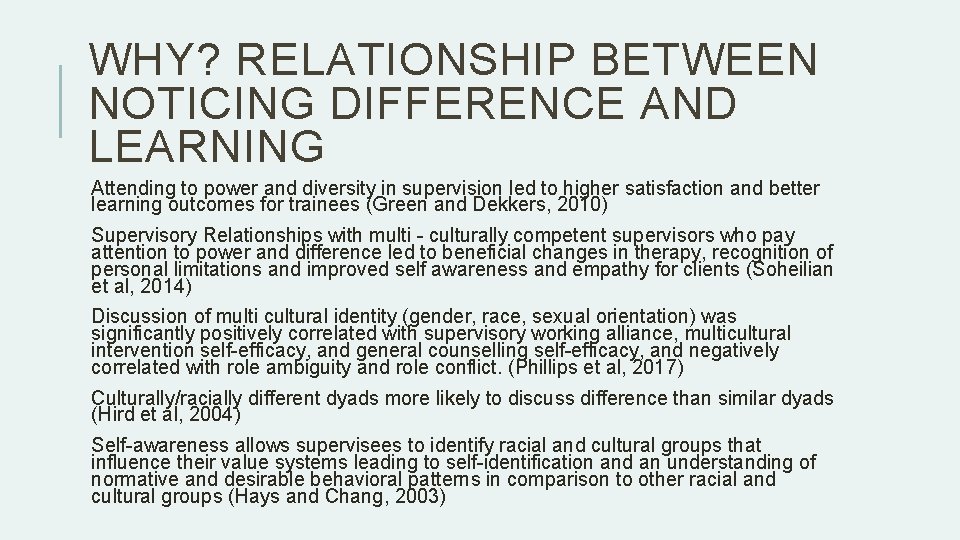
WHY? RELATIONSHIP BETWEEN NOTICING DIFFERENCE AND LEARNING Attending to power and diversity in supervision led to higher satisfaction and better learning outcomes for trainees (Green and Dekkers, 2010) Supervisory Relationships with multi - culturally competent supervisors who pay attention to power and difference led to beneficial changes in therapy, recognition of personal limitations and improved self awareness and empathy for clients (Soheilian et al, 2014) Discussion of multi cultural identity (gender, race, sexual orientation) was significantly positively correlated with supervisory working alliance, multicultural intervention self-efficacy, and general counselling self-efficacy, and negatively correlated with role ambiguity and role conflict. (Phillips et al, 2017) Culturally/racially different dyads more likely to discuss difference than similar dyads (Hird et al, 2004) Self-awareness allows supervisees to identify racial and cultural groups that influence their value systems leading to self-identification and an understanding of normative and desirable behavioral patterns in comparison to other racial and cultural groups (Hays and Chang, 2003)
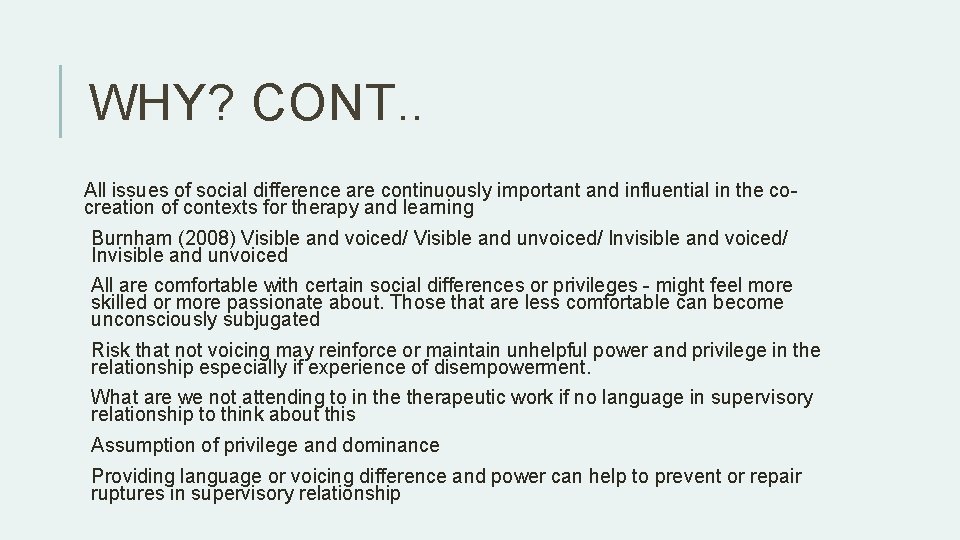
WHY? CONT. . All issues of social difference are continuously important and influential in the cocreation of contexts for therapy and learning Burnham (2008) Visible and voiced/ Visible and unvoiced/ Invisible and unvoiced All are comfortable with certain social differences or privileges - might feel more skilled or more passionate about. Those that are less comfortable can become unconsciously subjugated Risk that not voicing may reinforce or maintain unhelpful power and privilege in the relationship especially if experience of disempowerment. What are we not attending to in therapeutic work if no language in supervisory relationship to think about this Assumption of privilege and dominance Providing language or voicing difference and power can help to prevent or repair ruptures in supervisory relationship
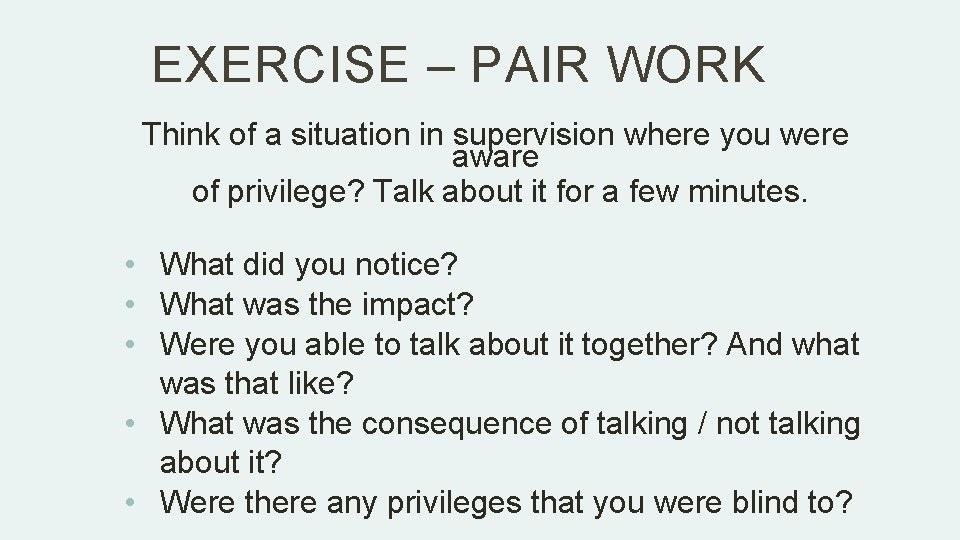
EXERCISE – PAIR WORK Think of a situation in supervision where you were aware of privilege? Talk about it for a few minutes. • What did you notice? • What was the impact? • Were you able to talk about it together? And what was that like? • What was the consequence of talking / not talking about it? • Were there any privileges that you were blind to?
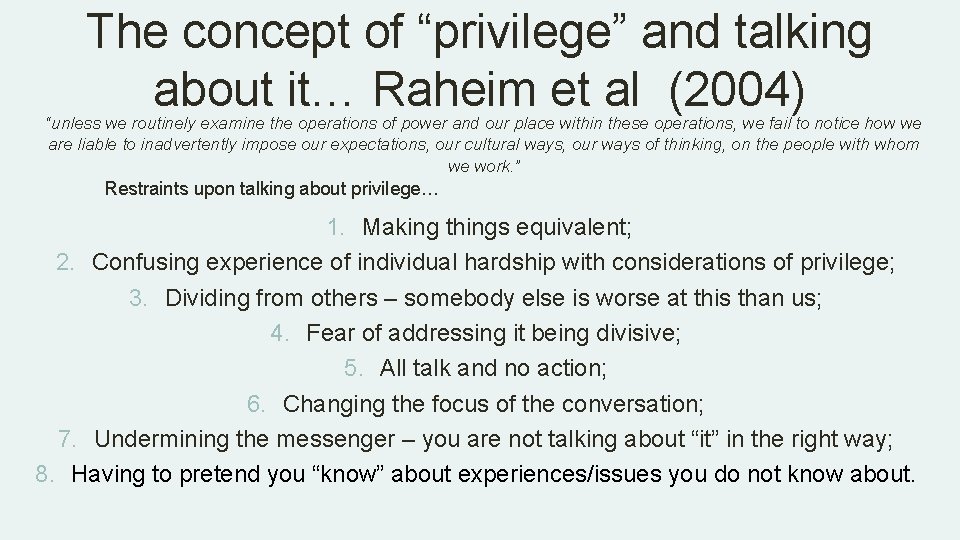
The concept of “privilege” and talking about it… Raheim et al (2004) “unless we routinely examine the operations of power and our place within these operations, we fail to notice how we are liable to inadvertently impose our expectations, our cultural ways, our ways of thinking, on the people with whom we work. ” Restraints upon talking about privilege… 1. Making things equivalent; 2. Confusing experience of individual hardship with considerations of privilege; 3. Dividing from others – somebody else is worse at this than us; 4. Fear of addressing it being divisive; 5. All talk and no action; 6. Changing the focus of the conversation; 7. Undermining the messenger – you are not talking about “it” in the right way; 8. Having to pretend you “know” about experiences/issues you do not know about.
EXERCISE – INDIVIDUAL WORK Which social differences might you be most comfortable talking about as a supervisor and which might you be less comfortable with and why?
HOW? Social GRRAACCEESS can be used as a framework to discuss thinking about power, privilege, advantage and disadvantage in relation to: Gender (Trans) Race Religion Age Ability Class Culture Creed Ethnicity Sexual Orientation Originally developed for the supervisory relationship (2008) and allows us to be reflexive about power
EXERCISE – PAIR WORK Choose one social difference from the GRRAACCEESS that you might be less comfortable or aware of and practice how you might provide space for them in supervision as a supervisor. Take turns to be the supervisor Reflect together on what this was like?
HOW? Narrative Practice recognises how powerful gender, race, sexuality is and places emphasis on setting a context in supervision that can shape these conversations. How do we hold an awareness of difference especially when this may be invisible and we may assume similarity. How will I know that this is challenging? Using the statement of Position Map 1
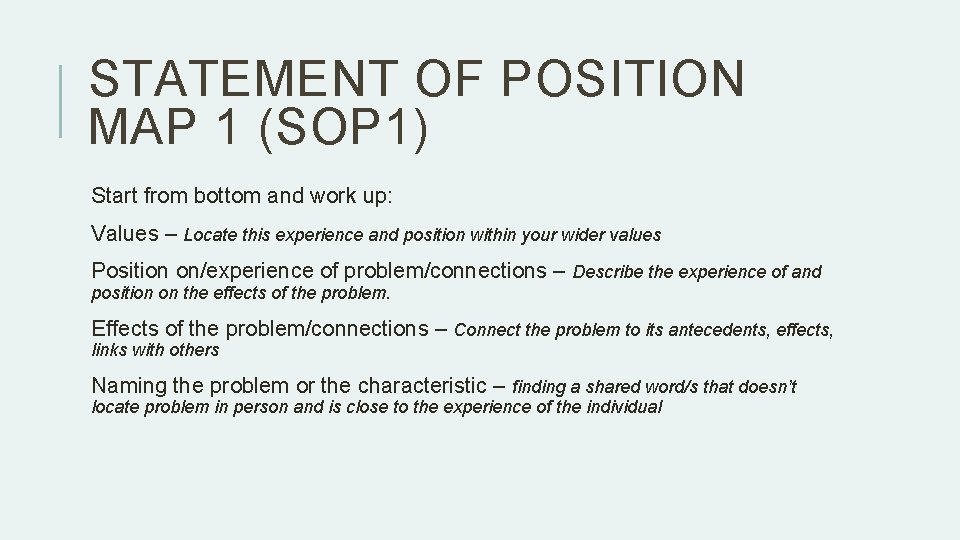
STATEMENT OF POSITION MAP 1 (SOP 1) Start from bottom and work up: Values – Locate this experience and position within your wider values Position on/experience of problem/connections – Describe the experience of and position on the effects of the problem. Effects of the problem/connections – Connect the problem to its antecedents, effects, links with others Naming the problem or the characteristic – finding a shared word/s that doesn’t locate problem in person and is close to the experience of the individual
SOME FINAL THOUGHTS Consider the ZPD of your supervisee when setting the culture in supervision (Contracting session) How do you hold onto the relational during ISW training and pay attention to the unvoiced visible and invisible in your supervisory practice? What internal/external reminders will you use to hold this in mind through this year and beyond? Jot some ideas to keep you in this position
REFERENCES Brown (2010) Situating Social Inequality And Collective Action In Cognitive Analytic Therapy. Reformulation, Winter, pp. 28 -34 Burnham, J. , Alvis Palma, D. , Whitehouse, L (2008) Learning as a context for differences and differences as a context for learning. Journal of Family Therapy 30: 529– 542 Green, M. S. , Dekkers, T. D (2010) Attending to Power and Diversity in Supervision: An Exploration of Supervisee Learning Outcomes and Satisfaction With Supervision. Journal of Feminist Family Therapy, 22: 4, 293 -312. Hays, D. G. , Chang, C. Y. (2003) White Privilege, Oppression, and Racial Identity Development: Implications for Supervision. Counselor Education & Supervision. December, 43, 134 – 145. Hird, J. S. , Tao, K. W. , Gloria, A. M. (2004) Examining Supervisors' Multicultural Competence in Racially Similar and Different Supervision Dyads, The Clinical Supervisor, 23: 2, 107 -122.
REFERENCES Raheim, White, Denborough, Waldegrave, Tamasese, Tuhaka, Franklin, Fox & Carey (2004). http: //dulwichcentre. com. au/a-continuing-invitation-to-narrativepractitioners-to-address-privilege-and-dominance/ Phillips, J. C. , Parent, M. C. , Casey Dozier, V. , Jackson, P. L. (2017) Depth of discussion of multicultural identities in supervision and supervisory outcomes. Counselling Psychology Quarterly, 30: 2, 188 -210 Ryde, J. (2000) Supervising across difference. International Journal of Psychotherapy 5 (1) 37 -48. Soheilian, S. S. , Inman, A. G. , Klinger, R. S. , Isenberg, D. S. , Kulp, L. E. (2014) Multicultural supervision: supervisees’ reflections on culturally competent supervision, Counselling Psychology Quarterly, 27: 4, 379 -392. Totton N. (2006) Power in therapeutic relationship in N Totton (ed), The Politics of Psychotherapy. Maidenhead: Open University Press. White, M (2007) Maps of Narrative Practice. Norton: London