The Suffering Servant ISAIAH 52 13 53 12
- Slides: 35
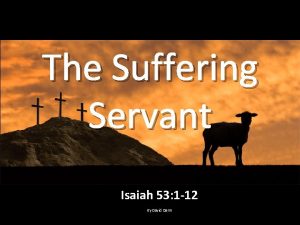
The Suffering Servant ISAIAH 52: 13 -53: 12
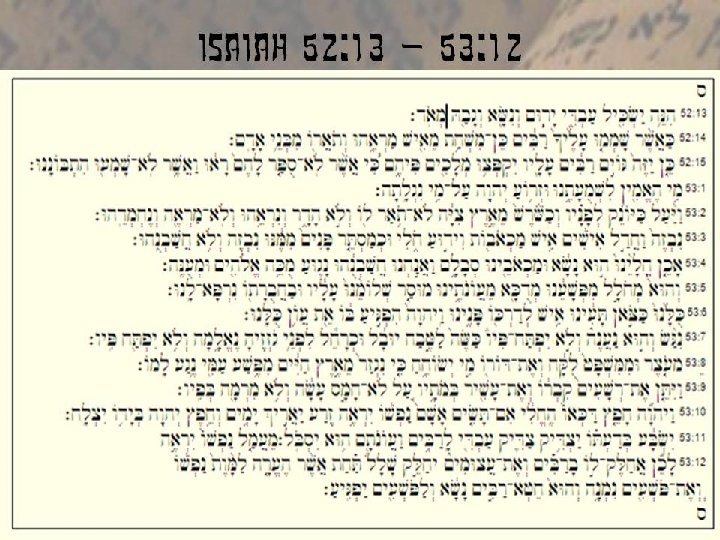
Isaiah 52: 13 – 53: 12
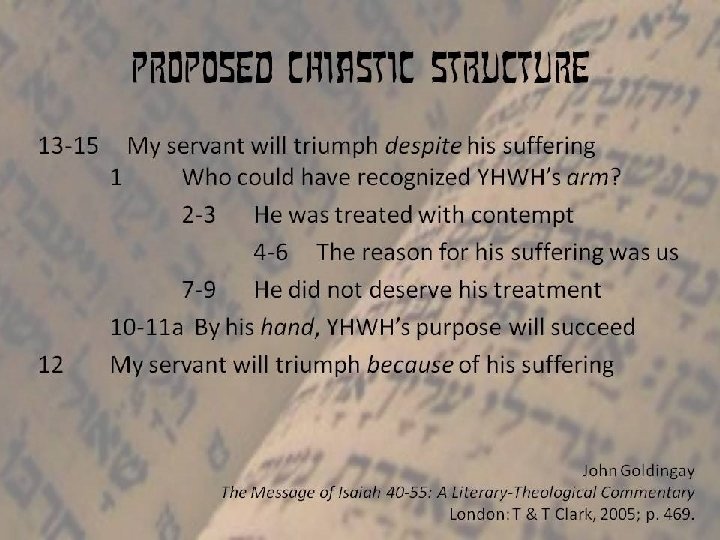
Proposed chiastic structure 13 -15 12 My servant will triumph despite his suffering 1 Who could have recognized YHWH’s arm? 2 -3 He was treated with contempt 4 -6 The reason for his suffering was us 7 -9 He did not deserve his treatment 10 -11 a By his hand, YHWH’s purpose will succeed My servant will triumph because of his suffering John Goldingay The Message of Isaiah 40 -55: A Literary-Theological Commentary London: T & T Clark, 2005; p. 469.
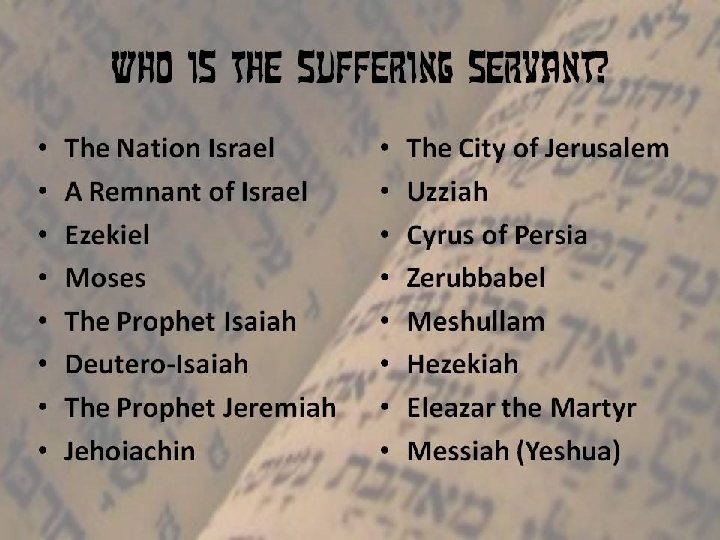
Who is the Suffering Servant? • • The Nation Israel A Remnant of Israel Ezekiel Moses The Prophet Isaiah Deutero-Isaiah The Prophet Jeremiah Jehoiachin • • The City of Jerusalem Uzziah Cyrus of Persia Zerubbabel Meshullam Hezekiah Eleazar the Martyr Messiah (Yeshua)
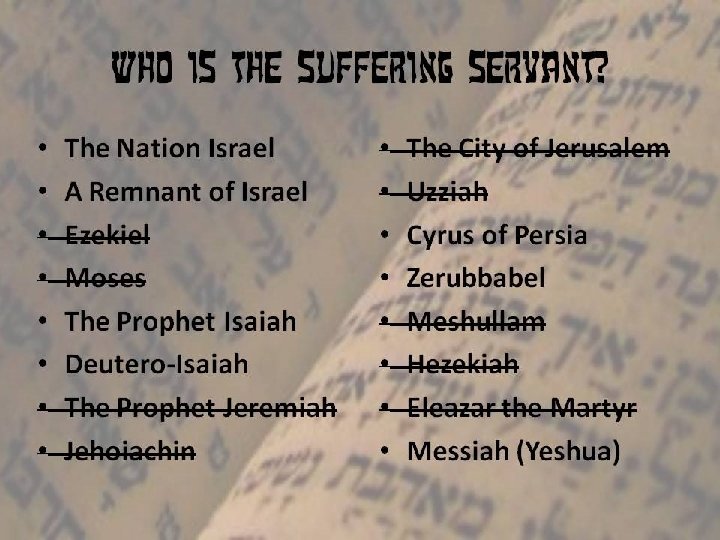
Who is the Suffering Servant? • • The Nation Israel A Remnant of Israel Ezekiel Moses The Prophet Isaiah Deutero-Isaiah The Prophet Jeremiah Jehoiachin • • The City of Jerusalem Uzziah Cyrus of Persia Zerubbabel Meshullam Hezekiah Eleazar the Martyr Messiah (Yeshua)
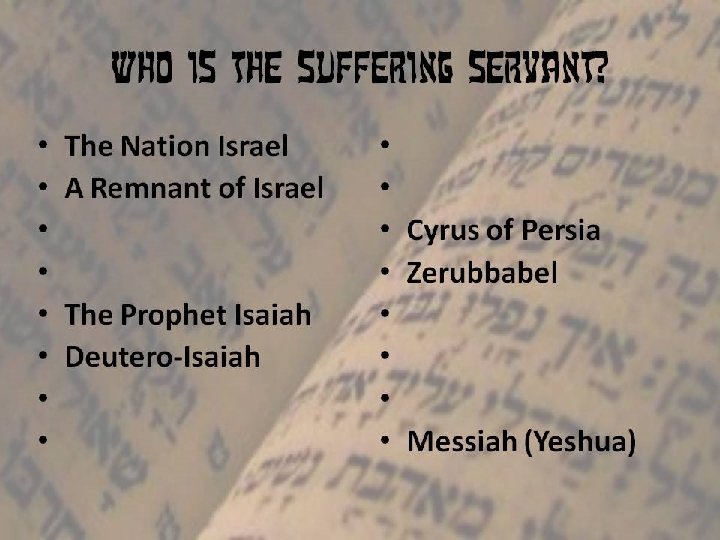
Who is the Suffering Servant? • • The Nation Israel A Remnant of Israel The Prophet Isaiah Deutero-Isaiah • • • Cyrus of Persia • Zerubbabel • • Messiah (Yeshua)
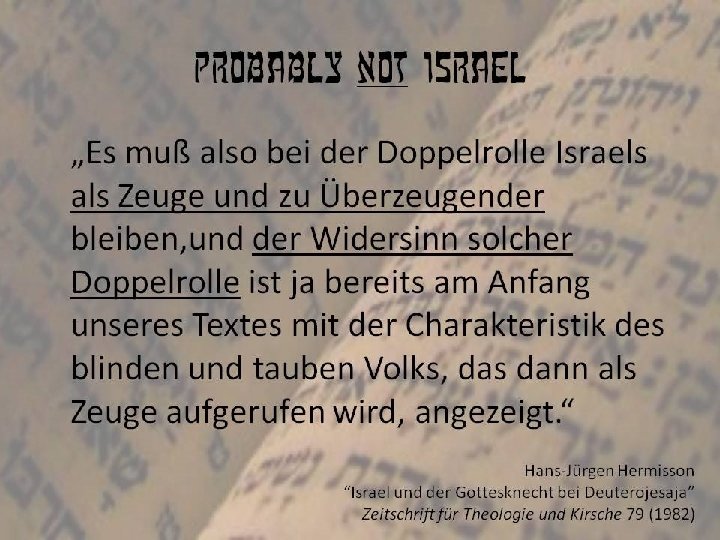
Probably not israel „Es muß also bei der Doppelrolle Israels als Zeuge und zu Überzeugender bleiben, und der Widersinn solcher Doppelrolle ist ja bereits am Anfang unseres Textes mit der Charakteristik des blinden und tauben Volks, das dann als Zeuge aufgerufen wird, angezeigt. “ Hans-Jürgen Hermisson “Israel und der Gottesknecht bei Deuterojesaja” Zeitschrift für Theologie und Kirsche 79 (1982)
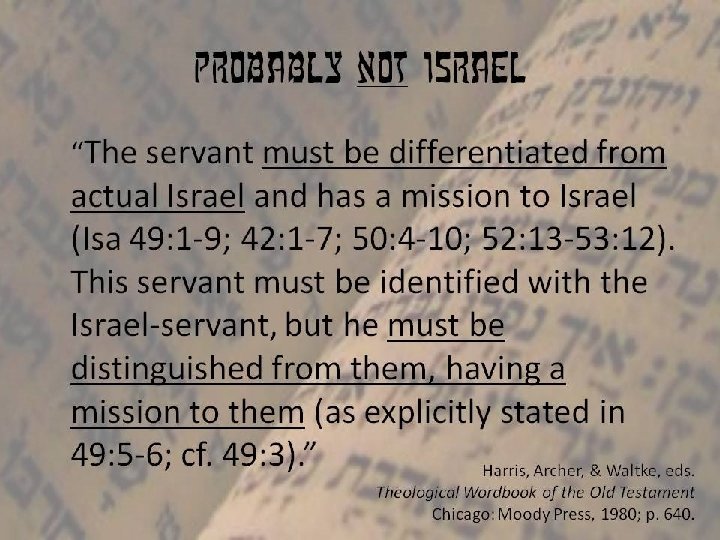
Probably not israel “The servant must be differentiated from actual Israel and has a mission to Israel (Isa 49: 1 -9; 42: 1 -7; 50: 4 -10; 52: 13 -53: 12). This servant must be identified with the Israel-servant, but he must be distinguished from them, having a mission to them (as explicitly stated in 49: 5 -6; cf. 49: 3). ” Harris, Archer, & Waltke, eds. Theological Wordbook of the Old Testament Chicago: Moody Press, 1980; p. 640.
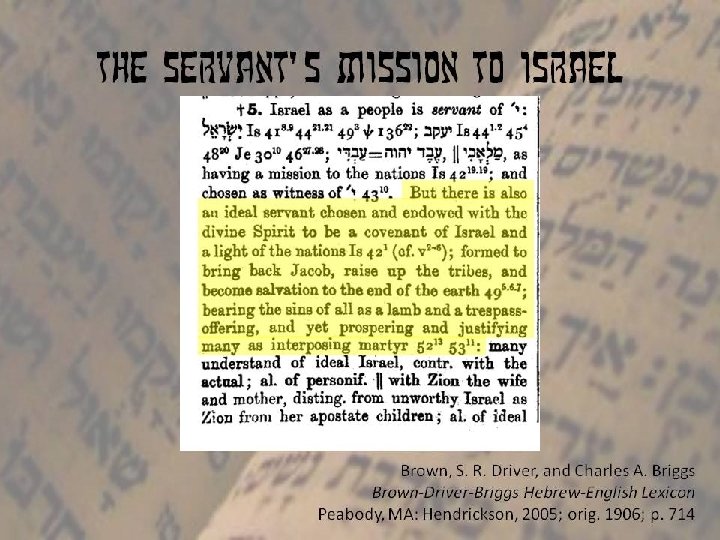
The servant’s mission to israel Brown, S. R. Driver, and Charles A. Briggs Brown-Driver-Briggs Hebrew-English Lexicon Peabody, MA: Hendrickson, 2005; orig. 1906; p. 714
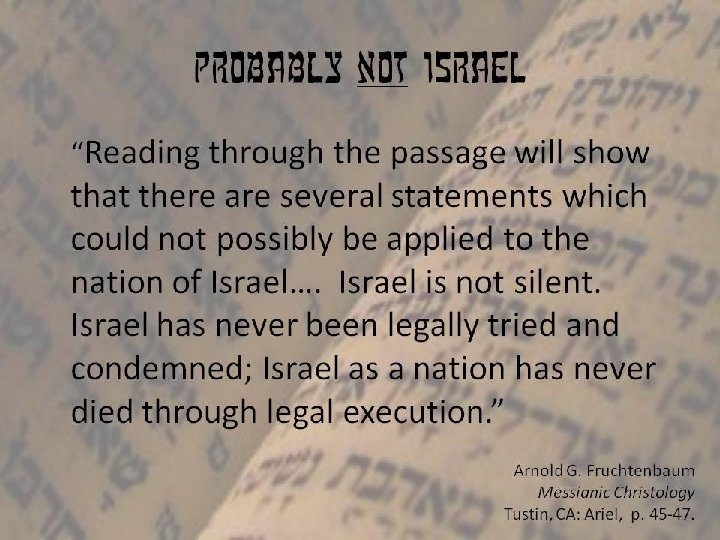
Probably not israel “Reading through the passage will show that there are several statements which could not possibly be applied to the nation of Israel…. Israel is not silent. Israel has never been legally tried and condemned; Israel as a nation has never died through legal execution. ” Arnold G. Fruchtenbaum Messianic Christology Tustin, CA: Ariel, p. 45 -47.
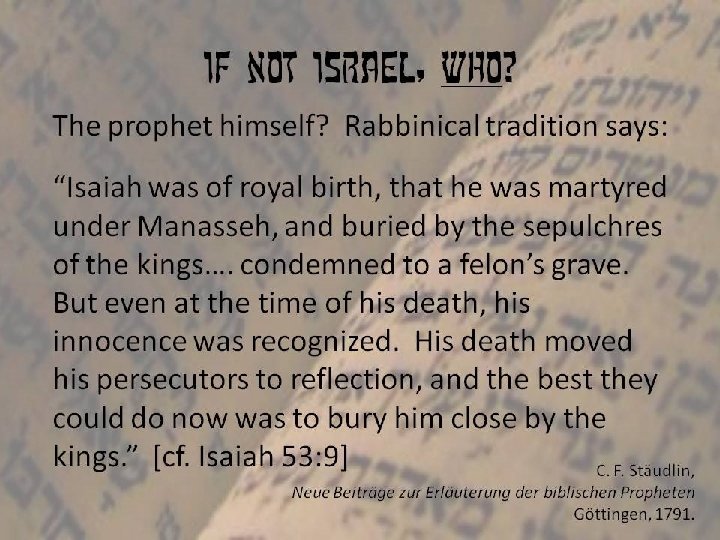
If not Israel, who? The prophet himself? Rabbinical tradition says: “Isaiah was of royal birth, that he was martyred under Manasseh, and buried by the sepulchres of the kings…. condemned to a felon’s grave. But even at the time of his death, his innocence was recognized. His death moved his persecutors to reflection, and the best they could do now was to bury him close by the kings. ” [cf. Isaiah 53: 9] C. F. Stäudlin, Neue Beiträge zur Erläuterung der biblischen Propheten Göttingen, 1791.
Questions this view fails to answer • What are the ramifications of Isaiah prophesying his own death? ! • Sigmund Mowinckel abandoned this view in 1931 because of this question.
If not israel, who? A Zukunftsknecht (a servant yet to come)? • Cyrus of Persia • Zerubbabel • Messiah C. R. North The suffering Servant in Deutero-Isaiah Oxford: Oxford University Press, 1948; p. 1.
If not israel, who? “All the data are applicable in a marked degree to Cyrus. He was, according to popular belief, brought up by a herdsman. His early successes were unparalleled, but it is not known how he came to his end. It is probable that he died of wounds received in battle…. The comparison of the slaughtered sheep might mean that his army was ambushed. ” T. H. Weir “A New Theory of ‘The Servant of Jehovah’ in Isa. 40 -55” Westminster Review 169 (1908): 309 -314.
Problems with this view As far as we know… • Cyrus never followed Israel’s G-d, so how is he His servant? • How did Cyrus suffer on Israel’s behalf?
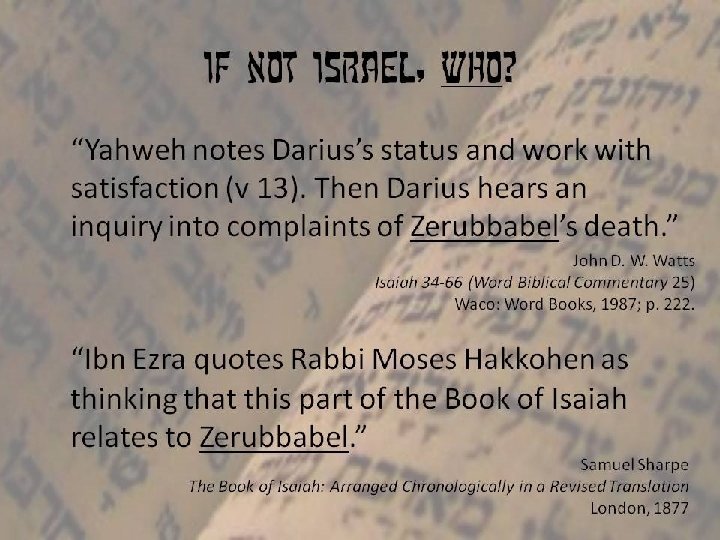
If not israel, who? “Yahweh notes Darius’s status and work with satisfaction (v 13). Then Darius hears an inquiry into complaints of Zerubbabel’s death. ” John D. W. Watts Isaiah 34 -66 (Word Biblical Commentary 25) Waco: Word Books, 1987; p. 222. “Ibn Ezra quotes Rabbi Moses Hakkohen as thinking that this part of the Book of Isaiah relates to Zerubbabel. ” Samuel Sharpe The Book of Isaiah: Arranged Chronologically in a Revised Translation London, 1877
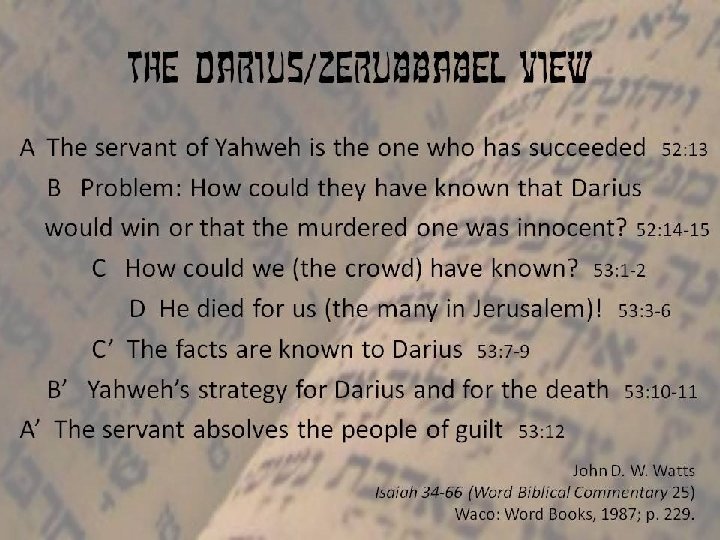
The Darius/zerubbabel view A The servant of Yahweh is the one who has succeeded 52: 13 B Problem: How could they have known that Darius would win or that the murdered one was innocent? 52: 14 -15 C How could we (the crowd) have known? 53: 1 -2 D He died for us (the many in Jerusalem)! 53: 3 -6 C’ The facts are known to Darius 53: 7 -9 B’ Yahweh’s strategy for Darius and for the death 53: 10 -11 A’ The servant absolves the people of guilt 53: 12 John D. W. Watts Isaiah 34 -66 (Word Biblical Commentary 25) Waco: Word Books, 1987; p. 229.
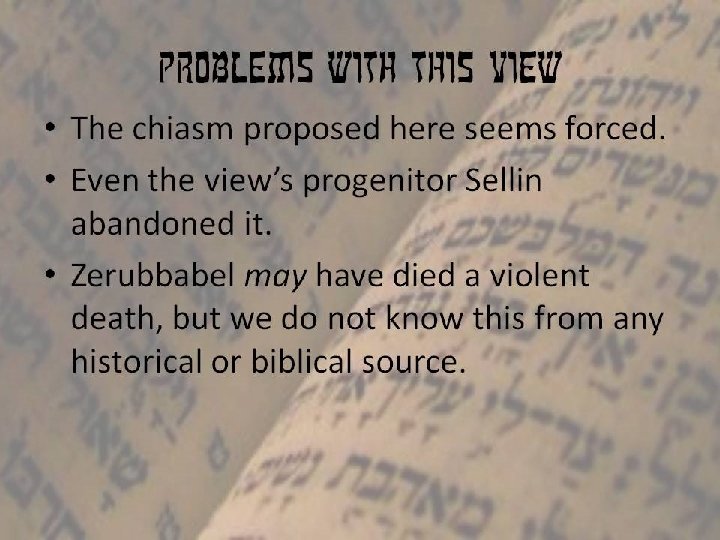
Problems with this view • The chiasm proposed here seems forced. • Even the view’s progenitor Sellin abandoned it. • Zerubbabel may have died a violent death, but we do not know this from any historical or biblical source.
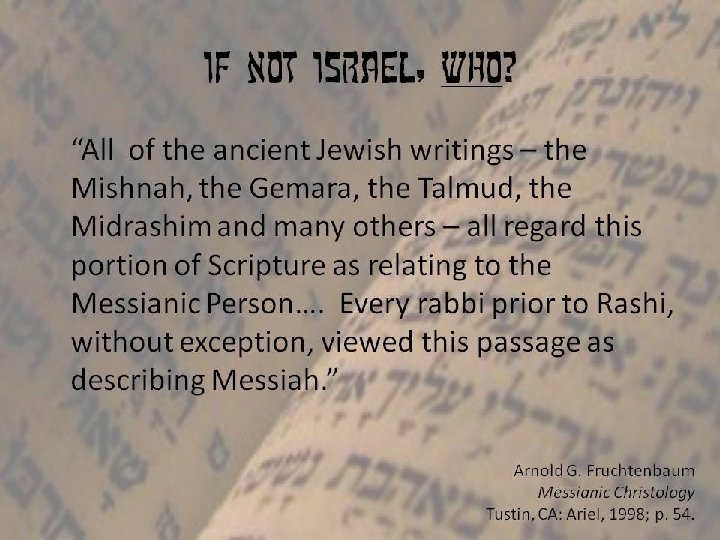
If not israel, who? “All of the ancient Jewish writings – the Mishnah, the Gemara, the Talmud, the Midrashim and many others – all regard this portion of Scripture as relating to the Messianic Person…. Every rabbi prior to Rashi, without exception, viewed this passage as describing Messiah. ” Arnold G. Fruchtenbaum Messianic Christology Tustin, CA: Ariel, 1998; p. 54.
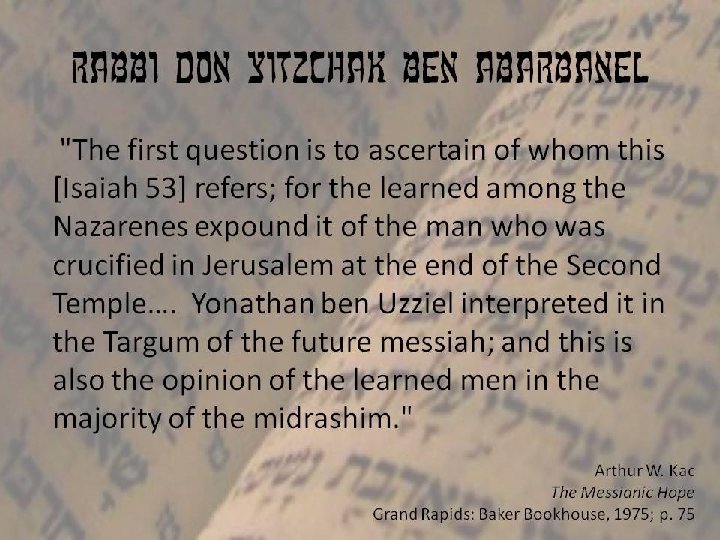
Rabbi don yitzchak ben abarbanel "The first question is to ascertain of whom this [Isaiah 53] refers; for the learned among the Nazarenes expound it of the man who was crucified in Jerusalem at the end of the Second Temple…. Yonathan ben Uzziel interpreted it in the Targum of the future messiah; and this is also the opinion of the learned men in the majority of the midrashim. " Arthur W. Kac The Messianic Hope Grand Rapids: Baker Bookhouse, 1975; p. 75
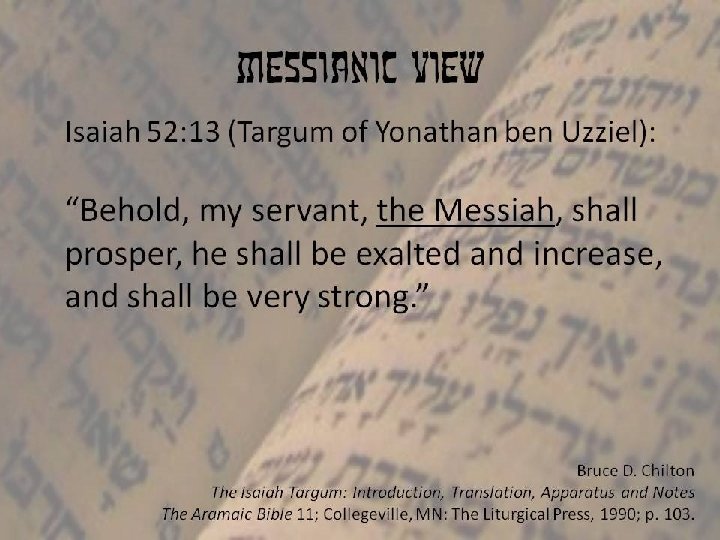
Messianic view Isaiah 52: 13 (Targum of Yonathan ben Uzziel): “Behold, my servant, the Messiah, shall prosper, he shall be exalted and increase, and shall be very strong. ” Bruce D. Chilton The Isaiah Targum: Introduction, Translation, Apparatus and Notes The Aramaic Bible 11; Collegeville, MN: The Liturgical Press, 1990; p. 103.
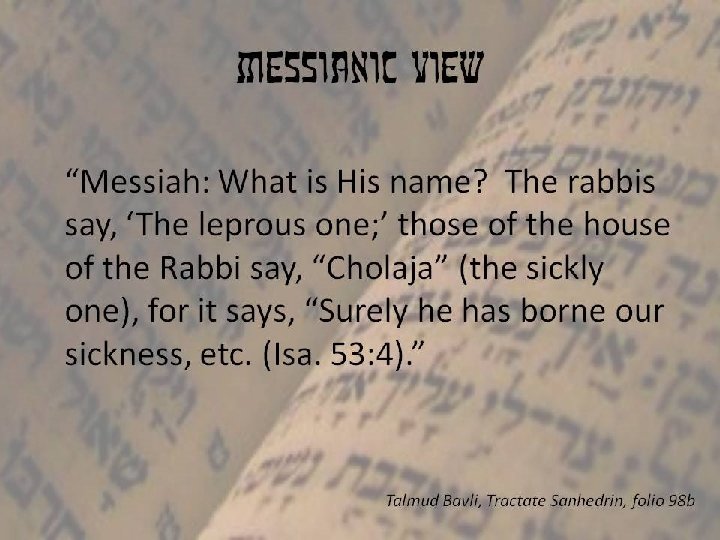
Messianic view “Messiah: What is His name? The rabbis say, ‘The leprous one; ’ those of the house of the Rabbi say, “Cholaja” (the sickly one), for it says, “Surely he has borne our sickness, etc. (Isa. 53: 4). ” Talmud Bavli, Tractate Sanhedrin, folio 98 b
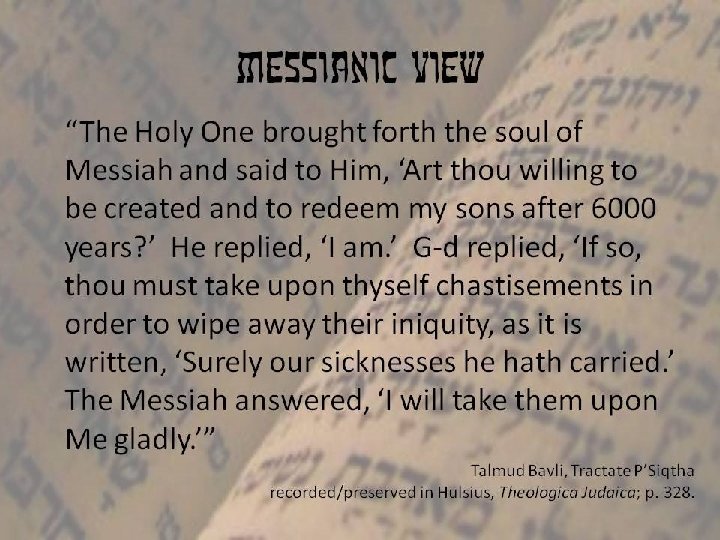
Messianic view “The Holy One brought forth the soul of Messiah and said to Him, ‘Art thou willing to be created and to redeem my sons after 6000 years? ’ He replied, ‘I am. ’ G-d replied, ‘If so, thou must take upon thyself chastisements in order to wipe away their iniquity, as it is written, ‘Surely our sicknesses he hath carried. ’ The Messiah answered, ‘I will take them upon Me gladly. ’” Talmud Bavli, Tractate P’Siqtha recorded/preserved in Hulsius, Theologica Judaica; p. 328.
Messianic view This passage is cited in discussion of Messiah from: • Chasidic Rabbi Shim’on ben Yohai (2 nd C. , recorded 11 th C. ) • Karaite Shammash Yepheth ben Ali (10 th C. ) • Rabbi Maimonides (12 th C. ) • Rabbi Nachmanides (13 th C. ) • Rabbi Levi ben Gershom (14 th C. ) • Rabbi Moshe Kohen ibn Crispin de Toledo España (14 th C. ) • Orthodox Rabbi Moshe ben Haim Al-Sheikh (16 th C. ) • Rabbi Sh’muel Lanyado (17 th C. ) • Rabbi Naphtali ben Asher Altschuler (17 th C. ) • Reform Rabbi Herz Homberg (in Korem, 1818)
Messianic view “Until the close of the 18 th Century, Christian writers – with almost the sole exception of Grotius, who thought of Jeremiah – were unanimous that Isa. liii was Messianic prophecy. ” C. R. North The suffering Servant in Deutero-Isaiah Oxford: Oxford University Press, 1948; p. 1.
Messianic view “At the very outset of the Song the Servant is pictured as a priest, ‘sprinkling’ the unclean (52: 15), and in the heart of the Song he is spoken of as a guilt offering (53: 10). The servant is both priest and sacrifice, and it is through his priestly work that the people of God are themselves made fit for priestly service. ” Barry Webb The Message of Isaiah: On Eagles’ Wings Leicester: Inter. Varsity Press, 1996), 209
The gospels • Matthew 8: 16 -17 quotes Isaiah 53: 4 and comments, “This was to fulfill what was spoken through the prophet Isaiah. ” • Mark 15: 27 -28 quotes Isaiah 53: 12 and responds, “And the Scripture was fulfilled. ” • Luke 22: 37 quotes Isaiah 53: 12 recording Yeshua as saying, “And I tell you that this must be fulfilled in Me. Yes, what is written about Me is reaching fulfillment. ” • John 12: 37 -38 quotes Isaiah 53: 1, saying, “This was to fulfill the word of Isaiah the prophet. ”
ACTS 8: 32 -35 After quoting Isaiah 53: 7 -8 (LXX)…. “The eunuch asked Philip, ‘Tell me, please, who is the prophet talking about, himself or someone else? ’ Then Philip began with that very passage of Scripture and told him the good news about Yeshua. ”
1 peter • 1 Peter 2: 22 attributes Isaiah 53: 9 to Messiah Yeshua. • 1 Peter 24 -25 quotes Isaiah 53: 5 -6 in reference to Messiah Yeshua.
Questions this view fails to answer • How does “descendants” and “prolonged life” fit Yeshua? (53: 10) • Where is the fulfillment in Isaiah’s generation?
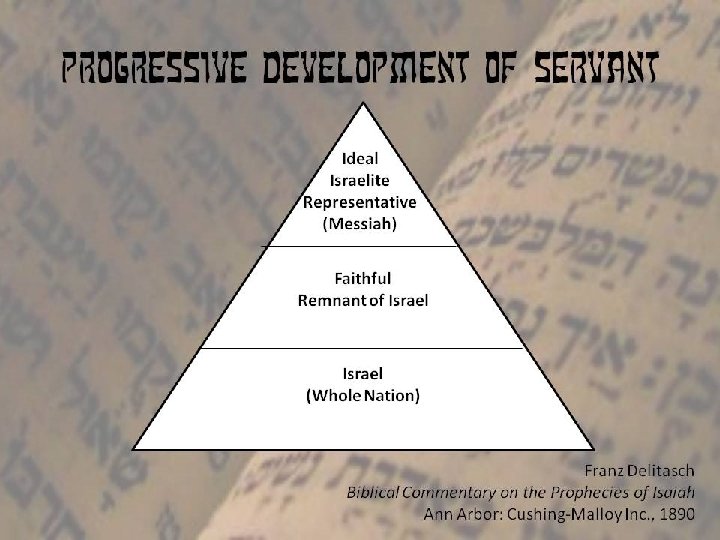
Progressive development of servant Ideal Israelite Representative (Messiah) Faithful Remnant of Israel (Whole Nation) Franz Delitasch Biblical Commentary on the Prophecies of Isaiah Ann Arbor: Cushing-Malloy Inc. , 1890
Problems with Hybrid view “The title, the ‘Fourth Servant Song’ is best avoided since it raises too many extraneous issues, and, what is worse, determines that we approach the poem with an already fixed frame of reference. ” David J. A. Clines I, He, We, & They: A Literary Approach to Isaiah 53 Sheffield: Journal for the Study of the Old Testament, 1976; p. 11
Problems with HYBRID view “We cannot say that Luke associated this passage with the four acknowledged Isaianic Servant texts, as some commentators in the modern period have done. ” Joseph Blenkinsopp Opening the Sealed Book: Interpretations of the Book of Isaiah in Late Antiquity Grand Rapids: Wm. B. Eerdmans Publishing, 2006; p. 131
Closing thoughts “… the Suffering Servant passages are examples of those instances of high ambiguity, so frequent in the Hebrew prophets, in which overheated orators are prone to scatter solipsisms like sprays of saliva…. ” Donald Harman Akenson Surpassing Wonder: The Invention of the Bible and the Talmuds Chicago: University of Chicago Press, 1998; p. 245 “The problem of ‘the servant’ is simply unsolvable. ” J. Lindblom The Servant Songs in Deutero-Isaiah: A New Attempt to Solve an Old Problem Lund: Gleerup, 1951; p. 10
Closing thoughts “A well-known commentator is said to have abandoned his projected commentary on Isaiah because this part of his subject overwhelmed him. ” H. Wheeler Robinson The Cross of the Servant: A Study in Deutero-Isaiah London, 1926; p. 18