The Stages of Litigation Dominic Ruck Keene and


- Slides: 23
The Stages of Litigation Dominic Ruck Keene and Paul Reynolds 1 COR Clinical Negligence Team © 1 Crown Office Row
-Aim of presentation: to focus on tactics from perspective of Claimant and Defendant at each stage of the litigation. -Medical scenario as outlined in hand-out
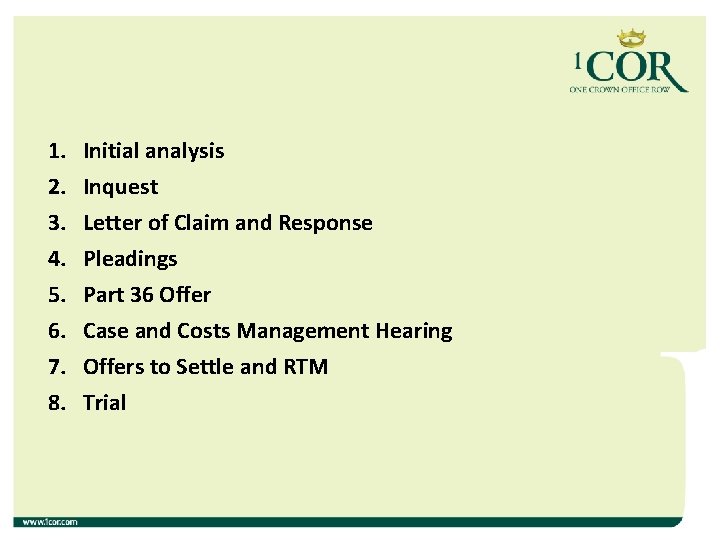
1. Initial analysis 2. Inquest 3. Letter of Claim and Response 4. Pleadings 5. Part 36 Offer 6. Case and Costs Management Hearing 7. Offers to Settle and RTM 8. Trial
1. Initial analysis – Claimant • Is there a claim? • Risk assessments and funding • Obtaining medical records • Witness statements • Expert reports • Against whom? • Multiple defendants • Costs consequences • For how much? • Heads of loss • Evidence gathering
1. Initial analysis – Defendant • Liability • Clinician comments • Expert evidence • Duty of candour • Other Defendants • Other Trusts • Defence organisations
2. The Inquest • Coronial investigation • Who died, when, where and how (“by what means”) • Article 2 inquests: “by what means and in what circumstances” • Inquisitorial rather than adversarial • Wide discretion to the Coroner • Scope • Evidential rules
3. The Letter of Claim and Response • Pre-Action Protocol for the Resolution of Clinical Disputes • Seeks to encourage openness • Resolve disputes without litigation • Timed sequence of steps: ensures predictability in time needed for steps pre-proceedings • Standardisation of relevant information, including records and documents to be disclosed • Guidance for Letter of Claim and Letter of Response and templates
3. The Letter of Claim and Response – Claimant’s perspective • Who to sue? • How much to show: clear summary of the facts; main allegations of negligence; description of patient’s injuries; present condition and prognosis; financial loss and heads of damage • Chronology? Draft Particulars of Claim instead of letter? • Attach records? (e. g. GP records to hospital) • Offer to settle? Medical report on injuries, condition and prognosis? • Limitation / Protective proceedings
3. The Letter of Claim and Response – Defendant’s perspective • How to reply: • Timescales – four months • Expert evidence • Getting facts right (or not mentioning them) • How strong to be in denials: “a reasoned answer”; “specific comments on the allegations of negligence”; version of events if chronology or facts disputed • Provide copies of internal protocols? • Part 20 actions – whether to bring in Dr Burns (GP); cost implications
4. Pleadings – Claimant • • Who to sue Multiple defendants Conference with client and expert Pleading styles Duty to plead certain matters, eg fraud Provisional damages Later pleadings – replies and schedules
4. Pleadings – Defendant • • Issue fees Decision on Part 20 Defendants/internal notification Is a conference required? Pleading requirements, e. g. positive case on causation • Calling Claimants out on vagueness! • Later pleadings – Counter-schedules
5. Part 36 Offers • Procedural mechanism to encourage reasonable offers and settlement • Intention: to keep cases out of Court • How it works: costs consequences of failing to “beat” an offer
5. Early Part 36 Offers – Claimant’s perspective • Information available at this early stage of the litigation • Benefits of an early settlement • Dangers of an early settlement • Litigation risk
5. Early Part 36 Offers – Defendant’s perspective • Information available at this early stage of the litigation • Factors to consider (among others) • Case analysis and chances of a successful defence • Costs of mounting a successful defence • Publicity • How to judge the offer • The dangers of a “derisory” offer • Genuine costs protection • Whether to include an admission of liability
6. Case and Costs Management Conference • Review steps, decide and give directions about future steps, record any agreement between parties • Standard items to cover: value of claim, amendments to claim or statement of case, disclosure of documents, expert evidence, factual evidence, expert discussions, split trial or trial of preliminary issues, time estimate, listing
6. CCMC – Claimant’s perspective • Good understanding of Claimant’s current situation and prognosis • Number and fields of experts – don’t ask, don’t get • Simultaneous rather than sequential exchange of expert evidence • Increase value of claim • Adequate time estimate for trial • Additional applications or relief from sanctions • Further CCMC required? Maximising pressure on Defendant
6. CCMC – Defendant’s perspective • Is claim unclear or inadequately pleaded? • Limiting expert evidence (e. g. care, related or similar disciplines) • Limiting witnesses of fact • Sequential exchange of expert evidence • Split trial or preliminary issue? • Additional applications or relief from sanctions
7. Further Part 36 Offers and RTMs – Claimant • • Information available at this stage of the litigation Benefits of a settlement Dangers of a settlement Litigation risk • Will I win? • Can I afford to lose?
7. Further Part 36 Offers and RTMs – Defendant • Information available at this stage of the litigation • Factors to consider • Case analysis and chances of a successful defence • Costs of mounting a successful defence • Publicity • How to judge the offer • Whether to make an offer • Looking to settle, or encourage discussion? • Genuine costs protection • Whether to include an admission of liability
7. The Round Table Meeting • Preparation • The meeting
8. Trial
Thank you Dominic. Ruck-Keene@1 cor. com Paul. Reynolds@1 cor. com