The Scope Of Corporate Finance Dr Del Hawley
- Slides: 40
The Scope Of Corporate Finance Dr. Del Hawley FIN 634
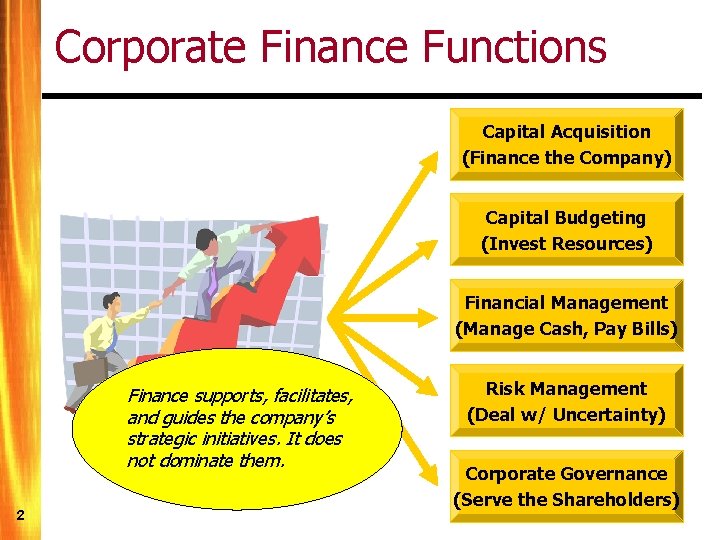
Corporate Finance Functions Capital Acquisition (Finance the Company) Capital Budgeting (Invest Resources) Financial Management (Manage Cash, Pay Bills) Finance supports, facilitates, and guides the company’s strategic initiatives. It does not dominate them. 2 Risk Management (Deal w/ Uncertainty) Corporate Governance (Serve the Shareholders)
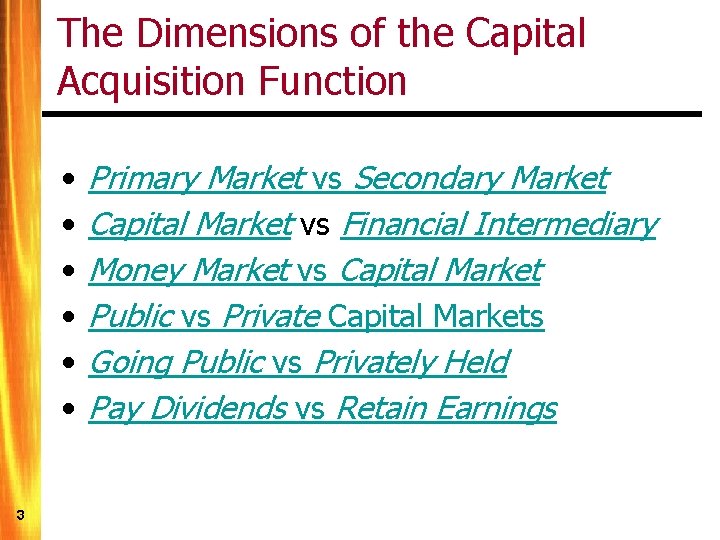
The Dimensions of the Capital Acquisition Function • • • 3 Primary Market vs Secondary Market Capital Market vs Financial Intermediary Money Market vs Capital Market Public vs Private Capital Markets Going Public vs Privately Held Pay Dividends vs Retain Earnings
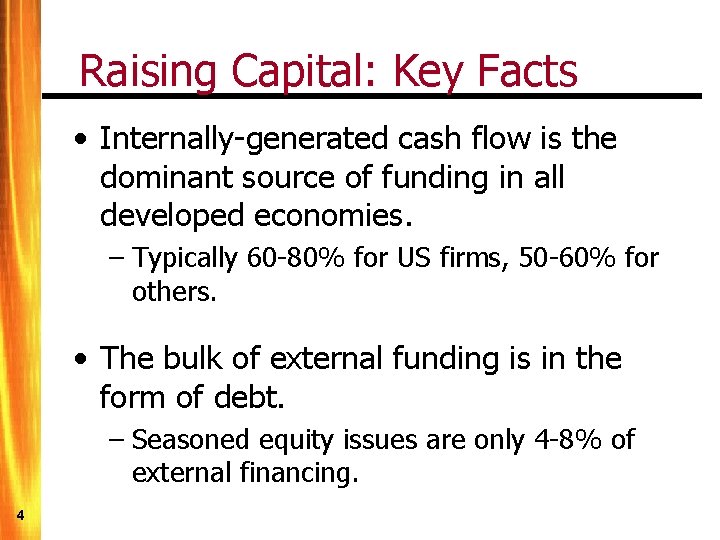
Raising Capital: Key Facts • Internally-generated cash flow is the dominant source of funding in all developed economies. – Typically 60 -80% for US firms, 50 -60% for others. • The bulk of external funding is in the form of debt. – Seasoned equity issues are only 4 -8% of external financing. 4
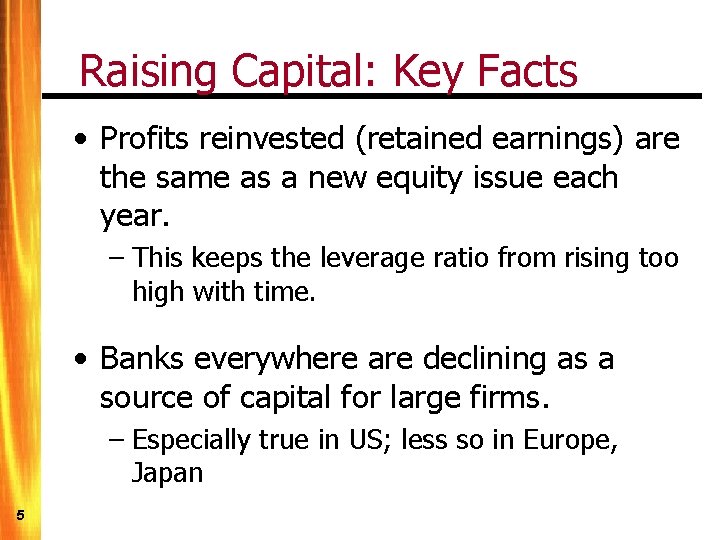
Raising Capital: Key Facts • Profits reinvested (retained earnings) are the same as a new equity issue each year. – This keeps the leverage ratio from rising too high with time. • Banks everywhere are declining as a source of capital for large firms. – Especially true in US; less so in Europe, Japan 5
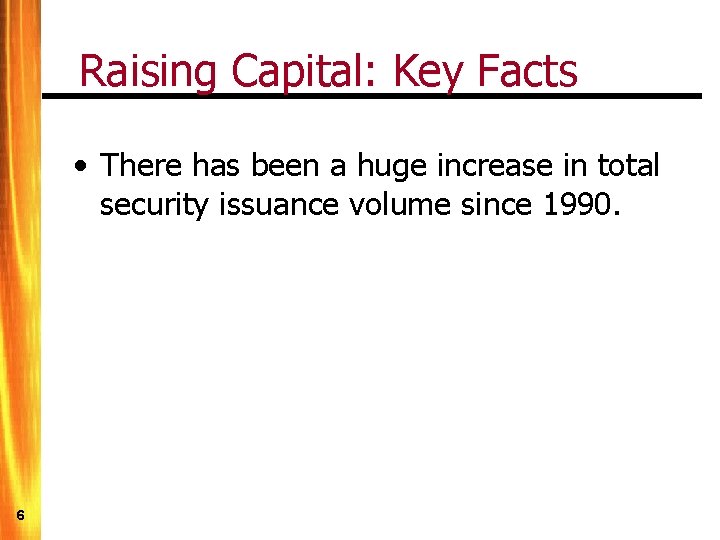
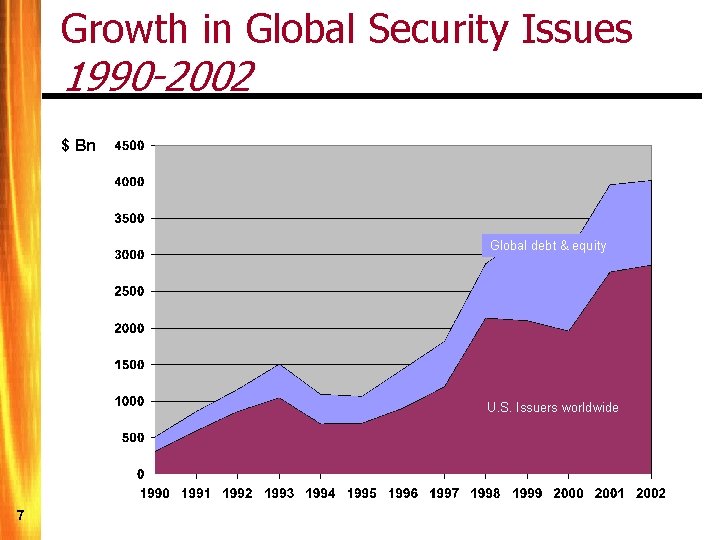
Raising Capital: Key Facts • There has been a huge increase in total security issuance volume since 1990. 6
Growth in Global Security Issues 1990 -2002 $ Bn Global debt & equity U. S. Issuers worldwide 7
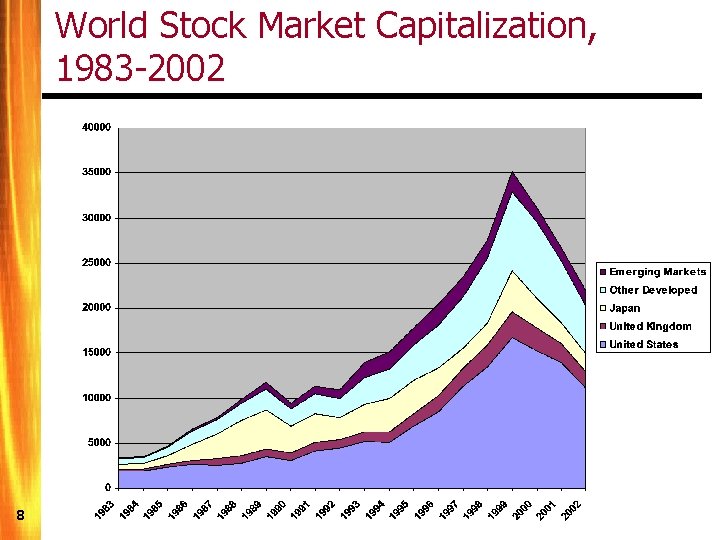
World Stock Market Capitalization, 1983 -2002 8
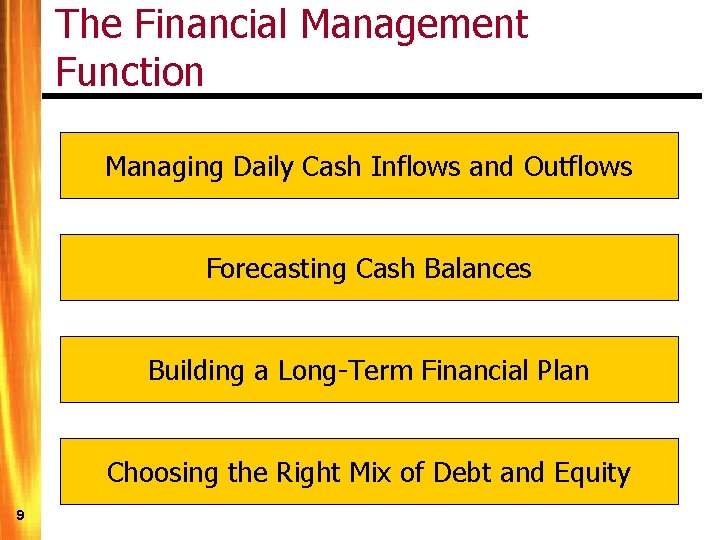
The Financial Management Function Managing Daily Cash Inflows and Outflows Forecasting Cash Balances Building a Long-Term Financial Plan Choosing the Right Mix of Debt and Equity 9
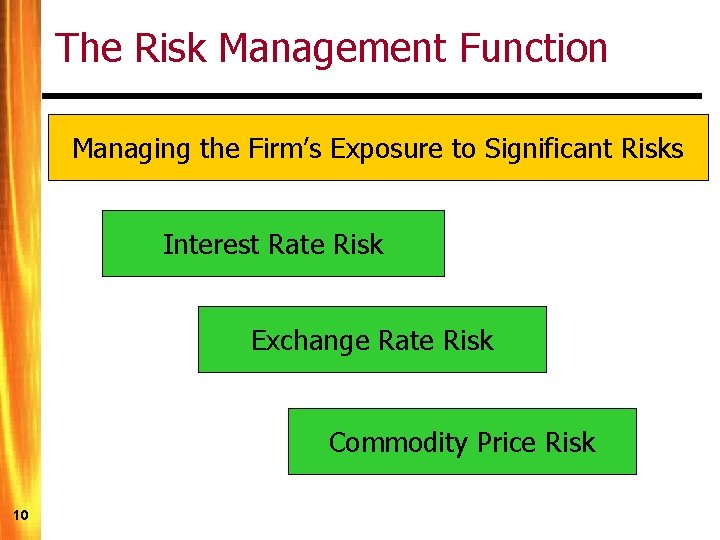
The Risk Management Function Managing the Firm’s Exposure to Significant Risks Interest Rate Risk Exchange Rate Risk Commodity Price Risk 10
The Corporate Governance Function The governance structure must ensure that managers make decisions that are will maximize shareholders’ wealth – not just their own wealth. 11
The Corporate Governance Function Incentives of managers, stockholders, and other stakeholders often conflict – Shareholders face a collective action problem in monitoring management – This is called the “agency problem” 12
The Corporate Governance Function Historical experience and academic research both suggest that ownership structure is very important. – Concentrated vs atomistic ownership structure – At least three forms of capitalism (US, Japan, Europe) – The country’s history & legal/regulatory system is very important as well 13
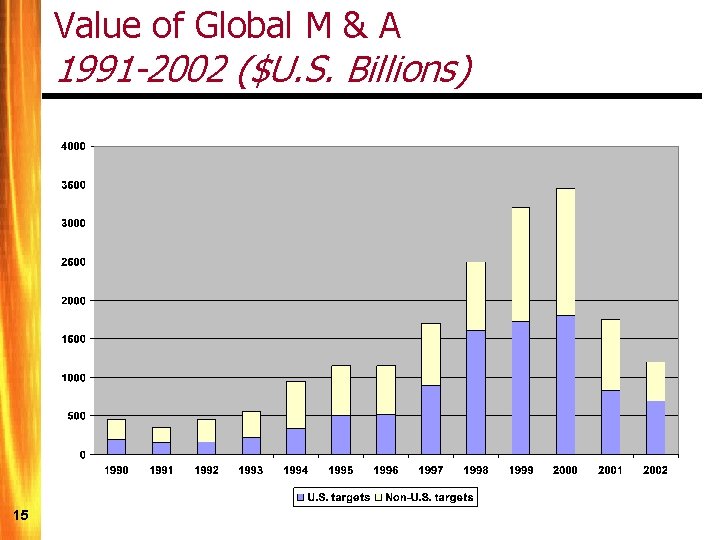
The Corporate Governance Function The role of takeovers in corporate governance has grown dramatically in recent years – Has long been important in the US and UK – Becoming increasingly important in Europe 14
Value of Global M & A 1991 -2002 ($U. S. Billions) 15
What Should Managers Maximize? Though plausible as a management objective, profit maximization has problems – Does not account for the timing of returns – Profits are not necessarily cash flows – Most importantly – it ignores risk 16
What Should Managers Maximize? The best management objective: Maximize shareholder wealth by maximizing the VALUE of the company, thereby maximizing stock price 17 – Accounts for risk, timing, and cash flows – As “Residual Claimants, ” shareholders have better incentives to maximize firm value than other stakeholders – Shareholders can benefit only after other claims are paid in full – Historical justification: Success of financial capitalism
Agency Costs In Corporate Finance Agency costs are due to the separation of ownership and control – Managers are the agents of the shareholders, but are also human. The interests of managers and shareholders inevitably diverge. 18
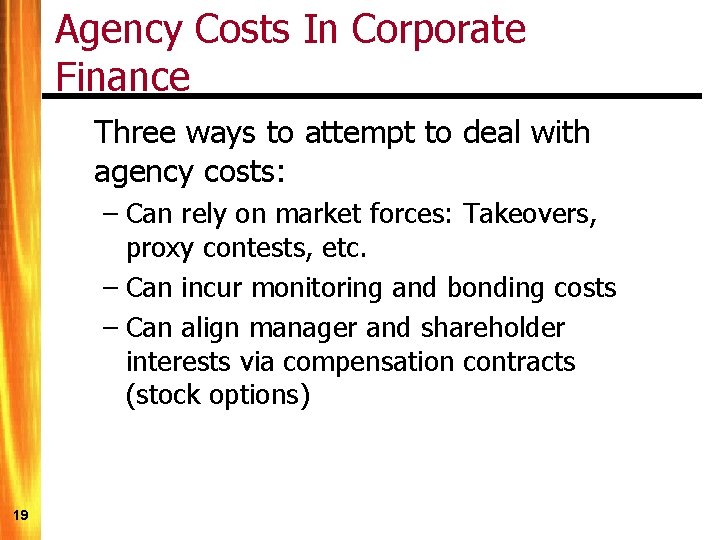
Agency Costs In Corporate Finance Three ways to attempt to deal with agency costs: – Can rely on market forces: Takeovers, proxy contests, etc. – Can incur monitoring and bonding costs – Can align manager and shareholder interests via compensation contracts (stock options) 19
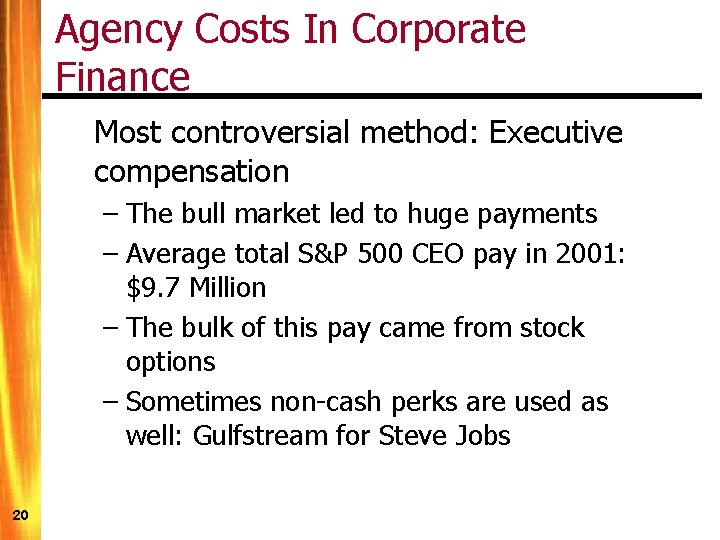
Agency Costs In Corporate Finance Most controversial method: Executive compensation – The bull market led to huge payments – Average total S&P 500 CEO pay in 2001: $9. 7 Million – The bulk of this pay came from stock options – Sometimes non-cash perks are used as well: Gulfstream for Steve Jobs 20
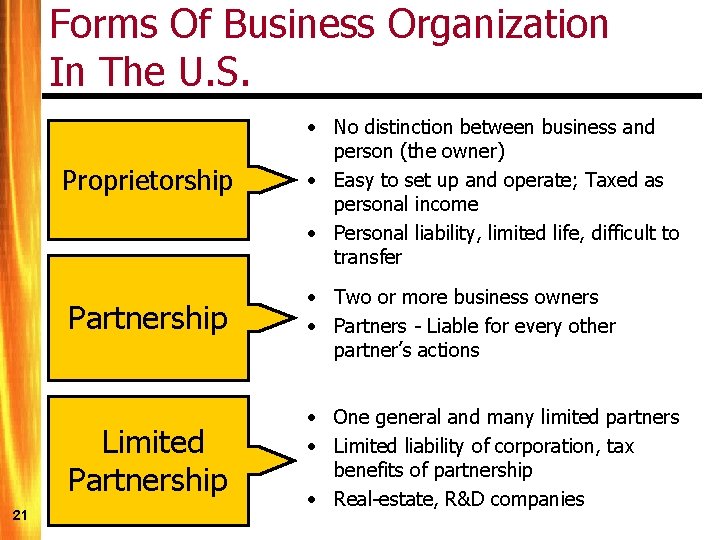
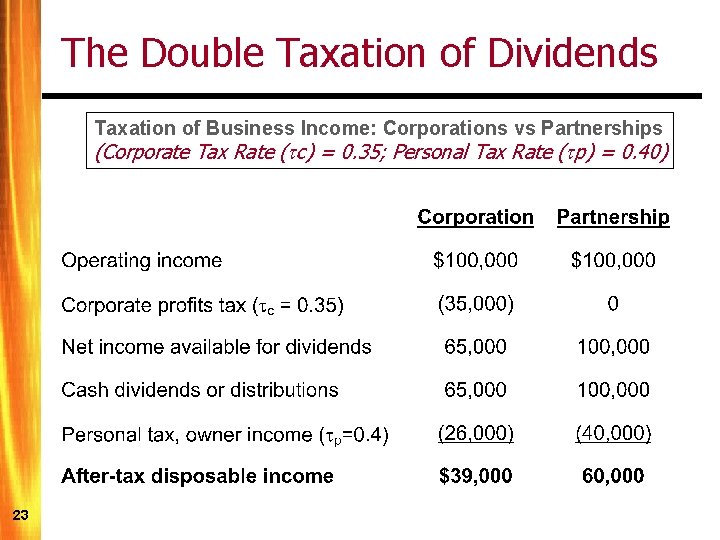
Forms Of Business Organization In The U. S. Proprietorship 21 • No distinction between business and person (the owner) • Easy to set up and operate; Taxed as personal income • Personal liability, limited life, difficult to transfer Partnership • Two or more business owners • Partners - Liable for every other partner’s actions Limited Partnership • One general and many limited partners • Limited liability of corporation, tax benefits of partnership • Real-estate, R&D companies
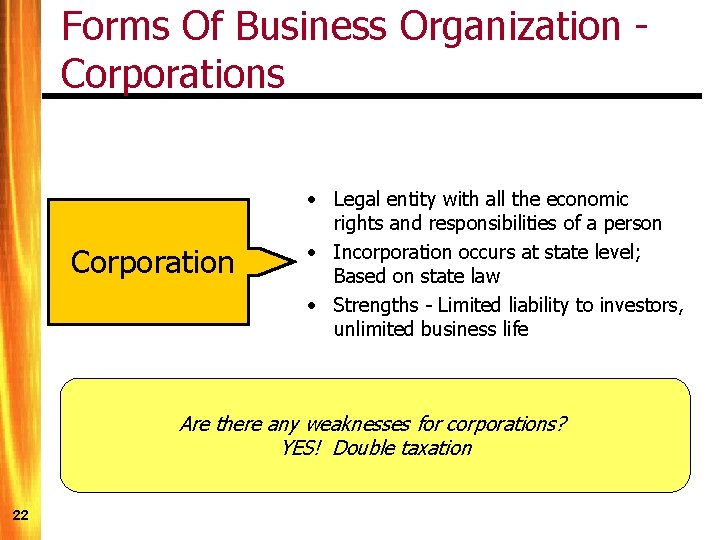
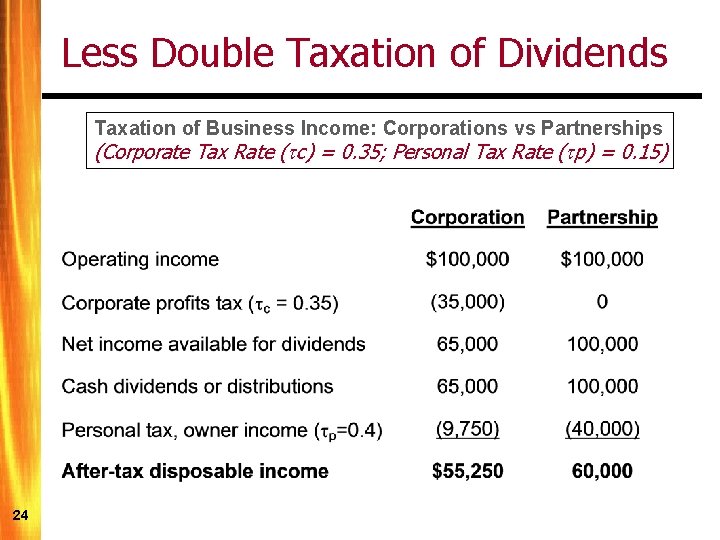
Forms Of Business Organization Corporations Corporation • Legal entity with all the economic rights and responsibilities of a person • Incorporation occurs at state level; Based on state law • Strengths - Limited liability to investors, unlimited business life Are there any weaknesses for corporations? YES! Double taxation 22
The Double Taxation of Dividends Taxation of Business Income: Corporations vs Partnerships (Corporate Tax Rate ( c) = 0. 35; Personal Tax Rate ( p) = 0. 40) 23
Less Double Taxation of Dividends Taxation of Business Income: Corporations vs Partnerships (Corporate Tax Rate ( c) = 0. 35; Personal Tax Rate ( p) = 0. 15) 24
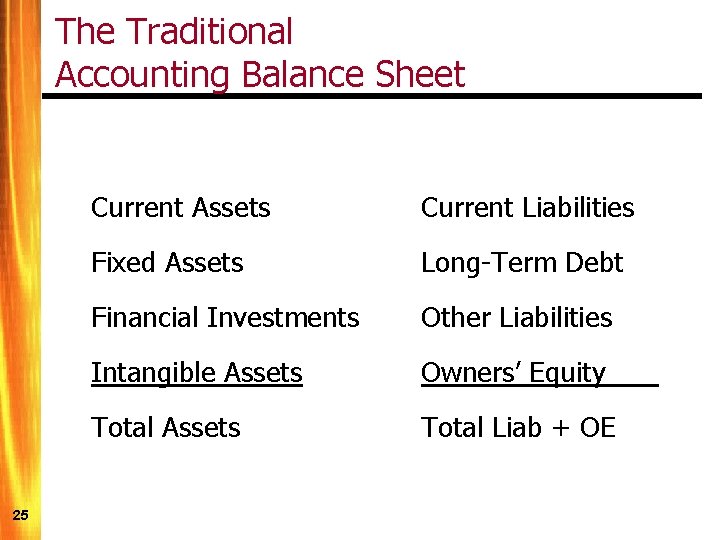
The Traditional Accounting Balance Sheet 25 Current Assets Current Liabilities Fixed Assets Long-Term Debt Financial Investments Other Liabilities Intangible Assets Owners’ Equity Total Assets Total Liab + OE
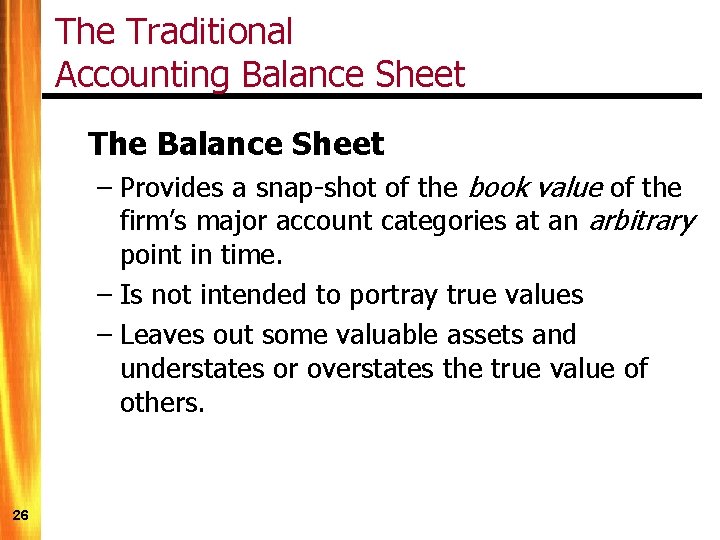
The Traditional Accounting Balance Sheet The Balance Sheet – Provides a snap-shot of the book value of the firm’s major account categories at an arbitrary point in time. – Is not intended to portray true values – Leaves out some valuable assets and understates or overstates the true value of others. 26
The Traditional Accounting Balance Sheet What’s missing on Microsoft’s 2002 balance sheet that has real value to the company and its investors? http: //www. microsoft. com/msft/ar. mspx 27
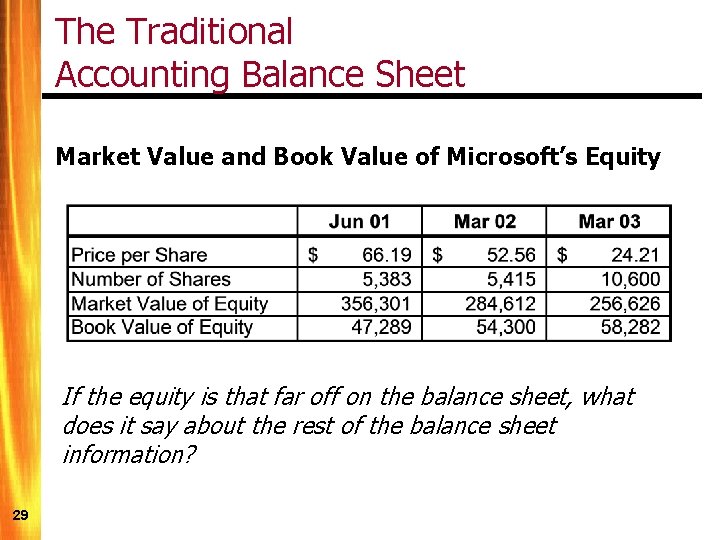
The Traditional Accounting Balance Sheet Check the book value of Microsoft’s Owners’ Equity here and compute the actual market value of equity based on its actual share price at end-of-quarter dates that you can get here. 28
The Traditional Accounting Balance Sheet Market Value and Book Value of Microsoft’s Equity If the equity is that far off on the balance sheet, what does it say about the rest of the balance sheet information? 29
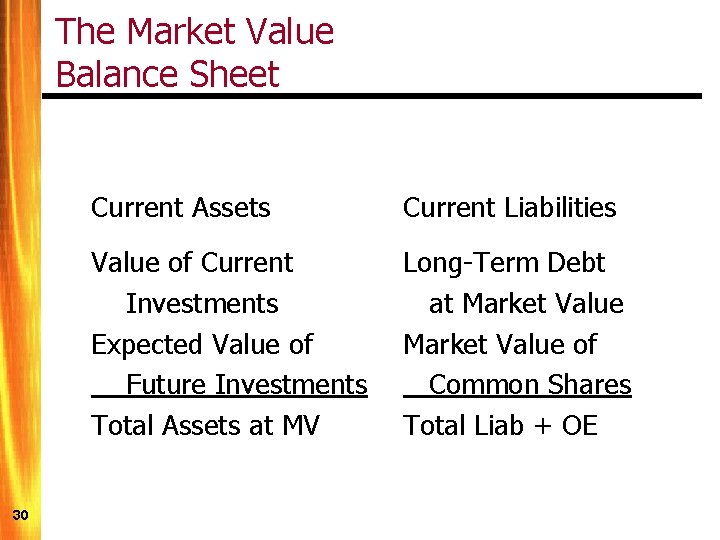
The Market Value Balance Sheet 30 Current Assets Current Liabilities Value of Current Investments Expected Value of Future Investments Total Assets at MV Long-Term Debt at Market Value of Common Shares Total Liab + OE
Valuation is the process of estimating the true value of assets, securities, or entire companies. – Value 31 is usually uncertain is based on future projections is affected by preferences changes constantly
The Goal of the Firm The goal of the firm is to maximize its value. – – 32 Maximize the value of the firm Maximize the wealth of its owners Maximize the price of its stock Maximize its contribution to the economy
How Is Value Created? Do something for investors that they can’t do for themselves. – Exploit proprietary resources • Raw materials, patents, information – Create proprietary knowledge • Expertise, experience, analysis – Be a value-added link in a channel • Wholesaler, distributor, retailer – Provide a service 33
The Investment Decision in a Nutshell • Invest in projects that yield a return greater than the minimum acceptable hurdle rate. • Invest in projects that have a rate of return that exceeds the cost of the invested funds. 34
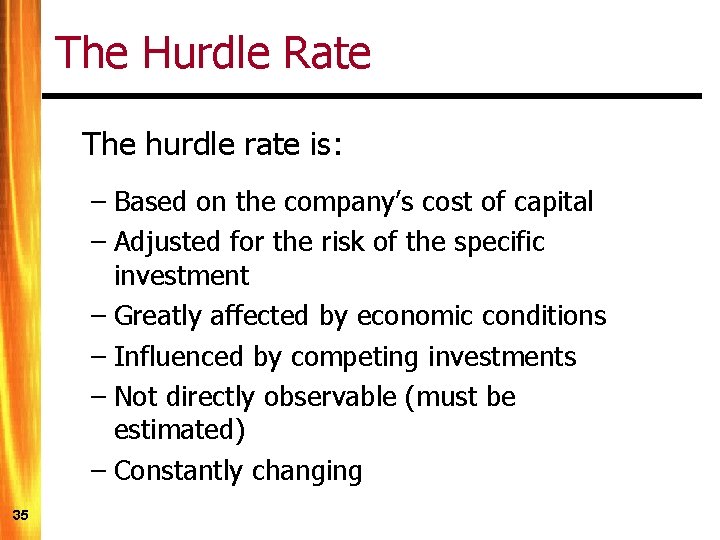
The Hurdle Rate The hurdle rate is: – Based on the company’s cost of capital – Adjusted for the risk of the specific investment – Greatly affected by economic conditions – Influenced by competing investments – Not directly observable (must be estimated) – Constantly changing 35
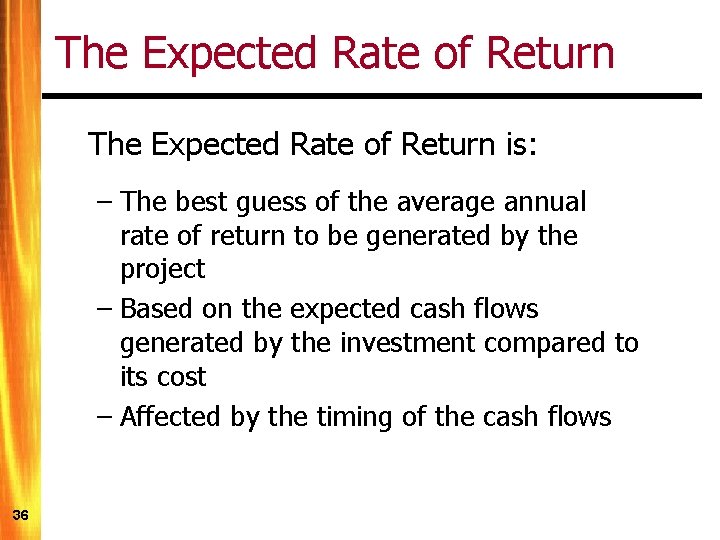
The Expected Rate of Return is: – The best guess of the average annual rate of return to be generated by the project – Based on the expected cash flows generated by the investment compared to its cost – Affected by the timing of the cash flows 36
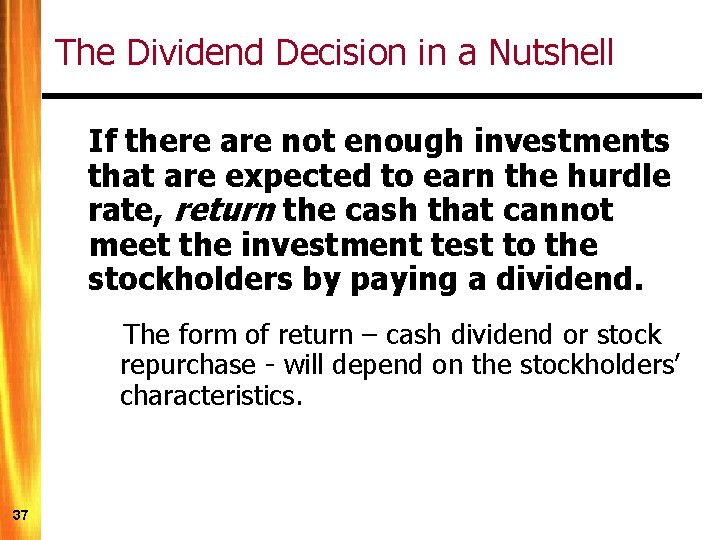
The Dividend Decision in a Nutshell If there are not enough investments that are expected to earn the hurdle rate, return the cash that cannot meet the investment test to the stockholders by paying a dividend. The form of return – cash dividend or stock repurchase - will depend on the stockholders’ characteristics. 37
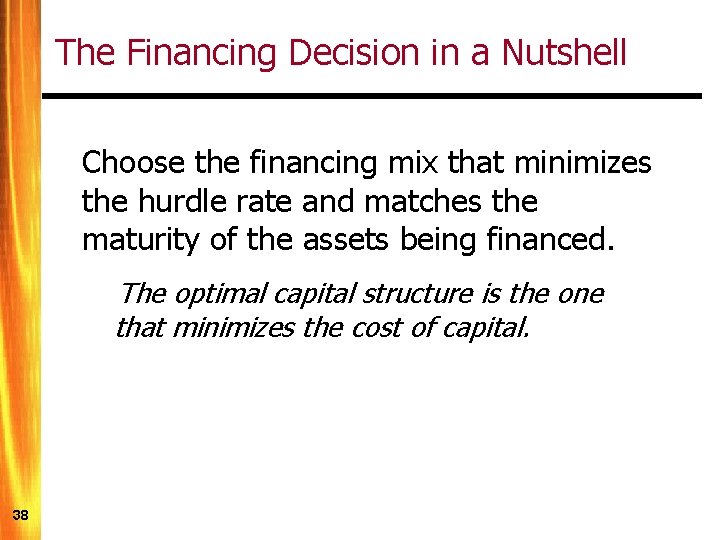
The Financing Decision in a Nutshell Choose the financing mix that minimizes the hurdle rate and matches the maturity of the assets being financed. The optimal capital structure is the one that minimizes the cost of capital. 38
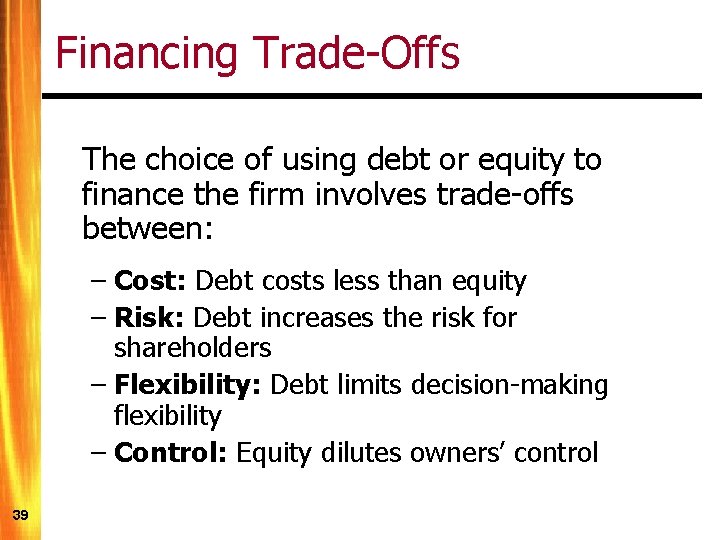
Financing Trade-Offs The choice of using debt or equity to finance the firm involves trade-offs between: – Cost: Debt costs less than equity – Risk: Debt increases the risk for shareholders – Flexibility: Debt limits decision-making flexibility – Control: Equity dilutes owners’ control 39
The Scope Of Corporate Finance Dr. Del Hawley FIN 634