
Contemporary Corporate Finance 11 th Edition By Mc
Contemporary Corporate Finance, 11 th Edition By Mc. Guigan, Kretlow, and Moyer Prepared by Rand Martin Bloomsburg University of Pennsylvania © 2009 South-Western/Cengage 1
1 The Role and Objective of Financial Management
Introduction n This chapter introduces the financial management process of the typical firm. It looks at the field of finance, various financial decisions and their implications, and the daily questions faced by the firm’s financial managers. 3
Questions Faced by Financial Managers n n n Will a particular investment be successful? Where will the funds come from to finance the investment? Does the firm have adequate cash or access to cash to meet its daily operating needs? 4
Principal Forms of Business Organizations n Sole proprietorship n Partnership n Corporation 5
Sole Proprietorship n n n Owned by one person Advantage: Easy formation Disadvantage: Unlimited liability Disadvantage: Difficulty raising funds Represent 75 percent of all businesses Account for less than 6 percent of total business revenues 6
Partnership n n n n Owned by two or more persons About 7 percent of US businesses, 5 percent of business revenues Classified as general or limited General partners work in the partnership Advantage: Limited partners’ liability is limited to what is specified in the agreement. Disadvantage: Partnership dissolves when a general partner dies Disadvantage: Unlimited liability for general partners 7
Corporation n Limited liability n Flexibility n Permanency n Legal entity n Ability to raise capital n n Has a board of directors Easy marketability of shares of ownership n Owners are stockholders All advantages 8
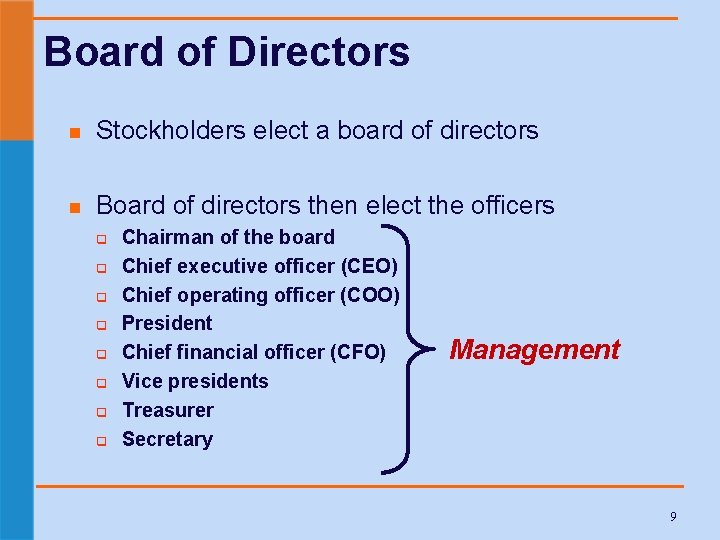
Board of Directors n Stockholders elect a board of directors n Board of directors then elect the officers q q q q Chairman of the board Chief executive officer (CEO) Chief operating officer (COO) President Chief financial officer (CFO) Vice presidents Treasurer Secretary Management 9
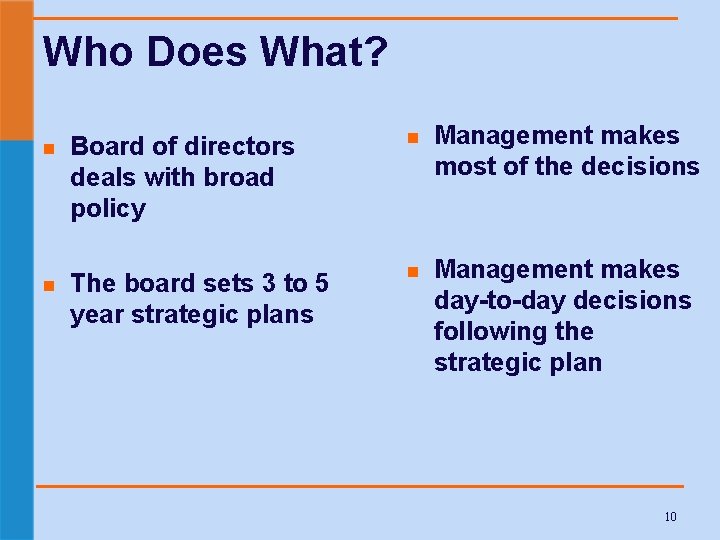
Who Does What? n n Board of directors deals with broad policy n Management makes most of the decisions The board sets 3 to 5 year strategic plans n Management makes day-to-day decisions following the strategic plan 10
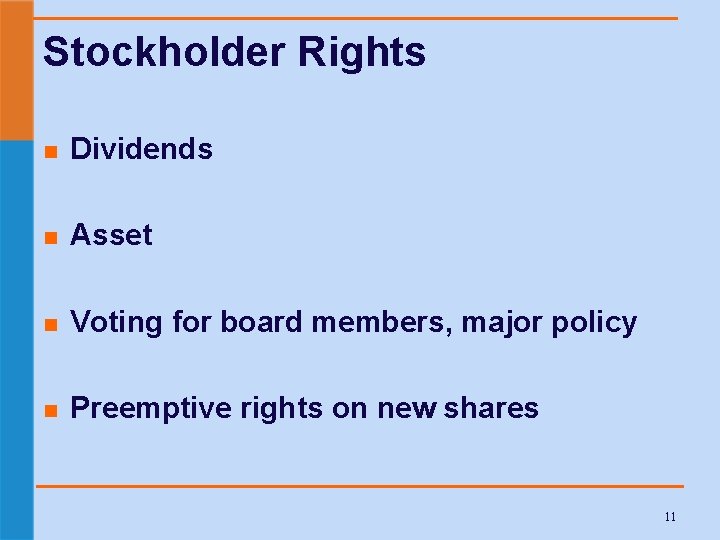
Stockholder Rights n Dividends n Asset n Voting for board members, major policy n Preemptive rights on new shares 11
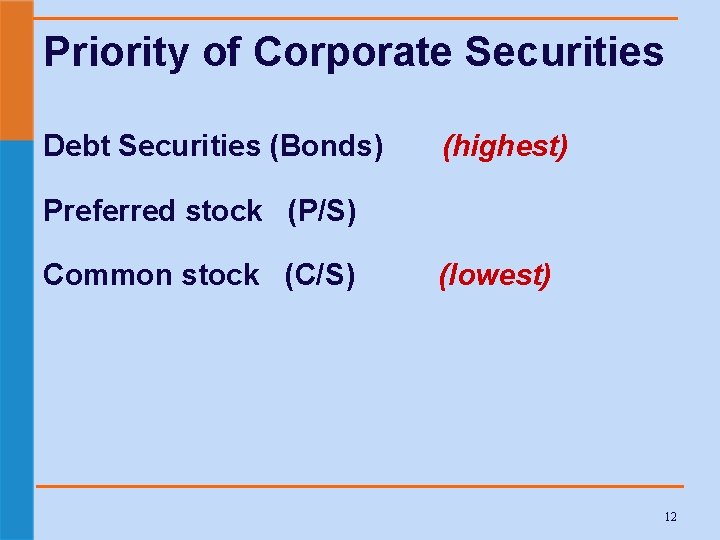
Priority of Corporate Securities Debt Securities (Bonds) (highest) Preferred stock (P/S) Common stock (C/S) (lowest) 12
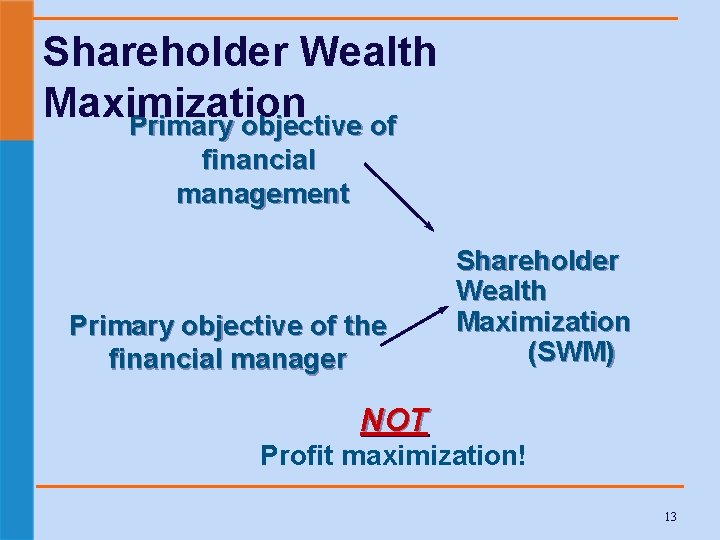
Shareholder Wealth Maximization Primary objective of financial management Primary objective of the financial manager Shareholder Wealth Maximization (SWM) NOT Profit maximization! 13
SWM n Considers the timing and risk of the benefits from stock ownership n Determines that a good decision increases the price of the firm’s common stock (C/S) n Is an impersonal objective n Is concerned for social responsibility 14

Divergent Objectives create Agency Problems n n Problem created by separation of Owners (shareholders) Management and Employees Management may maximize its own welfare instead of the owners’ wealth. Job security 15
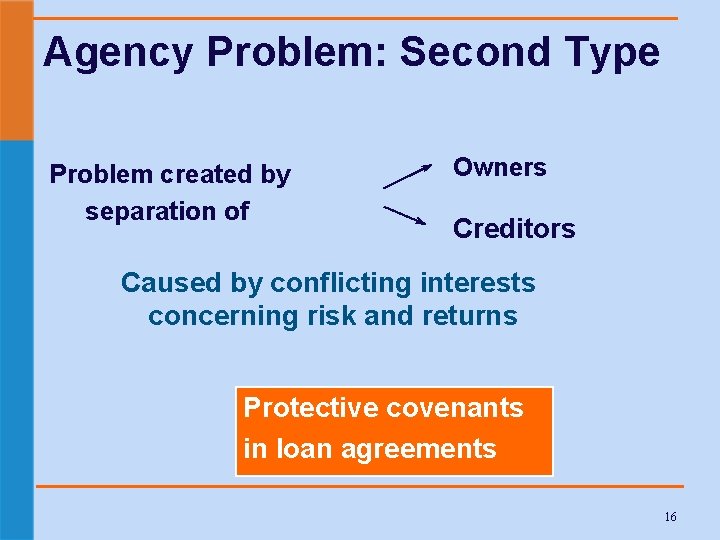
Agency Problem: Second Type Problem created by separation of Owners Creditors Caused by conflicting interests concerning risk and returns Protective covenants in loan agreements 16
Agency Costs n n Corporate governance Management compensation Threat of takeovers Annual audit by accounting firm Recent Development: Sarbanes-Oxley Act 17

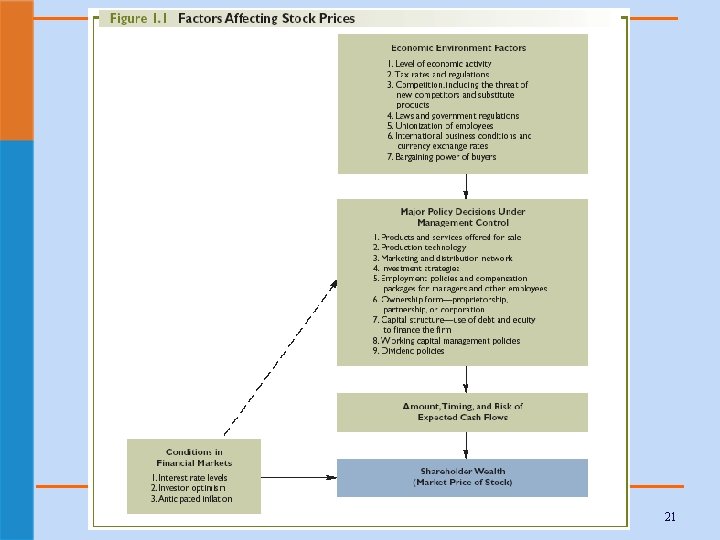
Shareholder Wealth Maximizing is a Market Concept and Results in Ø Maximizing PV of E(R) Important note! § Success is measured by Market Value of Common Stock--- § Not by profit maximization! 18
Limitations of Profit Maximization n Static nature of standard microeconomic model (Lack of time dimension) Variable definition of profit Provides no direct way for managers to consider the risk of alternative decisions 19
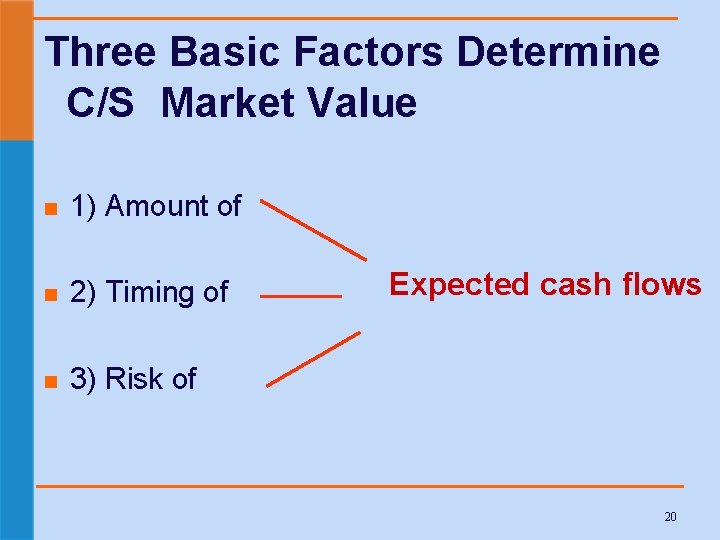
Three Basic Factors Determine C/S Market Value n 1) Amount of n 2) Timing of n 3) Risk of Expected cash flows 20
21
Managers deal with these competitive forces n New entrants n Substitute products n Bargaining power of buyers n Bargaining power of suppliers n Rivalry among current competitors 22
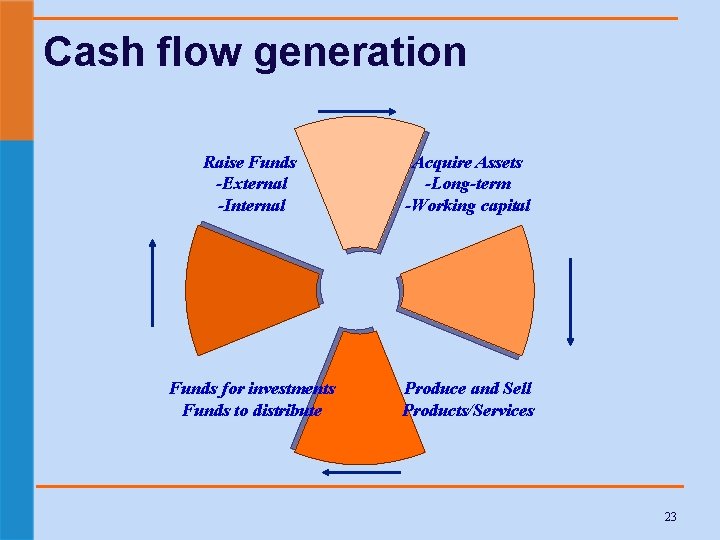
Cash flow generation Raise Funds -External -Internal Acquire Assets -Long-term -Working capital Funds for investments Funds to distribute Produce and Sell Products/Services 23
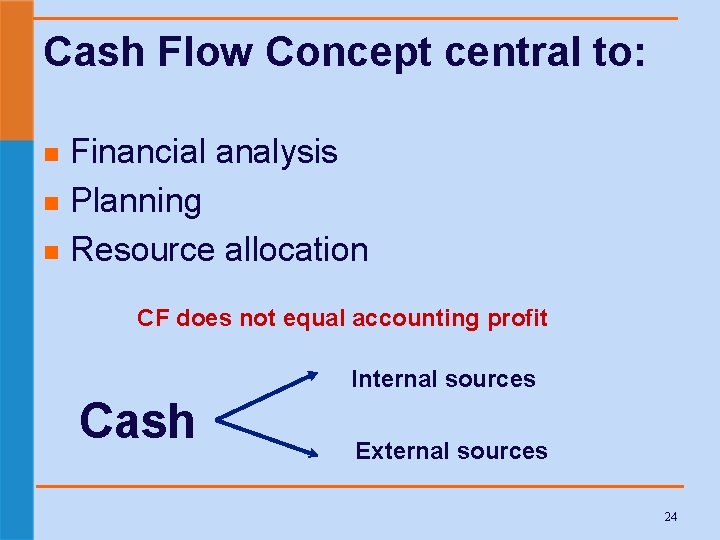
Cash Flow Concept central to: Financial analysis n Planning n Resource allocation n CF does not equal accounting profit Internal sources Cash External sources 24
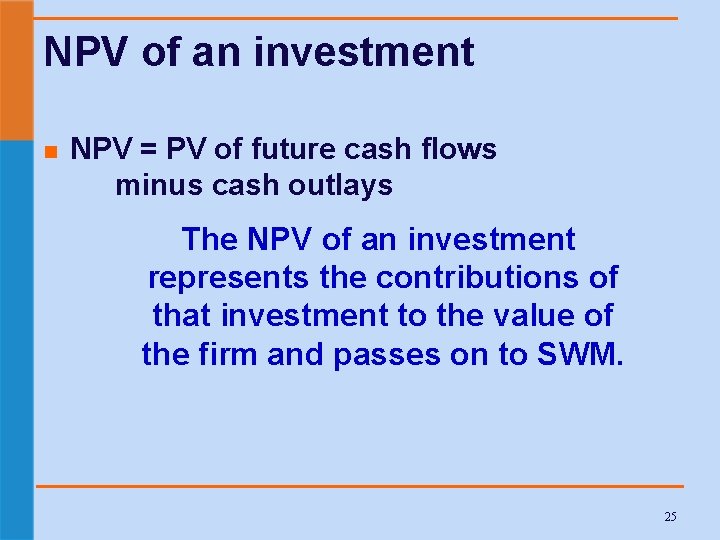
NPV of an investment n NPV = PV of future cash flows minus cash outlays The NPV of an investment represents the contributions of that investment to the value of the firm and passes on to SWM. 25
26
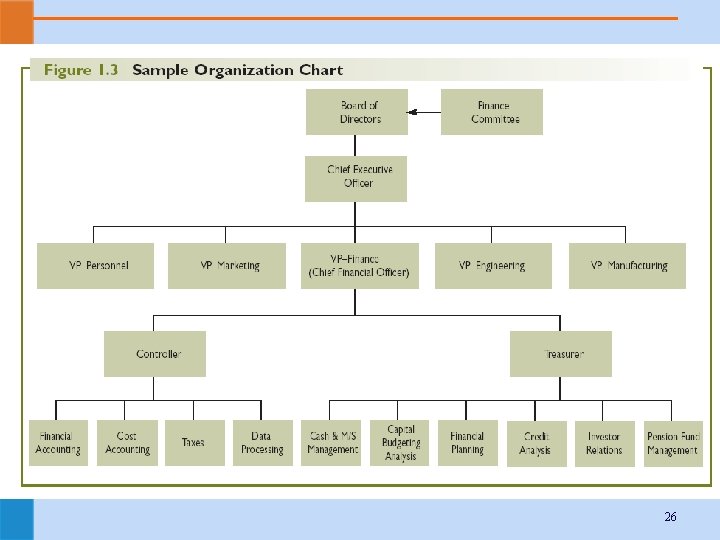
Controller’s Activities n Financial accounting n Cost accounting n Taxes n Data processing 27
Treasurer’s Activities n Management of cash and marketable securities n Capital budgeting n Financial planning n Credit analysis n Investor relations n Pension fund management 28
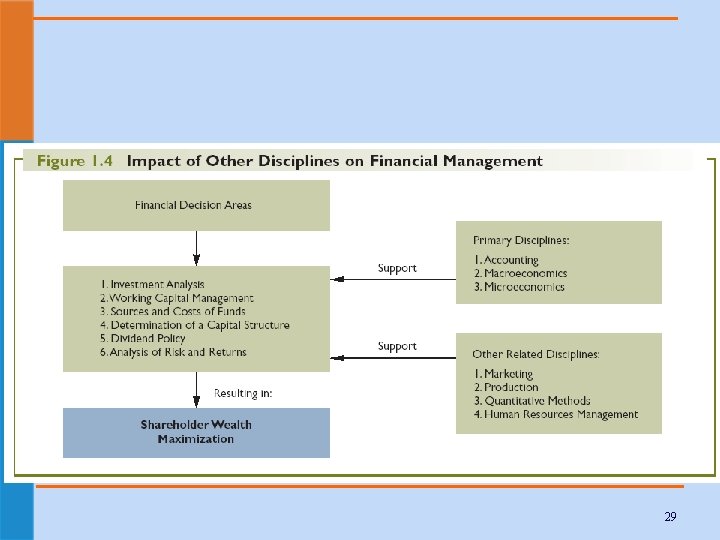
29
Professional Organizations n Financial Executive Institute n Institute of Charted Financial Analysis n Financial Management Association n Institute of Management Accounting 30

Exciting Career Opportunities n VP of Finance n Financial Analyst n Director Investor Relations n Account Executive Security Broker n Assistant Treasurer n Mortgage Analyst n Tax Manager n Banking Check out http: //www. careerpath. com/ 31
- Slides: 31