The River God Stevie Smith Register Task Look
- Slides: 11
The River God – Stevie Smith Register Task: • Look closely at the title of the poem. • Analyse the words. What are the connotations? I MUST: Identify the poem’s structure and the meaning of the poem. I SHOULD: Closely analyse the poem probing the subtext. I COULD: Evaluate the effect Smith’s language, structure and form has on the reader
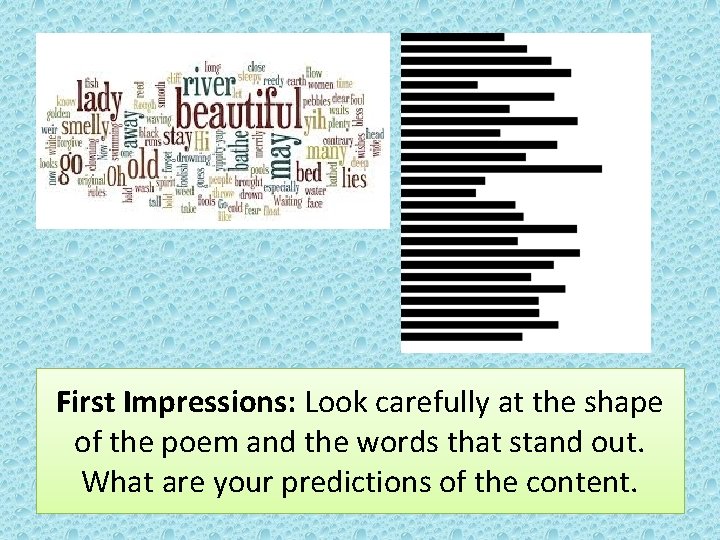
First Impressions: Look carefully at the shape of the poem and the words that stand out. What are your predictions of the content.
Discuss: What’s in a shape? What does the shape look like? What might the poem be about? Why, do you think, the poem is one verse long? What is the effect of the different line lengths? That is, what do they seem to capture? • What might the pace of the poem be during short lines? Long lines? What might this reflect? • •
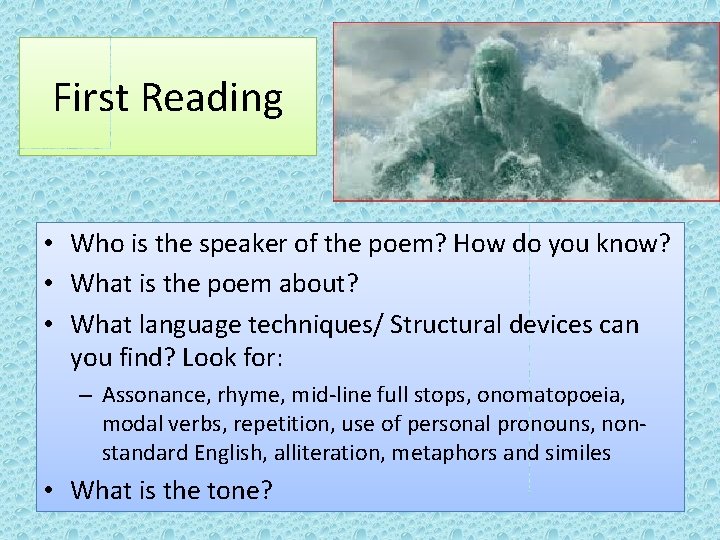
First Reading • Who is the speaker of the poem? How do you know? • What is the poem about? • What language techniques/ Structural devices can you find? Look for: – Assonance, rhyme, mid-line full stops, onomatopoeia, modal verbs, repetition, use of personal pronouns, nonstandard English, alliteration, metaphors and similes • What is the tone?
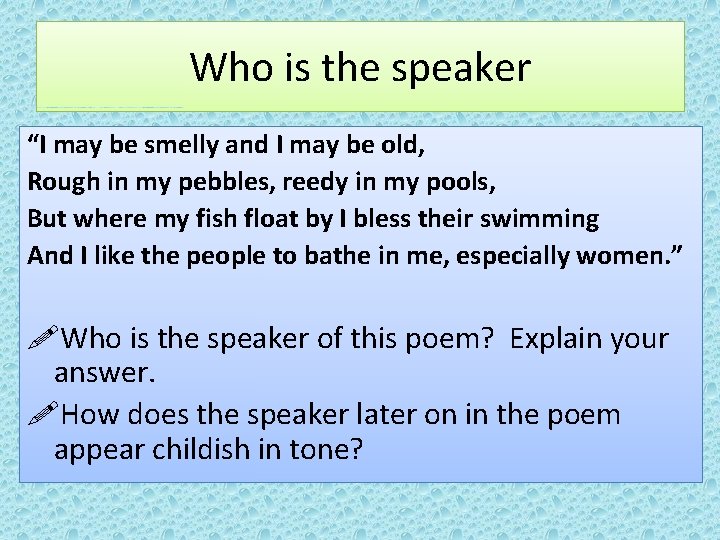
Who is the speaker “I may be smelly and I may be old, Rough in my pebbles, reedy in my pools, But where my fish float by I bless their swimming And I like the people to bathe in me, especially women. ” !Who is the speaker of this poem? Explain your answer. !How does the speaker later on in the poem appear childish in tone?
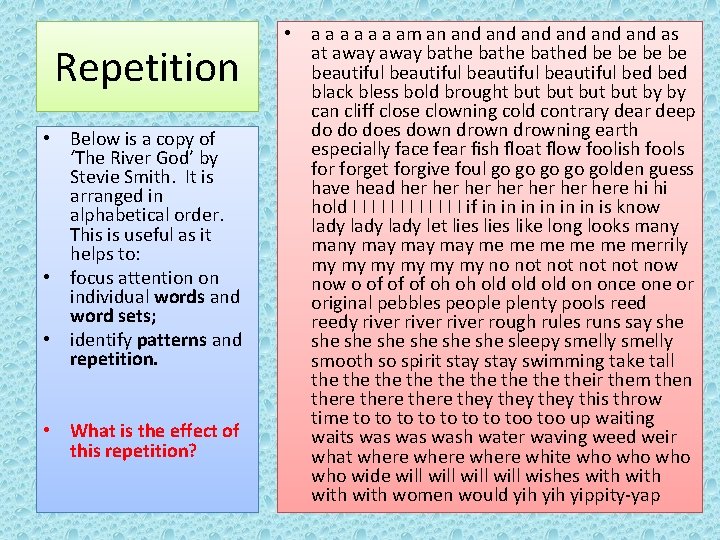
Repetition • Below is a copy of ‘The River God’ by Stevie Smith. It is arranged in alphabetical order. This is useful as it helps to: • focus attention on individual words and word sets; • identify patterns and repetition. • What is the effect of this repetition? • a a a am an and and and as at away bathed be be beautiful bed black bless bold brought but but by by can cliff close clowning cold contrary dear deep do do does down drowning earth especially face fear fish float flow foolish fools forget forgive foul go go golden guess have head her here hi hi hold I I I if in in in is know lady let lies like long looks many may may me me merrily my my my no not not now o of of of oh oh old old on once one or original pebbles people plenty pools reedy river rough rules runs say she she sleepy smelly smooth so spirit stay swimming take tall the the their them then there they this throw time to too too up waiting waits was wash water waving weed weir what where white who who wide will wishes with women would yih yippity-yap
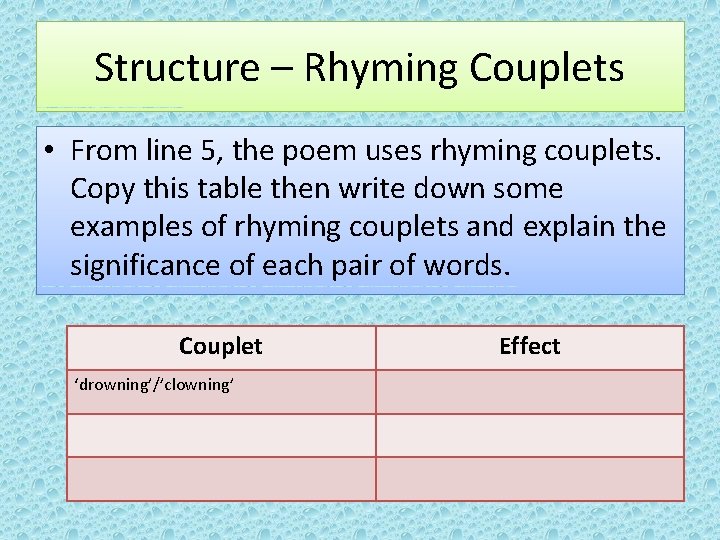
Structure – Rhyming Couplets • From line 5, the poem uses rhyming couplets. Copy this table then write down some examples of rhyming couplets and explain the significance of each pair of words. Couplet ‘drowning’/’clowning’ Effect
The effect of Double Vowel Sounds • Many words in this poem have a double vowel • Read the list of words and, working in groups of three, consider both the meaning and effect of these words within the context of the poem. It might help if you think about how the words affect the pace and rhythm of the lines. • • • reedy too pools fools deep weed reed smooth foolish sleepy
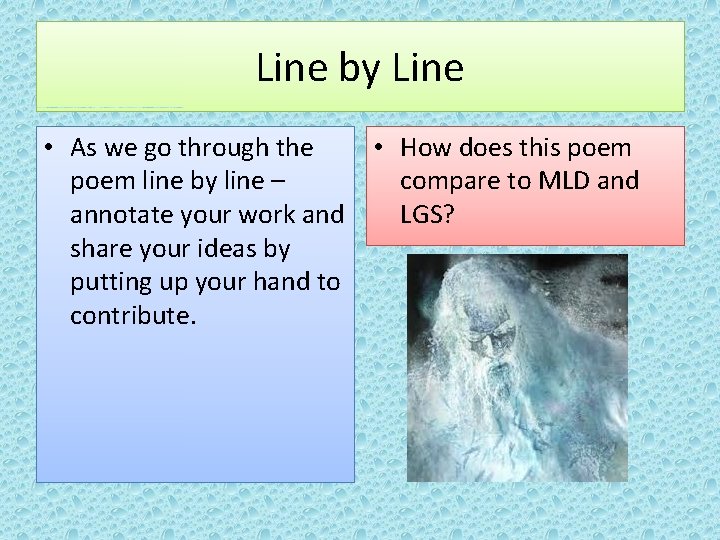
Line by Line • As we go through the poem line by line – annotate your work and share your ideas by putting up your hand to contribute. • How does this poem compare to MLD and LGS?
The River God Have you ever heard the expression ‘Still waters run deep’? It is sometimes used to describe someone who, like a river, has a calm appearance that hides deep and dangerous undercurrents. The River God in the poem may represent this idea – he is the dangerous spirit of the river that lies hidden beneath the surface.
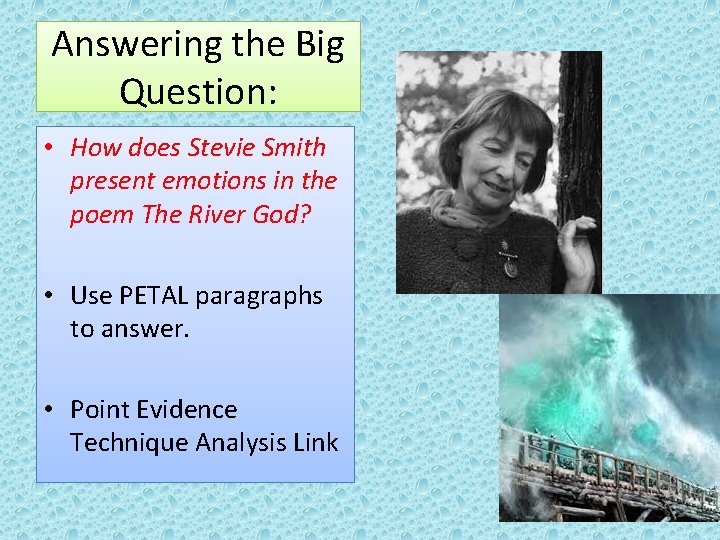
Answering the Big Question: • How does Stevie Smith present emotions in the poem The River God? • Use PETAL paragraphs to answer. • Point Evidence Technique Analysis Link