The Risk Modeling Work Group and the Application




- Slides: 25
The “Risk Modeling Work Group” and the Application of Risk Assessment in Integrity Management Programs Risk Model Work Group http: //primis. phmsa. dot. gov/rmwg/index. htm -1 -
Performance Based Regulations • Historically, regulations have been prescriptive, providing tasks that must be completed to meet established, minimum safety requirements • Performance based regulations (such as IM) provide a framework for an operator to continuously improve upon to enhance safety based on their unique operating environment and objectives -2 -
Performance Based Regulations • The term “performance-based” refers to: – Standards that mandate outcomes and give operators flexibility in how to meet them – Requirements for operators to use management systems consisting of internal plans and practices for promoting safety and reducing risk. • Prescription is added to performance based IM regulations to address inadequacies identified in inspections and lessons learned from failure investigations -3 -
Risk Analysis Application in IM • Integrity Management is a Performance based Risk Management Program • Risk Models and Risk Assessments are required to be used throughout the IMP – Baseline Assessment – Data Integration / Information Analysis – Preventive Measures Determinations – Mitigative Measures Determinations – Continuing Evaluation and Assessment -4 -4 -
Implementation • PHMSA has identified through inspections, failure investigations, NTSB Recommendations, and other feedback that operators need additional guidance and directions on the requirements for using Risk Models and Risk Assessments in their IMPs. • PHMSA has addressed these deficiencies by: – Issuing Safety Advisory Bulletins – Updating Inspection Materials (Protocols and Inspection Assistant inspection question set) – Updating PHMSA Inspector Training Materials – Proposing New Regulations (e. g. , Gas and HL IM NPRMs) -5 -5 -
Assessing Maturity -6 -
PHMSA Resources • New Regulations http: //phmsa. dot. gov/pipeline/regs • Adjustments to Inspection Materials http: //www. phmsa. dot. gov/pipeline/library/forms • Safety Advisory Bulletins http: //phmsa. dot. gov/pipeline/regs/advisorybulletin • Public Workshops http: //primis. phmsa. dot. gov/meetings/ • Risk Modeling Work Group http: //primis. phmsa. dot. gov/rmwg/index. htm -7 -
NTSB and Others’ Comments On Risk Methodologies • Industry and PHMSA are in general agreement that risk models need to evolve in such a way as to be more investigative in nature – As summarized and discussed in past public forums and workshops on pipeline safety (e. g. , 2014 Government/Industry Pipeline R&D Forum) • Risk evaluation methods must be sufficiently analytical to be predictive (NTSB Investigations and Safety Study Recommendations) – Are Threats on a particular line segment increasing or decreasing? – Consequence potential impacts increasing? - 8 - – Interactive threat potential becoming a major issue?
Sufficiently Analytical to be Predictive • Do Results reflect year-to-year changes in risk levels? – Operational, Environmental, Assessments • Does the overall risk profile adequately match operational experience? • Approaches may need to vary between respective types of threats (time dependent/independent) • More complexity does not necessarily mean better – Interactive threats may need more sophisticated modeling than threats being evaluated individually -9 -
Connection to Decision Making • Risk evaluation results must have a connection to real-life decision making – Point of risk assessments is not to only do a risk evaluation – Risk insights must be integrated into routine integrity-related decision making – Operators should be able to easily demonstrate how risk evaluation results influence work practices and decisions - 10 -
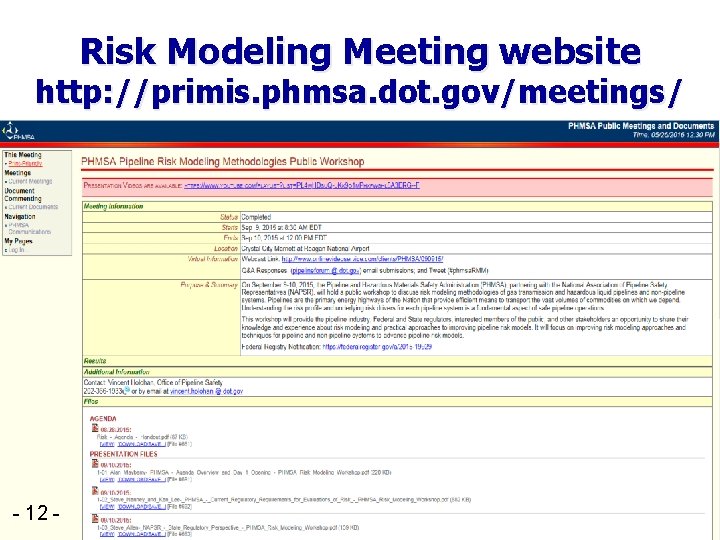
Public Workshops – Risk Modeling • PHMSA has sponsored 2 Public Workshops focused on Risk Models and their Application in IM Programs – July 21, 2011 Improving Pipeline Risk Assessments and Recordkeeping (Mtg #70) – September 9 & 10, 2015 PHMSA Pipeline Risk Modeling Methodologies Public Workshop (Mtg #104) - 11 -
Risk Modeling Meeting website http: //primis. phmsa. dot. gov/meetings/ - 12 -
Risk Modeling Work Group (RMWG) • The Risk Modeling Work Group was formed as a follow up to the September 2015 PHMSA Pipeline Risk Modeling Methodologies Public Workshop • The purpose of the group is to provide technical, integrity management and operational input to PHMSA to aid in the development of a pipeline system risk modeling technical guidance document • http: //primis. phmsa. dot. gov/rmwg/index. htm - 13
Risk Modeling Work Group • PHMSA is seeking a wide range of input and consensus as part of the development of this technical guidance, both from within the Regulatory Community and from Pipeline Safety Stakeholders • There approximately 30 members of the RMWG from the regulatory, operator, and interested party communities • This work group provides a forum to obtain the combined perspective of industry, regulators, public, and risk services providers, and it will also provide a mechanism for eventual public input/comment - 14 14
RMWG Mission Statement • The mission of the Risk Modeling Work Group (RMWG) is: – Characterize the state of the art of pipeline risk modeling for gas and liquid transmission pipelines, – Identify and, if necessary in specific areas, develop a range of state-of-the-art methods and tools capable of addressing the spectrum of pipeline risk management applications, and – Provide recommendations to PHMSA regarding the use of these methods, tools, and data requirements - 15 -
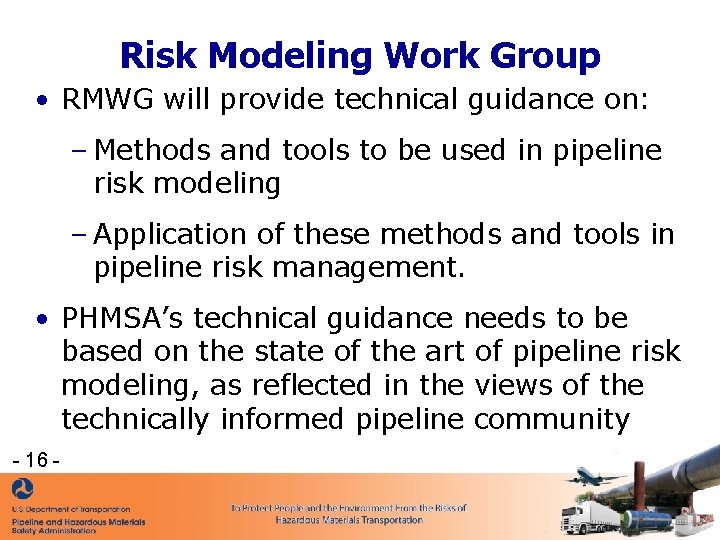
Risk Modeling Work Group • RMWG will provide technical guidance on: – Methods and tools to be used in pipeline risk modeling – Application of these methods and tools in pipeline risk management. • PHMSA’s technical guidance needs to be based on the state of the art of pipeline risk modeling, as reflected in the views of the technically informed pipeline community - 16 -
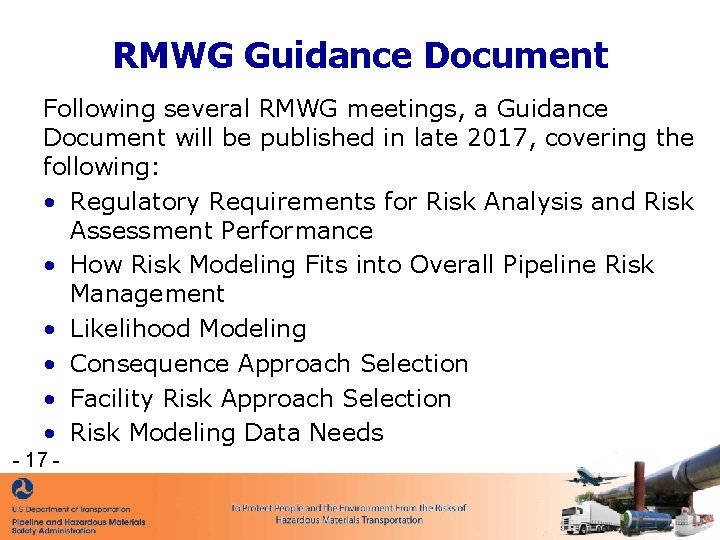
RMWG Guidance Document Following several RMWG meetings, a Guidance Document will be published in late 2017, covering the following: • Regulatory Requirements for Risk Analysis and Risk Assessment Performance • How Risk Modeling Fits into Overall Pipeline Risk Management • Likelihood Modeling • Consequence Approach Selection • Facility Risk Approach Selection • Risk Modeling Data Needs - 17 -
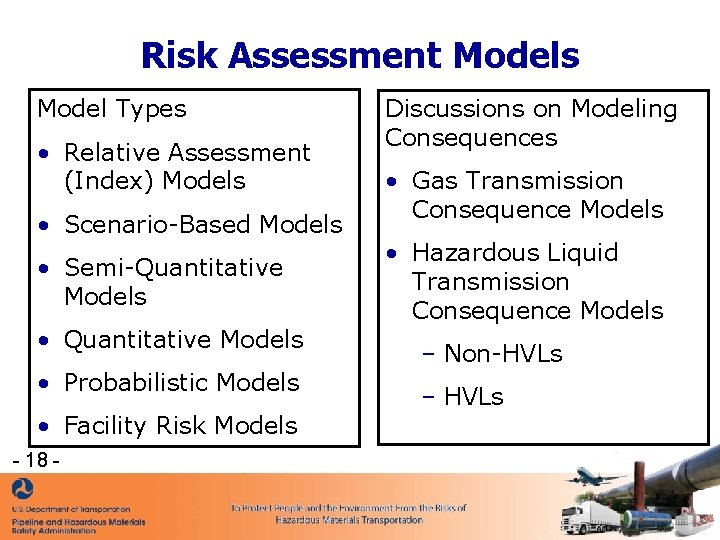
Risk Assessment Models Model Types • Relative Assessment (Index) Models • Scenario-Based Models • Semi-Quantitative Models • Probabilistic Models • Facility Risk Models - 18 - Discussions on Modeling Consequences • Gas Transmission Consequence Models • Hazardous Liquid Transmission Consequence Models – Non-HVLs – HVLs
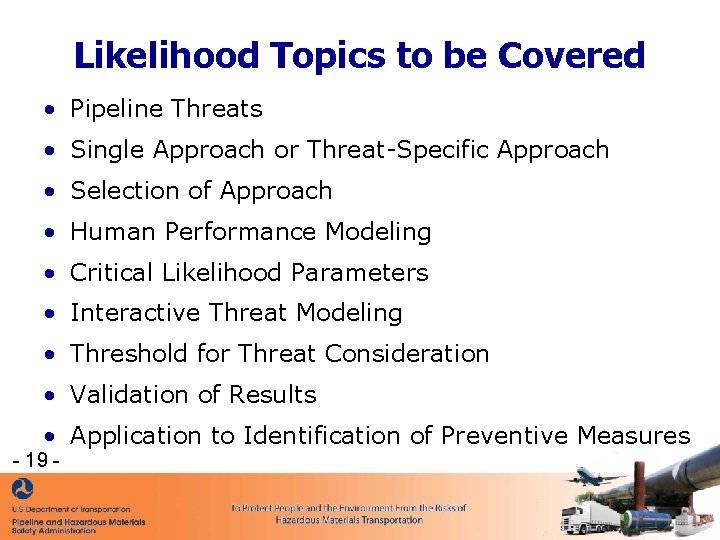
Likelihood Topics to be Covered • Pipeline Threats • Single Approach or Threat-Specific Approach • Selection of Approach • Human Performance Modeling • Critical Likelihood Parameters • Interactive Threat Modeling • Threshold for Threat Consideration • Validation of Results • Application to Identification of Preventive Measures - 19 -
Consequence Topics to be Covered • Selection of Approach • Identification of Receptors • Emergency Response • Critical Consequence Parameters • Validation of Results • Application to Identification of Mitigative Measures - 20 -
Facility Topics to be Covered • Selection of Approach – Hazard Identification, Bowtie Analysis, Scenarios, etc. • Comparison with Line Pipe Risk • Application to Preventive Measures and Mitigative Measures to reduce risks • Risk Reduction Measures implemented may be similar to integrity assessment methods – Hydrostatic pressure testing - 21 - – Direct Assessment techniques
Data Need Topics to be Covered • Threat-Specific Data • Consequence-Specific Data • Data Validation • Available Industry Data • Available Government Data • Available International Data • Related NTSB Recommendations - 22 -
RMWG Public Meeting in 2017 • PHMSA anticipates hosting a Public Meeting in the Summer, 2017 to present the findings of the RMWG efforts • The Public Meeting would allow for the combined perspectives of industry, regulators, public, and risk services providers to be considered prior to publication of the Guidance Document - 23 23
Why is RMWG Guidance Important? • PHMSA has identified through inspections, failure investigations, and NTSB Recommendations that operators need additional guidance and directions on developing and maintaining accurate risk models • Risk models should enable the selection of appropriate assessment methods and risk reduction measures that improve pipeline safety • More prescription is being added to current performance based regulations to address these concerns on risk assessment and other pipeline - 24 -integrity and safety related topics - 24 -
Thank you for your Participation in Pipeline Safety - 25 -