The message The sentence English Morphosyntax The skeleton
- Slides: 7
The message The sentence English Morphosyntax
The skeleton of the message p Traditionally, the clause (or simple sentence) is divided into two basic units, Subject and Predicate. n n The Subject tends to be quite a simple constituent: Tom watched TV yesterday The Predicate, the most informative part of the sentence, is normally made up of several other constituents: Tom watched TV yesterday
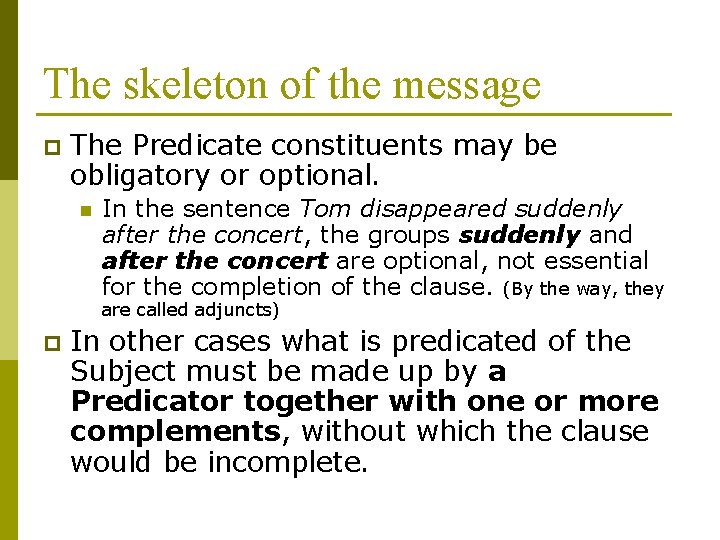
The skeleton of the message p The Predicate constituents may be obligatory or optional. n In the sentence Tom disappeared suddenly after the concert, the groups suddenly and after the concert are optional, not essential for the completion of the clause. (By the way, they are called adjuncts) p In other cases what is predicated of the Subject must be made up by a Predicator together with one or more complements, without which the clause would be incomplete.
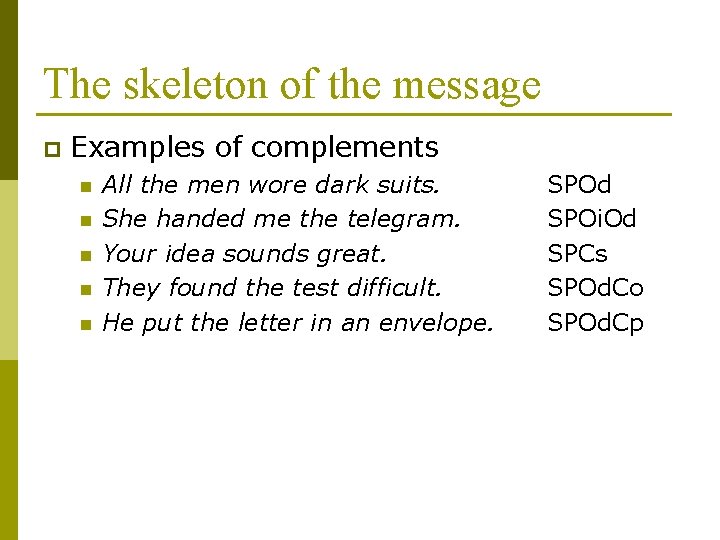
The skeleton of the message p Examples of complements n n n All the men wore dark suits. She handed me the telegram. Your idea sounds great. They found the test difficult. He put the letter in an envelope. SPOd SPOi. Od SPCs SPOd. Co SPOd. Cp
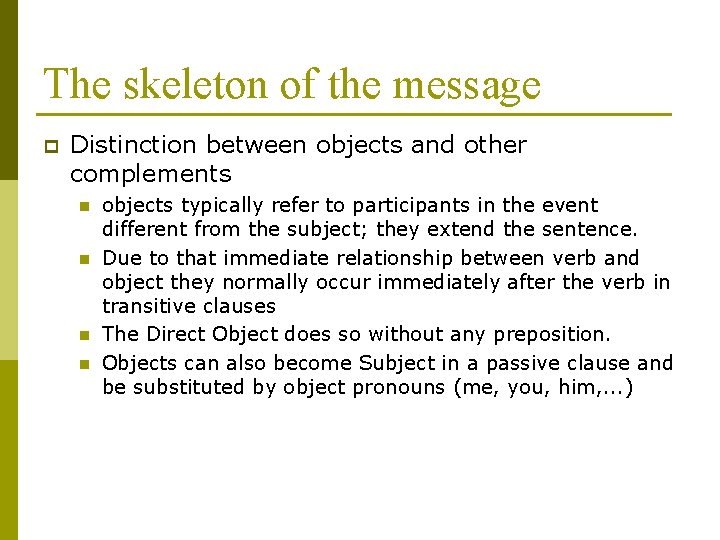
The skeleton of the message p Distinction between objects and other complements n n objects typically refer to participants in the event different from the subject; they extend the sentence. Due to that immediate relationship between verb and object they normally occur immediately after the verb in transitive clauses The Direct Object does so without any preposition. Objects can also become Subject in a passive clause and be substituted by object pronouns (me, you, him, . . . )
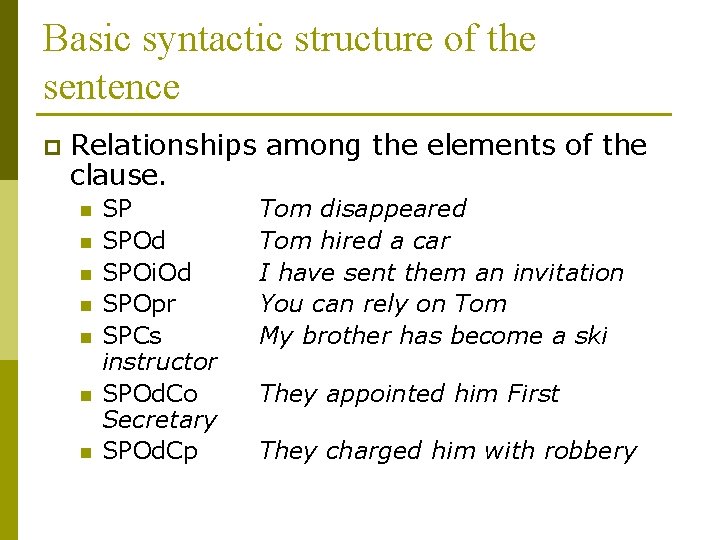
Basic syntactic structure of the sentence p Relationships among the elements of the clause. n n n n SP SPOd SPOi. Od SPOpr SPCs instructor SPOd. Co Secretary SPOd. Cp Tom disappeared Tom hired a car I have sent them an invitation You can rely on Tom My brother has become a ski They appointed him First They charged him with robbery
Basic syntactic structure of the sentence p Other optional elements : n Adjunct (A): an optional circumstance of the process expressed by the clause. p n Disjunct (D): a comment by the speaker on the sentence. p n Tom disappeared suddenly after the concert. Obviously, he'll rely on you even more now. Conjunct (C): element which serves to join together two utterances. p The hotel was rather noisy. On the other hand, it wasn't expensive.