The Life and Legacy of Andrew Jackson Should



- Slides: 13
The Life and Legacy of Andrew Jackson: Should he be praised as a hero – or – condemned as a villain?
Social Studies Success
Texas 8 th Grade TEKS (1) History. The student understands traditional historical points of reference in U. S. history through 1877. The student is expected to: (A) identify the major eras and events in U. S. history through 1877, including …the Age of Jackson, and describe their causes and effects; (5) History. The student understands the challenges confronted by the government and its leaders in the early years of the republic and the Age of Jackson. The student is expected to: (F) explain the impact of the election of Andrew Jackson, including expanded suffrage; and (G) analyze the reasons for the removal and resettlement of Cherokee Indians during the Jacksonian era, including the Indian Removal Act, Worcester v. Georgia, and the Trail of Tears. (7) History. The student understands how political, economic, and social factors led to the growth of sectionalism and the Civil War. The student is expected to: (A) analyze the impact of tariff policies on sections of the United States before the Civil War; (10) Geography. The student understands the location and characteristics of places and regions of the United States, past and present. The student is expected to: (A) locate places and regions of importance in the United States during the 17 th, 18 th, and 19 th centuries; (C) analyze the effects of physical and human geographic factors on major historical and contemporary events in the United States. (17) Government. The student understands the dynamic nature of the powers of the national government and state governments in a federal system. The student is expected to: (B) explain constitutional issues arising over the issue of states' rights, including the Nullification Crisis and the Civil War. (21) Citizenship. The student understands the importance of the expression of different points of view in a constitutional republic. The student is expected to: (C) summarize a historical event in which compromise resulted in a peaceful resolution. (23) Culture. The student understands the relationships between and among people from various groups, including racial, ethnic, and religious groups, during the 17 th, 18 th, and 19 th centuries. The student is expected to: (B) explain the relationship between urbanization and conflicts resulting from differences in religion, social class, and political beliefs; (C) identify ways conflicts between people from various racial, ethnic, and religious groups were resolved; (26) Culture. The student understands the relationship between the arts and the times during which they were created. The student is expected to: (B) identify examples of American art, music, and literature that reflect society in different eras; and (29) Social studies skills. The student applies critical-thinking skills to organize and use information acquired through established research methodologies from a variety of valid sources, including electronic technology. The student is expected to: (A) differentiate between, locate, and use valid primary and secondary sources such as computer software, databases, media and news services, biographies, interviews, and artifacts to acquire information about the United States; (B) analyze information by sequencing, categorizing, identifying cause-and-effect relationships, comparing, contrasting, finding the main idea, summarizing, making generalizations and predictions, and drawing inferences and conclusions; (C) organize and interpret information from outlines, reports, databases, and visuals, including graphs, charts, timelines, and maps; (D) identify points of view from the historical context surrounding an event and the frame of reference which influenced the participants; (E) support a point of view on a social studies issue or event; Social Studies Success
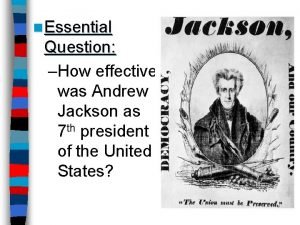
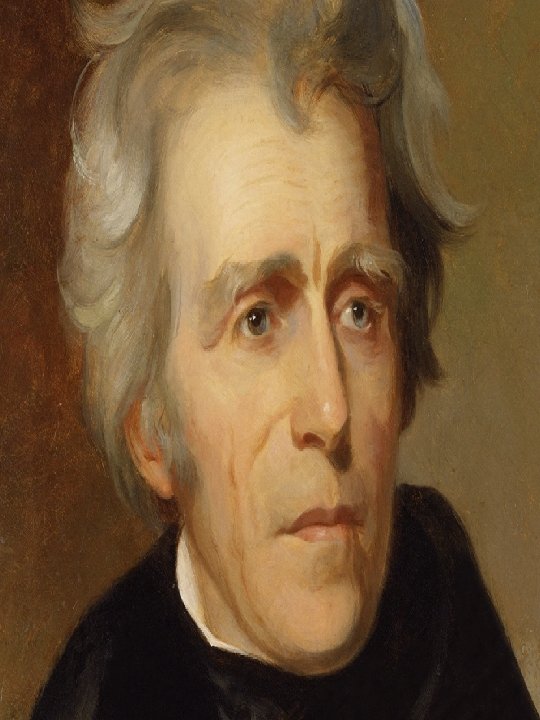
The Life and Legacy of Andrew Jackson was elected as the Jackson seventh president of the United States in 1828. He served as president from 1829 -1837. In his personal and professional life, his actions have earned him the title of both a hero and a villain. He was an extremely popular war hero who started the Democratic Party and was known as “the People’s President”. During his time as president, Jackson destroyed the Second National Bank of the United States, Andrew Jackson – Seventh President of the U. S. increased people’s participation in government, and implemented policies that resulted in the forced migration of Native Americans that killed thousands of people. He died on June 8, 1845, but his legacy has lasted into the 21 st century. Early Life Andrew Jackson was born in a small house somewhere between the border of North and South Carolina. His father died just 3 months before his birth, and his family lived in poverty. His mother and two brothers were killed by the British during the American Revolution. Painting showing a young Andrew Jackson fighting the British. Despite these hardships, Jackson studied law and became an attorney at age 21. He started a successful law practice and fell in love with Rachel Robards – who at the time was separated from her husband. Rachel and Andrew married before the divorce was final, which caused controversy the rest of their married life. Andrew earned the reputation as a fighter, because he fought many duels to defend his wife’s and own honor – he even killed one man in a duel. Andrew Jackson also owned a plantation in Tennessee. When he first purchased the home and land, he also purchased 9 enslaved people. By the time of his death in 1845, he owned more than 150 enslaved people. Stop and Discuss: In what ways would Andrew Jackson be viewed as a hero? In what ways would he be viewed as a villain? Add statements to your Andrew Jackson graphic organizer for both “Hero” and “Villain”. Social Studies Success 1
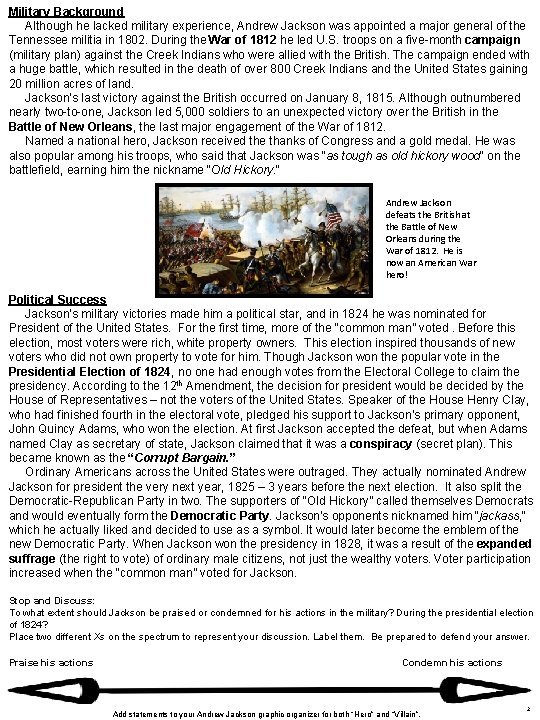
Military Background Although he lacked military experience, Andrew Jackson was appointed a major general of the Tennessee militia in 1802. During the War of 1812 he led U. S. troops on a five-month campaign (military plan) against the Creek Indians who were allied with the British. The campaign ended with a huge battle, which resulted in the death of over 800 Creek Indians and the United States gaining 20 million acres of land. Jackson’s last victory against the British occurred on January 8, 1815. Although outnumbered nearly two-to-one, Jackson led 5, 000 soldiers to an unexpected victory over the British in the Battle of New Orleans, the last major engagement of the War of 1812. Named a national hero, Jackson received the thanks of Congress and a gold medal. He was also popular among his troops, who said that Jackson was "as tough as old hickory wood" on the battlefield, earning him the nickname "Old Hickory. " Andrew Jackson defeats the British at the Battle of New Orleans during the War of 1812. He is now an American War hero! Political Success Jackson’s military victories made him a political star, and in 1824 he was nominated for President of the United States. For the first time, more of the “common man” voted. Before this election, most voters were rich, white property owners. This election inspired thousands of new voters who did not own property to vote for him. Though Jackson won the popular vote in the Presidential Election of 1824, no one had enough votes from the Electoral College to claim the presidency. According to the 12 th Amendment, the decision for president would be decided by the House of Representatives – not the voters of the United States. Speaker of the House Henry Clay, who had finished fourth in the electoral vote, pledged his support to Jackson’s primary opponent, John Quincy Adams, who won the election. At first Jackson accepted the defeat, but when Adams named Clay as secretary of state, Jackson claimed that it was a conspiracy (secret plan). This became known as the “Corrupt Bargain. ” Ordinary Americans across the United States were outraged. They actually nominated Andrew Jackson for president the very next year, 1825 – 3 years before the next election. It also split the Democratic-Republican Party in two. The supporters of “Old Hickory” called themselves Democrats and would eventually form the Democratic Party. Jackson's opponents nicknamed him "jackass, “ which he actually liked and decided to use as a symbol. It would later become the emblem of the new Democratic Party. When Jackson won the presidency in 1828, it was a result of the expanded suffrage (the right to vote) of ordinary male citizens, not just the wealthy voters. Voter participation increased when the “common man” voted for Jackson. Stop and Discuss: To what extent should Jackson be praised or condemned for his actions in the military? During the presidential election of 1824? Place two different Xs on the spectrum to represent your discussion. Label them. Be prepared to defend your answer. Praise his actions Condemn his actions Add statements to your Andrew Jackson graphic organizer for both “Hero” and “Villain”. 2
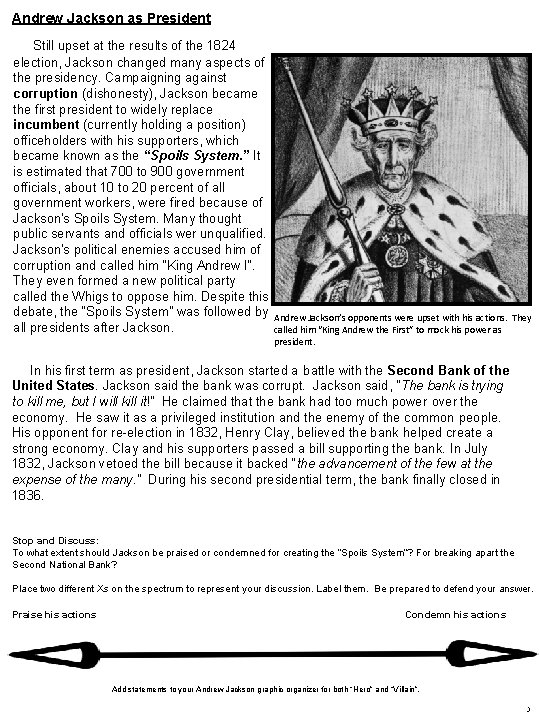
Andrew Jackson as President Still upset at the results of the 1824 election, Jackson changed many aspects of the presidency. Campaigning against corruption (dishonesty), Jackson became the first president to widely replace incumbent (currently holding a position) officeholders with his supporters, which became known as the “Spoils System. ” It is estimated that 700 to 900 government officials, about 10 to 20 percent of all government workers, were fired because of Jackson's Spoils System. Many thought public servants and officials wer unqualified. Jackson's political enemies accused him of corruption and called him "King Andrew I“. They even formed a new political party called the Whigs to oppose him. Despite this debate, the “Spoils System” was followed by Andrew Jackson’s opponents were upset with his actions. They all presidents after Jackson. called him “King Andrew the First” to mock his power as president. In his first term as president, Jackson started a battle with the Second Bank of the United States. Jackson said the bank was corrupt. Jackson said, "The bank is trying to kill me, but I will kill it!" He claimed that the bank had too much power over the economy. He saw it as a privileged institution and the enemy of the common people. His opponent for re-election in 1832, Henry Clay, believed the bank helped create a strong economy. Clay and his supporters passed a bill supporting the bank. In July 1832, Jackson vetoed the bill because it backed “the advancement of the few at the expense of the many. ” During his second presidential term, the bank finally closed in 1836. Stop and Discuss: To what extent should Jackson be praised or condemned for creating the “Spoils System”? For breaking apart the Second National Bank? Place two different Xs on the spectrum to represent your discussion. Label them. Be prepared to defend your answer. Praise his actions Condemn his actions Add statements to your Andrew Jackson graphic organizer for both “Hero” and “Villain”. 3
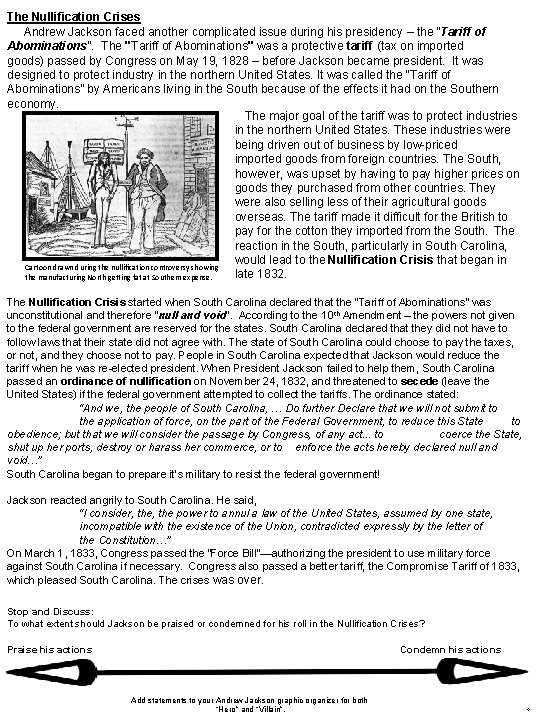
The Nullification Crises Andrew Jackson faced another complicated issue during his presidency – the “Tariff of Abominations”. The "Tariff of Abominations" was a protective tariff (tax on imported goods) passed by Congress on May 19, 1828 – before Jackson became president. It was designed to protect industry in the northern United States. It was called the “Tariff of Abominations” by Americans living in the South because of the effects it had on the Southern economy. The major goal of the tariff was to protect industries in the northern United States. These industries were being driven out of business by low-priced imported goods from foreign countries. The South, however, was upset by having to pay higher prices on goods they purchased from other countries. They were also selling less of their agricultural goods overseas. The tariff made it difficult for the British to pay for the cotton they imported from the South. The reaction in the South, particularly in South Carolina, would lead to the Nullification Crisis that began in Cartoon drawn during the nullification controversy showing late 1832. the manufacturing North getting fat at Southern expense. The Nullification Crisis started when South Carolina declared that the “Tariff of Abominations” was unconstitutional and therefore “null and void”. According to the 10 th Amendment – the powers not given to the federal government are reserved for the states. South Carolina declared that they did not have to follow laws that their state did not agree with. The state of South Carolina could choose to pay the taxes, or not, and they choose not to pay. People in South Carolina expected that Jackson would reduce the tariff when he was re-elected president. When President Jackson failed to help them, South Carolina passed an ordinance of nullification on November 24, 1832, and threatened to secede (leave the United States) if the federal government attempted to collect the tariffs. The ordinance stated: “And we, the people of South Carolina, … Do further Declare that we will not submit to the application of force, on the part of the Federal Government, to reduce this State to obedience; but that we will consider the passage by Congress, of any act. . . to coerce the State, shut up her ports, destroy or harass her commerce, or to enforce the acts hereby declared null and void…” South Carolina began to prepare it’s military to resist the federal government! Jackson reacted angrily to South Carolina. He said, “I consider, the power to annul a law of the United States, assumed by one state, incompatible with the existence of the Union, contradicted expressly by the letter of the Constitution…” On March 1, 1833, Congress passed the ”Force Bill”—authorizing the president to use military force against South Carolina if necessary. Congress also passed a better tariff, the Compromise Tariff of 1833, which pleased South Carolina. The crises was over. Stop and Discuss: To what extent should Jackson be praised or condemned for his roll in the Nullification Crises? Praise his actions Condemn his actions Add statements to your Andrew Jackson graphic organizer for both “Hero” and “Villain”. 4
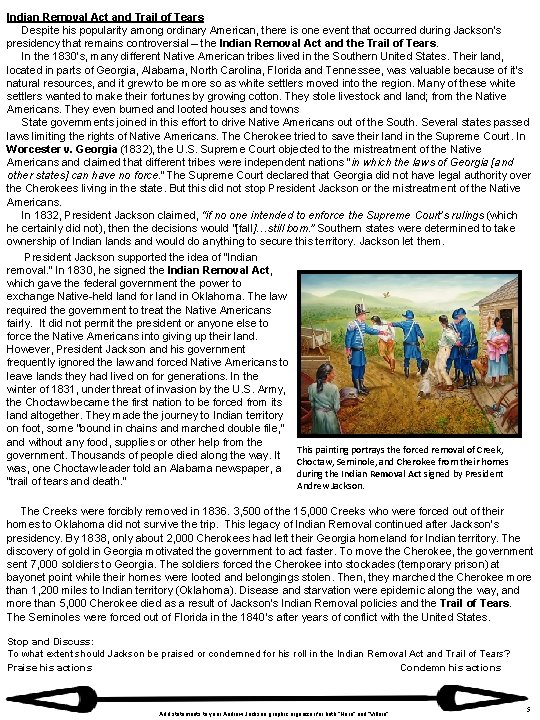
Indian Removal Act and Trail of Tears Despite his popularity among ordinary American, there is one event that occurred during Jackson’s presidency that remains controversial – the Indian Removal Act and the Trail of Tears. In the 1830’s, many different Native American tribes lived in the Southern United States. Their land, located in parts of Georgia, Alabama, North Carolina, Florida and Tennessee, was valuable because of it’s natural resources, and it grew to be more so as white settlers moved into the region. Many of these white settlers wanted to make their fortunes by growing cotton. They stole livestock and land; from the Native Americans. They even burned and looted houses and towns State governments joined in this effort to drive Native Americans out of the South. Several states passed laws limiting the rights of Native Americans. The Cherokee tried to save their land in the Supreme Court. In Worcester v. Georgia (1832), the U. S. Supreme Court objected to the mistreatment of the Native Americans and claimed that different tribes were independent nations “in which the laws of Georgia [and other states] can have no force. ” The Supreme Court declared that Georgia did not have legal authority over the Cherokees living in the state. But this did not stop President Jackson or the mistreatment of the Native Americans. In 1832, President Jackson claimed, “if no one intended to enforce the Supreme Court’s rulings (which he certainly did not), then the decisions would “[fall]…still born. ” Southern states were determined to take ownership of Indian lands and would do anything to secure this territory. Jackson let them. President Jackson supported the idea of “Indian removal. ” In 1830, he signed the Indian Removal Act, which gave the federal government the power to exchange Native-held land for land in Oklahoma. The law required the government to treat the Native Americans fairly. It did not permit the president or anyone else to force the Native Americans into giving up their land. However, President Jackson and his government frequently ignored the law and forced Native Americans to leave lands they had lived on for generations. In the winter of 1831, under threat of invasion by the U. S. Army, the Choctaw became the first nation to be forced from its land altogether. They made the journey to Indian territory on foot, some “bound in chains and marched double file, ” and without any food, supplies or other help from the This painting portrays the forced removal of Creek, government. Thousands of people died along the way. It Choctaw, Seminole, and Cherokee from their homes was, one Choctaw leader told an Alabama newspaper, a during the Indian Removal Act signed by President “trail of tears and death. ” Andrew Jackson. The Creeks were forcibly removed in 1836. 3, 500 of the 15, 000 Creeks who were forced out of their homes to Oklahoma did not survive the trip. This legacy of Indian Removal continued after Jackson’s presidency. By 1838, only about 2, 000 Cherokees had left their Georgia homeland for Indian territory. The discovery of gold in Georgia motivated the government to act faster. To move the Cherokee, the government sent 7, 000 soldiers to Georgia. The soldiers forced the Cherokee into stockades (temporary prison) at bayonet point while their homes were looted and belongings stolen. Then, they marched the Cherokee more than 1, 200 miles to Indian territory (Oklahoma). Disease and starvation were epidemic along the way, and more than 5, 000 Cherokee died as a result of Jackson’s Indian Removal policies and the Trail of Tears. The Seminoles were forced out of Florida in the 1840’s after years of conflict with the United States. Stop and Discuss: To what extent should Jackson be praised or condemned for his roll in the Indian Removal Act and Trail of Tears? Praise his actions Condemn his actions Add statements to your Andrew Jackson graphic organizer for both “Hero” and “Villain”. 5
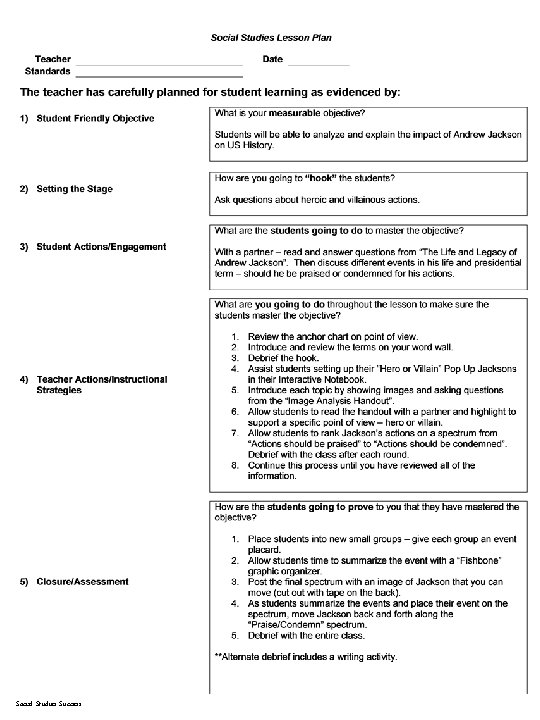
Additional Lesson Materials Prior to the lesson, make copies of “hero and villain” Jackson for your students – each student will need two figures – one to represent each side. I recommend copying them onto card stock, but they will work on regular paper as well. Directions for the Pop-Up Jacksons are embedded into the Power. Point. The image of Jackson at the end of this packet can be used to move him along the spectrum in the debrief activity. Event placards and Word Wall terms are located at the end of the Power. Point with the presentation. Social Studies Success
Fold here and glue this spot down in notebook. ---------------------------------------------------------------------------------------------------------------------------------- Fold here and glue this spot down in notebook. Social Studies Success Fold here and glue this spot down in notebook.
Connect with me! Email me at Social. Studies. Success 1@gmail. com with questions or for custom work – and follow my blog at Social. Studies. Success 1. blogspot. com Did you like this lesson? Click on a link below to explore more exciting lessons for US History, Texas History and Geography! © 2016 Social Studies Success, LLC. All rights reserved by author. This product is to be used by one teacher only. Copying for more than one teacher, classroom, department, school, or school system is prohibited. This product may not be distributed or displayed digitally for public view. Please so not upload to a shared computer space! Failure to comply is a copyright infringement and a violation of the Digital Millennium Copyright Act (DMCA). Clipart and elements found in this PDF are copyrighted and cannot be extracted and used outside of this file without permission or license. Intended for classroom and personal use ONLY. All images are taken from public domain or purchased through The Dollar Spot Stock Photography. This includes images taken by employees of various US Government agencies; images published prior to 1923; or images that have otherwise been released to public domain. Clip Art from Dandy Doodles, The Spanish Teacher, and Tracey Gurley Design. Fonts from Kimberly Geswen fonts.