THE LEGAL JUDGE THE RIGHT TO THE ORDINARY



- Slides: 25
THE LEGAL JUDGE THE RIGHT TO THE ORDINARY JUDGE PREDETERMINED BY LAW
Meaning of Legal Judge • Restricted/narrow sense: the natural judge, that is, the judge allocated to the place were the crime has been committed/ defendant lives. • Broader/wider sense: the ordinary judge predermined by law.
Judge predermined by law • The rules establish not only the territorial location in which a litigation should be conducted, but also the objective and functional competence: – Which court is competent for first instance proceeding. – Which court is competent for appeal….
CASE ASSIGNMENT • Is the core-business of court organisation. • Touches upon some essential aspects of rendering justice: – Judicial independence and impartiality. – Organisational flexibility – Efficiency.
First conclusions • The right to ordinary judge predetermined by law touch upon both essential principles of adjudication and the practicability of everyday work in the courts. • If courts did not organize case allocation properly general public could form the view that judges are not impartial. • It is essential that case allocation processes is predeterminated by law and transparent.
Spanish meaning of Legal Judge • Article 24. 2 Spanish Constitution: • “All have the right to the ordinary judge predertermined by law” • Includes both the narrow and wider sense. • Article 24. 2 has to be enforced by all public powers.
Fundamental features 1. When our Constitution says “by law” means Organic Law. 2. Legal Judge predetermined by law has to be integrated in the Judicial Power. 3. The Judge is independent and subject only to the rule of law 4. The “legal Judge” and the judicial competence.
ORGANIC LAW
ORGANIC LAW • Is a law passed by an absolute majority of Parliament. • Laws of Development of Fundamental Rights and Freedoms. • Organic laws are at the same level as ordinary laws. • Difference between the two: more restrictive process for creating Organic Laws and the matters that they regulates.
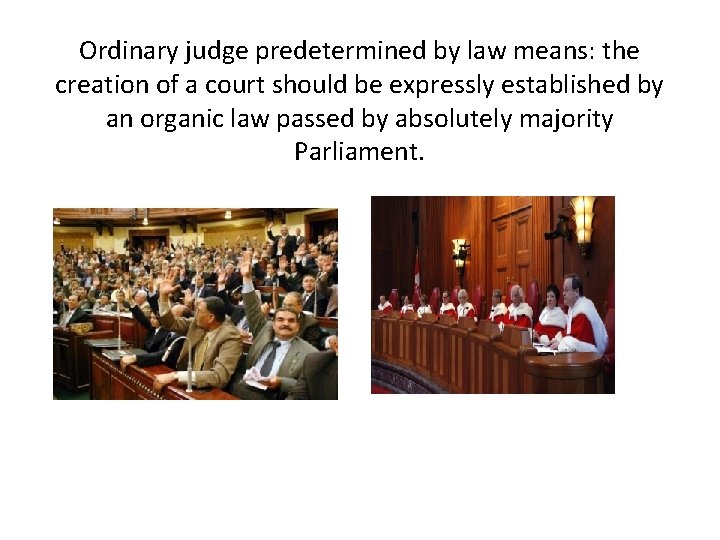
Ordinary judge predetermined by law means: the creation of a court should be expressly established by an organic law passed by absolutely majority Parliament.
Second conclusion • The LOPJ is a law that belongs to constitutional laws group. • It is not possible to pass a law that determines the creation of courts with a procedure different from absolute majority of votes from Parliament.
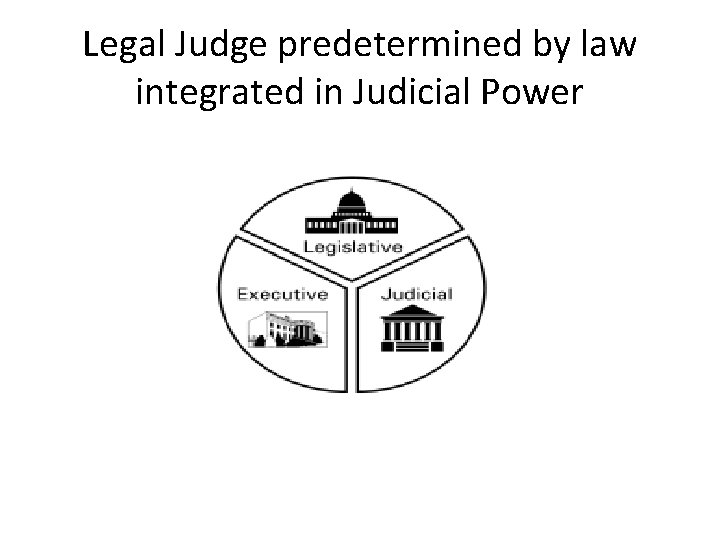
Legal Judge predetermined by law integrated in Judicial Power
Legal Judge predetermined by law integrated in Judicial Power • The judge must be “ordinary”: belongs to ordinary jurisdiction (civil, criminal, administrative, labour) • Exceptions: Consuetudinary Tribunals, military jusrisdiction, constitutional court,
Independent and subject only to the rule of law
Independent and subject only to the rule of law • Article 117 Spanish Constitution: • “The judges members of the Judicial Power shall be independent, sahll have fixed tenure (inamovibles), shall be accountable for their acts (responsables) and subject only to the rule of law (sometidos únicamente al imperio de la ley). • Legitimacy of their jurisdiction.
Independent and subject only to the rule of law Rule of law: Judges are not allowed to do political functions through their judments. When deciding a case they cannot have in mind anything other than the enforcement of law, the rule of law.
Third conclusion Only an independent judiciary is able to render justice impartially on the basis of law, thereby also protecting human rights and fundamental freedoms. The principle of independence of judges was not invented for personal benefit of judges themselves, but to protect human beings against abuses of power.
Legal judge and judicial competence
Legal judge and judicial competence The ordinary judge predetermined by law is the judge that has: objective, functional and territorial competence.
Violation of right to the ordinary judge predermined by law The violation of the right that establish the judicial competence implies a violation of judicial independence.
Examples • Manipulation of rules distribution of cases among judges (case assignment ) • Manipulation of rules that composition panel of judges establish
No violation right • When condition of acces are predermined by law: substitute judges, alternate judges, temporary judges. • Creation of National High Court (Audiencia Nacional)
Prohibition of exceptional courts Disallowing aspect of the right to the legal judge predetermined by law: prohibition of ad hoc courts.
Meaning of Ad Hoc Courts • Special courts created only for judging a specific kind of crime and after the commission of that crime (Nuremberg Court) • Courts manipualted in their composition. • High National Court?
National High Court • Constitutional Court (judgment nº 56/1990, 30 th March) 1. The right to the legal judge does not excluded the possibility to establish spacial rules of competence among the several courts in Spain. 2. The National High Court is not contrary to article 152. 1 CE, becasue the power to try some special cases (matters) in that court has been conferred by the LOPJ with exclusion of the rest of courts in Spain.