
Teaching Clinical Reasoning Jennifer Jackson MD Wake Forest

- Slides: 32
Teaching Clinical Reasoning Jennifer Jackson, MD Wake Forest School of Medicine Ronald Silvestri, MD Harvard Medical School
Goals & Objectives l Discuss clinical reasoning terminology l Describe cognitive models of clinical reasoning l Discuss instructional strategies for helping students develop their clinical reasoning skills throughout their curriculum l Take home to your institutions practical ideas for how to improve the teaching of clinical reasoning to your students
Why teach students about clinical reasoning? l Diagnostic errors are frequent. – – l Estimates: 10 -15% Common occurrence in all fields of medicine Diagnostic errors have major consequences. – – 2 nd leading cause of adverse events, among medical errors Associated with higher morbidity than other medical error types
Why teach students about clinical reasoning? l Thinking about how we reason makes us more effective clinicians. - l When clinicians are forced to rethink their instinctive responses in solving complex cases, they make fewer diagnostic errors. Teaching novices strategies to avoid cognitive errors can shorten their road to attainment of expertise.
Clinical Reasoning Skills THE LINGO
Clinical Reasoning (“Clinical Cognition”) “The range of strategies that clinicians use to generate, test, and verify diagnoses, to assess the benefits and risks of tests and treatments, and to judge the prognostic significance of the outcomes of these cognitive achievements” - Kassirer 2010
Problem Representation l A physician’s evolving sense of the clinical picture; a way of describing a specific case in abstract terms (“one liner”) - l e. g. , full-term newborn with severe, acute respiratory distress Components: - Patient demographics Clinical features from the history and PE Semantic qualifiers (severe vs. mild; acute vs. chronic; unilateral vs. bilateral)
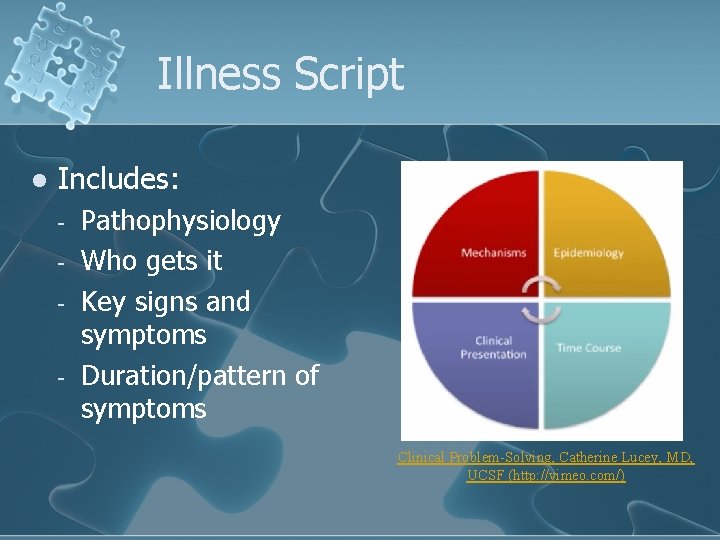
Illness Script l A mental representation of the important elements of an illness - e. g. , strep throat: acute, febrile illness with exudative tonsillitis l The same illness script may be linked to more than one problem representation (i. e. , different clinical presentations of the same disease). l Developed by medical knowledge and refined through clinical experience
Illness Script l Includes: - Pathophysiology Who gets it Key signs and symptoms Duration/pattern of symptoms Clinical Problem-Solving, Catherine Lucey, MD, UCSF (http: //vimeo. com/)
Cognitive Models of Clinical Reasoning Dual-processing theory: 2 distinct modes of thinking occur when clinicians reason: l Intuitive (non-analytic) reasoning: “gut reaction”—impulsive, effortless, reflexive - l Pattern recognition Highly context dependent Error prone “Looks like a duck” Analytical reasoning: slow, explicit, deliberate, purposeful effort to solve a problem - Hypothetico-deductive Generally more reliable
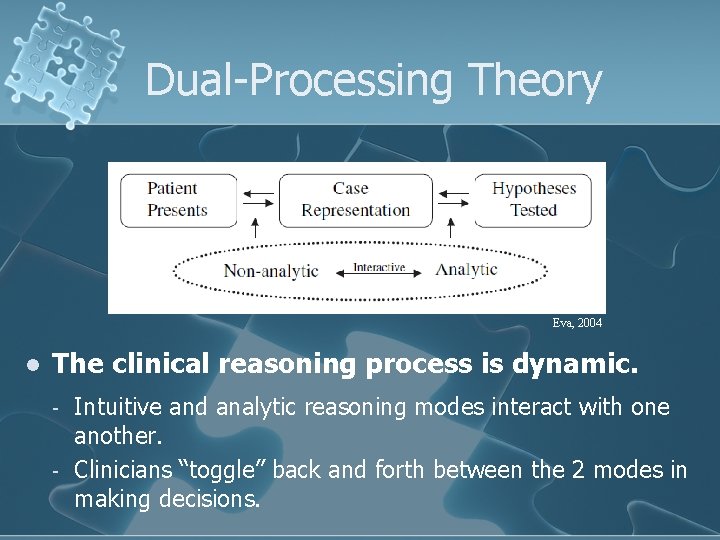
Dual-Processing Theory Eva, 2004 l The clinical reasoning process is dynamic. - Intuitive and analytic reasoning modes interact with one another. Clinicians “toggle” back and forth between the 2 modes in making decisions.
Dual-Processing Theory l Analytic mode can override the intuitive mode, and vice versa. l Repeated presentations to the analytic mode will eventually result in pattern recognition default to the intuitive mode. l Novices tend to spend more time in the analytic mode, whereas experienced clinicians spend more time in the intuitive mode.
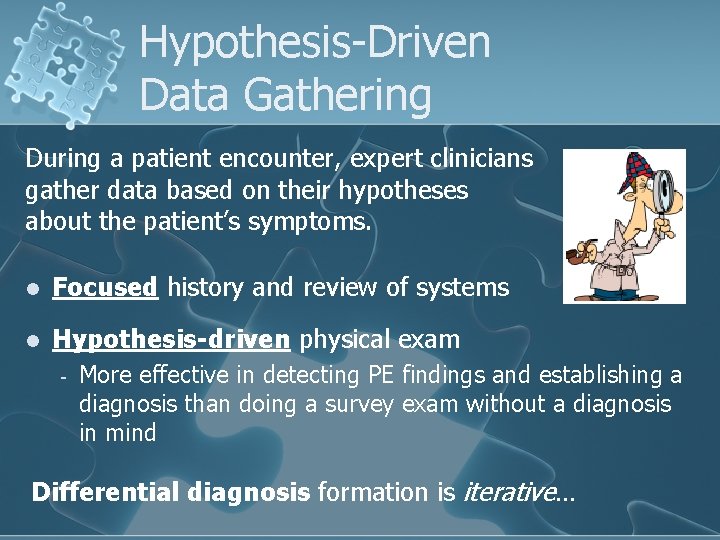
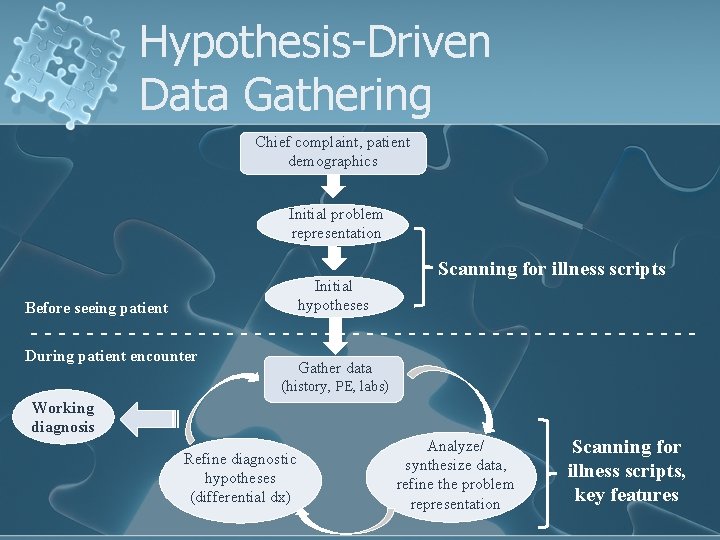
Hypothesis-Driven Data Gathering During a patient encounter, expert clinicians gather data based on their hypotheses about the patient’s symptoms. l Focused history and review of systems l Hypothesis-driven physical exam - More effective in detecting PE findings and establishing a diagnosis than doing a survey exam without a diagnosis in mind Differential diagnosis formation is iterative…
Hypothesis-Driven Data Gathering Chief complaint, patient demographics Initial problem representation Initial hypotheses Before seeing patient Scanning for illness scripts ------------------------During patient encounter Gather data (history, PE, labs) Working diagnosis Refine diagnostic hypotheses (differential dx) Analyze/ synthesize data, refine the problem representation Scanning for illness scripts, key features
Metacognition l A method of introspection in which one contemplates or reflects on one’s own thinking; i. e. , thinking about thinking “It distinguishes…the thinking of experts from that of non-experts. ” - Croskerry 2003
Metacognition l Effective metacognition involves: - Awareness of the learning process—knowing when a piece of information is important enough to commit to memory - Recognition of the limitations of memory - Ability to step back from the immediate problem at hand appreciate the broader picture - Capacity for realistic self-critique and self-monitoring - Ability to actively select a strategy to deal with problems in decision-making—a deliberate cognitive intervention in the thinking process
Coming…. . Clinical Reasoning Skills TEACHING METHODS & STRATEGIES
Small Group Discussion Your curriculum revision subcommittee is charged with optimizing the teaching of clinical reasoning 1. What specific educational experiences and curricular changes would you propose & where? 2. Which of these changes are possible in the near term vs. intermediate term in your institution? 3. What are the obstacles to your students improving their clinical reasoning skillfulness?
Large Group Discussion l Each table takes 5 minutes to report its proposed educational experiences, curricular changes, obstacles, etc. l Large group exchange of ideas
Clinical Reasoning Skills TEACHING METHODS & STRATEGIES
Clinical Reasoning Starts at the Bedside l Sufficiently detailed & discriminating H&P l Think “What’s going on & what’s causing it” from the beginning of the HPI l Generate hypotheses as to potential causes of the problem l Test these hypotheses during H&P, seeking evidence of “clusters” of sx and signs pointing to various hypotheses amidst HTT exam l Allow hypotheses to be refined as new H&P data obtained l Use illness scripts, prior experience, or Dx props
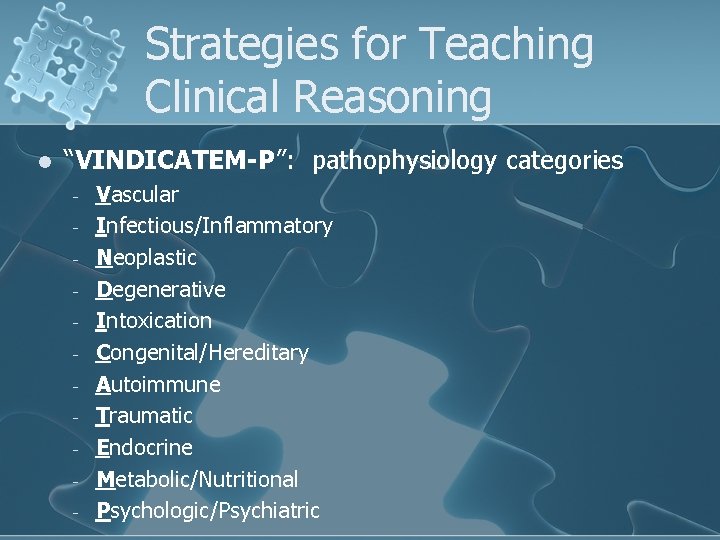
Strategies for Teaching Clinical Reasoning l “VINDICATEM-P”: pathophysiology categories - Vascular Infectious/Inflammatory Neoplastic Degenerative Intoxication Congenital/Hereditary Autoimmune Traumatic Endocrine Metabolic/Nutritional Psychologic/Psychiatric
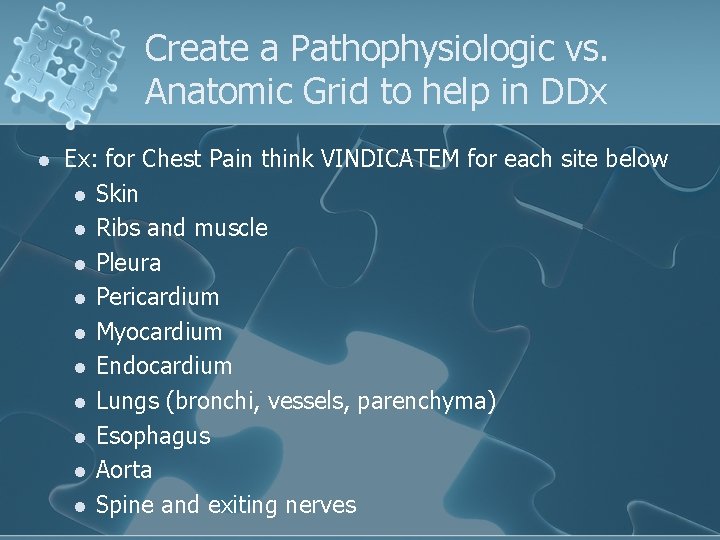
Create a Pathophysiologic vs. Anatomic Grid to help in DDx l Ex: for Chest Pain think VINDICATEM for each site below l Skin l Ribs and muscle l Pleura l Pericardium l Myocardium l Endocardium l Lungs (bronchi, vessels, parenchyma) l Esophagus l Aorta l Spine and exiting nerves
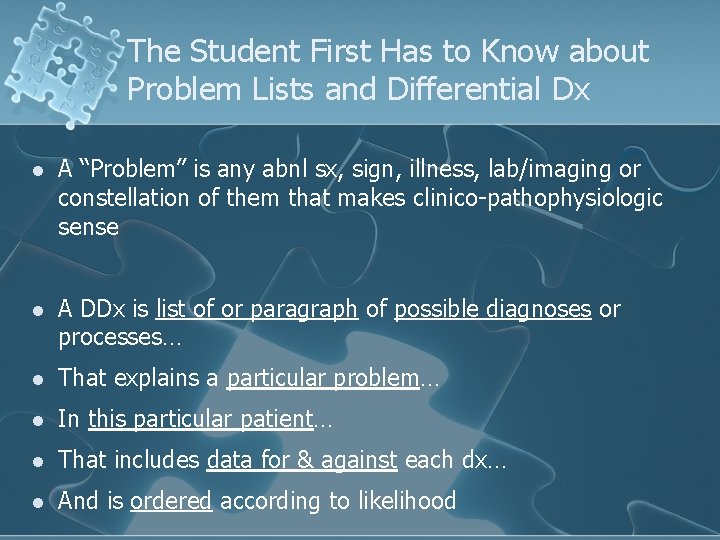
The Student First Has to Know about Problem Lists and Differential Dx l A “Problem” is any abnl sx, sign, illness, lab/imaging or constellation of them that makes clinico-pathophysiologic sense l A DDx is list of or paragraph of possible diagnoses or processes… l That explains a particular problem… l In this particular patient… l That includes data for & against each dx… l And is ordered according to likelihood
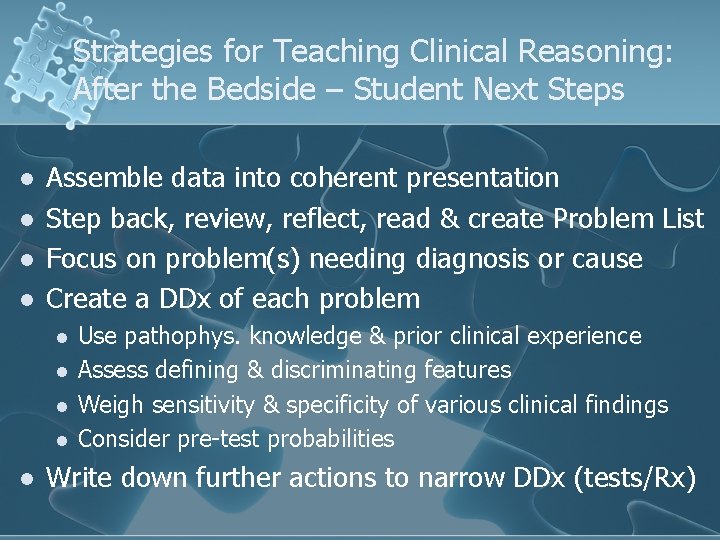
Strategies for Teaching Clinical Reasoning: After the Bedside – Student Next Steps l l Assemble data into coherent presentation Step back, review, reflect, read & create Problem List Focus on problem(s) needing diagnosis or cause Create a DDx of each problem l l l Use pathophys. knowledge & prior clinical experience Assess defining & discriminating features Weigh sensitivity & specificity of various clinical findings Consider pre-test probabilities Write down further actions to narrow DDx (tests/Rx)
Teaching Clinical Reasoning l Early meaningful mentored clinical exposure l Allow students to PRACTICE these skills on their own patient cases, and do it often! l Use current “unknown dx” cases and return to those cases where the dx finally made l Introduce the basic concepts of problem representations, illness scripts, and dual-processing. l Discuss possible cognitive errors that can occur (use real examples) and methods for avoiding them.
Strategies for Teaching Clinical Reasoning l CARD: variations of clinical presentation types - Common diseases Atypical presentation of a disease Rare diseases “Don’t miss” diseases
Strategies for Teaching Clinical Reasoning l SEA TOW - Avoiding Errors of Omission Second Opinion…Do I need one? l Eureka Moment…Is this a pattern recognition dx? l Anti-evidence…Is there anything refuting the dx? l Thinking over my thinking…Have I done it? l Overconfident…Am I? l What else… could I be missing? l Williams, PA. Society for Medical Decision Making 2010
Strategies for Teaching Clinical Reasoning - Get a commitment: “what do you think is going on in this case? ” - Probe for supporting evidence: “What led you to that conclusion? ” - Do a Wrap up for “adequacy” and “coherence” of case discussion - Teach 1 -2 general rules that will apply to other situations - Reinforce what was done well - Correct mistakes
Strategies for Teaching Clinical Reasoning Guidebook for Clerkship Directors, 4 th Ed. by Bruce Morgenstern • Lots of additional examples of clinical reasoning exercises for all levels of medical students
References l l l Croskerry P, Nimmo GR. Better clinical decision making and reducing diagnostic error. J R Coll Physicians Edinb 2011; 41: 155– 62. Croskerry P. The importance of cognitive errors in diagnosis and strategies to prevent them. Acad Med 2003; 78: 1– 6. Croskerry P. Cognitive and affective dispositions to respond. In: Croskerry P, Cosby KS, Schenkel S et al. , editors. Patient safety in emergency medicine. Philadelphia: Lippincott Williams & Wilkins; 2008. p. 219– 27. Croskerry P. Cognitive Forcing Strategies in Clinical Decisionmaking. Annals of Emergency Medicine 2003; 41(1): 110 -118. Croskerry P, Abbass A, Wu A. Emotional Influences in Patient Safety. J Patient Saf 2010; 6(4): 1 -7. Hogarth RM. Educating intuition. Chicago: University of Chicago Press; 2001. Elder L, Paul R. Critical thinking development: a stage theory with implications for instruction. Tomales, CA: Foundation for Critical Thinking; 2010. Available from: http: //www. criticalthinking. org/page. cfm? Page. ID=483&Category. ID=68. Kassirer JP. Teaching Clinical Reasoning: Case-Based and Coached. Academic Medicine 2010; 85(7): 1118 -1124. Atkinson K, Ajjawi R, Cooling N. Promoting clinical reasoning in general practice trainees: role of the clinical teacher. The Clinical Teacher 2011; 8: 176 -180. Rencic J. Twelve tips for teaching expertise in clinical reasoning. Med Teach 2011; 33: 887 -892 Eva KW. What every teacher needs to know about clinical reasoning. Med Educ 2004; 39: 98 -106
Wrap Up • Take home points from today • How can or should DOCS as an organization advance the teaching of clinical reasoning? • Can we or should we try to do it alone? If not, who should our partners be?