The Ethical Implications of using Artificial Intelligence in
- Slides: 17
The Ethical Implications of using Artificial Intelligence in Auditing Ivy Munoko Helen Brown-Liburd Miklos Vasarhelyi
Why consider ethics in Artificial Intelligence? The increased use of automation and artificial intelligence (AI) in auditing will result in a shift in the auditor’s roles and level of involvement in the audit, but not the auditor’s responsibility. There are benefits: • AI promises the capability to review unstructured data real-time and provide a concise analysis of numerical, textual and visual data. • “ 30% of corporate audits [will be] performed by AI” by 2025 - World Economic Forum survey of 800 executives and experts However, there are unintended consequences: • “Many AI systems are trained using biased data” – IBM • overreliance on AI when the technology is not matched to the appropriately experienced professional • data privacy issues 44 th WCARS – Sevilla, Spain 2
Why consider ethics in Artificial Intelligence? • The identification of ethical risks has proven a challenging endeavor since the ethical implications of using emerging technology, such as AI, usually become evident after long-term use. • While the accounting profession has a code of conduct that guide ethical decision making and behavior, the existing code and practice guidelines do not presently consider the current or the future use of AI used to assist or, in some cases potentially replace accounting professionals! 44 th WCARS – Sevilla, Spain 3
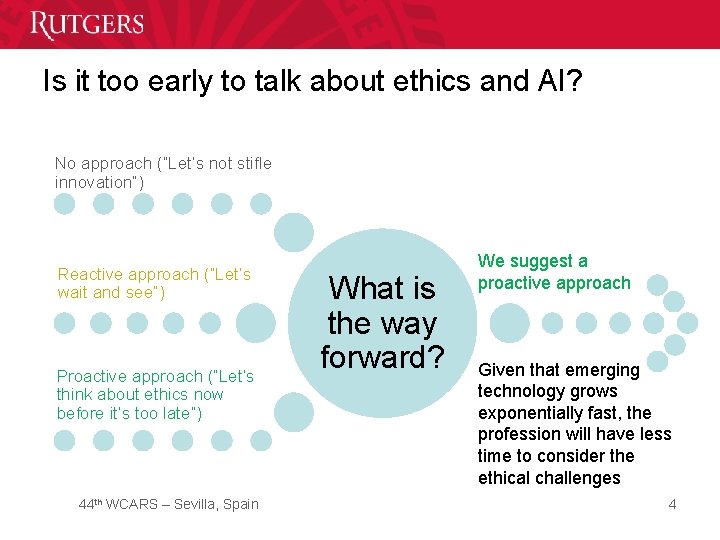
Is it too early to talk about ethics and AI? No approach (“Let’s not stifle innovation”) Reactive approach (“Let’s wait and see”) Proactive approach (“Let’s think about ethics now before it’s too late”) 44 th WCARS – Sevilla, Spain What is the way forward? We suggest a proactive approach Given that emerging technology grows exponentially fast, the profession will have less time to consider the ethical challenges 4
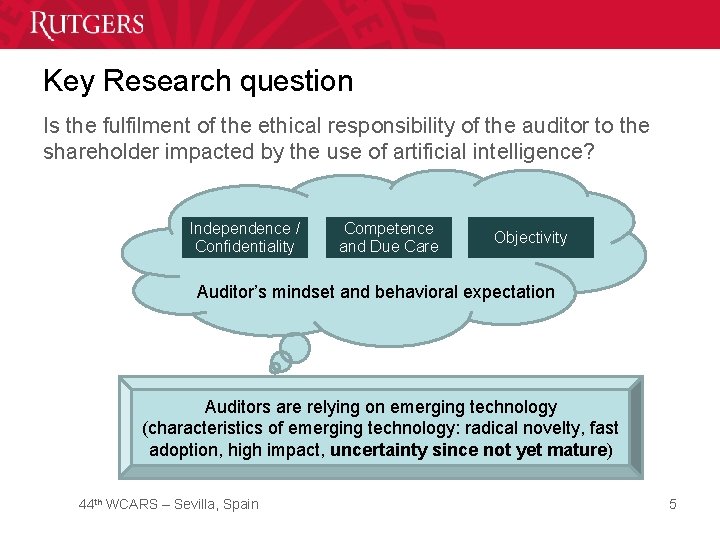
Key Research question Is the fulfilment of the ethical responsibility of the auditor to the shareholder impacted by the use of artificial intelligence? Independence / Confidentiality Competence and Due Care Objectivity Auditor’s mindset and behavioral expectation Auditors are relying on emerging technology (characteristics of emerging technology: radical novelty, fast adoption, high impact, uncertainty since not yet mature) 44 th WCARS – Sevilla, Spain 5
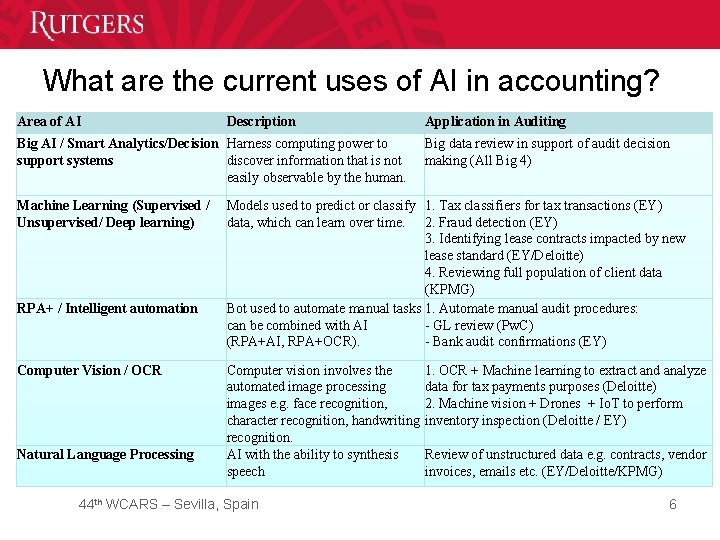
What are the current uses of AI in accounting? Area of AI Description Big AI / Smart Analytics/Decision Harness computing power to support systems discover information that is not easily observable by the human. Machine Learning (Supervised / Unsupervised/ Deep learning) RPA+ / Intelligent automation Computer Vision / OCR Natural Language Processing Application in Auditing Big data review in support of audit decision making (All Big 4) Models used to predict or classify 1. Tax classifiers for tax transactions (EY) data, which can learn over time. 2. Fraud detection (EY) 3. Identifying lease contracts impacted by new lease standard (EY/Deloitte) 4. Reviewing full population of client data (KPMG) Bot used to automate manual tasks 1. Automate manual audit procedures: can be combined with AI - GL review (Pw. C) (RPA+AI, RPA+OCR). - Bank audit confirmations (EY) Computer vision involves the 1. OCR + Machine learning to extract and analyze automated image processing data for tax payments purposes (Deloitte) images e. g. face recognition, 2. Machine vision + Drones + Io. T to perform character recognition, handwriting inventory inspection (Deloitte / EY) recognition. AI with the ability to synthesis Review of unstructured data e. g. contracts, vendor speech invoices, emails etc. (EY/Deloitte/KPMG) 44 th WCARS – Sevilla, Spain 6
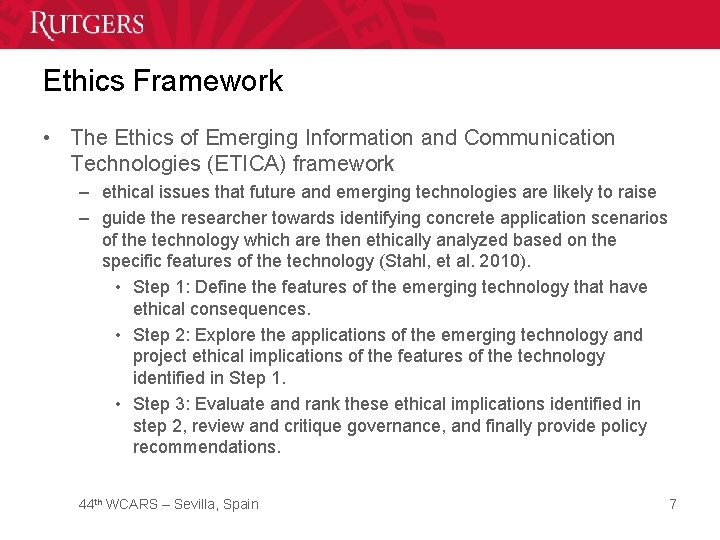
Ethics Framework • The Ethics of Emerging Information and Communication Technologies (ETICA) framework – ethical issues that future and emerging technologies are likely to raise – guide the researcher towards identifying concrete application scenarios of the technology which are then ethically analyzed based on the specific features of the technology (Stahl, et al. 2010). • Step 1: Define the features of the emerging technology that have ethical consequences. • Step 2: Explore the applications of the emerging technology and project ethical implications of the features of the technology identified in Step 1. • Step 3: Evaluate and rank these ethical implications identified in step 2, review and critique governance, and finally provide policy recommendations. 44 th WCARS – Sevilla, Spain 7
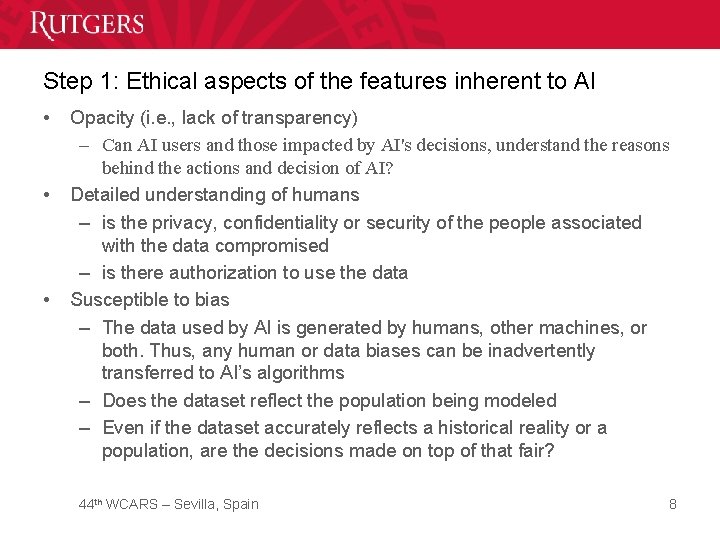
Step 1: Ethical aspects of the features inherent to AI • • • Opacity (i. e. , lack of transparency) – Can AI users and those impacted by AI's decisions, understand the reasons behind the actions and decision of AI? Detailed understanding of humans – is the privacy, confidentiality or security of the people associated with the data compromised – is there authorization to use the data Susceptible to bias – The data used by AI is generated by humans, other machines, or both. Thus, any human or data biases can be inadvertently transferred to AI’s algorithms – Does the dataset reflect the population being modeled – Even if the dataset accurately reflects a historical reality or a population, are the decisions made on top of that fair? 44 th WCARS – Sevilla, Spain 8
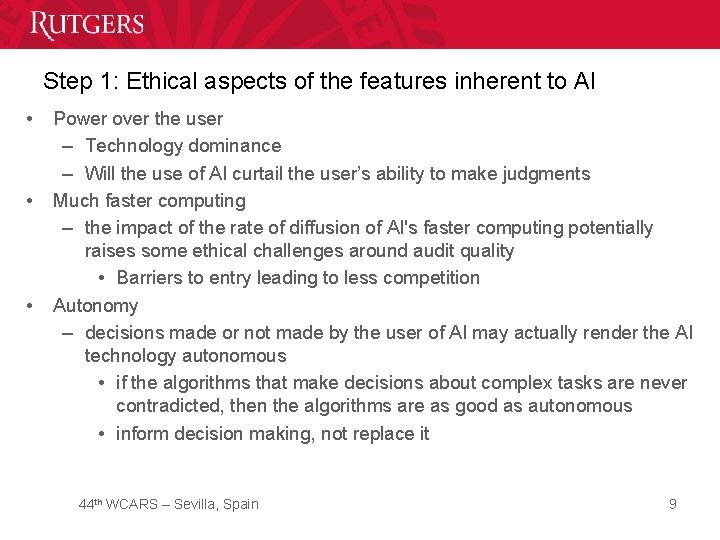
Step 1: Ethical aspects of the features inherent to AI • • • Power over the user – Technology dominance – Will the use of AI curtail the user’s ability to make judgments Much faster computing – the impact of the rate of diffusion of AI's faster computing potentially raises some ethical challenges around audit quality • Barriers to entry leading to less competition Autonomy – decisions made or not made by the user of AI may actually render the AI technology autonomous • if the algorithms that make decisions about complex tasks are never contradicted, then the algorithms are as good as autonomous • inform decision making, not replace it 44 th WCARS – Sevilla, Spain 9
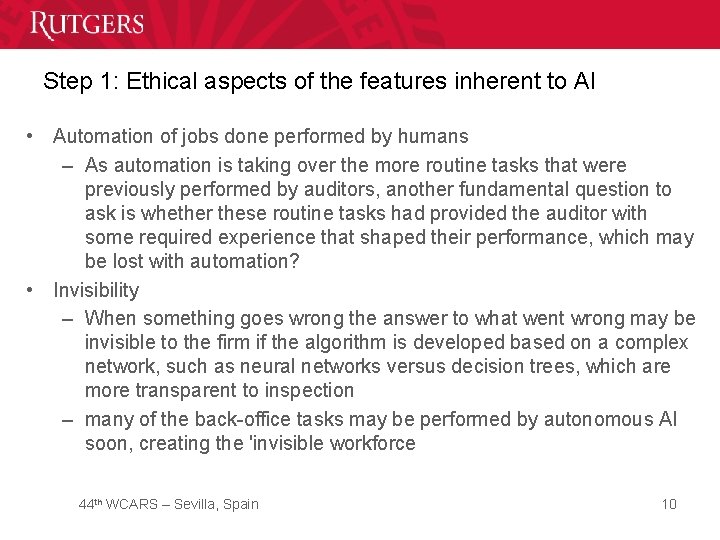
Step 1: Ethical aspects of the features inherent to AI • Automation of jobs done performed by humans – As automation is taking over the more routine tasks that were previously performed by auditors, another fundamental question to ask is whether these routine tasks had provided the auditor with some required experience that shaped their performance, which may be lost with automation? • Invisibility – When something goes wrong the answer to what went wrong may be invisible to the firm if the algorithm is developed based on a complex network, such as neural networks versus decision trees, which are more transparent to inspection – many of the back-office tasks may be performed by autonomous AI soon, creating the 'invisible workforce 44 th WCARS – Sevilla, Spain 10
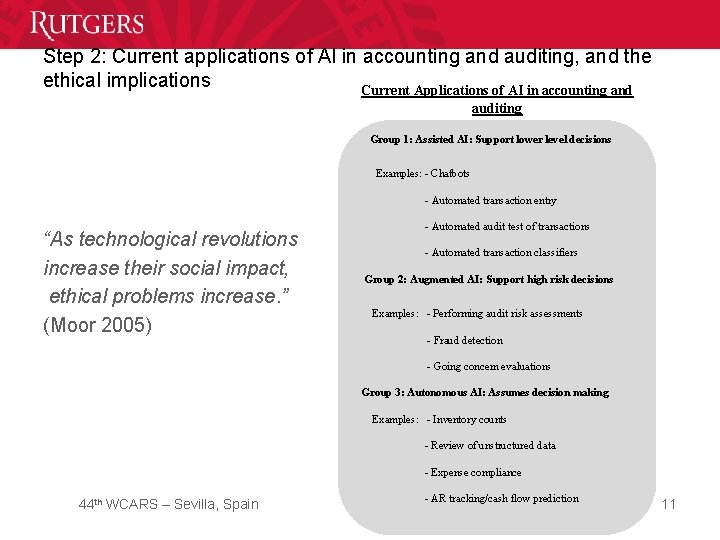
Step 2: Current applications of AI in accounting and auditing, and the ethical implications Current Applications of AI in accounting and auditing Group 1: Assisted AI: Support lower level decisions Examples: - Chatbots - Automated transaction entry “As technological revolutions increase their social impact, ethical problems increase. ” (Moor 2005) - Automated audit test of transactions - Automated transaction classifiers Group 2: Augmented AI: Support high risk decisions Examples: - Performing audit risk assessments - Fraud detection - Going concern evaluations Group 3: Autonomous AI: Assumes decision making Examples: - Inventory counts - Review of unstructured data - Expense compliance 44 th WCARS – Sevilla, Spain - AR tracking/cash flow prediction 11
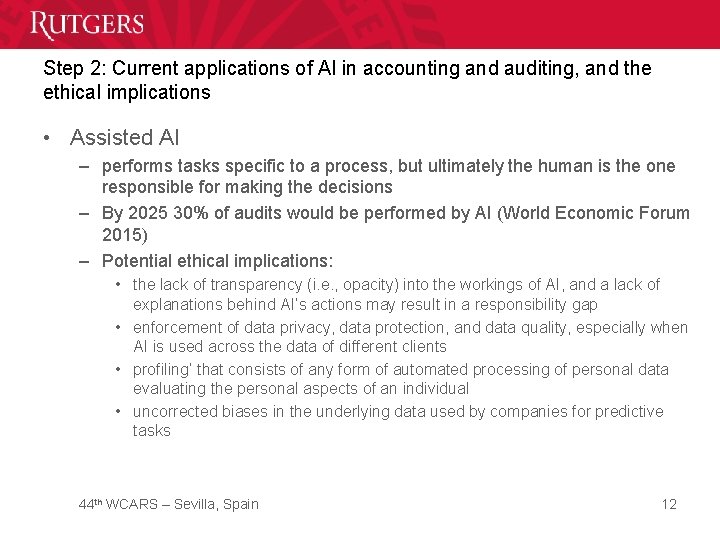
Step 2: Current applications of AI in accounting and auditing, and the ethical implications • Assisted AI – performs tasks specific to a process, but ultimately the human is the one responsible for making the decisions – By 2025 30% of audits would be performed by AI (World Economic Forum 2015) – Potential ethical implications: • the lack of transparency (i. e. , opacity) into the workings of AI, and a lack of explanations behind AI’s actions may result in a responsibility gap • enforcement of data privacy, data protection, and data quality, especially when AI is used across the data of different clients • profiling’ that consists of any form of automated processing of personal data evaluating the personal aspects of an individual • uncorrected biases in the underlying data used by companies for predictive tasks 44 th WCARS – Sevilla, Spain 12
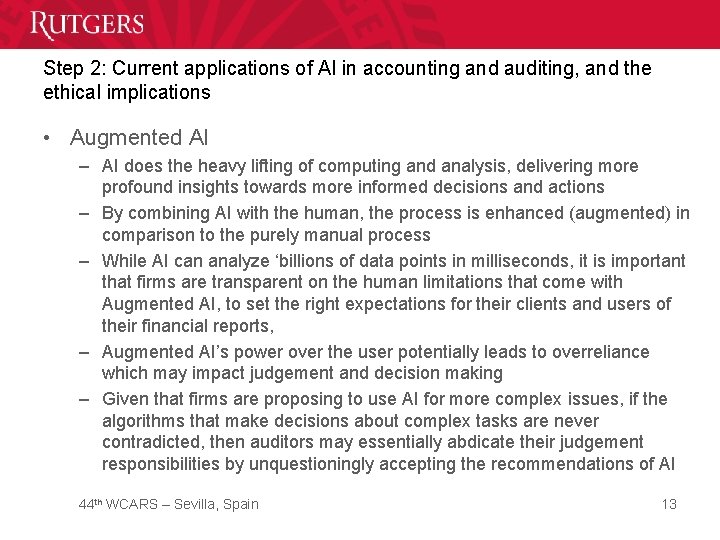
Step 2: Current applications of AI in accounting and auditing, and the ethical implications • Augmented AI – AI does the heavy lifting of computing and analysis, delivering more profound insights towards more informed decisions and actions – By combining AI with the human, the process is enhanced (augmented) in comparison to the purely manual process – While AI can analyze ‘billions of data points in milliseconds, it is important that firms are transparent on the human limitations that come with Augmented AI, to set the right expectations for their clients and users of their financial reports, – Augmented AI’s power over the user potentially leads to overreliance which may impact judgement and decision making – Given that firms are proposing to use AI for more complex issues, if the algorithms that make decisions about complex tasks are never contradicted, then auditors may essentially abdicate their judgement responsibilities by unquestioningly accepting the recommendations of AI 44 th WCARS – Sevilla, Spain 13
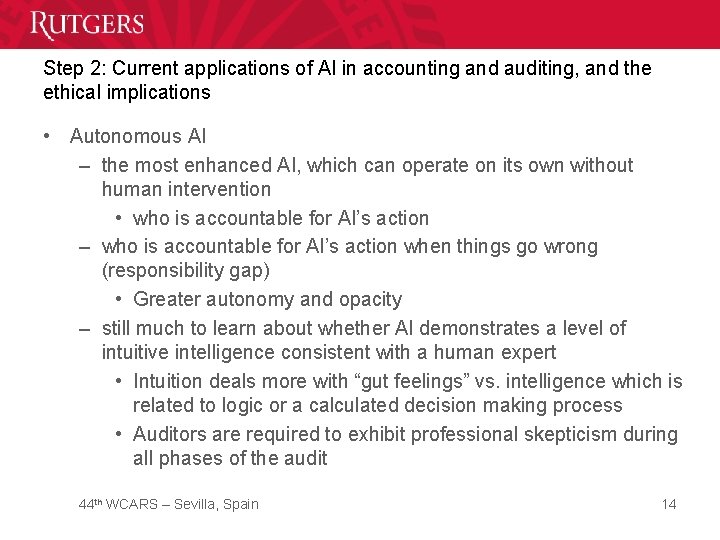
Step 2: Current applications of AI in accounting and auditing, and the ethical implications • Autonomous AI – the most enhanced AI, which can operate on its own without human intervention • who is accountable for AI’s action – who is accountable for AI’s action when things go wrong (responsibility gap) • Greater autonomy and opacity – still much to learn about whether AI demonstrates a level of intuitive intelligence consistent with a human expert • Intuition deals more with “gut feelings” vs. intelligence which is related to logic or a calculated decision making process • Auditors are required to exhibit professional skepticism during all phases of the audit 44 th WCARS – Sevilla, Spain 14
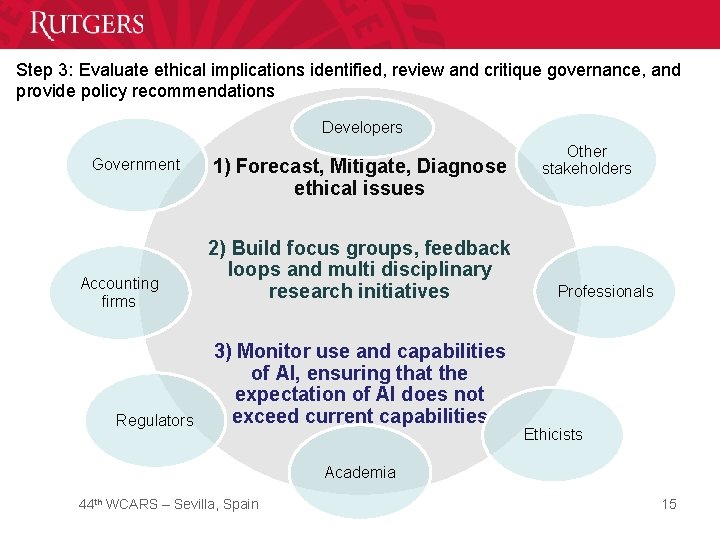
Step 3: Evaluate ethical implications identified, review and critique governance, and provide policy recommendations Developers Government Accounting firms Regulators 1) Forecast, Mitigate, Diagnose ethical issues 2) Build focus groups, feedback loops and multi disciplinary research initiatives 3) Monitor use and capabilities of AI, ensuring that the expectation of AI does not exceed current capabilities Other stakeholders Professionals Ethicists Academia 44 th WCARS – Sevilla, Spain 15
Significance of this research Theoretical Significance Begins to address some of the questions raised in literature: 1. How does the evolution of technology and its adoption affect the audit process? (Issa, Sun and Vasarhelyi 2016) 2. Consider how to address the known limitations of AI, whether unintended consequences of AI outweigh its benefits and what problematic issues will be uncovered as AI matures (Kokina and Davenport 2017 ) Practical Significance 1. Inform regulators such as PCAOB who are initiating oversight programs over emerging technologies 2. Inform audit firms implementing governance over technology 44 th WCARS – Sevilla, Spain 16
Questions? 44 th WCARS – Sevilla, Spain 17