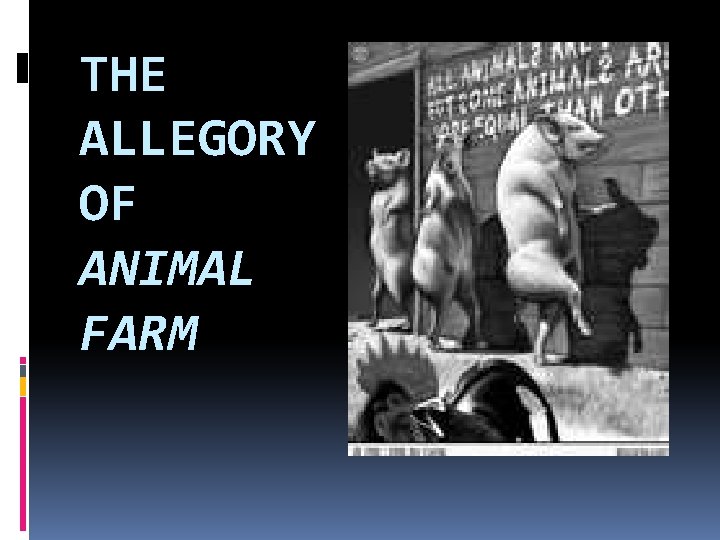
THE ALLEGORY OF ANIMAL FARM Allegory Characters setting

- Slides: 27
THE ALLEGORY OF ANIMAL FARM
Allegory Characters, setting, and events make sense on the literal level, but are designed to represent OTHER characters, setting, and events.
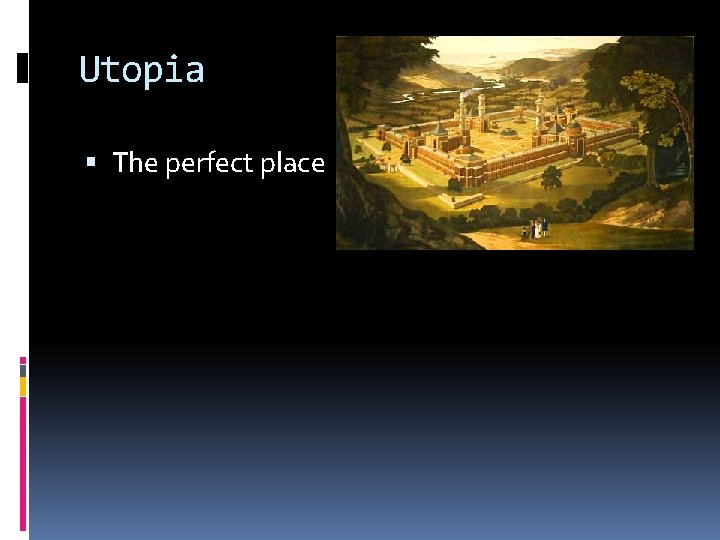
Utopia The perfect place
Russian Society At the beginning of the 20 th century, Europe and America were evolving into capitalistic, industrial states; Russia remained “backward” in an agrarian economy under the absolute authority of the Czar. Russia was in an appalling state of poverty while the Czar lived in luxury. There was tremendous dissatisfaction.
Communism The nation’s workers and peasants rebelled against the wealthy and powerful capitalists and aristocrats Hoped to establish a socialist utopia based on the principles of political philosopher Karl Marx
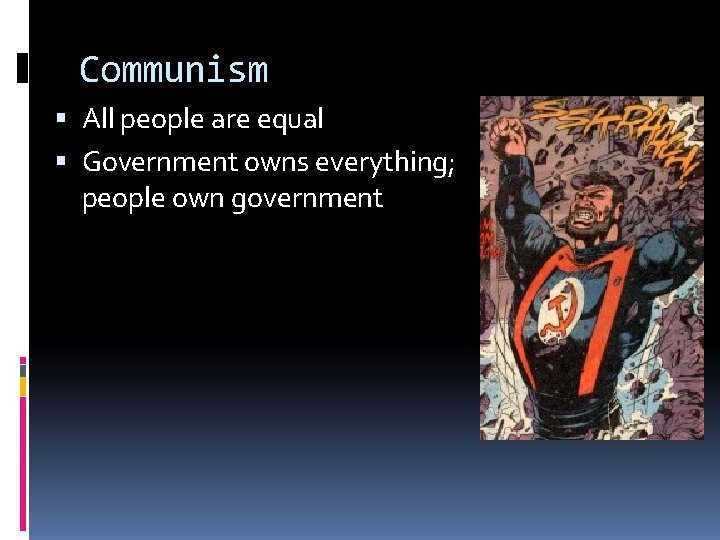
Communism All people are equal Government owns everything; people own government
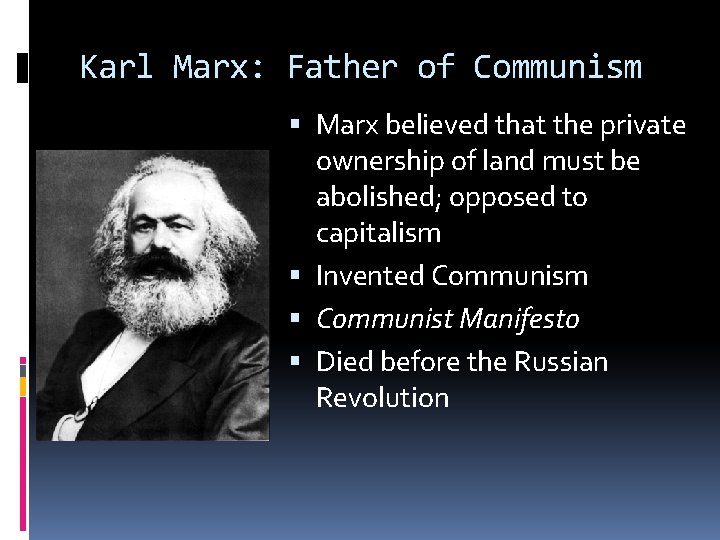
Karl Marx: Father of Communism Marx believed that the private ownership of land must be abolished; opposed to capitalism Invented Communism Communist Manifesto Died before the Russian Revolution
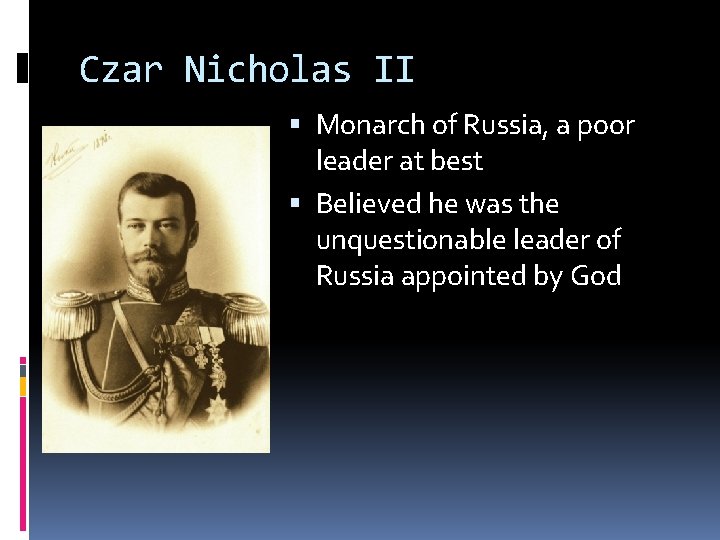
Czar Nicholas II Monarch of Russia, a poor leader at best Believed he was the unquestionable leader of Russia appointed by God
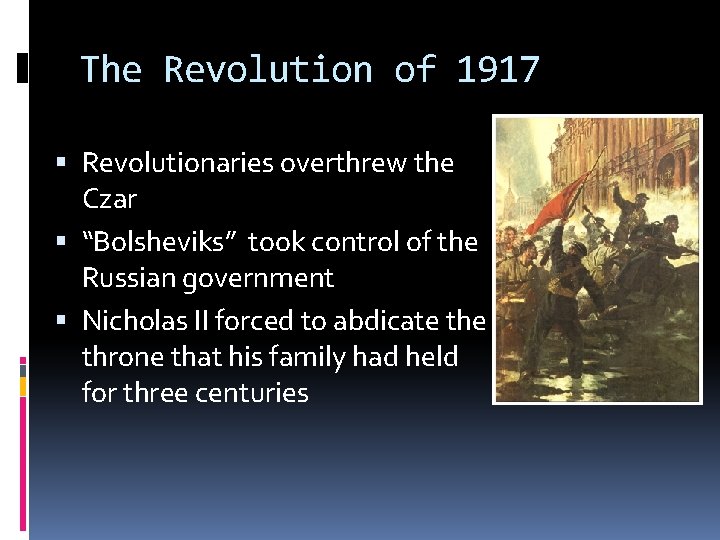
The Revolution of 1917 Revolutionaries overthrew the Czar “Bolsheviks” took control of the Russian government Nicholas II forced to abdicate throne that his family had held for three centuries
Vladimir Lenin Immediately seized power in the name of the Communist Party (1917) Lenin adopted Marx’s ideas; took land industry from private control and put them under government supervision. Understood the emotional impact of simple, powerful slogans like “Workers of the world unite. ”
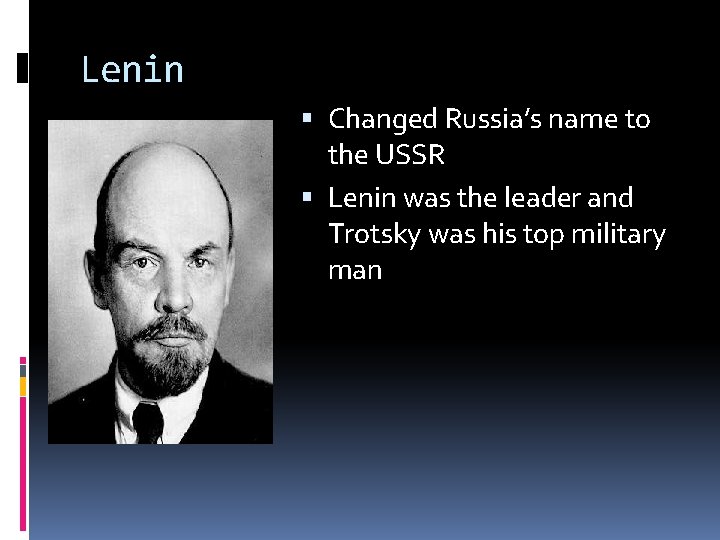
Lenin Changed Russia’s name to the USSR Lenin was the leader and Trotsky was his top military man
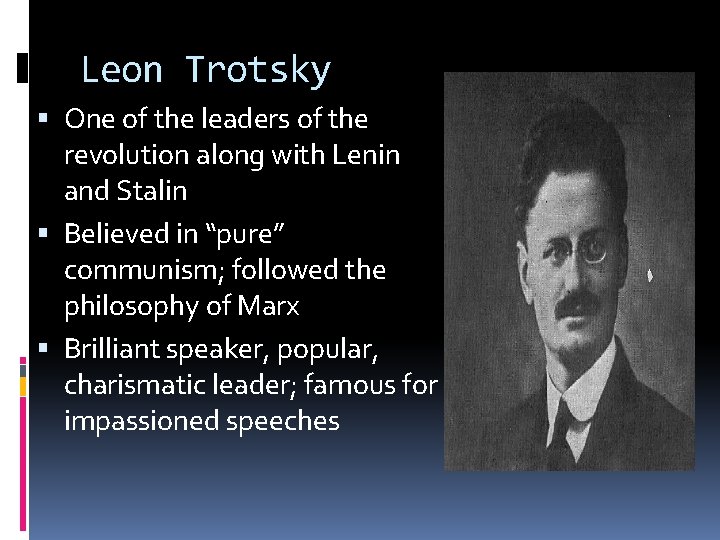
Leon Trotsky One of the leaders of the revolution along with Lenin and Stalin Believed in “pure” communism; followed the philosophy of Marx Brilliant speaker, popular, charismatic leader; famous for impassioned speeches
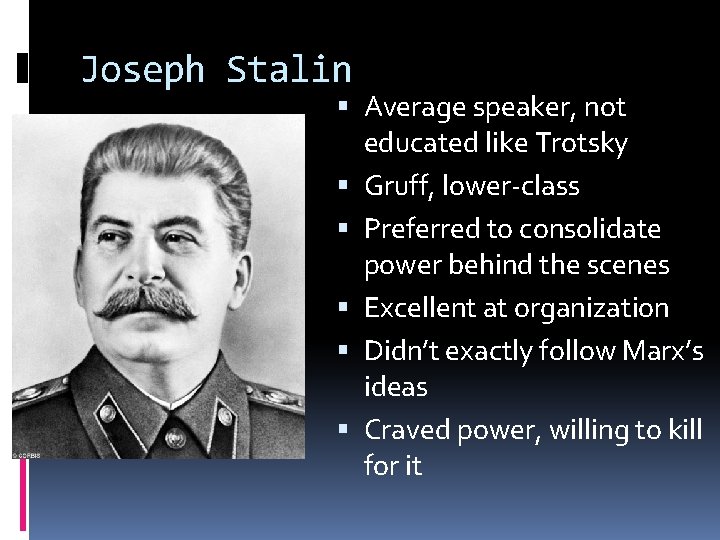
Joseph Stalin Average speaker, not educated like Trotsky Gruff, lower-class Preferred to consolidate power behind the scenes Excellent at organization Didn’t exactly follow Marx’s ideas Craved power, willing to kill for it
Civil War From 1918 -1921, there was Civil War Reds (Communists) vs. Whites (foreign countries sympathetic to the Czar, tried to expel the Reds) Foreign countries (Britain, France, Poland, and USA) were alarmed at the spread of communism but the Red Army led by Trotsky proved successful. Reds won.
Power Struggle While Lenin and Trotsky concentrated on the War, Stalin began to take over the machinery of the Communist Party. Stalin used Trotsky’s enemies to form alliance that would serve him in the future Lenin became fatally ill and died
Stalin Took power when Lenin died in 1924 Ridiculed Trotsky’s ideas Secured his power base and engineered the permanent exile of Trotsky in 1929 The exiled Trotsky was still very useful to Stalin as he now had Trotsky to blame for all the problems and difficulties that Russia suffered
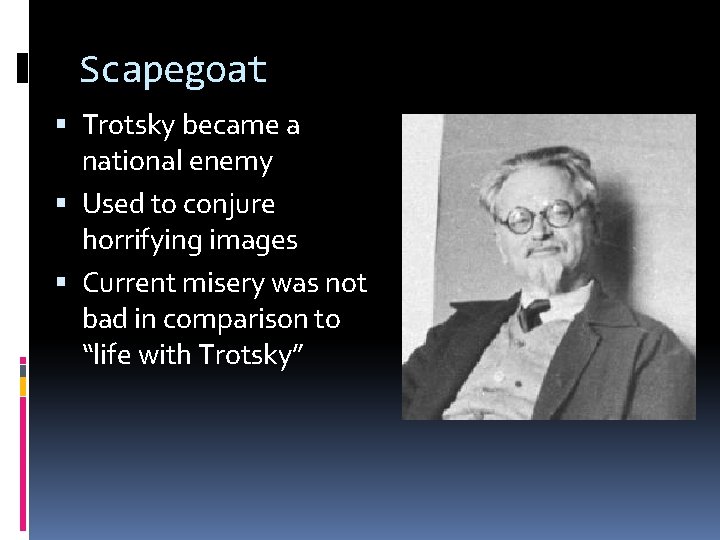
Scapegoat Trotsky became a national enemy Used to conjure horrifying images Current misery was not bad in comparison to “life with Trotsky”
Stalin After exiling Trotsky, Stalin began to consolidate his power with intensity Assumed a complete, totalitarian control Killed or imprisoned perceived political enemies Oversaw the purge of approximately 20 million Soviet Citizens (Stalin’s Purge) Held “show trials”; outcomes had already been decided Had his opponents denounced as Trotskyists or anti. Stalinist; immediately executed
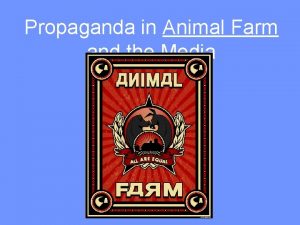
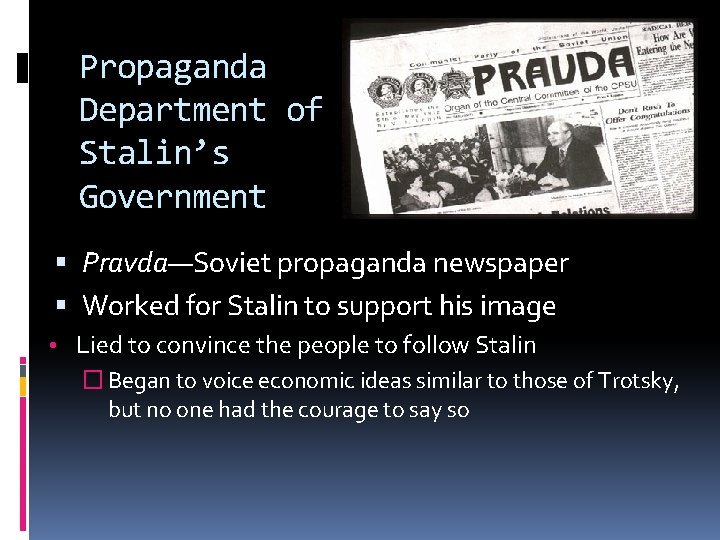
Propaganda Department of Stalin’s Government Pravda—Soviet propaganda newspaper Worked for Stalin to support his image • Lied to convince the people to follow Stalin � Began to voice economic ideas similar to those of Trotsky, but no one had the courage to say so
KGB Secret police during Stalin’s dictatorship Not really police, but forced all to support Stalin Often killed entire families for disobedience Totally loyal, part of Stalin’s power
Politburo Policy-making body of the Communist party’s Central Committee In reality it was merely a force to carry out Stalin’s orders and secure his positions as dictator
Religion Marx said religion was the “opiate of the people” and a lie Used to make people not complain and do their work Stalin knew religion would stop violent revolutions
Supporters People believed Stalin because he was “Communist” Many stayed loyal after it was obvious Stalin was a tyrant Many of these people were betrayed by Stalin who ignored and killed them
5 Year Plans From 1927 -1932, new economic plans, called the five year plans, were introduced. The purpose was to improve industry. Soviet farmers were to join “collective” farms Much of the food had to be sent to the government Any who opposed to his plan were executed
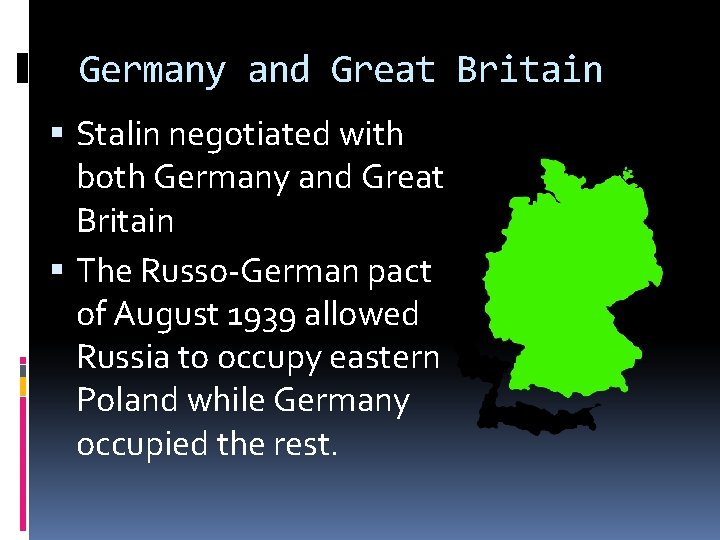
Germany and Great Britain Stalin negotiated with both Germany and Great Britain The Russo-German pact of August 1939 allowed Russia to occupy eastern Poland while Germany occupied the rest.
Germany and Great Britain On June 22, 1941, Germany (Hitler) attacked her ally Russia without warning. The alliance between Nazism and Communism fell apart and Russia formed an alliance with Britain and the USA. Because of all the purges order by Stalin, the Nazis almost conquered the USSR.
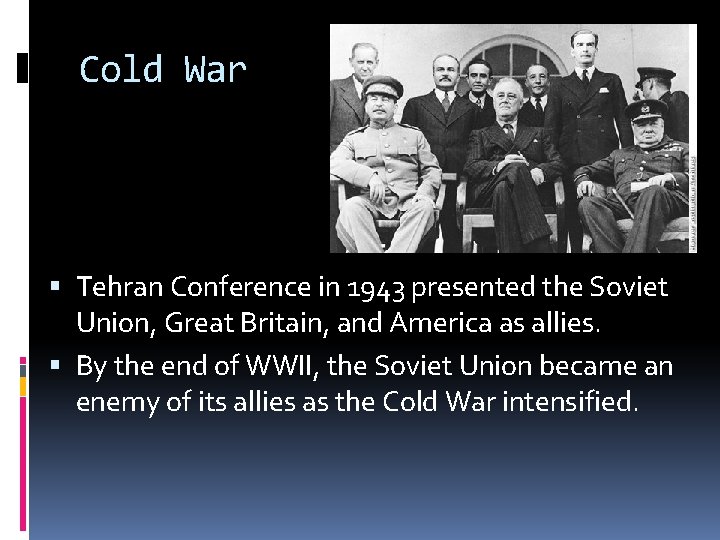
Cold War Tehran Conference in 1943 presented the Soviet Union, Great Britain, and America as allies. By the end of WWII, the Soviet Union became an enemy of its allies as the Cold War intensified.