THE ACCELERATOR THEORY OF INVESTMENT INTRODUCTION The Keynesian








- Slides: 20
THE ACCELERATOR THEORY OF INVESTMENT
INTRODUCTION � The Keynesian concept of multiplier which states that as the investment increase, income increases by a multiple amount. � On the other hand, there is a concept of accelerator which was not taken into account by Keynes. � The acceleration prin ciple describes the effect quite opposite to that of multiplier. � According to this, when income or consumption increases, investment will increase by a multiple amount.
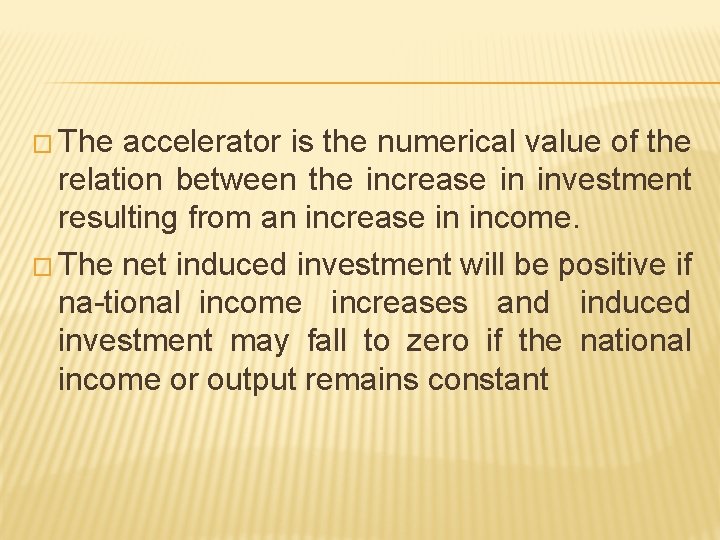
� The accelerator is the numerical value of the relation between the increase in investment resulting from an increase in income. � The net induced investment will be positive if na tional income increases and induced investment may fall to zero if the national income or output remains constant
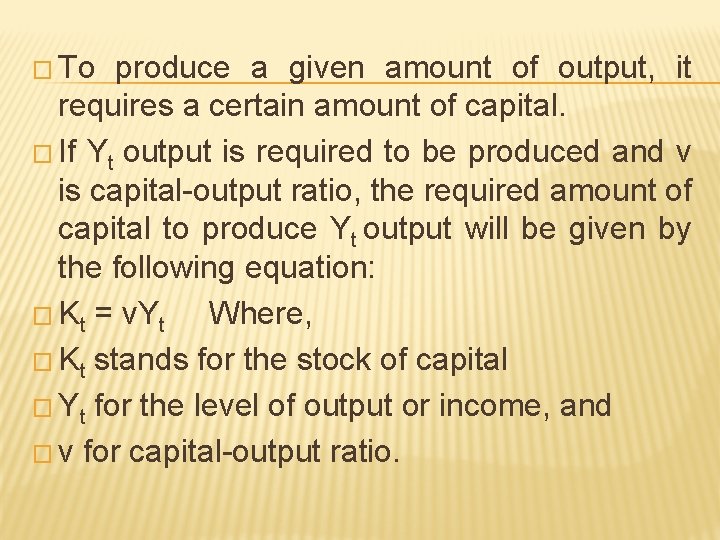
� To produce a given amount of output, it requires a certain amount of capital. � If Yt output is required to be produced and v is capital output ratio, the required amount of capital to produce Yt output will be given by the following equation: � Kt = v. Yt Where, � Kt stands for the stock of capital � Yt for the level of output or income, and � v for capital output ratio.
� This capital output ratio v is equal to K/Y and in theory of accelerator this capital output ratio is assumed to be constant. � Therefore, under the assumption of constant capital output ratio, changes in output are made possible by changes in the stock of capital. � Thus, when income is Yt � then required stock of capital Kt = v. Yt when output or income is equal to then required stock of capital will be Kt 1 = v. Yt 1.
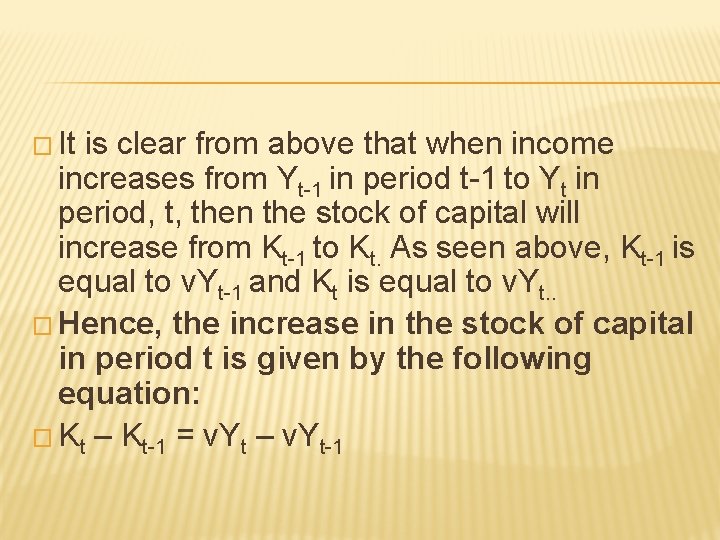
� It is clear from above that when income increases from Yt 1 in period t 1 to Yt in period, t, then the stock of capital will increase from Kt 1 to Kt. As seen above, Kt 1 is equal to v. Yt 1 and Kt is equal to v. Yt. . � Hence, the increase in the stock of capital in period t is given by the following equation: � Kt – Kt 1 = v. Yt – v. Yt 1
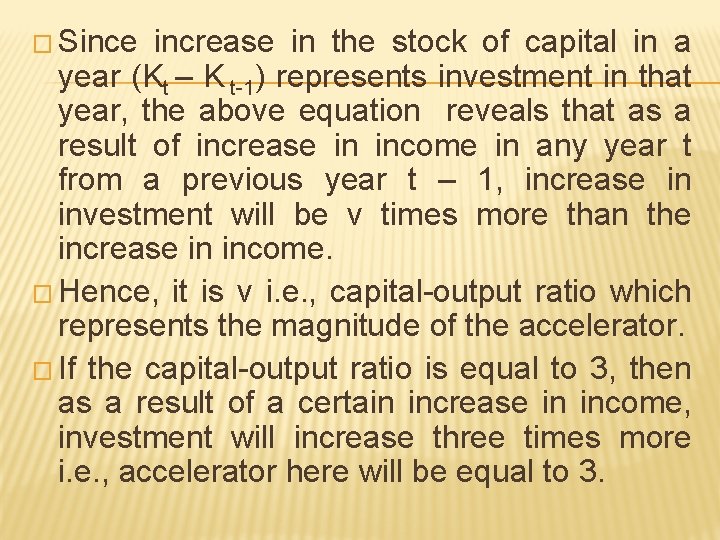
� Since increase in the stock of capital in a year (Kt – K t 1) represents investment in that year, the above equation reveals that as a result of increase in income in any year t from a previous year t – 1, increase in investment will be v times more than the increase in income. � Hence, it is v i. e. , capital output ratio which represents the magnitude of the accelerator. � If the capital output ratio is equal to 3, then as a result of a certain increase in income, investment will increase three times more i. e. , accelerator here will be equal to 3.
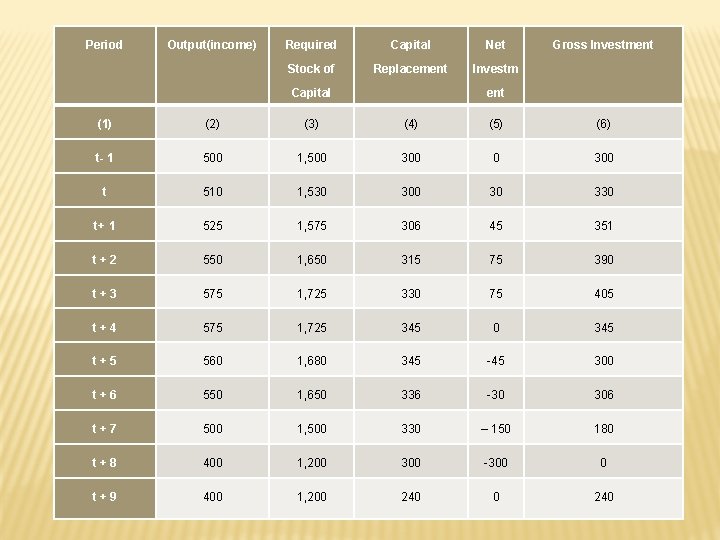
� An arithmetical example will make clear the working of the accelerator. This has been repre sented in the accompanying table. � We have made the following assumptions in making this table: � (i) Capital output ratio remains constant and is equal to 3. � (ii) The depreciation that takes place in the stock of capital is equal to one fifth of the stock existing in the previous year. Therefore, one fifth of the stock of capital is to be replaced every year.
Period Output(income) Required Capital Net Stock of Replacement Investm Capital Gross Investment (1) (2) (3) (4) (5) (6) t- 1 500 1, 500 300 t 510 1, 530 30 330 t+ 1 525 1, 575 306 45 351 t+2 550 1, 650 315 75 390 t+3 575 1, 725 330 75 405 t+4 575 1, 725 345 0 345 t+5 560 1, 680 345 45 300 t+6 550 1, 650 336 30 306 t+7 500 1, 500 330 – 150 180 t+8 400 1, 200 300 0 t+9 400 1, 200 240
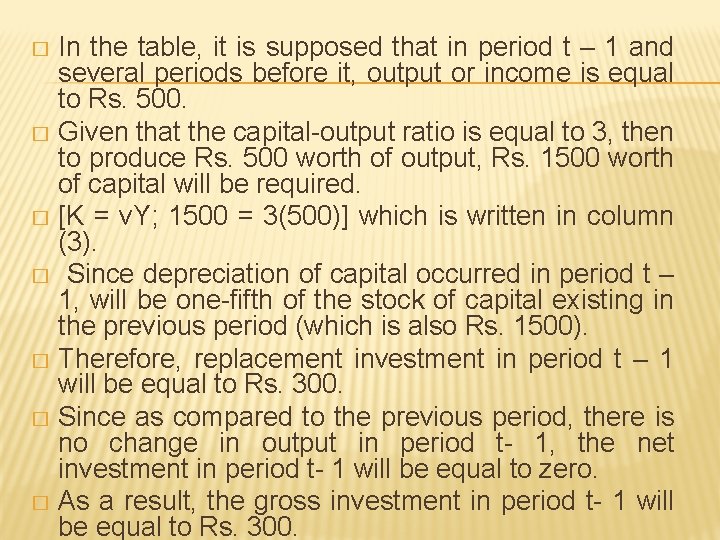
In the table, it is supposed that in period t – 1 and several periods before it, output or income is equal to Rs. 500. � Given that the capital output ratio is equal to 3, then to produce Rs. 500 worth of output, Rs. 1500 worth of capital will be required. � [K = v. Y; 1500 = 3(500)] which is written in column (3). � Since depreciation of capital occurred in period t – 1, will be one fifth of the stock of capital existing in the previous period (which is also Rs. 1500). � Therefore, replacement investment in period t – 1 will be equal to Rs. 300. � Since as compared to the previous period, there is no change in output in period t 1, the net investment in period t 1 will be equal to zero. � As a result, the gross investment in period t 1 will be equal to Rs. 300. �
Now suppose that production in the period t rises to Rs. 510 crores as a result of increase in Government expenditure or autonomous investment. � To produce output worth Rs. 510 crores, total capital worth Rs. 1530 is required [Kt = v. Yt 1530 = 3(510)] which is written in column (3). � Thus, as a result of increase in output (income) by Rs. 10, net investment has increased by Rs. 30, that is, 1530 – 1500 = 30 which means that accelerator is here equal to 3. � In period t the depreciation equal to 1/5 th of the capital stock of period t 1 will occur, that is, capital depreciation of Rs. 300, (1/ 5 x 1500 = 300) will occur in period t. � Therefore, capital replacement investment in period t will be equal to Rs. 300. �
� Thus, gross investment in period t will be equal to 30 + 300 = 330. � In this way, if output (or income) increases by Rs 15 in period t + 1, Rs. 25 in period t+ 2, and also Rs. 25 in period I + 3, the net investment will increase by three times the increment in output (or income), � that is, net investment will increase by Rs. 45 in period t + 1, Rs. 75 in period t + 2 and also Rs. 75 in period t + 3.
� It will be further observed from Table that when output falls in period t + 5 by Rs. 15, the net, investment will decline by 3 times of it, that is, equal to Rs. 45. � Likewise, from changes in output in different periods we can find out net investment that will take place in any period and with the capital replacement investment we can obtain the gross investment that will occur in any period.
� columns 2, 5 and 6 will show that with a change in output, investment will increase by a multiple of it. � This shows that acceleration principle is a powerful destabilising force working in the economy. � If the accelerator is the only force at work, then we shall have too much of instability in the economy—more than is actually found. � In real life, we find that there are limits to instability, both in the upward as well as the downward direction, so that fluctuations in economic activity or what are called business cycles must have a peak as well as a bottom.
CRITICISM OF THE ACCELERATOR THEORY: � The principle of acceleration has come in for a good deal of criticism in recent years � has been pointed out by Kaldor that we cannot assume a constant value of the accelerator throughout the trade cycle, that is, it is not true that an increase in output or income by an amount must always give rise to a multiple increase in investment
� if expectation of entrepreneurs is that the rise in demand brought about by increase in income or output is only a temporary one, they will try to meet it by overworking the existing machinery rather than installing a new plant. � Thus, in theory of accelerator it has been assumed that there is no excess capacity existing in consumer goods industries
� Further, in the principle of acceleration principle it has also been assumed that in the capital goods industries, there exists surplus productive capacity. � If there is no excess capacity in the ma chine making industries, increased demand for machines caused by the requirement for additional output would not lead to increase in the supply of machines. � In the absence of supply of machines, investment cannot increase in the short run.
� The size of the accelerator does not remain constant over time. � Its value will be affected by the businessmen’s calculation regarding the profitability of installing new plants to make more machines on the basis of their probable working life. � It is also assumed that the demand for machines will remain stable in future, although the increase in demand has suddenly cropped up.
CONCLUSION � However, in spite of the “above limitations of acceleration principle, it points out an important force which causes economic fluctuations in the economy. � Econo mists like Samuelson, Hicks and Dusenberry have shown how accelerator combined with mul tiplier provides an adequate and satisfactory theory of trade cycles that occur in the capitalist economies. �