The 5 point Screen for Hantavirus Conference 2019







- Slides: 24
The 5 -point Screen for Hantavirus Conference 2019 Dine College, Tsaile Campus Aaron Kofman, MD EIS Officer, Viral Special Pathogens Branch CDC, Atlanta GA
Overview • Clinical review of hantavirus disease • Background on 5 -point screen for hantavirus • Use of 5 -point screen in the Four Corners region • Questions
Clinical Review of Hantavirus Disease
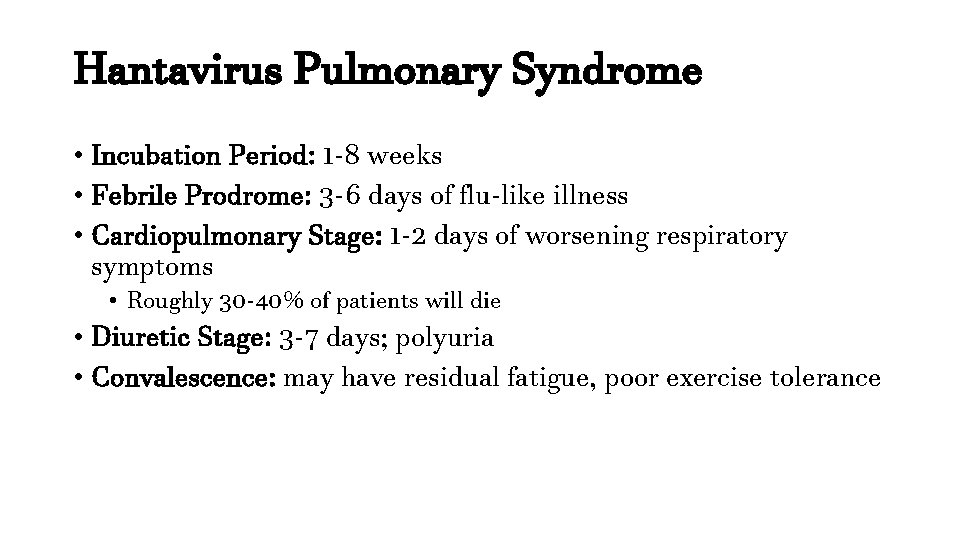
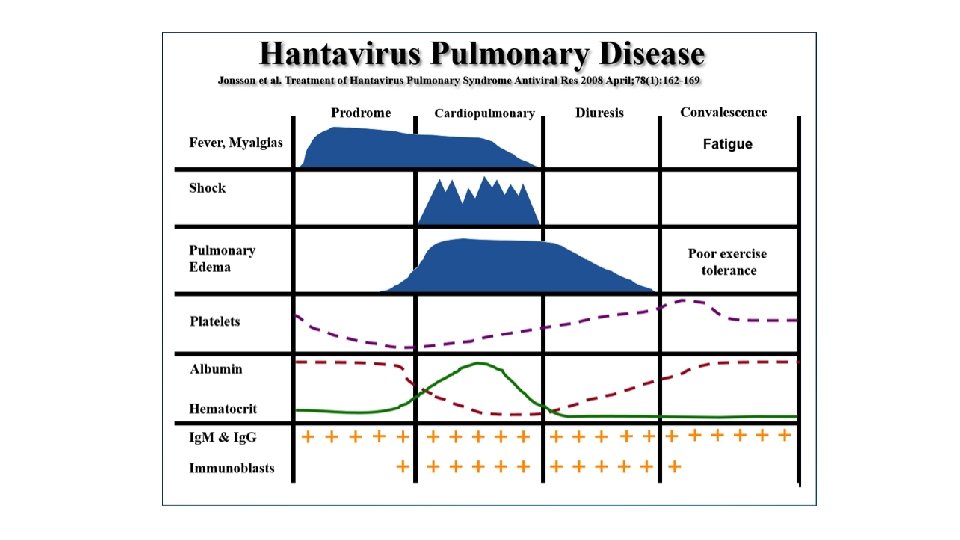
Hantavirus Pulmonary Syndrome • Incubation Period: 1 -8 weeks • Febrile Prodrome: 3 -6 days of flu-like illness • Cardiopulmonary Stage: 1 -2 days of worsening respiratory symptoms • Roughly 30 -40% of patients will die • Diuretic Stage: 3 -7 days; polyuria • Convalescence: may have residual fatigue, poor exercise tolerance
How do we diagnose someone with Hantavirus Pulmonary Syndrome? • It is rare; even in the Four Corners region! • Many people with rodent exposure…most do not end up with hantavirus. • Most clinicians have never seen a case • It looks like other illnesses • Influenza, pneumonia, etc. • Most cases in spring/summer but can occur any time of year • Bottom line: Requires a high index of suspicion in the appropriate context.
Once we suspect it…how do we diagnose? • Diagnostic tests • ELISA for anti-hantavirus Ig. M and Ig. G antibodies • Problem: turnaround time • 4 -6 hours to run the test • But longer to ship the specimen • Meanwhile, clock is ticking…patient may be getting more ill…
Once we suspect it…how do we diagnose? • Diagnostic tests • ELISA for anti-hantavirus Ig. M and Ig. G antibodies • Problem: turnaround time • 4 -6 hours to run the test • But longer to ship the specimen • Meanwhile, clock is ticking…patient may be getting more ill… • What can make a difference? 1. Rapid referral to facilities with high-level intensive medical support and extracorporeal membrane oxygenation (ECMO) 2. Early identification of illness to enable #1
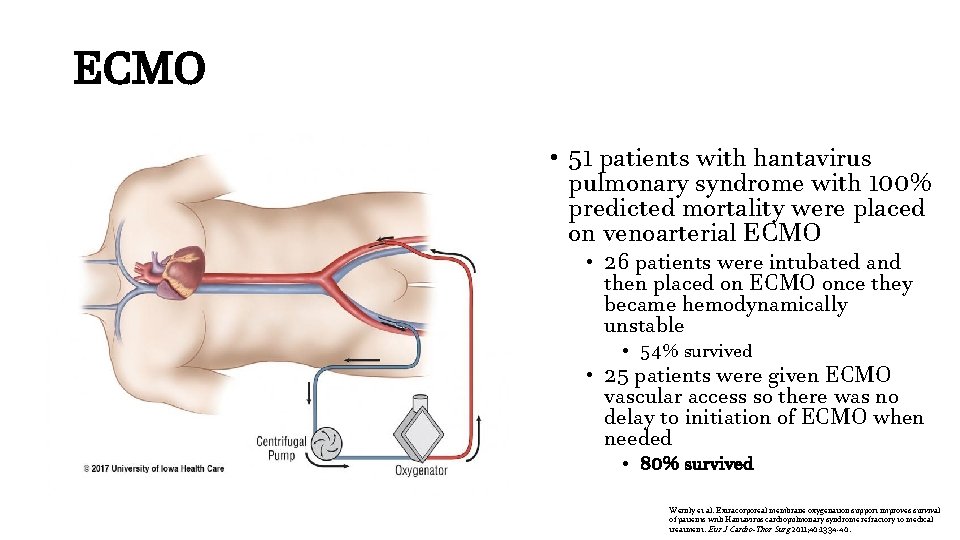
Treatment for patients with Hantavirus Pulmonary Syndrome • Supportive therapy • Blood pressure medications • Supplemental oxygen • Extracorporeal membrane oxygenation = ECMO • UNM has initiated ECMO in patients with a cardiac index of <2 L/min, Pa. O 2/Fi. O 2 ratio <60, and refractory shock
ECMO • 51 patients with hantavirus pulmonary syndrome with 100% predicted mortality were placed on venoarterial ECMO • 26 patients were intubated and then placed on ECMO once they became hemodynamically unstable • 54% survived • 25 patients were given ECMO vascular access so there was no delay to initiation of ECMO when needed • 80% survived Wernly et al. Extracorporeal membrane oxygenation support improves survival of patients with Hantavirus cardiopulmonary syndrome refractory to medical treatment. Eur J Cardio-Thor Surg 2011; 40: 1334 -40.
5 -point screen
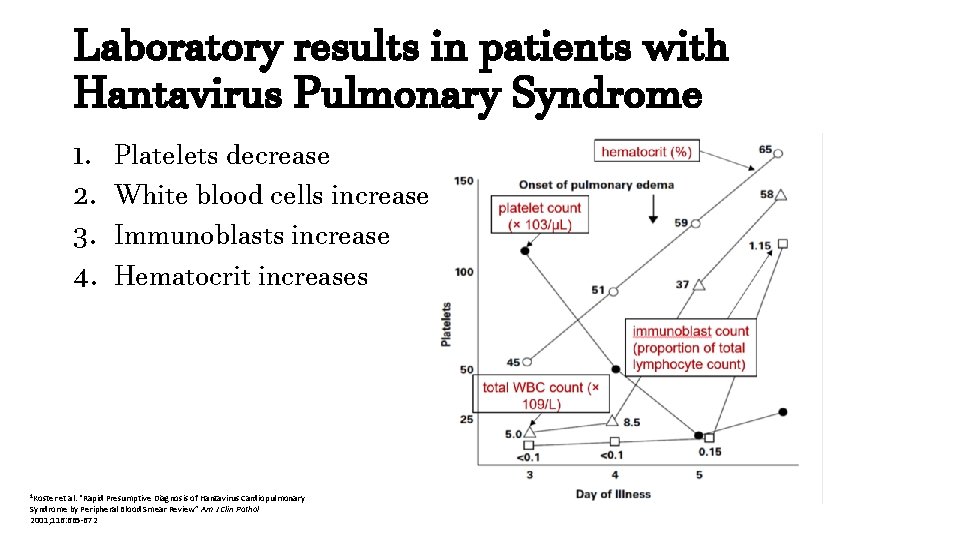
Laboratory results in patients with Hantavirus Pulmonary Syndrome 1. 2. 3. 4. 1 Koster Platelets decrease White blood cells increase Immunoblasts increase Hematocrit increases et al. “Rapid Presumptive Diagnosis of Hantavirus Cardiopulmonary Syndrome by Peripheral Blood Smear Review” Am J Clin Pathol 2001; 116: 665 -672
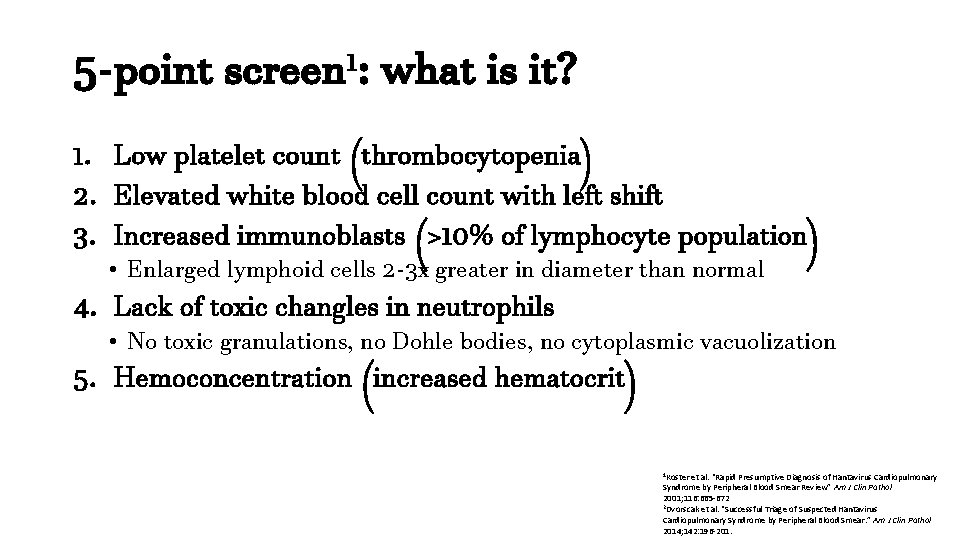
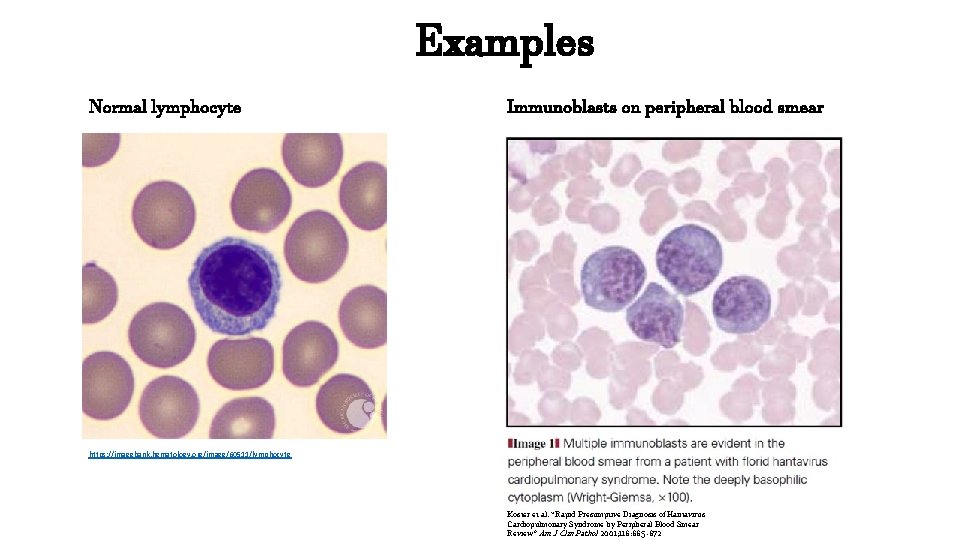
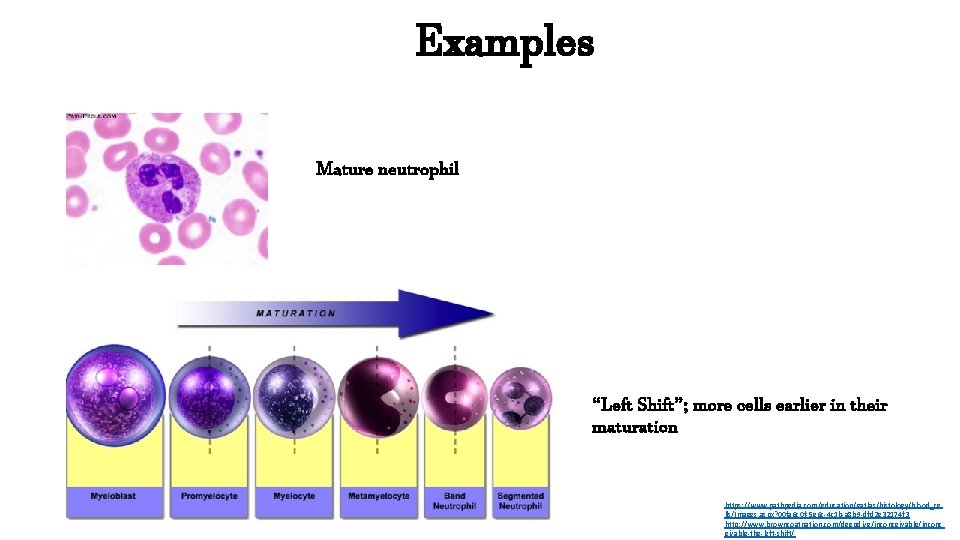
5 -point screen 1: what is it? 1. Low platelet count (thrombocytopenia) 2. Elevated white blood cell count with left shift 3. Increased immunoblasts (>10% of lymphocyte population) • Enlarged lymphoid cells 2 -3 x greater in diameter than normal 4. Lack of toxic changles in neutrophils • No toxic granulations, no Dohle bodies, no cytoplasmic vacuolization 5. Hemoconcentration (increased hematocrit) 1 Koster et al. “Rapid Presumptive Diagnosis of Hantavirus Cardiopulmonary Syndrome by Peripheral Blood Smear Review” Am J Clin Pathol 2001; 116: 665 -672 2 Dvorscak et al. “Successful Triage of Suspected Hantavirus Cardiopulmonary Syndrome by Peripheral Blood Smear. ” Am J Clin Pathol 2014; 142: 196 -201.
Normal lymphocyte https: //imagebank. hematology. org/image/60511/lymphocyte Examples
Normal lymphocyte Examples Immunoblasts on peripheral blood smear https: //imagebank. hematology. org/image/60511/lymphocyte Koster et al. “Rapid Presumptive Diagnosis of Hantavirus Cardiopulmonary Syndrome by Peripheral Blood Smear Review” Am J Clin Pathol 2001; 116: 665 -672
Examples Mature neutrophil “Left Shift”; more cells earlier in their maturation https: //www. pathpedia. com/education/eatlas/histology/blood_ce lls/Images. aspx? 00 fa 6 c 0 f-5 e 6 c-4 c 1 b-a 8 b 9 -dfd 2 e 32174 f 3 http: //www. browncoatnation. com/deepdive/inconceivable/inconc eivable-the-left-shift/
Thrombocytopenia, hemoconcentration, and left shift in granulocytic series Examples Koster et al. “Rapid Presumptive Diagnosis of Hantavirus Cardiopulmonary Syndrome by Peripheral Blood Smear Review” Am J Clin Pathol 2001; 116: 665 -672
Use of 5 -point screen in Four Corners Region
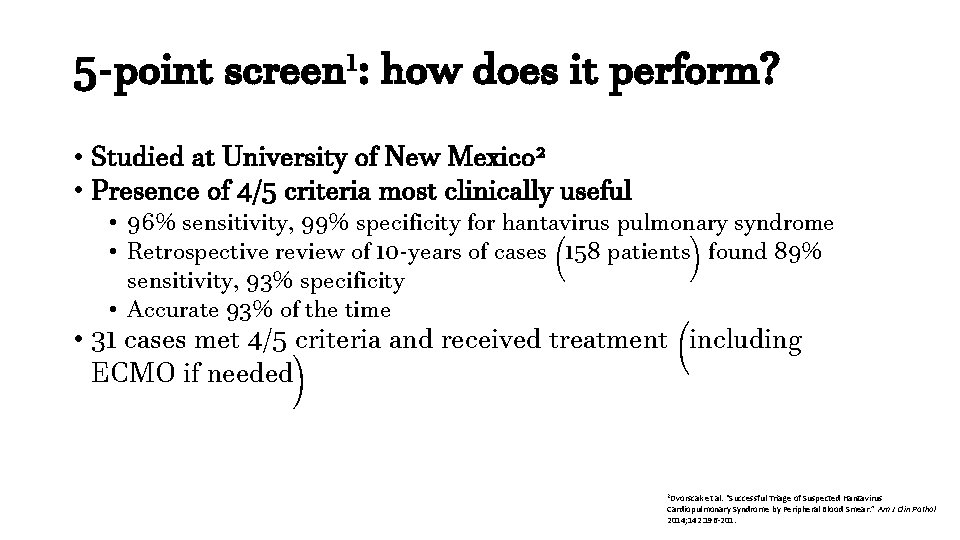
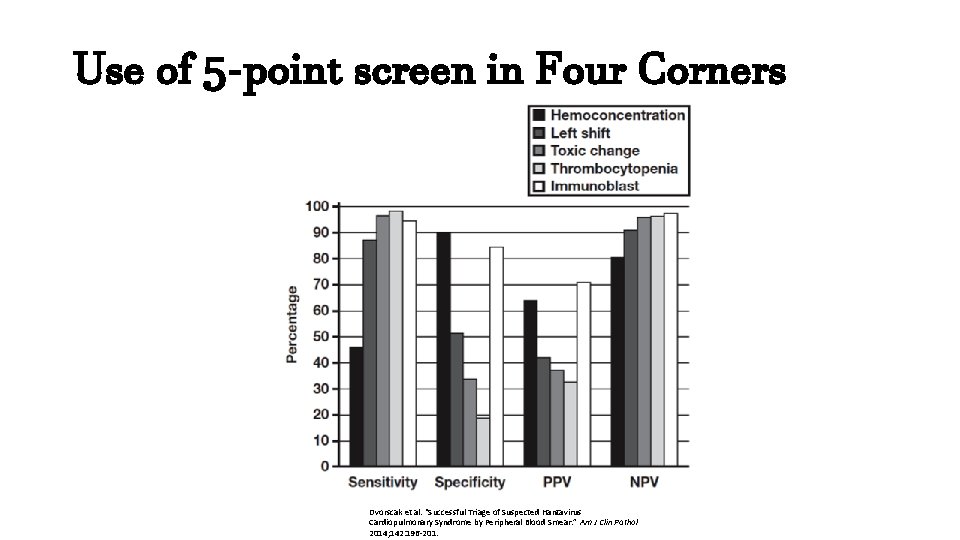
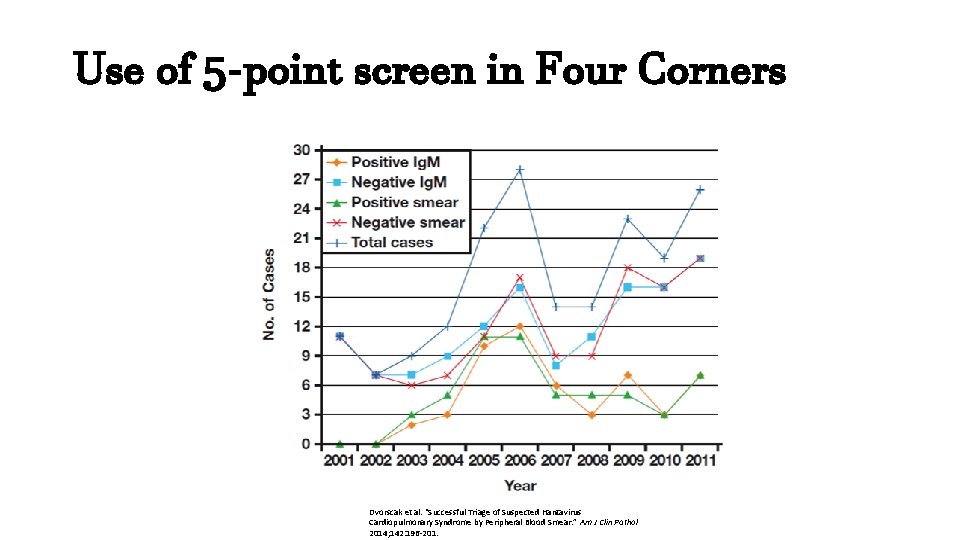
5 -point screen 1: how does it perform? • Studied at University of New Mexico 2 • Presence of 4/5 criteria most clinically useful • 96% sensitivity, 99% specificity for hantavirus pulmonary syndrome • Retrospective review of 10 -years of cases (158 patients) found 89% sensitivity, 93% specificity • Accurate 93% of the time • 31 cases met 4/5 criteria and received treatment (including ECMO if needed) 2 Dvorscak et al. “Successful Triage of Suspected Hantavirus Cardiopulmonary Syndrome by Peripheral Blood Smear. ” Am J Clin Pathol 2014; 142: 196 -201.
Use of 5 -point screen in Four Corners Dvorscak et al. “Successful Triage of Suspected Hantavirus Cardiopulmonary Syndrome by Peripheral Blood Smear. ” Am J Clin Pathol 2014; 142: 196 -201.
Use of 5 -point screen in Four Corners Dvorscak et al. “Successful Triage of Suspected Hantavirus Cardiopulmonary Syndrome by Peripheral Blood Smear. ” Am J Clin Pathol 2014; 142: 196 -201.
5 -point screen: Limitations • Not perfect • Serial evaluation is critical • Different smear interpretations may affect scores • On-call UNM infectious diseases and medical critical care physician available at 1 -800 -272 -2000
Thank you