Teaching Geo Ethics Across the Geoscience Curriculum David


- Slides: 16
Teaching Geo. Ethics Across the Geoscience Curriculum David Mogk Montana State University http: //serc. carleton. edu/geoethics/index. html
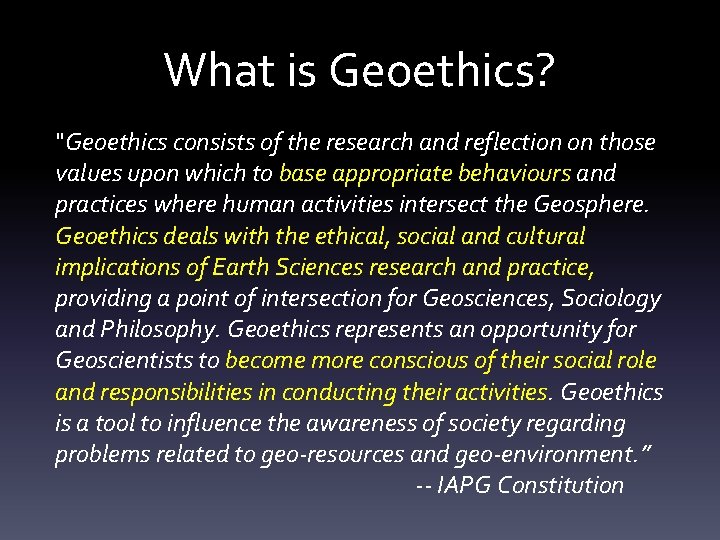
What is Geoethics? "Geoethics consists of the research and reflection on those values upon which to base appropriate behaviours and practices where human activities intersect the Geosphere. Geoethics deals with the ethical, social and cultural implications of Earth Sciences research and practice, providing a point of intersection for Geosciences, Sociology and Philosophy. Geoethics represents an opportunity for Geoscientists to become more conscious of their social role and responsibilities in conducting their activities. Geoethics is a tool to influence the awareness of society regarding problems related to geo-resources and geo-environment. ” -- IAPG Constitution
Nature of Geoscience • Geosciences encompass the history, materials, and processes of the complex Earth system • Earth system is open, heterogeneous, dynamic and complex; “deep time” and spatial scales from atomic to planetary • A central role in contributing to the safety, health, and economic welfare of humanity. • Geoscientists must make inferences from an incomplete geologic record, deal with ambiguity and uncertainty in their professional work GEOSCIENCES PRESENT MANY CHALLENGES THAT CONFRONT ISSUES OF GEOETHICS
Why Teach Geoethics I: Professional Development • Ethics Education is an increasingly important component of the pre-professional training of (geo)scientists. • Funding agencies (NSF, NIH) require training of students in the responsible conduct of research, • Employers are increasingly expecting their workers to have basic training in ethics, and • The public demands the highest standards of ethical conduct by scientists. TRUST, CONFIDENCE, RESPONSIBILITY
Why Teach Geoethics II: Pedagogy • Promotes critical thinking and review • Guides the formation of responsible solutions to socioeconomic problems • Highlights environmental, social, and economic stewardship • Fosters critical thinking and thoughtful resource management • Provides a systems-thinking context for dealing with risks • Encourages thoughtful communication of scientific findings to different audiences • Establishes relevance for geological content knowledge outside of the classroom • Stimulates social awareness of nature and history SUPPORTS A CO-CURRICULUM ON HOW TO “BE” A GEOSCIENTIST
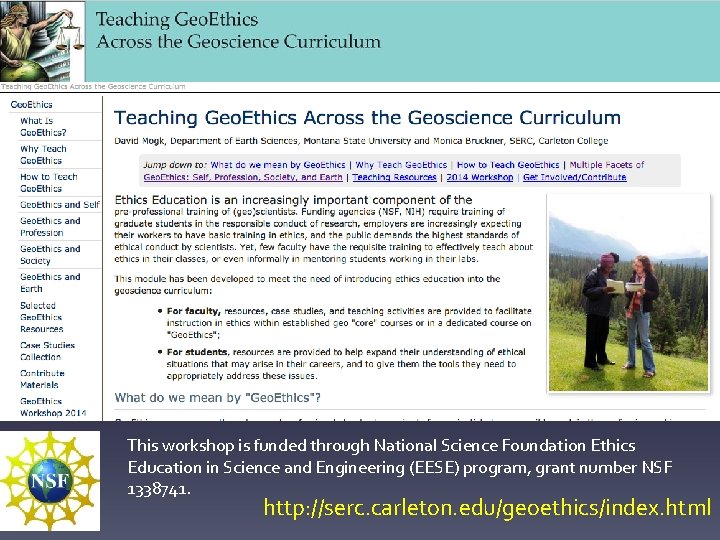
This workshop is funded through National Science Foundation Ethics Education in Science and Engineering (EESE) program, grant number NSF 1338741. http: //serc. carleton. edu/geoethics/index. html
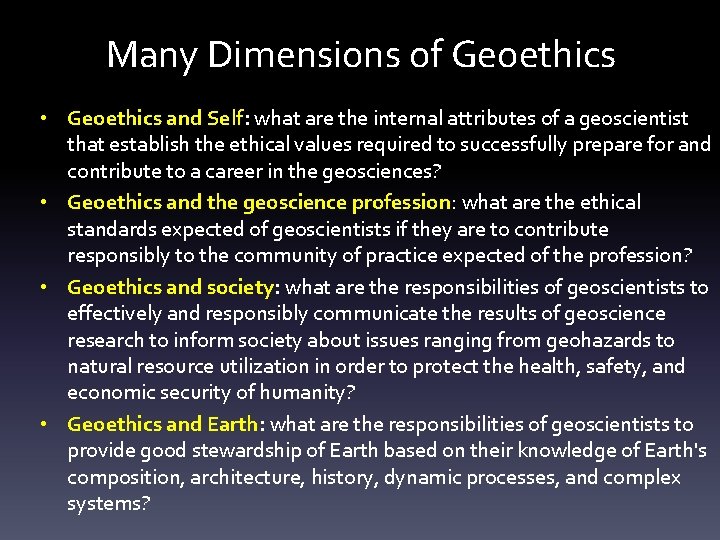
Many Dimensions of Geoethics • Geoethics and Self: what are the internal attributes of a geoscientist that establish the ethical values required to successfully prepare for and contribute to a career in the geosciences? • Geoethics and the geoscience profession: what are the ethical standards expected of geoscientists if they are to contribute responsibly to the community of practice expected of the profession? • Geoethics and society: what are the responsibilities of geoscientists to effectively and responsibly communicate the results of geoscience research to inform society about issues ranging from geohazards to natural resource utilization in order to protect the health, safety, and economic security of humanity? • Geoethics and Earth: what are the responsibilities of geoscientists to provide good stewardship of Earth based on their knowledge of Earth's composition, architecture, history, dynamic processes, and complex systems?
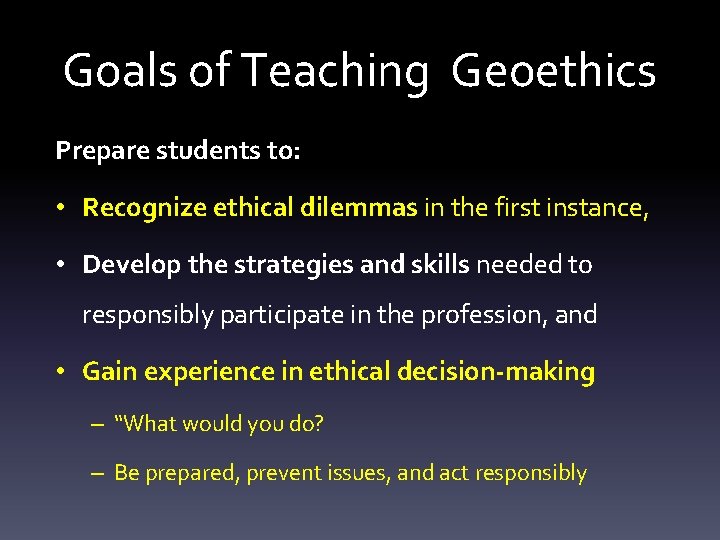
Goals of Teaching Geoethics Prepare students to: • Recognize ethical dilemmas in the first instance, • Develop the strategies and skills needed to responsibly participate in the profession, and • Gain experience in ethical decision-making – “What would you do? – Be prepared, prevent issues, and act responsibly
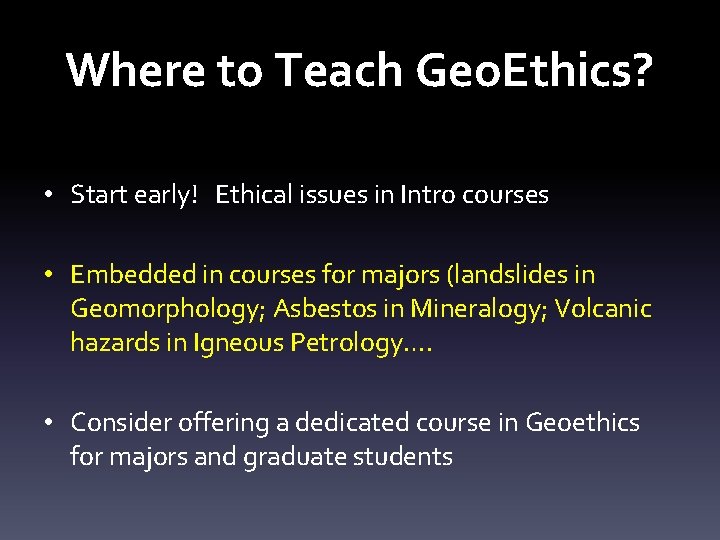
Where to Teach Geo. Ethics? • Start early! Ethical issues in Intro courses • Embedded in courses for majors (landslides in Geomorphology; Asbestos in Mineralogy; Volcanic hazards in Igneous Petrology…. • Consider offering a dedicated course in Geoethics for majors and graduate students
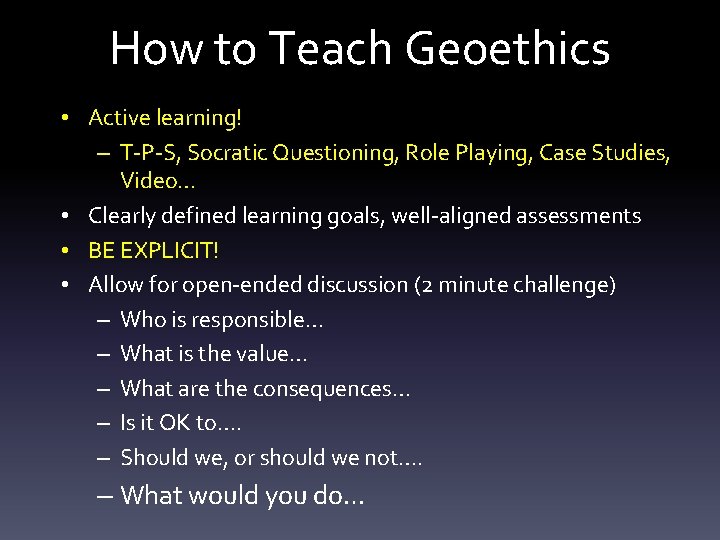
How to Teach Geoethics • Active learning! – T-P-S, Socratic Questioning, Role Playing, Case Studies, Video… • Clearly defined learning goals, well-aligned assessments • BE EXPLICIT! • Allow for open-ended discussion (2 minute challenge) – Who is responsible… – What is the value… – What are the consequences… – Is it OK to…. – Should we, or should we not…. – What would you do…
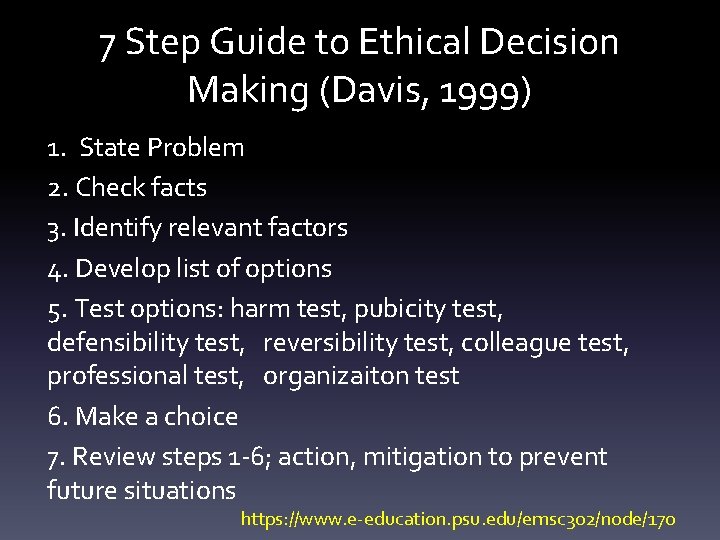
7 Step Guide to Ethical Decision Making (Davis, 1999) 1. State Problem 2. Check facts 3. Identify relevant factors 4. Develop list of options 5. Test options: harm test, pubicity test, defensibility test, reversibility test, colleague test, professional test, organizaiton test 6. Make a choice 7. Review steps 1 -6; action, mitigation to prevent future situations https: //www. e-education. psu. edu/emsc 302/node/170
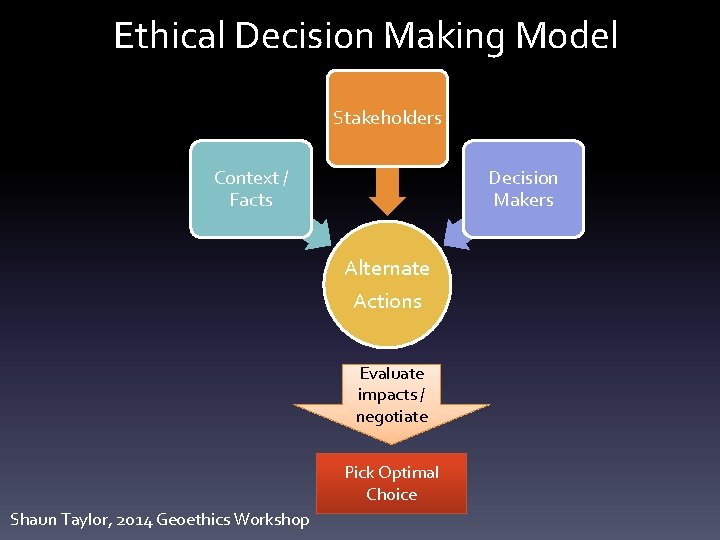
Ethical Decision Making Model Stakeholders Context / Facts Decision Makers Alternate Actions Evaluate impacts / negotiate Pick Optimal Choice Shaun Taylor, 2014 Geoethics Workshop
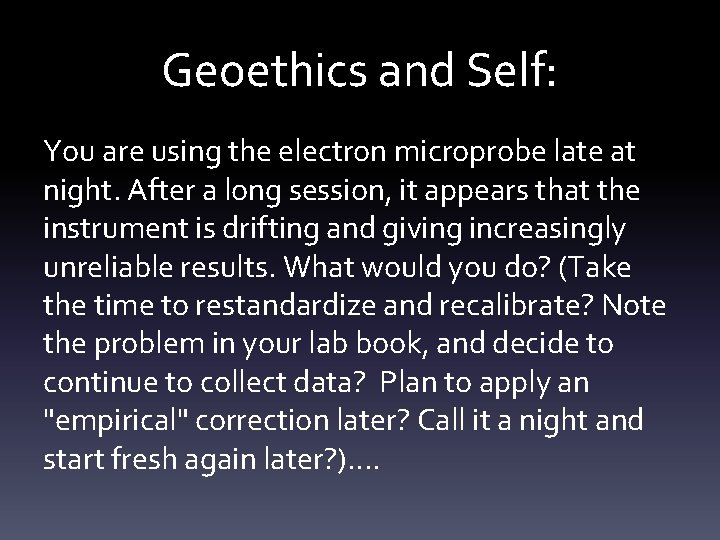
Geoethics and Self: You are using the electron microprobe late at night. After a long session, it appears that the instrument is drifting and giving increasingly unreliable results. What would you do? (Take the time to restandardize and recalibrate? Note the problem in your lab book, and decide to continue to collect data? Plan to apply an "empirical" correction later? Call it a night and start fresh again later? ). .
Geo. Ethics and Profession Jill is a newly hired geochemist working with an oil company. One of her first projects is to sample and chemically analyze produced waters from a large oil and gas production field that is looking to expand could impinge on a community’s sole water source. In her report, she notes that several regulated contaminants are well over acceptable limits within the current oil and gas field. Her modeling of the fluid flow for the expansion of the field shows that the maximum projected concentrations of regulated contaminants are well over the health regulation and could easily reach the community reservoir. However, the median modeled concentrations are within acceptable limits. In the final public report for the expansion permit, her supervisor only includes the median concentrations calculated by the modeling. The proposed expansion passes public comment with few problems and will now move onto state and federal review. Jill is concerned about what to do next and how her science is being used, what should she do?
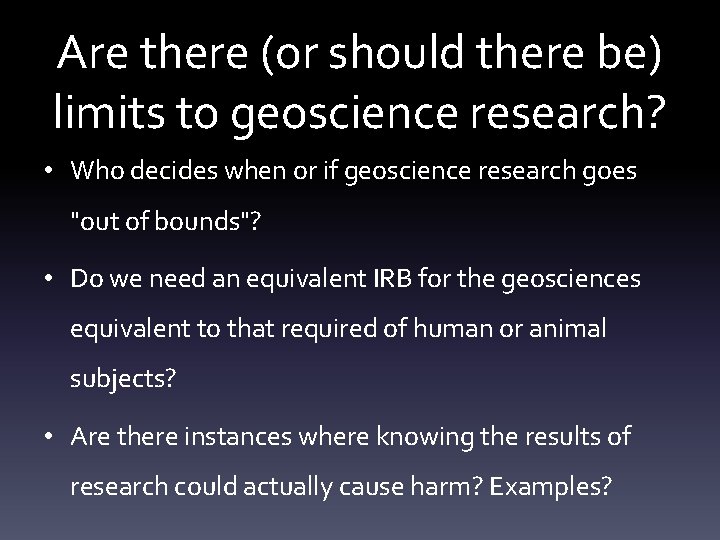
Are there (or should there be) limits to geoscience research? • Who decides when or if geoscience research goes "out of bounds"? • Do we need an equivalent IRB for the geosciences equivalent to that required of human or animal subjects? • Are there instances where knowing the results of research could actually cause harm? Examples?
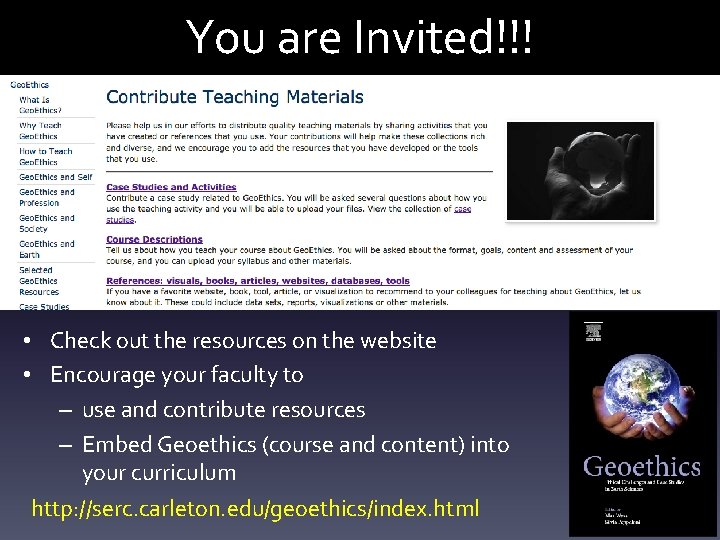
You are Invited!!! • Check out the resources on the website • Encourage your faculty to – use and contribute resources – Embed Geoethics (course and content) into your curriculum http: //serc. carleton. edu/geoethics/index. html