Targeted TEKS A 8A Solve quadratic equations having


- Slides: 22
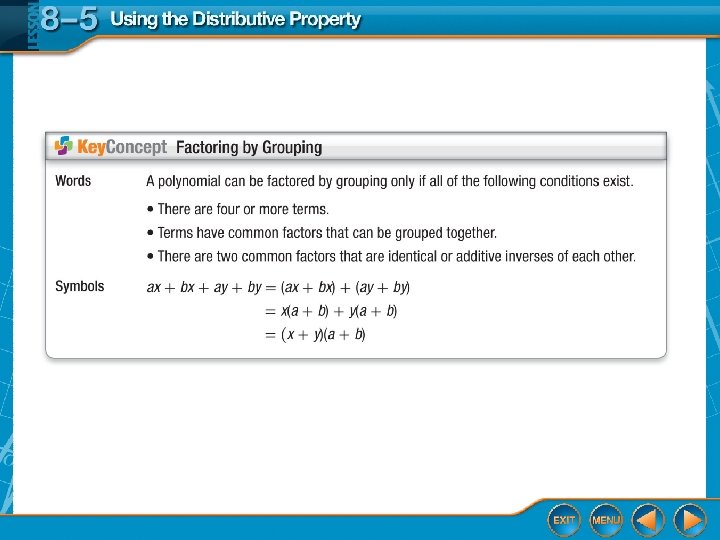
Targeted TEKS A. 8(A) Solve quadratic equations having real solutions by factoring, taking square roots, completing the square, and applying the quadratic formula. Mathematical Processes A. 1(E), A. 1(F)
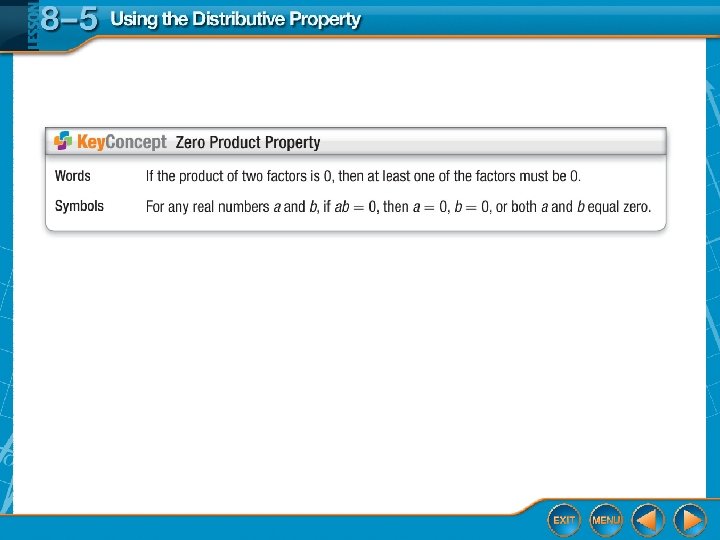
• factoring by grouping • Zero Product Property
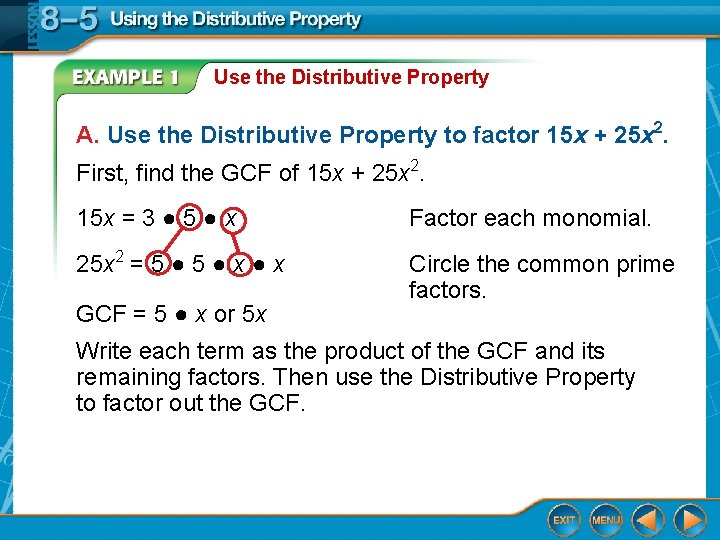
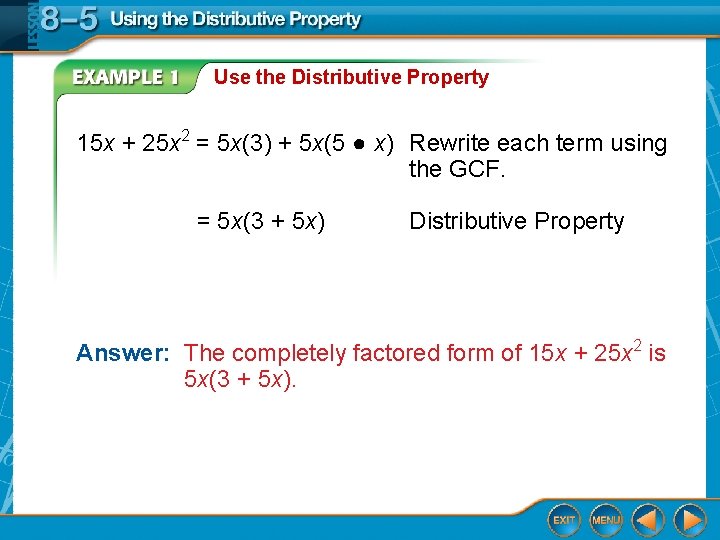
Use the Distributive Property A. Use the Distributive Property to factor 15 x + 25 x 2. First, find the GCF of 15 x + 25 x 2. 15 x = 3 ● 5 ● x Factor each monomial. 25 x 2 = 5 ● x ● x Circle the common prime factors. GCF = 5 ● x or 5 x Write each term as the product of the GCF and its remaining factors. Then use the Distributive Property to factor out the GCF.
Use the Distributive Property 15 x + 25 x 2 = 5 x(3) + 5 x(5 ● x) Rewrite each term using the GCF. = 5 x(3 + 5 x) Distributive Property Answer: The completely factored form of 15 x + 25 x 2 is 5 x(3 + 5 x).
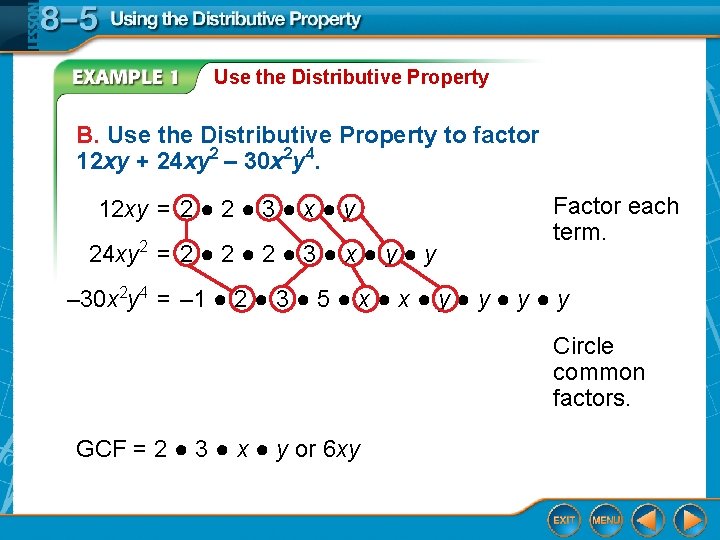
Use the Distributive Property B. Use the Distributive Property to factor 12 xy + 24 xy 2 – 30 x 2 y 4. 12 xy = 2 ● 3 ● x ● y 24 xy 2 = 2 ● 2 ● 3 ● x ● y Factor each term. – 30 x 2 y 4 = – 1 ● 2 ● 3 ● 5 ● x ● y ● y Circle common factors. GCF = 2 ● 3 ● x ● y or 6 xy
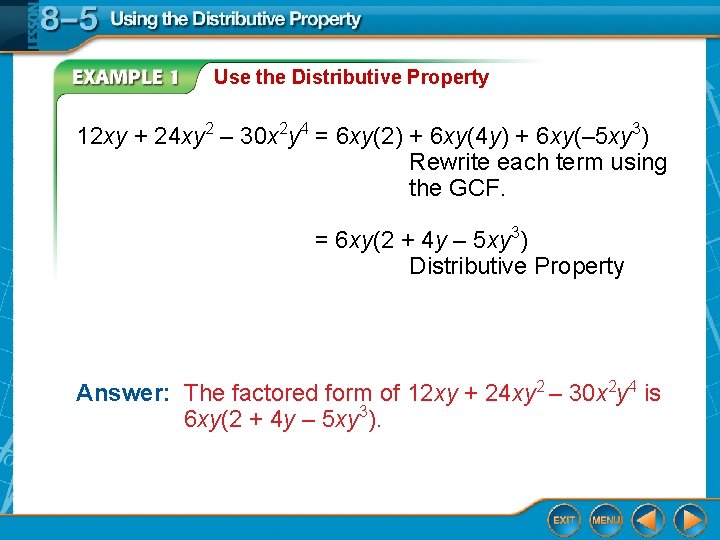
Use the Distributive Property 12 xy + 24 xy 2 – 30 x 2 y 4 = 6 xy(2) + 6 xy(4 y) + 6 xy(– 5 xy 3) Rewrite each term using the GCF. = 6 xy(2 + 4 y – 5 xy 3) Distributive Property Answer: The factored form of 12 xy + 24 xy 2 – 30 x 2 y 4 is 6 xy(2 + 4 y – 5 xy 3).
A. Use the Distributive Property to factor the polynomial 3 x 2 y + 12 xy 2. A. 3 xy(x + 4 y) B. 3(x 2 y + 4 xy 2) C. 3 x(xy + 4 y 2) D. xy(3 x + 2 y)
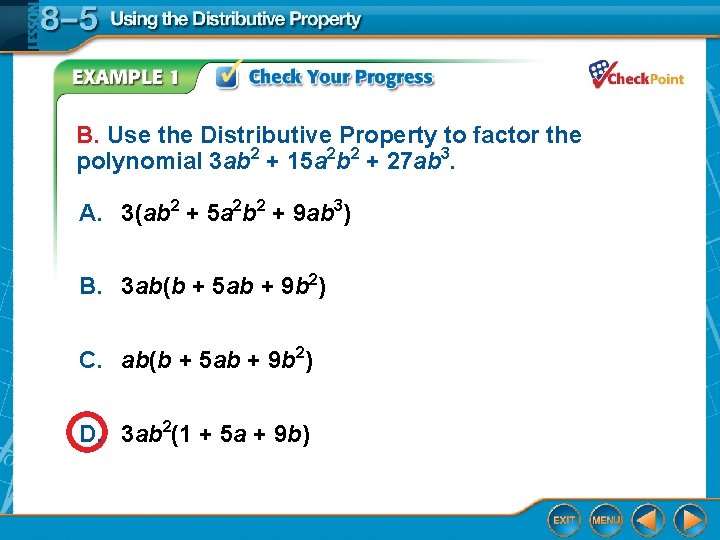
B. Use the Distributive Property to factor the polynomial 3 ab 2 + 15 a 2 b 2 + 27 ab 3. A. 3(ab 2 + 5 a 2 b 2 + 9 ab 3) B. 3 ab(b + 5 ab + 9 b 2) C. ab(b + 5 ab + 9 b 2) D. 3 ab 2(1 + 5 a + 9 b)
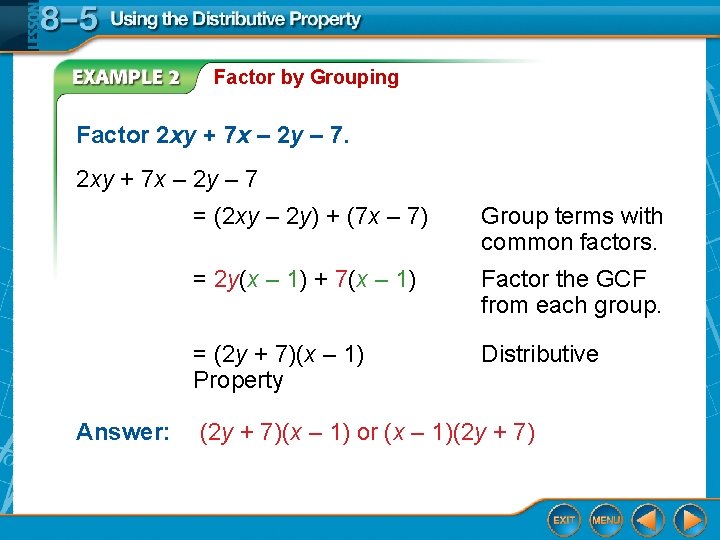
Factor by Grouping Factor 2 xy + 7 x – 2 y – 7 Answer: = (2 xy – 2 y) + (7 x – 7) Group terms with common factors. = 2 y(x – 1) + 7(x – 1) Factor the GCF from each group. = (2 y + 7)(x – 1) Property Distributive (2 y + 7)(x – 1) or (x – 1)(2 y + 7)
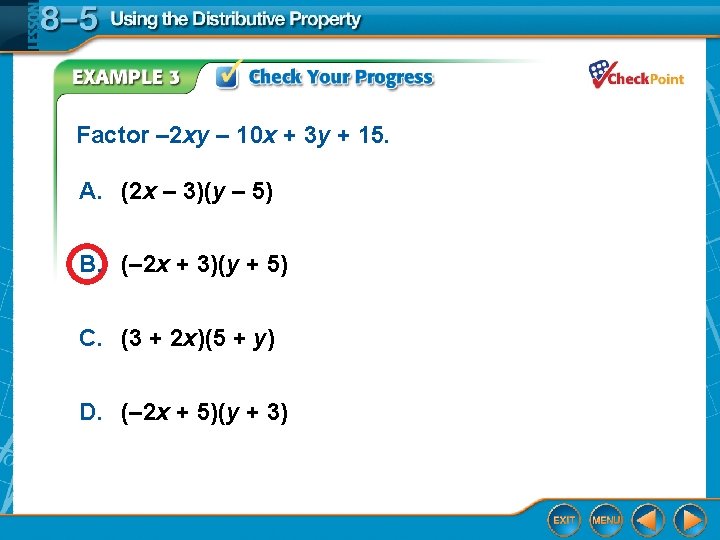
Factor 4 xy + 3 y – 20 x – 15. A. (4 x – 5)(y + 3) B. (7 x + 5)(2 y – 3) C. (4 x + 3)(y – 5) D. (4 x – 3)(y + 5)
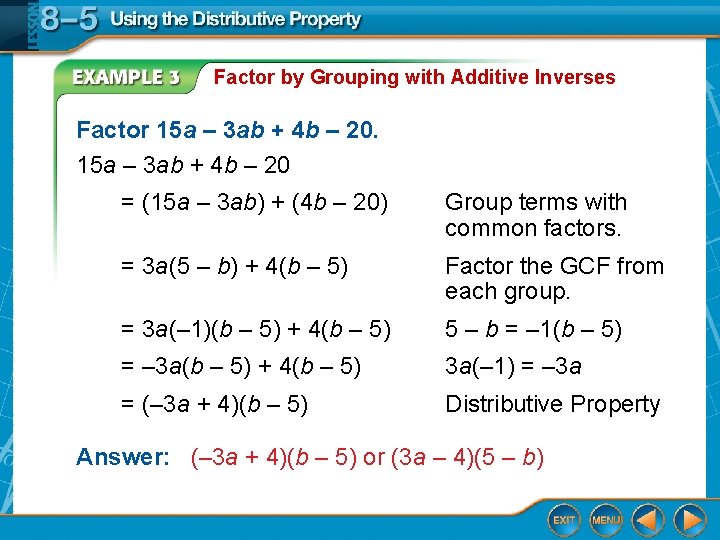
Factor by Grouping with Additive Inverses Factor 15 a – 3 ab + 4 b – 20 = (15 a – 3 ab) + (4 b – 20) Group terms with common factors. = 3 a(5 – b) + 4(b – 5) Factor the GCF from each group. = 3 a(– 1)(b – 5) + 4(b – 5) 5 – b = – 1(b – 5) = – 3 a(b – 5) + 4(b – 5) 3 a(– 1) = – 3 a = (– 3 a + 4)(b – 5) Distributive Property Answer: (– 3 a + 4)(b – 5) or (3 a – 4)(5 – b)
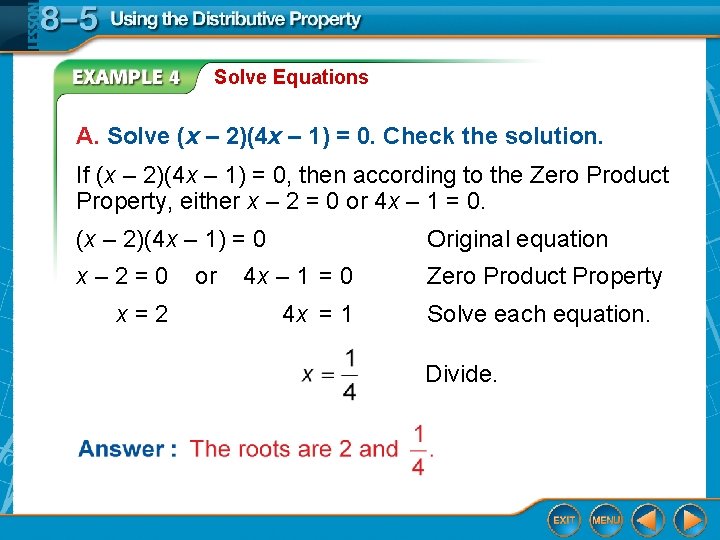
Solve Equations A. Solve (x – 2)(4 x – 1) = 0. Check the solution. If (x – 2)(4 x – 1) = 0, then according to the Zero Product Property, either x – 2 = 0 or 4 x – 1 = 0. (x – 2)(4 x – 1) = 0 Original equation x– 2=0 Zero Product Property x=2 or 4 x – 1 = 0 4 x = 1 Solve each equation. Divide.
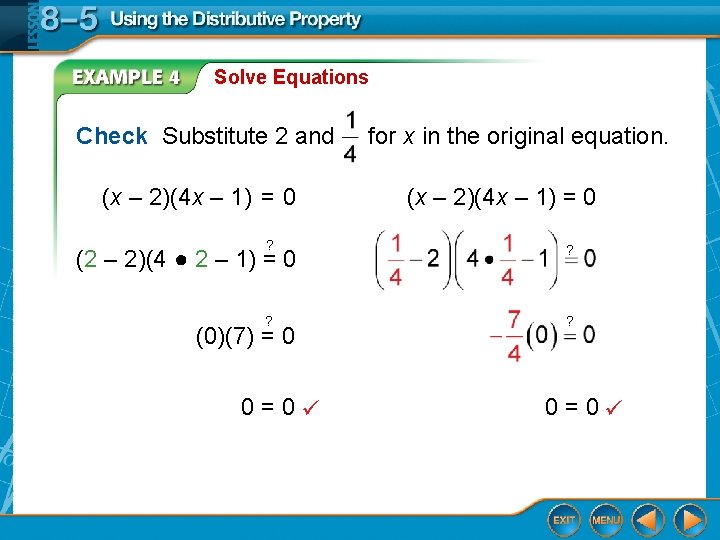
Solve Equations Check Substitute 2 and (x – 2)(4 x – 1) = 0 for x in the original equation. (x – 2)(4 x – 1) = 0 ? ? (2 – 2)(4 ● 2 – 1) = 0 (0)(7) = 0 0=0 0 = 0
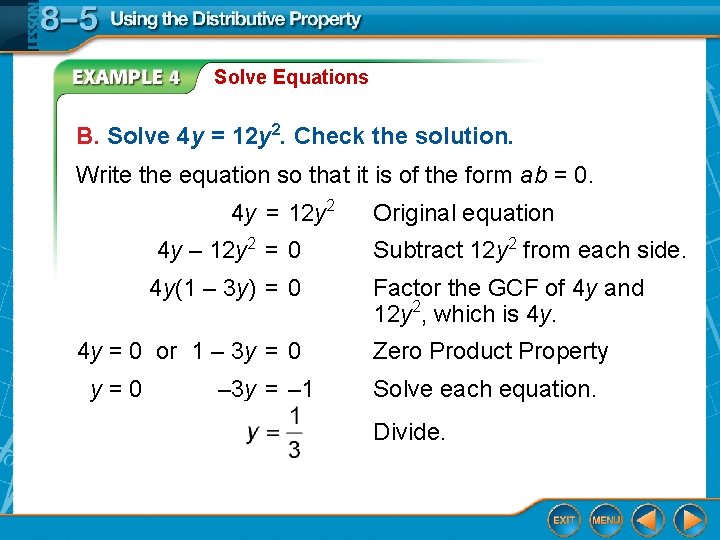
Solve Equations B. Solve 4 y = 12 y 2. Check the solution. Write the equation so that it is of the form ab = 0. 4 y = 12 y 2 4 y – 12 y 2 = 0 Subtract 12 y 2 from each side. 4 y(1 – 3 y) = 0 Factor the GCF of 4 y and 12 y 2, which is 4 y. 4 y = 0 or 1 – 3 y = 0 y=0 Original equation – 3 y = – 1 Zero Product Property Solve each equation. Divide.
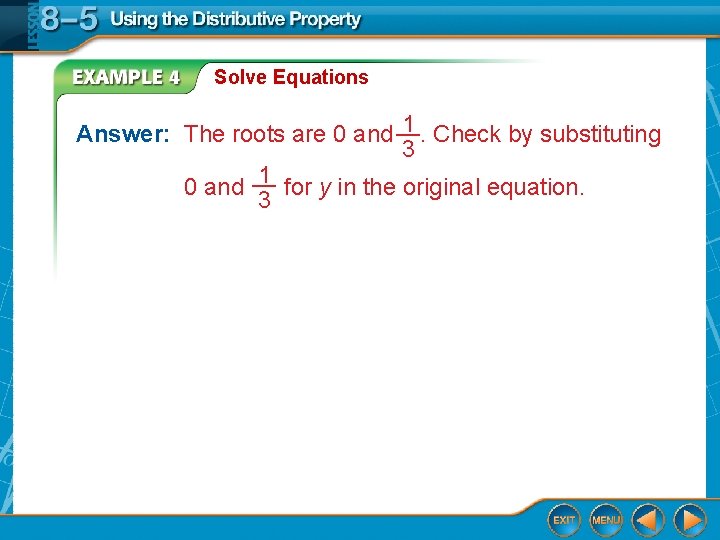
Solve Equations 1. Check by substituting Answer: The roots are 0 and __ 3 __ 1 0 and for y in the original equation. 3
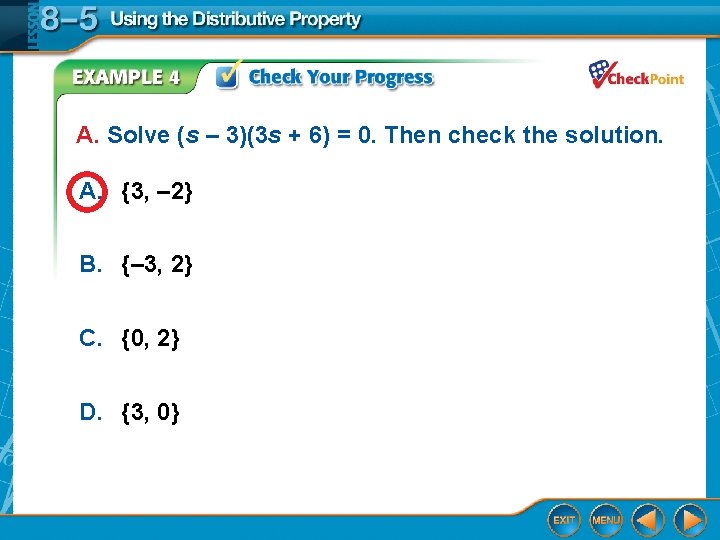
A. Solve (s – 3)(3 s + 6) = 0. Then check the solution. A. {3, – 2} B. {– 3, 2} C. {0, 2} D. {3, 0}
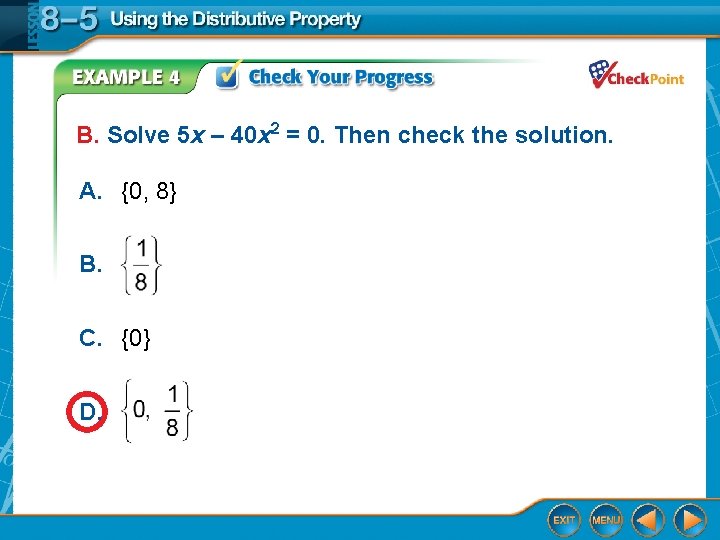
B. Solve 5 x – 40 x 2 = 0. Then check the solution. A. {0, 8} B. C. {0} D.
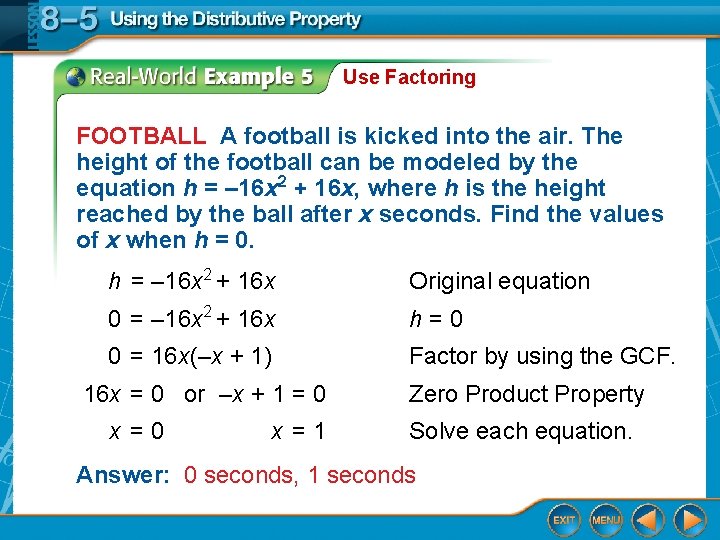
Use Factoring FOOTBALL A football is kicked into the air. The height of the football can be modeled by the equation h = – 16 x 2 + 16 x, where h is the height reached by the ball after x seconds. Find the values of x when h = 0. h = – 16 x 2 + 16 x Original equation 0 = – 16 x 2 + 16 x h=0 0 = 16 x(–x + 1) Factor by using the GCF. 16 x = 0 or –x + 1 = 0 x =1 Zero Product Property Solve each equation. Answer: 0 seconds, 1 seconds
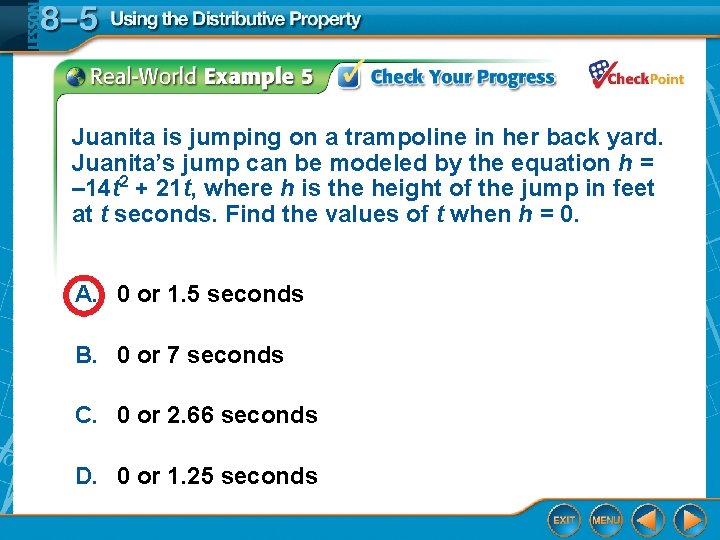
Juanita is jumping on a trampoline in her back yard. Juanita’s jump can be modeled by the equation h = – 14 t 2 + 21 t, where h is the height of the jump in feet at t seconds. Find the values of t when h = 0. A. 0 or 1. 5 seconds B. 0 or 7 seconds C. 0 or 2. 66 seconds D. 0 or 1. 25 seconds