Supporting Students with Accommodations Lori Clapis Coordinator of
- Slides: 16
Supporting Students with Accommodations Lori Clapis, Coordinator of Accommodation Resources
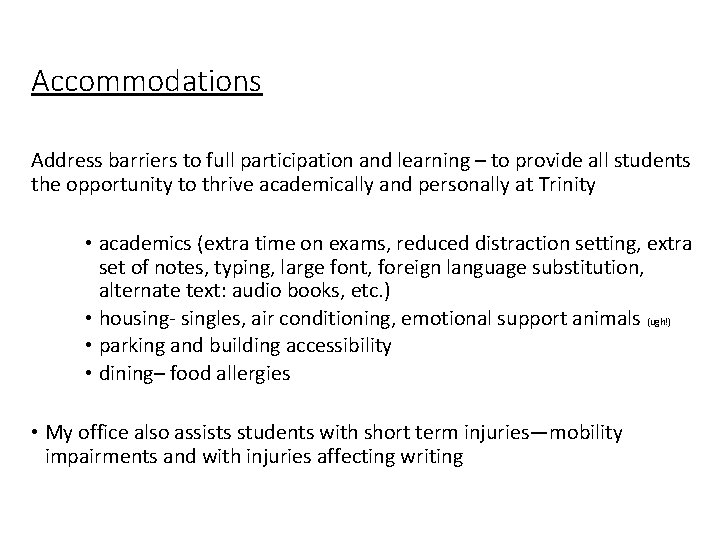
Accommodations Address barriers to full participation and learning – to provide all students the opportunity to thrive academically and personally at Trinity • academics (extra time on exams, reduced distraction setting, extra set of notes, typing, large font, foreign language substitution, alternate text: audio books, etc. ) • housing- singles, air conditioning, emotional support animals (ugh!) • parking and building accessibility • dining– food allergies • My office also assists students with short term injuries—mobility impairments and with injuries affecting writing
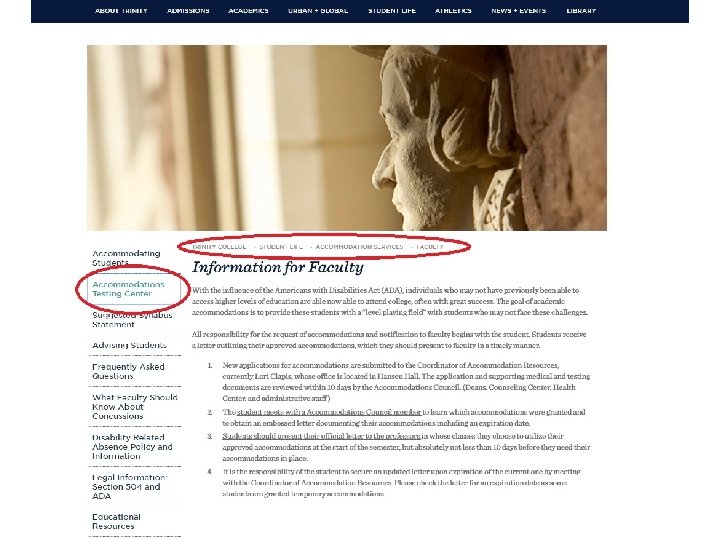
How Students Obtain Accommodations • Students must submit an application and supporting medical and/or psychoeducational testing documentation to prove need • Accommodation Committee reviews application and documentation, and will give students a decision • It is an interactive process and there is an official appeal process
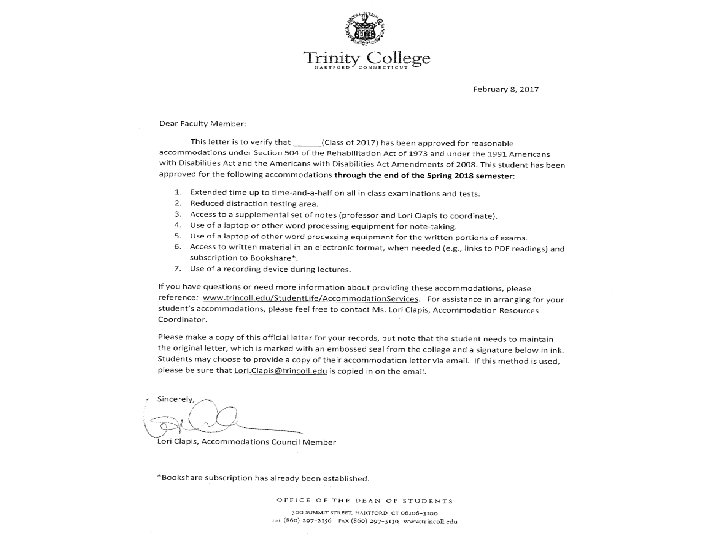
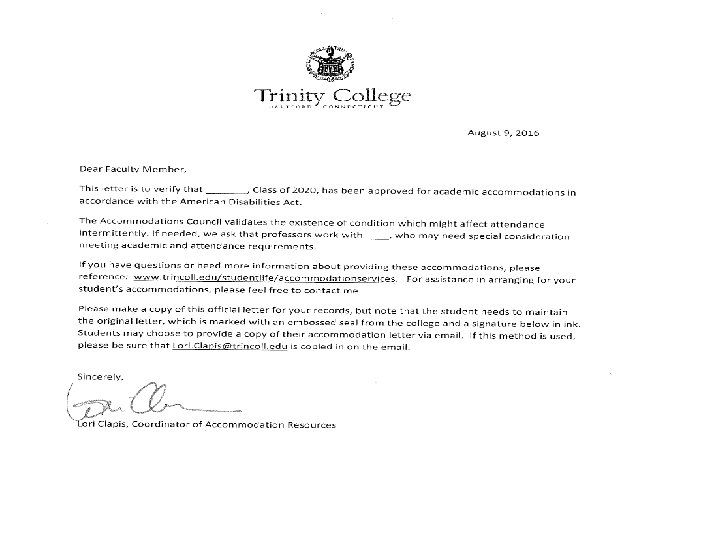
Student’s Responsibility: Notify Faculty • Within the first two weeks of the semester but must give a minimum notice of 10 days before an exam • Provide a hard copy of their official accommodation letter or email a PDF of their letter (cc to Lori Clapis) • Encouraged to meet with faculty to make a plan • Why do students hesitate? (the eternal question)
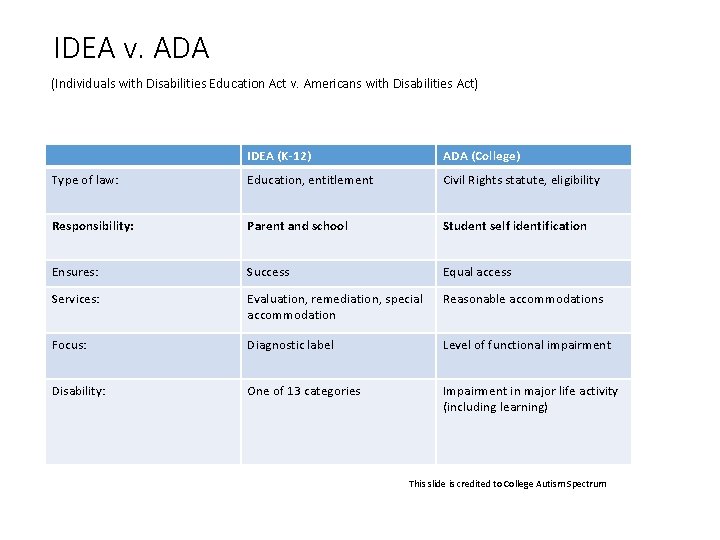
IDEA v. ADA (Individuals with Disabilities Education Act v. Americans with Disabilities Act) IDEA (K-12) ADA (College) Type of law: Education, entitlement Civil Rights statute, eligibility Responsibility: Parent and school Student self identification Ensures: Success Equal access Services: Evaluation, remediation, special accommodation Reasonable accommodations Focus: Diagnostic label Level of functional impairment Disability: One of 13 categories Impairment in major life activity (including learning) This slide is credited to College Autism Spectrum
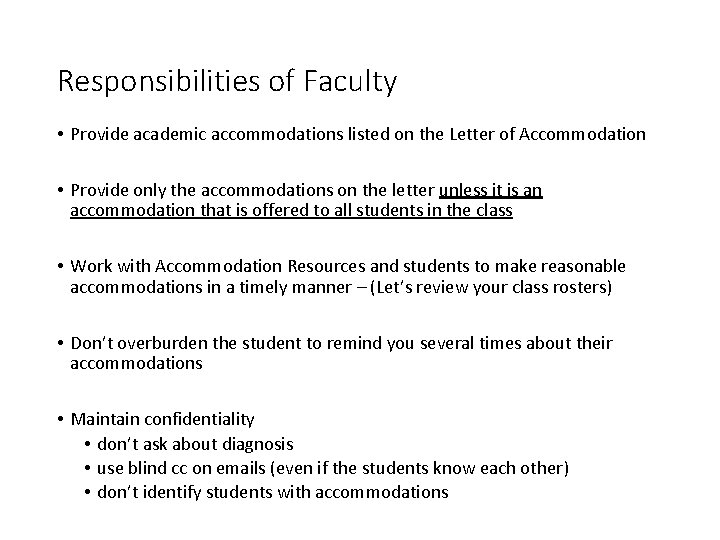
Responsibilities of Faculty • Provide academic accommodations listed on the Letter of Accommodation • Provide only the accommodations on the letter unless it is an accommodation that is offered to all students in the class • Work with Accommodation Resources and students to make reasonable accommodations in a timely manner – (Let’s review your class rosters) • Don’t overburden the student to remind you several times about their accommodations • Maintain confidentiality • don’t ask about diagnosis • use blind cc on emails (even if the students know each other) • don’t identify students with accommodations
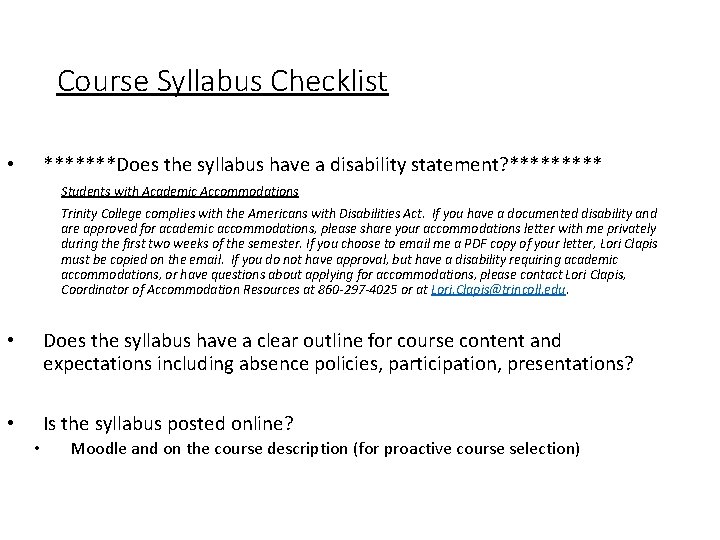
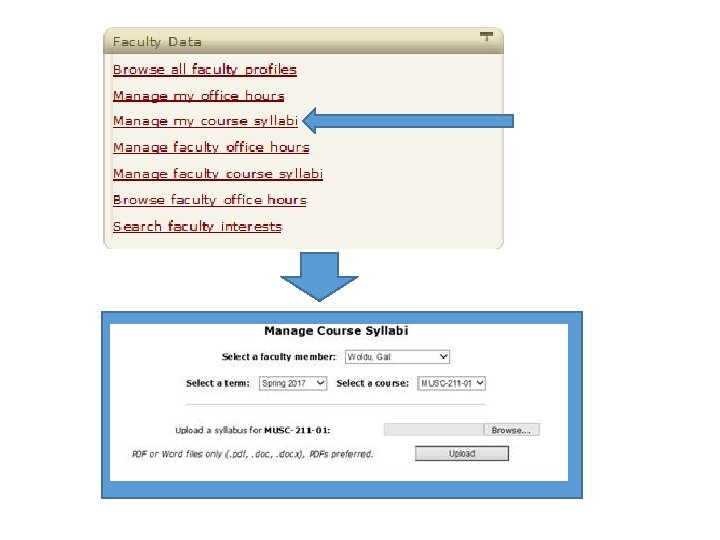
Course Syllabus Checklist *******Does the syllabus have a disability statement? ***** • Students with Academic Accommodations Trinity College complies with the Americans with Disabilities Act. If you have a documented disability and are approved for academic accommodations, please share your accommodations letter with me privately during the first two weeks of the semester. If you choose to email me a PDF copy of your letter, Lori Clapis must be copied on the email. If you do not have approval, but have a disability requiring academic accommodations, or have questions about applying for accommodations, please contact Lori Clapis, Coordinator of Accommodation Resources at 860 -297 -4025 or at Lori. Clapis@trincoll. edu. • Does the syllabus have a clear outline for course content and expectations including absence policies, participation, presentations? • Is the syllabus posted online? • Moodle and on the course description (for proactive course selection)
Absences, Deadline Extensions and the ADA • Faculty should not lower course expectations or fundamentally alter the nature of the course at the request of a student with a disability • ADA course requirement language is vague because only the professor can determine the course requirements Ø However, if a student presents a “consideration letter”, then faculty should take into consideration the student’s condition covered under the ADA • Popular accommodation request that we hardly ever approve: extensions on papers
Important Reminders • Trinity receives federal funding - we are legally obligated to comply with ADA • Student conduct rules apply equally to students with disabilities • Students with accommodations can be very successful in the workplace! [National Center for Education Statistics. (1999). Students with disabilities in postsecondary education: A profile of preparation, participation, and outcomes. (NCES 1999 -187)] • You might not know a student’s specific diagnosis – that is OK--but the diagnosis matters far less than the student’s experience-- ask them about it • Disability information must be treated confidentially--identifying a student to peers or making comments about a student’s disability in class violates the student’s right to privacy
Language Use • Use “students with accommodations” not “special needs students” • Use “accessible” rather than “handicapped” • accessible parking, accessible buildings, accessible entry, accessible ramp • Place their personhood first, and their challenge second • “An individual with a disability” NOT: “a disabled individual” • “A person with dyslexia” NOT a “dyslexic” • If you are unsure how to refer to a person with a disability, ask their preference
When to refer students to the Counseling Center (or the Dean of Students Office)… • Significant change in academic functioning • Absences • Change in mood • Change in weight • Change in hygiene • If you suspect a learning disability • Other things?
Resources for Faculty • Dean of Students Office- including Nest Deans and Trinsition Fellows • Counseling Center/Health Center • Accommodation Resources