SUPERVISOR SAFEGUARD ON MORAL INJURY FOR PEERS Presented
- Slides: 11
SUPERVISOR SAFEGUARD ON MORAL INJURY FOR PEERS Presented by Adria Powles, LBSW, CPFS University Of Arizona’s College of Medicine, Department of Family and Community Medicine Workforce Development Program (WDP)
Moral Dilemma and Consequently Moral Injury Navigating an ethical path among such intensely competing drivers is emotionally and morally exhausting. Continually being caught between the Values and Ethics of Peer Supports, years of lived experience and formal learning, and the realities of workplace demands and policies. Routinely experiencing the suffering, anguish, and loss of being unable to deliver the emotional care people need is deeply painful. These routine, incessant betrayals of care and trust are examples of “death by a thousand cuts. ” Any one of them, delivered alone, might heal. But repeated on a daily basis, they coalesce into the moral injury of health care. www. website. com
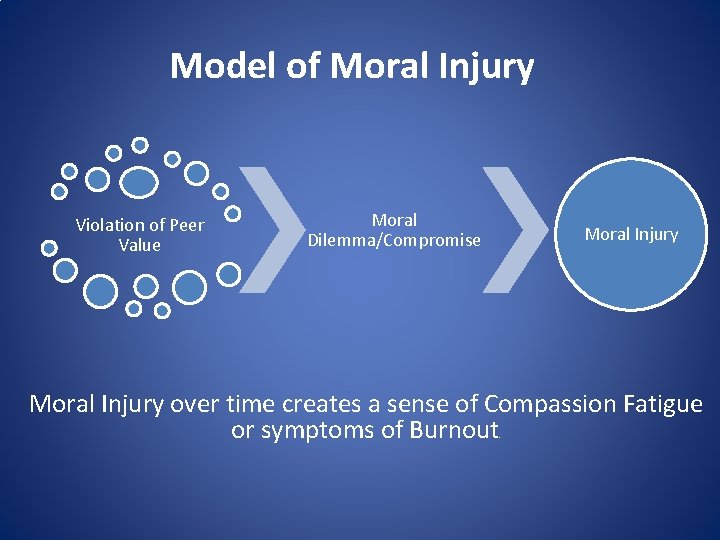
Model of Moral Injury Violation of Peer Value Moral Dilemma/Compromise Moral Injury over time creates a sense of Compassion Fatigue or symptoms of Burnout.
Supervisor’s Point of View What we need is leadership willing to acknowledge the human costs and moral injury of multiple competing allegiances. We need leadership that has the courage to confront and minimize those competing demands. Peer Supports must be treated with respect, autonomy, and the authority to make rational, safe, evidence-based, and financially responsible decisions. Top-down authoritarian mandates on practices are degrading and ultimately ineffective. We need leaders who recognize that caring for their Peer Supports results in thoughtful, compassionate care for members, which ultimately is good business. Experienced peer supports whose knowledge and skills transcend the next business cycle should be treated with loyalty and not as a replaceable, depreciating asset.
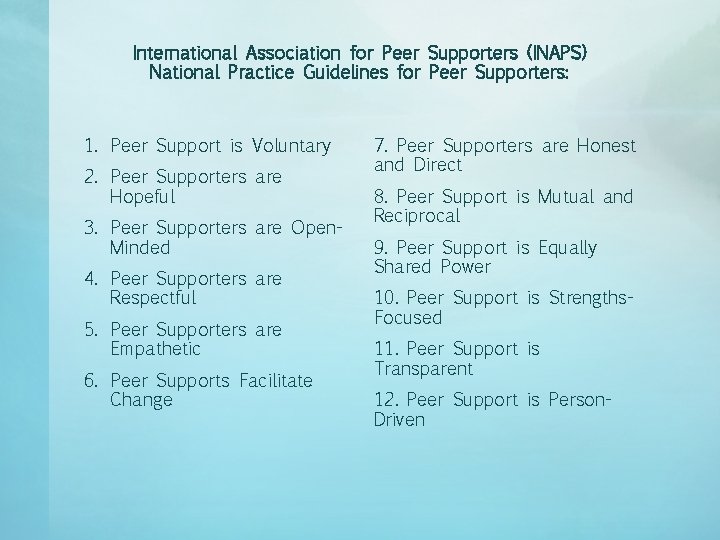
International Association for Peer Supporters (INAPS) National Practice Guidelines for Peer Supporters: 1. Peer Support is Voluntary 2. Peer Supporters are Hopeful 3. Peer Supporters are Open. Minded 4. Peer Supporters are Respectful 5. Peer Supporters are Empathetic 6. Peer Supports Facilitate Change 7. Peer Supporters are Honest and Direct 8. Peer Support is Mutual and Reciprocal 9. Peer Support is Equally Shared Power 10. Peer Support is Strengths. Focused 11. Peer Support is Transparent 12. Peer Support is Person. Driven
Share Your Story I would like to invite you to share your experiences of moral injury or distress… How does your story relate to Peer Practice Guidelines/Peer Values? Does it align with Peer Values? If not, how so?
How is Moral Injury different than Compassion Fatigue and Burnout?
Compassion Fatigue “We have not been directly exposed to the trauma scene, but we hear the story told with such intensity, or we hear similar stories so often, or we have the gift and curse of extreme empathy and we suffer. We feel the feelings of our clients. We experience their fears. We dream their dreams. Eventually, we lose a certain spark of optimism, humor and hope. We tire. We aren’t sick, but we aren’t ourselves. ” – C. Figley, 1995 www. website. com
THE DYNAMICS OF BURNOUT According to the current WHO classification, burnout can arise from unsuccessful management of chronic work-related stress, resulting in an occupational syndrome characterized such symptoms as "feelings of energy depletion or exhaustion; increased mental distance from one’s job, or feelings of negativism or cynicism related to one's job; and reduced professional efficacy. “ DSM V has burnout under problems associated with employment/unemployment related to lifemanagement difficulty on factors influencing health status but is not considered a disease or medical condition. According to these definitions do you believe burnout is the result of a person’s own inabilities to manage work-related stress? What if we have little influence on external conditions bestowed upon us?
So now what? How do we manage constant and repeated Moral Injury without it becoming Compassion Fatigue or Burnout? Peer Specific Supervision Supporting Peer Core Competencies • Use National Practice Guidelines and Core Competencies for Peer Workers in Behavioral Health Systems to guide supervisions Promote Leadership and Advocacy Peer Core Competency #11 • Advocate for needs and desires of peers in within treatment a treatment team, specify peer roles within the work environment and be attentive to counter transference • Participate in efforts to eliminate prejudice and discrimination of people who have behavioral health conditions and their families Wellness Planning Peer Core competency #12 • Plans shall reflect and examine personal motivations, judgements, and feelings, that may be activated by the peer work recognizing signs of distress and knowing when to seek support • Daily Maintenance Plan (Home and Work)
REFERENCES AND RESOURCES American Institute of Science, Stephen M. Campbell, Bentley University; Connie M. Ulrich, University of Pennsylvania; Christine Grady National Institute of Health; American Journal of Bioethics; Sven Nyholm, Eindhoven University of Technology; Markus Christen, University of Zurich, Johannes Katsarov, University of Zurich; Andrew Mc. Aninch, Milwaukee School of Engineering; Stephen Lathum, Yale Interdisciplinary Center for Bioethics; Haavi Morreim, University of Tennessee Health Science Center Adams R. E. , Boscarino J. A. , Figley CR. (2006). Compassion Fatigue and Psychological Distress Among Social Workers: A Validation Study. Am J Orthopsychiatry. 76(1): 103– 108. Stamm BH. (2010). The concise Pro. QOL manual. Pocatello ID Pro. QOL Org. Potter P, Deshields T, Divanbeigi J, Berger J, Cipriano D, Norris L, Olsen S. Compassion Fatigue and Burnout. (2010). Clin J Oncol Nurs. 14(5): E 56–E 62. Diagnostic and Statistical Manual of Mental Disorders (DSM-5)