STUDENT PERSPECTIVES ON HIGHIMPACT COURSES ELISE FENN PSY
- Slides: 10
STUDENT PERSPECTIVES ON HIGH-IMPACT COURSES ELISE FENN, PSY, SBS JONATHAN MARTINEZ, PSY, SBS EMILY RUSSELL, CADV, HHD SVETLANA TYUTINA, MCLL, COH
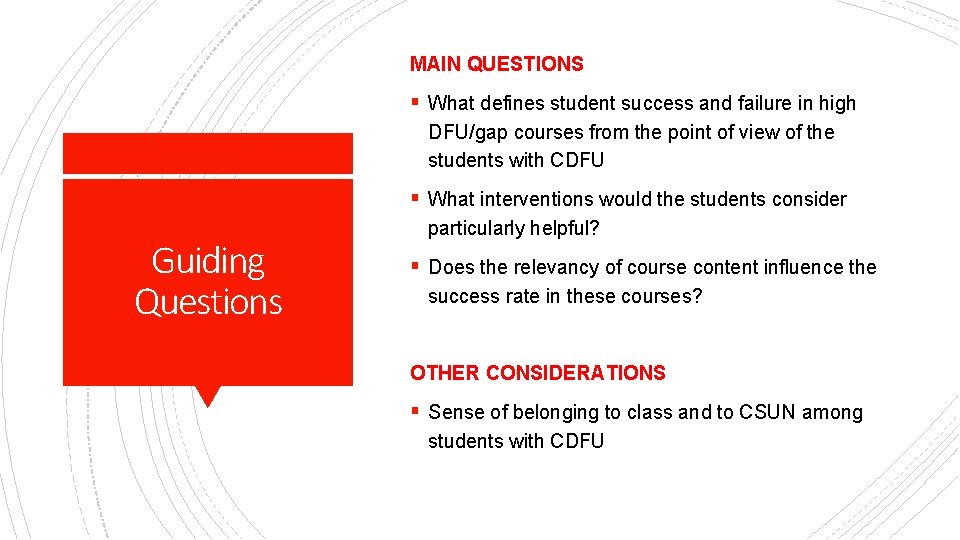
MAIN QUESTIONS § What defines student success and failure in high DFU/gap courses from the point of view of the students with CDFU § What interventions would the students consider Guiding Questions particularly helpful? § Does the relevancy of course content influence the success rate in these courses? OTHER CONSIDERATIONS § Sense of belonging to class and to CSUN among students with CDFU
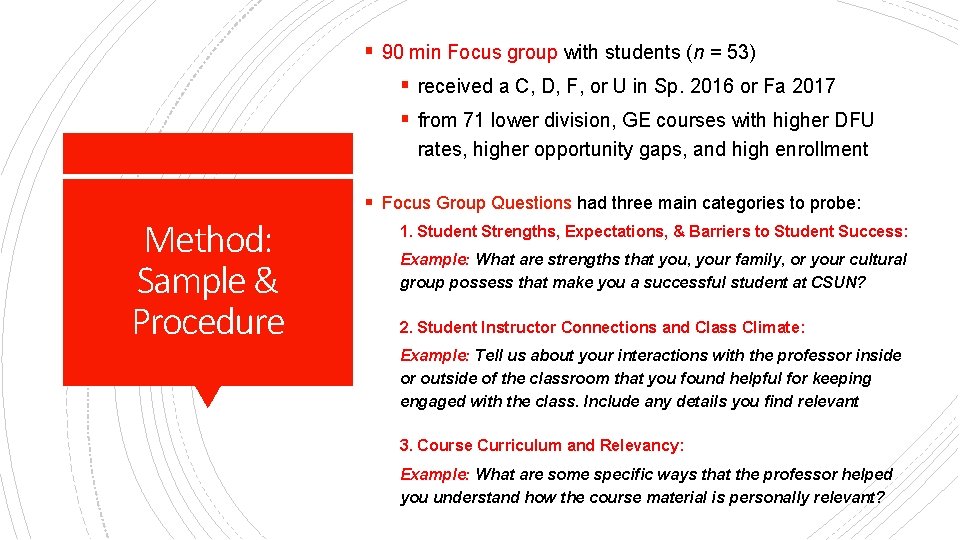
§ 90 min Focus group with students (n = 53) § received a C, D, F, or U in Sp. 2016 or Fa 2017 § from 71 lower division, GE courses with higher DFU rates, higher opportunity gaps, and high enrollment § Focus Group Questions had three main categories to probe: Method: Sample & Procedure 1. Student Strengths, Expectations, & Barriers to Student Success: Example: What are strengths that you, your family, or your cultural group possess that make you a successful student at CSUN? 2. Student Instructor Connections and Class Climate: Example: Tell us about your interactions with the professor inside or outside of the classroom that you found helpful for keeping engaged with the class. Include any details you find relevant 3. Course Curriculum and Relevancy: Example: What are some specific ways that the professor helped you understand how the course material is personally relevant?
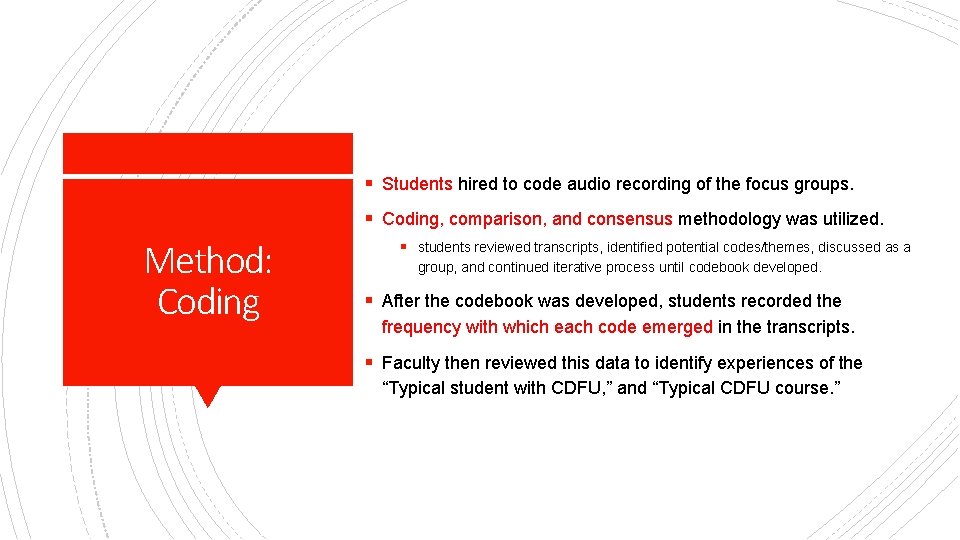
§ Students hired to code audio recording of the focus groups. § Coding, comparison, and consensus methodology was utilized. Method: Coding § students reviewed transcripts, identified potential codes/themes, discussed as a group, and continued iterative process until codebook developed. § After the codebook was developed, students recorded the frequency with which each code emerged in the transcripts. § Faculty then reviewed this data to identify experiences of the “Typical student with CDFU, ” and “Typical CDFU course. ”
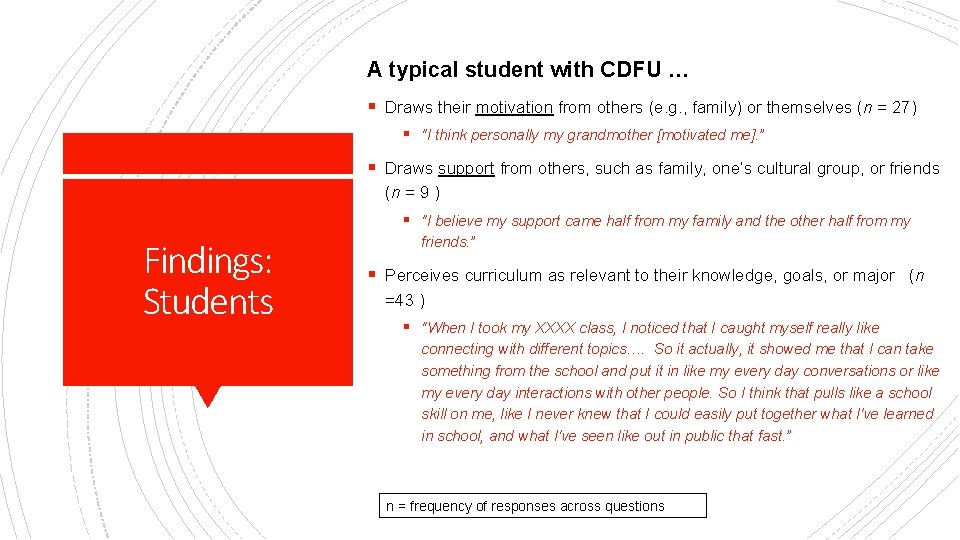
A typical student with CDFU … § Draws their motivation from others (e. g. , family) or themselves (n = 27) § "I think personally my grandmother [motivated me]. ” § Draws support from others, such as family, one’s cultural group, or friends (n = 9 ) § "I believe my support came half from my family and the other half from my Findings: Students friends. ” § Perceives curriculum as relevant to their knowledge, goals, or major (n =43 ) § "When I took my XXXX class, I noticed that I caught myself really like connecting with different topics…. So it actually, it showed me that I can take something from the school and put it in like my every day conversations or like my every day interactions with other people. So I think that pulls like a school skill on me, like I never knew that I could easily put together what I've learned in school, and what I've seen like out in public that fast. ” n = frequency of responses across questions
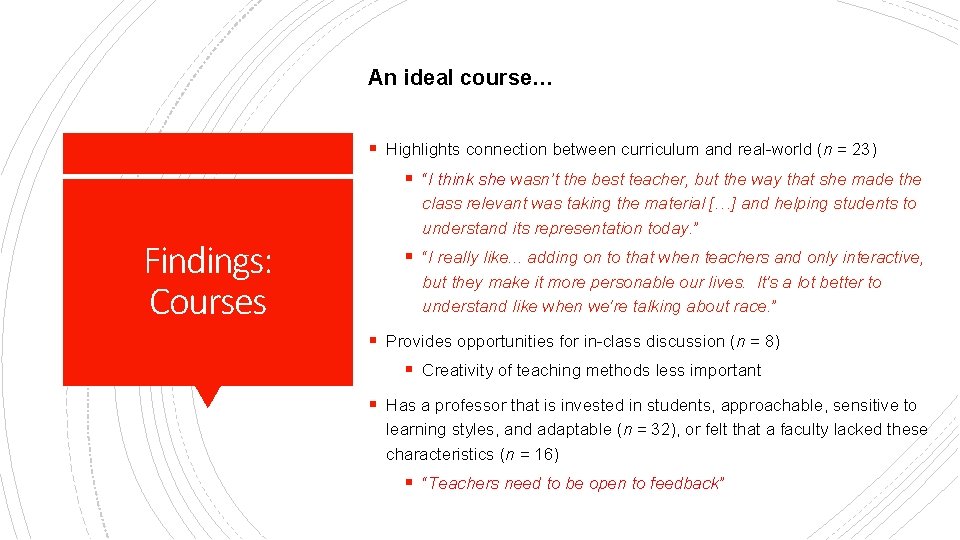
An ideal course… § Highlights connection between curriculum and real-world (n = 23) § “I think she wasn’t the best teacher, but the way that she made the Findings: Courses class relevant was taking the material […] and helping students to understand its representation today. ” § “I really like. . . adding on to that when teachers and only interactive, but they make it more personable our lives. It's a lot better to understand like when we're talking about race. ” § Provides opportunities for in-class discussion (n = 8) § Creativity of teaching methods less important § Has a professor that is invested in students, approachable, sensitive to learning styles, and adaptable (n = 32), or felt that a faculty lacked these characteristics (n = 16) § “Teachers need to be open to feedback”
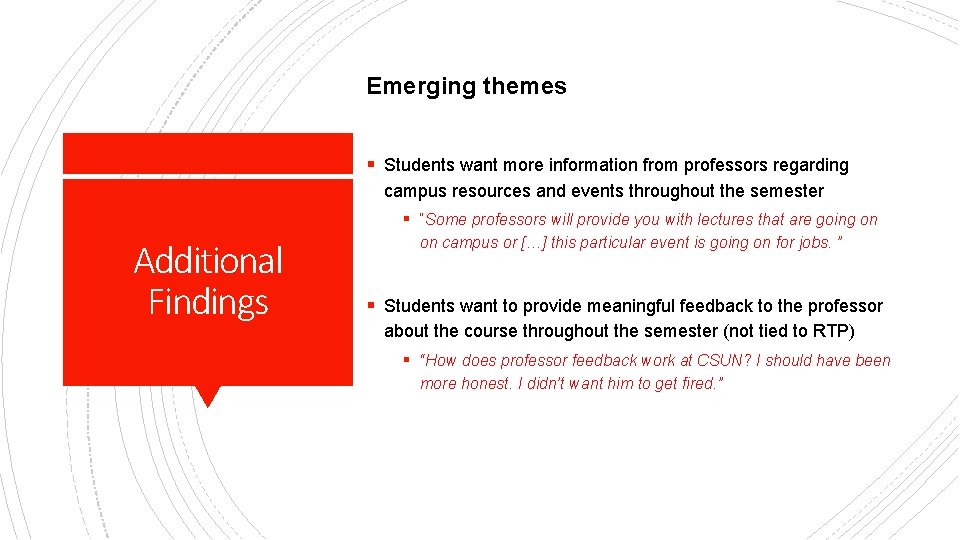
Emerging themes § Students want more information from professors regarding campus resources and events throughout the semester § “Some professors will provide you with lectures that are going on Additional Findings on campus or […] this particular event is going on for jobs. ” § Students want to provide meaningful feedback to the professor about the course throughout the semester (not tied to RTP) § “How does professor feedback work at CSUN? I should have been more honest. I didn’t want him to get fired. ”
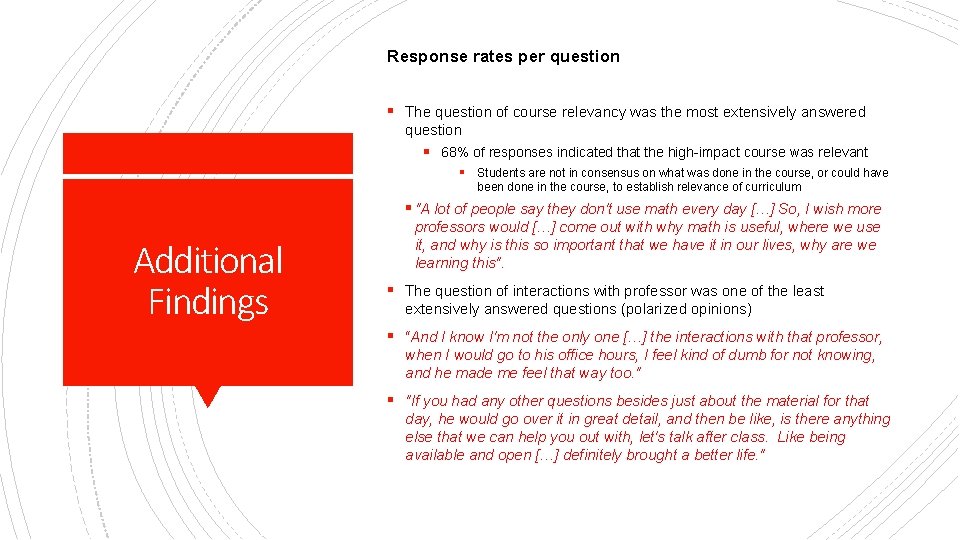
Response rates per question § The question of course relevancy was the most extensively answered question § 68% of responses indicated that the high-impact course was relevant § Students are not in consensus on what was done in the course, or could have been done in the course, to establish relevance of curriculum § "A lot of people say they don't use math every day […] So, I wish more Additional Findings professors would […] come out with why math is useful, where we use it, and why is this so important that we have it in our lives, why are we learning this". § The question of interactions with professor was one of the least extensively answered questions (polarized opinions) § “And I know I'm not the only one […] the interactions with that professor, when I would go to his office hours, I feel kind of dumb for not knowing, and he made me feel that way too. " § "If you had any other questions besides just about the material for that day, he would go over it in great detail, and then be like, is there anything else that we can help you out with, let's talk after class. Like being available and open […] definitely brought a better life. "
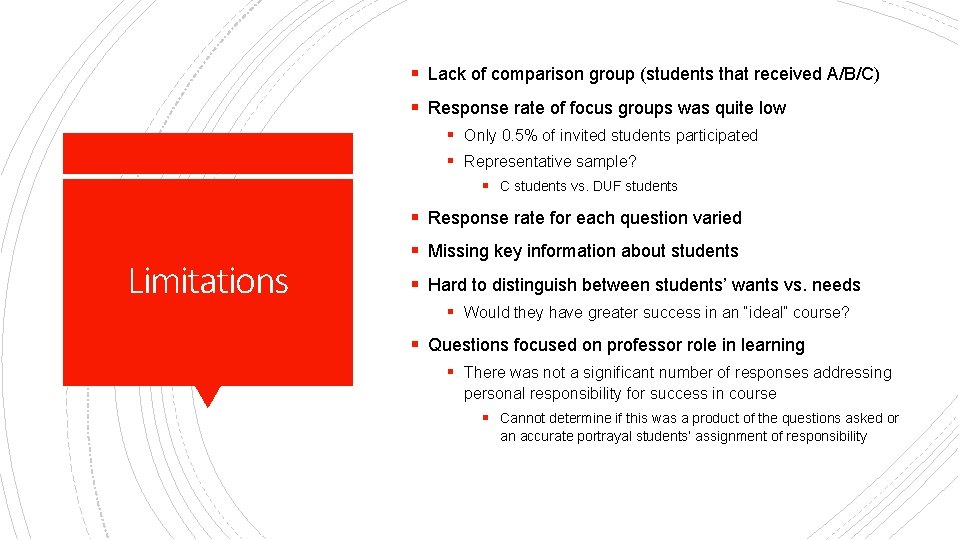
§ Lack of comparison group (students that received A/B/C) § Response rate of focus groups was quite low § Only 0. 5% of invited students participated § Representative sample? § C students vs. DUF students § Response rate for each question varied Limitations § Missing key information about students § Hard to distinguish between students’ wants vs. needs § Would they have greater success in an “ideal” course? § Questions focused on professor role in learning § There was not a significant number of responses addressing personal responsibility for success in course § Cannot determine if this was a product of the questions asked or an accurate portrayal students’ assignment of responsibility
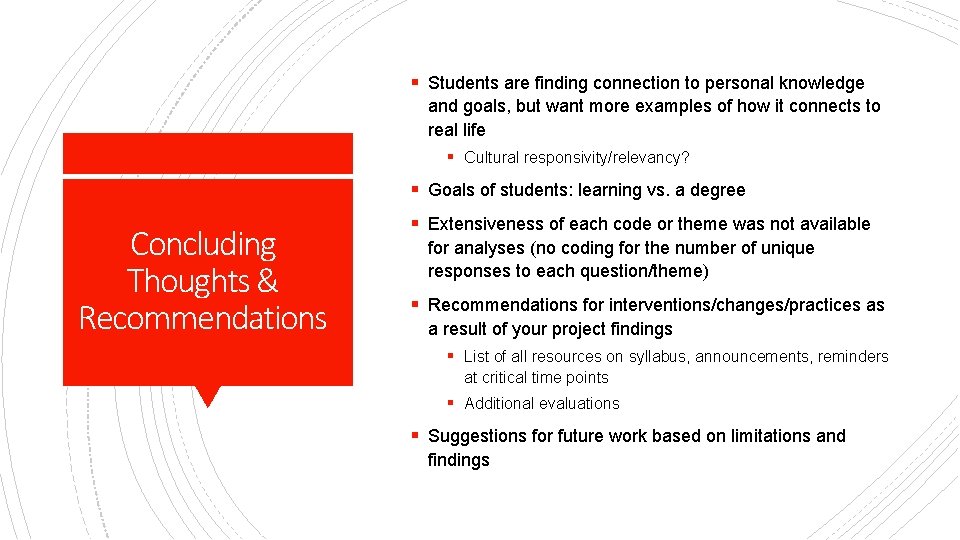
§ Students are finding connection to personal knowledge and goals, but want more examples of how it connects to real life § Cultural responsivity/relevancy? § Goals of students: learning vs. a degree Concluding Thoughts & Recommendations § Extensiveness of each code or theme was not available for analyses (no coding for the number of unique responses to each question/theme) § Recommendations for interventions/changes/practices as a result of your project findings § List of all resources on syllabus, announcements, reminders at critical time points § Additional evaluations § Suggestions for future work based on limitations and findings