Structure Shapes from Excited States Piet Van Duppen


- Slides: 26
Structure, Shapes from Excited States Piet Van Duppen IKS - K. U. Leuven, Belgium for the MINIBALL Collaboration Ø Physics Motivation and Questions (see D. Vretenar) Ø ISOLDE has unique possibilities to produce high-quality results that form stringent test for our understanding of the atomic nucleus Outline Ø Introduction (probing excited states, radioactive beam experiments) Ø The REX-ISOLDE - MINIBALL Physics Program: a few Selected Cases Ø Future Outlook and Conclusion Ø Needs K. U. Leuven NUPAC CERN 2005
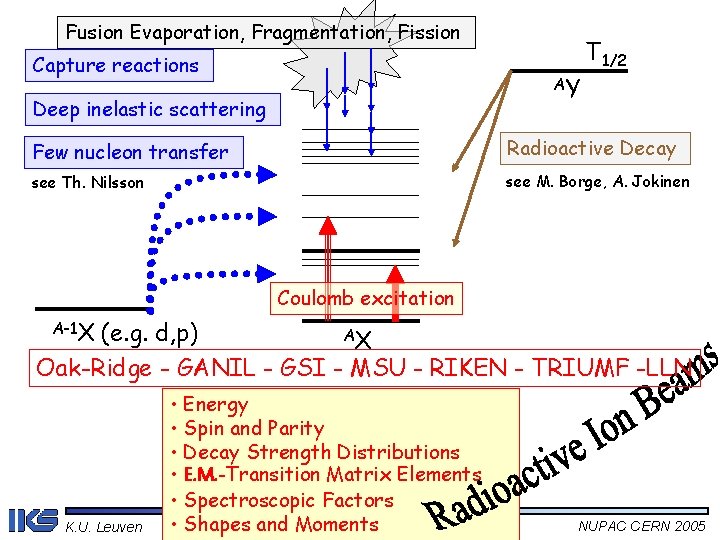
Fusion Evaporation, Fragmentation, Fission Capture reactions T 1/2 AY Deep inelastic scattering Few nucleon transfer Radioactive Decay see Th. Nilsson see M. Borge, A. Jokinen Coulomb excitation A-1 X (e. g. d, p) AX Oak-Ridge - GANIL - GSI - MSU - RIKEN - TRIUMF -LLN K. U. Leuven • Energy • Spin and Parity • Decay Strength Distributions • E. M. -Transition Matrix Elements • Spectroscopic Factors • Shapes and Moments NUPAC CERN 2005
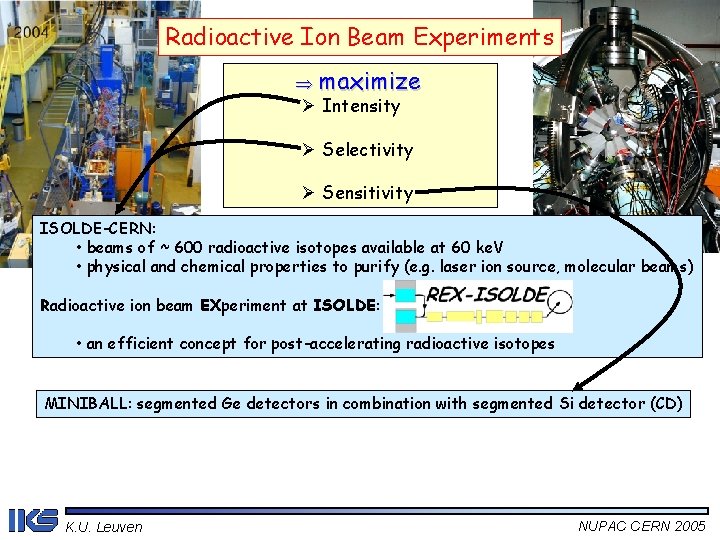
Radioactive Ion Beam Experiments maximize Ø Intensity Ø Selectivity Ø Sensitivity ISOLDE-CERN: • beams of ~ 600 radioactive isotopes available at 60 ke. V • physical and chemical properties to purify (e. g. laser ion source, molecular beams) Radioactive ion beam EXperiment at ISOLDE: • an efficient concept for post-accelerating radioactive isotopes MINIBALL: segmented Ge detectors in combination with segmented Si detector (CD) K. U. Leuven NUPAC CERN 2005
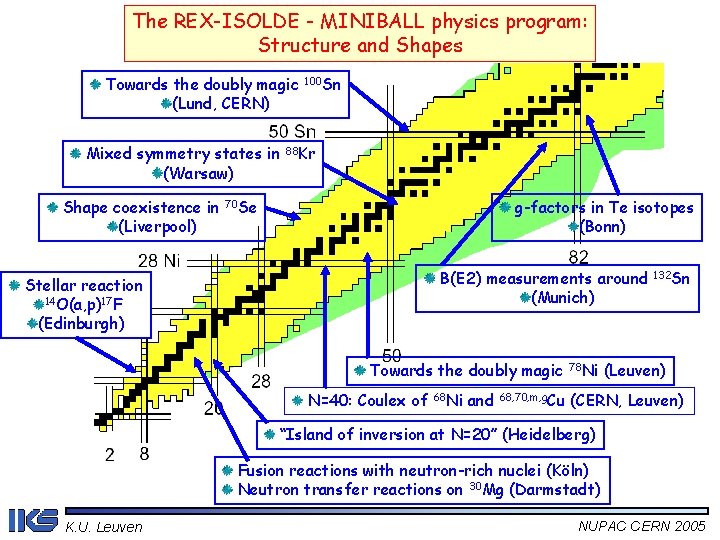
The REX-ISOLDE - MINIBALL physics program: Structure and Shapes Towards the doubly magic (Lund, CERN) Mixed symmetry states in (Warsaw) Shape coexistence in (Liverpool) 100 Sn 88 Kr g-factors in Te isotopes (Bonn) 70 Se B(E 2) measurements around (Munich) Stellar reaction 14 O(a, p)17 F (Edinburgh) Towards the doubly magic N=40: Coulex of 68 Ni and 68, 70, m, g. Cu 78 Ni 132 Sn (Leuven) (CERN, Leuven) “Island of inversion at N=20” (Heidelberg) Fusion reactions with neutron-rich nuclei (Köln) Neutron transfer reactions on 30 Mg (Darmstadt) K. U. Leuven NUPAC CERN 2005
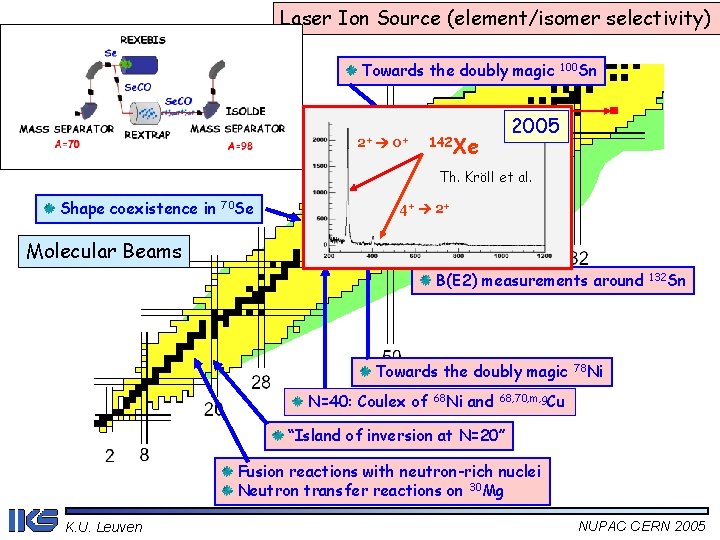
Laser Ion Source (element/isomer selectivity) Towards the doubly magic 2+ 0 + 100 Sn 2005 142 Xe Th. Kröll et al. Shape coexistence in 70 Se 4+ 2 + Molecular Beams B(E 2) measurements around Towards the doubly magic N=40: Coulex of 68 Ni and 132 Sn 78 Ni 68, 70, m, g. Cu “Island of inversion at N=20” Fusion reactions with neutron-rich nuclei Neutron transfer reactions on 30 Mg K. U. Leuven NUPAC CERN 2005
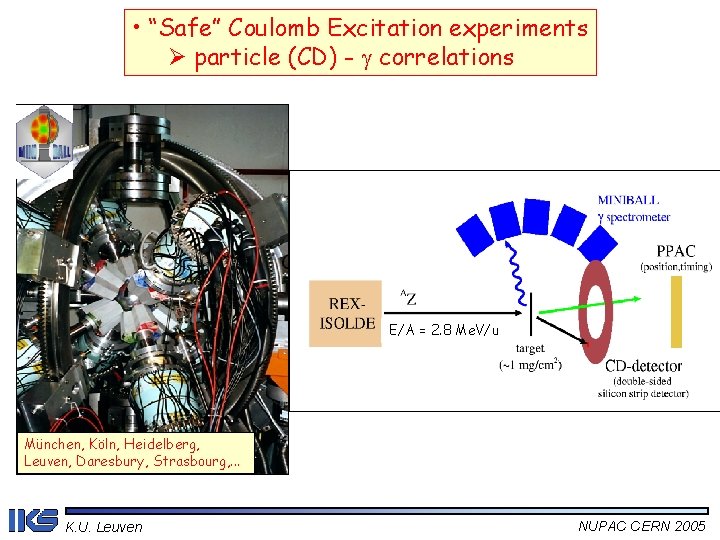
• “Safe” Coulomb Excitation experiments Ø particle (CD) - g correlations E/A = 2. 8 Me. V/u München, Köln, Heidelberg, Leuven, Daresbury, Strasbourg, . . . K. U. Leuven NUPAC CERN 2005
ü “Island of Inversion” at N=20 ü Towards the doubly magic 78 Ni (Coulex of Zn) ü N=40: Coulomb excitation 68, 70 mg. Cu ü Transfer reactions K. U. Leuven NUPAC CERN 2005
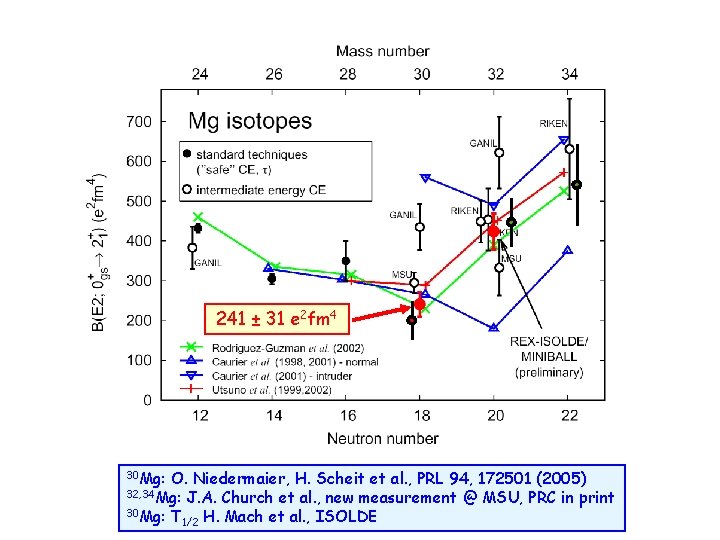
Ø Collectivity of the neutron-rich Mg isotopes Island of inversion (see D. Vretenar) • experimental values inconsistent • spread in recent theoretical calculations N=20 30, 32 Mg “safe” Coulex @ 2. 2 3. 0 Me. V/u O. Niedermaier, H. Scheit, MPI-Heidelberg K. U. Leuven NUPAC CERN 2005
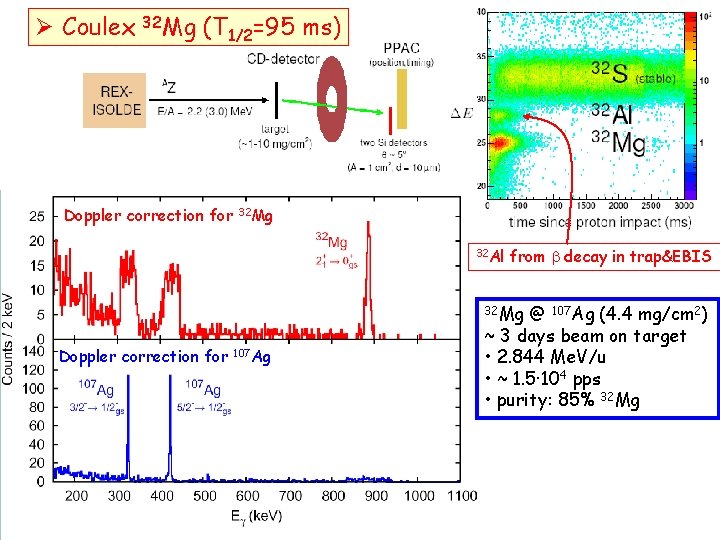
Ø Coulex 32 Mg (T 1/2=95 ms) Doppler correction for 32 Mg 32 Al from b decay in trap&EBIS 32 Mg Doppler correction for K. U. Leuven 107 Ag @ 107 Ag (4. 4 mg/cm 2) ~ 3 days beam on target • 2. 844 Me. V/u • ~ 1. 5· 104 pps • purity: 85% 32 Mg NUPAC CERN 2005
241 ± 31 e 2 fm 4 30 Mg: O. Niedermaier, H. Scheit et al. , PRL 94, 172501 (2005) 32, 34 Mg: J. A. Church et al. , new measurement @ MSU, PRC in print 30 Mg: T 1/2 H. Mach et al. , ISOLDE K. U. Leuven NUPAC CERN 2005
ü “Island of Inversion” at N=20 ü Towards the doubly magic 78 Ni (Coulomb excitation of Zn) ü N=40: Coulomb excitation 68, 70 mg. Cu ü Transfer reactions K. U. Leuven NUPAC CERN 2005
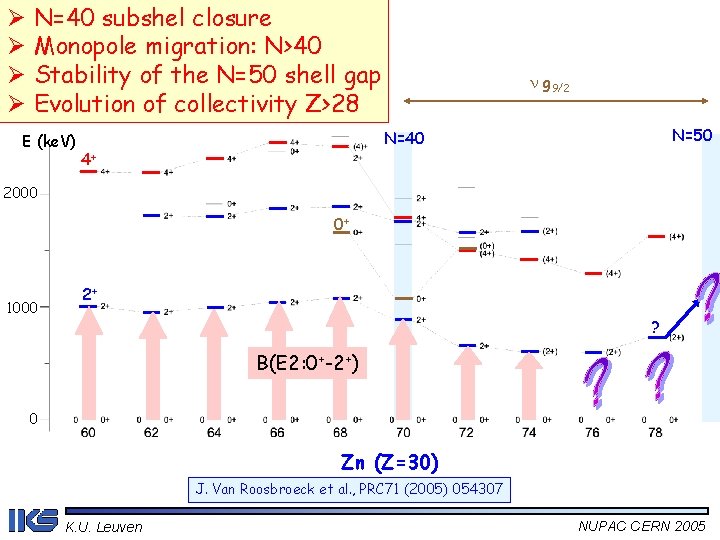
Ø N=40 subshel closure Ø Monopole migration: N>40 Ø Stability of the N=50 shell gap Ø Evolution of collectivity Z>28 E (ke. V) n g 9/2 N=50 N=40 4+ 2000 0+ 1000 2+ ? B(E 2: 0+-2+) 0 Zn (Z=30) J. Van Roosbroeck et al. , PRC 71 (2005) 054307 K. U. Leuven NUPAC CERN 2005
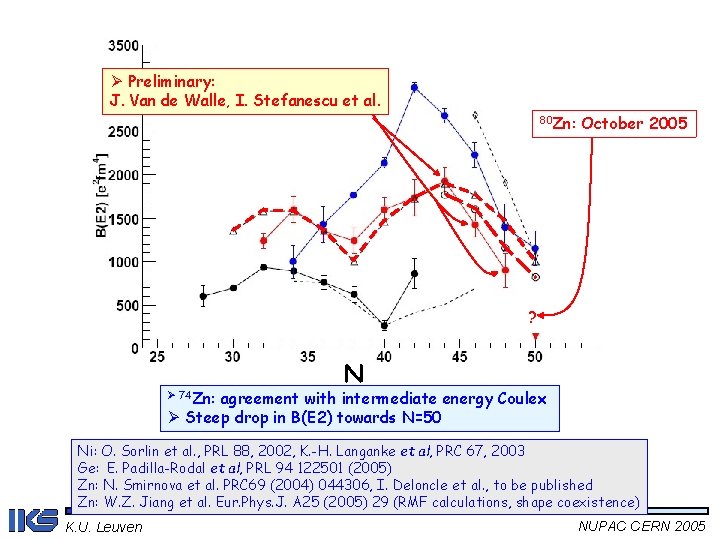
Ø evolution of collectivity Z>28 (Zn, Ge) N=28 50 40 Ge Zn GANIL Oak-Ridge “safe” Coulex Ni GANIL intermediate energy 72 Zn: S. N Leenhardt et al, EPJA 14, 2002 O. Sorlin et al. , PRL 88, 2002 78 -82 Ge: E. Padilla-Rodal et al, PRL 94 122501 (2005) 74 Zn-70 Ni: O. Perru, Ph. D. Thesis, Orsay 68 Ni: K. U. Leuven NUPAC CERN 2005
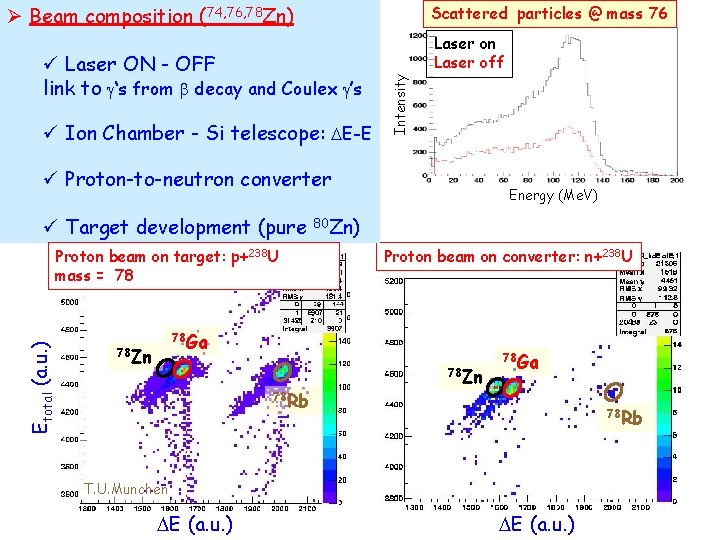
Ø Beam composition (74, 76, 78 Zn) Scattered particles @ mass 76 ü Ion Chamber - Si telescope: DE-E Intensity ü Laser ON - OFF link to g‘s from b decay and Coulex g’s Laser on Laser off ü Proton-to-neutron converter ü Target development (pure Etotal (a. u. ) Proton beam on target: p+238 U mass = 78 Energy (Me. V) 80 Zn) Proton beam on converter: n+238 U 78 Ga 78 Zn 78 Rb 78 Zn 78 Ga 78 Rb T. U. Munchen K. U. Leuven DE (a. u. ) NUPAC CERN 2005
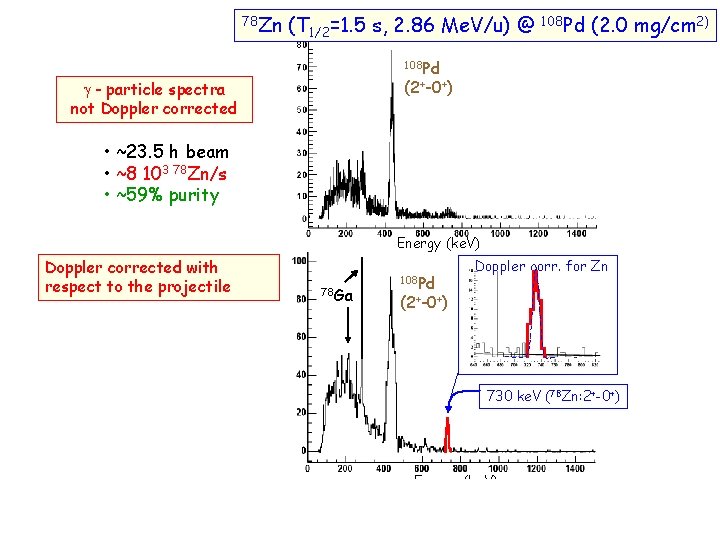
78 Zn (T 1/2=1. 5 s, 2. 86 Me. V/u) @ 108 Pd (2. 0 mg/cm 2) 108 Pd (2+-0+) g - particle spectra not Doppler corrected • ~23. 5 h beam • ~8 103 78 Zn/s • ~59% purity Energy (ke. V) Doppler corrected with respect to the projectile 78 Ga 108 Pd Doppler corr. for Zn (2+-0+) 730 ke. V (78 Zn: 2+-0+) Energy (ke. V) K. U. Leuven NUPAC CERN 2005
Ø Preliminary: J. Van de Walle, I. Stefanescu et al. 80 Zn: October 2005 ? Ø 74 Zn: N agreement with intermediate energy Coulex Ø Steep drop in B(E 2) towards N=50 Ni: O. Sorlin et al. , PRL 88, 2002, K. -H. Langanke et al, PRC 67, 2003 Ge: E. Padilla-Rodal et al, PRL 94 122501 (2005) Zn: N. Smirnova et al. PRC 69 (2004) 044306, I. Deloncle et al. , to be published Zn: W. Z. Jiang et al. Eur. Phys. J. A 25 (2005) 29 (RMF calculations, shape coexistence) K. U. Leuven NUPAC CERN 2005
ü “Island of Inversion” at N=20 ü Towards the doubly magic 78 Ni (Coulex of Zn) ü N=40: Coulomb excitation of 68, 70 mg. Cu ü Transfer reactions K. U. Leuven NUPAC CERN 2005
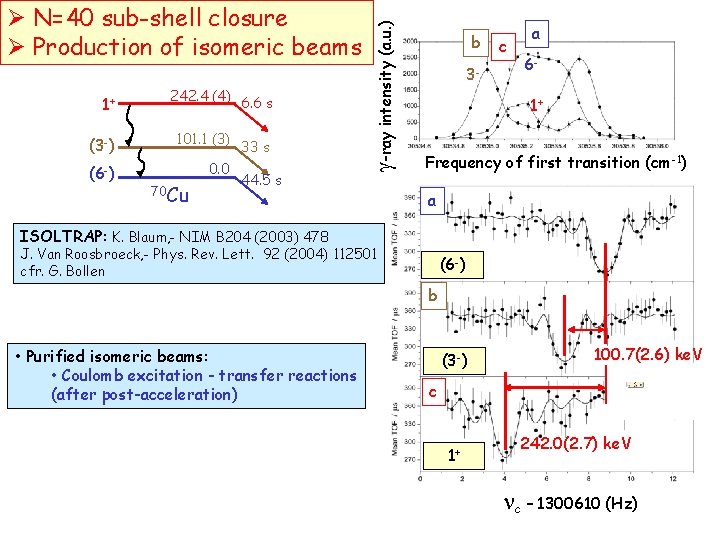
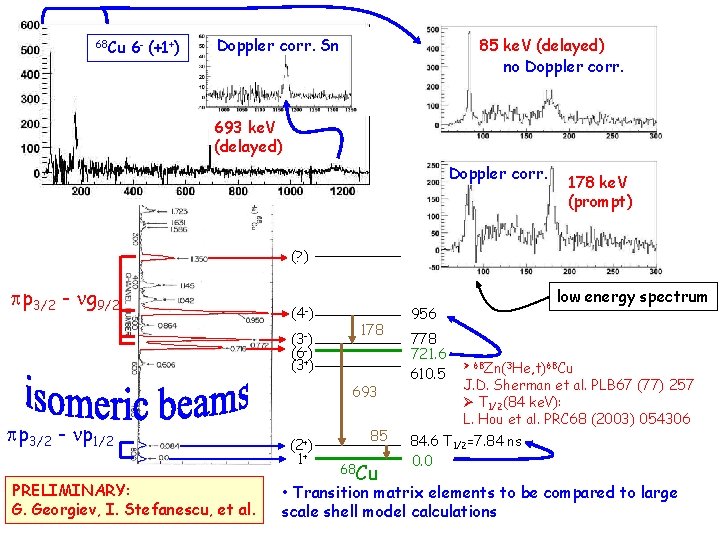
1+ 242. 4 (4) (3 -) 101. 1 (3) (6 -) 0. 0 70 Cu 6. 6 s 33 s 44. 5 s g-ray intensity (a. u. ) Ø N=40 sub-shell closure Ø Production of isomeric beams b 3 - c a 61+ Frequency of first transition (cm-1) a ISOLTRAP: K. Blaum, - NIM B 204 (2003) 478 J. Van Roosbroeck, - Phys. Rev. Lett. 92 (2004) 112501 cfr. G. Bollen (6 -) b • Purified isomeric beams: • Coulomb excitation - transfer reactions (after post-acceleration) (3 -) 100. 7(2. 6) ke. V c 1+ 242. 0(2. 7) ke. V nc – 1300610 (Hz) K. U. Leuven NUPAC CERN 2005
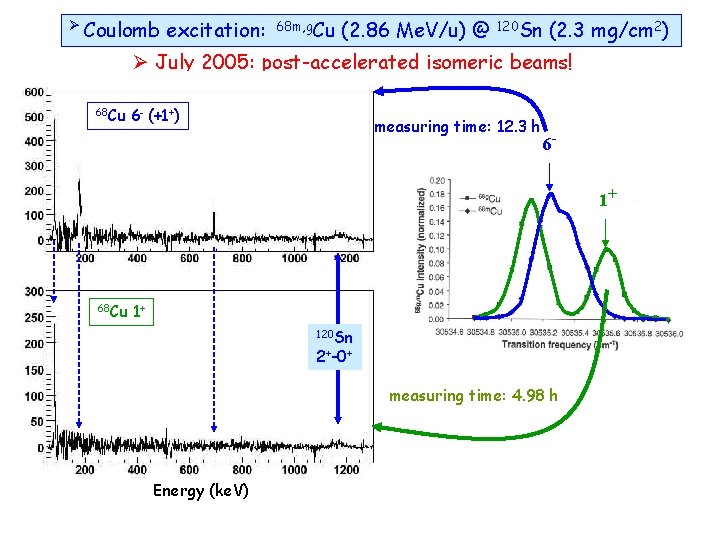
Ø Coulomb excitation: 68 m, g. Cu (2. 86 Me. V/u) @ 120 Sn (2. 3 mg/cm 2) Ø July 2005: post-accelerated isomeric beams! 68 Cu 6 - (+1+) measuring time: 12. 3 h 61+ 68 Cu 1+ 120 Sn 2+-0+ measuring time: 4. 98 h Energy (ke. V) K. U. Leuven NUPAC CERN 2005
68 Cu 6 - (+1+) Doppler corr. Sn 85 ke. V (delayed) no Doppler corr. 693 ke. V (delayed) Doppler corr. 178 ke. V (prompt) (? ) pp 3/2 - ng 9/2 (4 -) (3 -) (6 -) (3+) 178 693 pp 3/2 - np 1/2 PRELIMINARY: G. Georgiev, I. Stefanescu, et al. K. U. Leuven (2+) 1+ 85 68 Cu low energy spectrum 956 778 721. 6 610. 5 Ø 68 Zn(3 He, t)68 Cu J. D. Sherman et al. PLB 67 (77) 257 Ø T 1/2(84 ke. V): L. Hou et al. PRC 68 (2003) 054306 84. 6 T 1/2=7. 84 ns 0. 0 • Transition matrix elements to be compared to large scale shell model calculations NUPAC CERN 2005
ü “Island of Inversion” at N=20 ü Towards the doubly magic 78 Ni (Coulex of Zn) ü N=40: Coulomb excitation 68, 70 mg. Cu ü Transfer reactions K. U. Leuven NUPAC CERN 2005
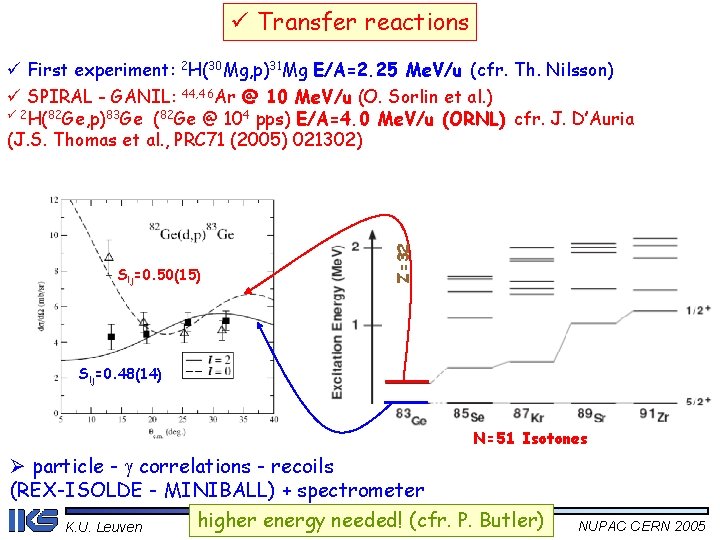
ü Transfer reactions Slj=0. 50(15) Z=32 ü First experiment: 2 H(30 Mg, p)31 Mg E/A=2. 25 Me. V/u (cfr. Th. Nilsson) ü SPIRAL - GANIL: 44, 46 Ar @ 10 Me. V/u (O. Sorlin et al. ) ü 2 H(82 Ge, p)83 Ge (82 Ge @ 104 pps) E/A=4. 0 Me. V/u (ORNL) cfr. J. D’Auria (J. S. Thomas et al. , PRC 71 (2005) 021302) Slj=0. 48(14) N=51 Isotones Ø particle - g correlations - recoils (REX-ISOLDE - MINIBALL) + spectrometer higher energy needed! (cfr. P. Butler) K. U. Leuven NUPAC CERN 2005
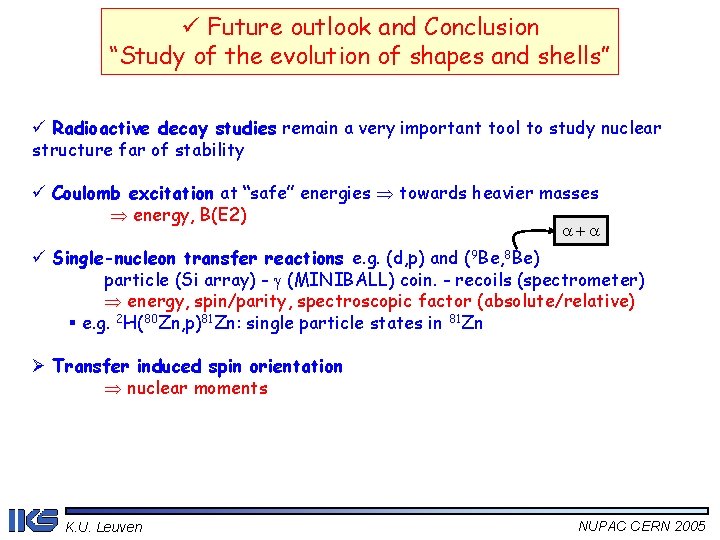
ü Future outlook and Conclusion “Study of the evolution of shapes and shells” ü Radioactive decay studies remain a very important tool to study nuclear structure far of stability ü Coulomb excitation at “safe” energies towards heavier masses energy, B(E 2) a+a ü Single-nucleon transfer reactions e. g. (d, p) and (9 Be, 8 Be) particle (Si array) - g (MINIBALL) coin. - recoils (spectrometer) energy, spin/parity, spectroscopic factor (absolute/relative) § e. g. 2 H(80 Zn, p)81 Zn: single particle states in 81 Zn Ø Transfer induced spin orientation nuclear moments K. U. Leuven NUPAC CERN 2005
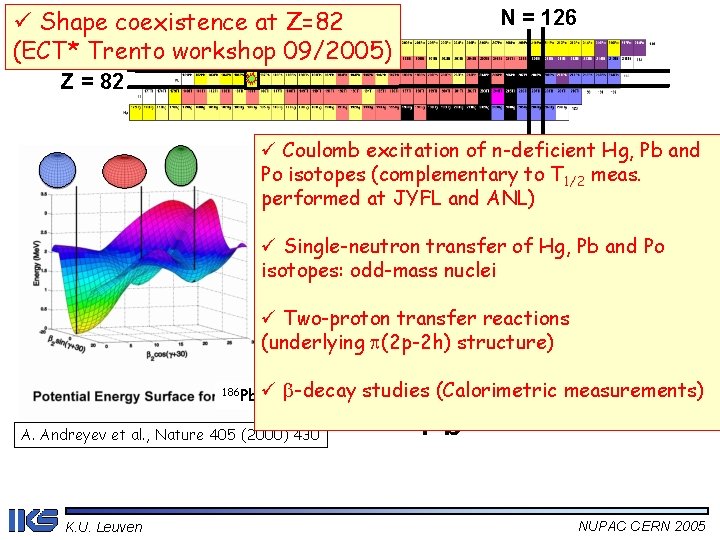
ü Shape coexistence at Z=82 (ECT* Trento workshop 09/2005) 188 Po 189 Po N = 126 191 Po …. Z = 82 ü Coulomb excitation of n-deficient Hg, Pb and 10+ Po isotopes (complementary to T 1/2 meas. performed at JYFL+ and ANL) 8 + 6 ü Single-neutron transfer of Hg, Pb and Po isotopes: odd-mass 4+nuclei 662 650 Two-proton 2+ + 0 ü transfer reactions 0+ 532 p(2 p-2 h) structure) (underlying - ee g 186 Pb ü b-decay studies (Calorimetric measurements) 0+ 0 A. Andreyev et al. , Nature 405 (2000) 430 K. U. Leuven 186 Pb NUPAC CERN 2005
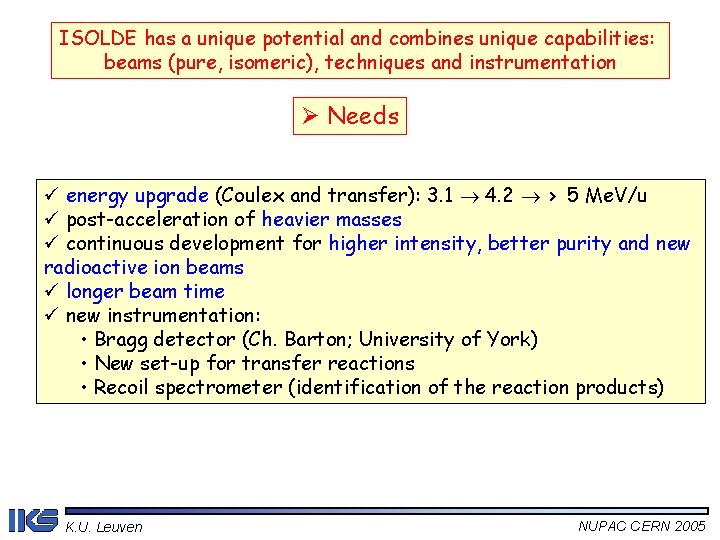
ISOLDE has a unique potential and combines unique capabilities: beams (pure, isomeric), techniques and instrumentation Ø Needs ü energy upgrade (Coulex and transfer): 3. 1 4. 2 > 5 Me. V/u ü post-acceleration of heavier masses ü continuous development for higher intensity, better purity and new radioactive ion beams ü longer beam time ü new instrumentation: • Bragg detector (Ch. Barton; University of York) • New set-up for transfer reactions • Recoil spectrometer (identification of the reaction products) K. U. Leuven NUPAC CERN 2005
Max Planck Institut fur Kernphysik Heidelberg Germany Institut fur Kernphysik Universitat Koln Germany TU Darmstadt Germany TU Munchen Germany LMU Munchen Germany Johannes Gutenberg Universitat, Mainz, Germany GSI-Darmstadt, Germany University of Gottingen, Germany University of Frankfurt, Germany IKS KULeuven Belgium Chalmers Teknaska Hogskola, Goteborg, Sweden CERN Switzerland University of Liverpool, U. K. ILL, Grenoble, France IRES, Strasbourg, France IPN Orsay France GANIL Caen France University of Edinburgh, U. K. Neils Bohr Institute Roskilde Denmark University of Camerino, Italy NCSR Athens, Greece University of Warsaw, Poland University of York, U. K. U. Leuven NUPAC CERN 2005