State aidcompliant financing restructuring and privatisation of Stateowned

- Slides: 18
State aid-compliant financing, restructuring and privatisation of State-owned enterprises (SOE) European Commission DG Competition 1
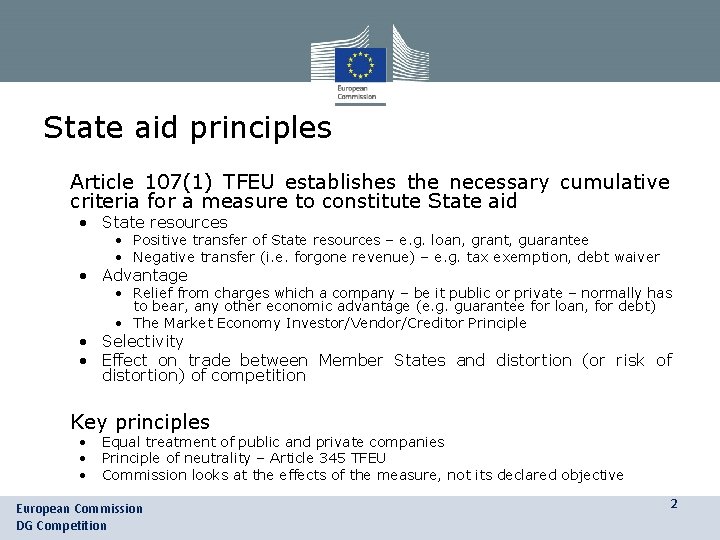
State aid principles • Article 107(1) TFEU establishes the necessary cumulative criteria for a measure to constitute State aid • State resources • Positive transfer of State resources – e. g. loan, grant, guarantee • Negative transfer (i. e. forgone revenue) – e. g. tax exemption, debt waiver • Advantage • Relief from charges which a company – be it public or private – normally has to bear, any other economic advantage (e. g. guarantee for loan, for debt) • The Market Economy Investor/Vendor/Creditor Principle • Selectivity • Effect on trade between Member States and distortion (or risk of distortion) of competition • Key principles • • • Equal treatment of public and private companies Principle of neutrality – Article 345 TFEU Commission looks at the effects of the measure, not its declared objective European Commission DG Competition 2
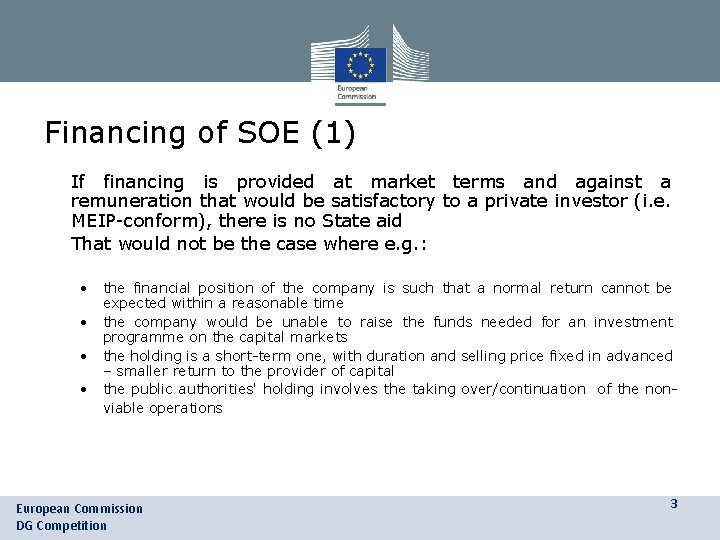
Financing of SOE (1) • If financing is provided at market terms and against a remuneration that would be satisfactory to a private investor (i. e. MEIP-conform), there is no State aid • That would not be the case where e. g. : • • the financial position of the company is such that a normal return cannot be expected within a reasonable time the company would be unable to raise the funds needed for an investment programme on the capital markets the holding is a short-term one, with duration and selling price fixed in advanced – smaller return to the provider of capital the public authorities' holding involves the taking over/continuation of the nonviable operations European Commission DG Competition 3
Financing of SOE (2) • Possible grounds for compatibility (e. g. R&R aid, training aid, regional aid, R&D&I aid, etc. ) • New rules on public compensation for SGEI • Social services excluded from State aid scrutiny • Other services – notification threshold of € 15 million • Clarified rules for the assessment of compensation • Reinforced transparency • Transparency Directive – definition of public undertakings, requirement of separate accounts European Commission DG Competition 4
Restructuring of SOE (1) • Rescue and restructuring Guidelines • • • “Firm in difficulty” Restoration of long-term viability Aid limited to the minimum necessary Compensatory measures “One time, last time” principle European Commission DG Competition 5
Restructuring of SOE (2) • The beneficiary must be a firm in difficulty: • it is unable to stem losses which without outside intervention by the public authorities will almost certainly condemns it to going out of business in the short or medium term • it is unable to do it whether through its own resources or with the funds it is able to obtain from its owner/shareholders or creditors European Commission DG Competition 6
Restructuring of SOE (3) • Restructuring plan • Aid conditional on implementation of a restructuring plan • Plan aimed at restoration the long-term viability on the basis of realistic assumptions within a reasonable time-frame • • Aid limited to the minimum necessary • Real contribution - free of aid • The amount of the minimum contribution depending on the size of a company European Commission DG Competition 7
Restructuring of SOE (4) • Compensatory measures e. g. : • Divestment of assets, reduction in capacity or market presence, reduction of entry barriers on the markets • • "One time, last time" – no restructuring aid in the previous 10 years Particular rules and conditions in the sectors: agricultural, fisheries, financial and transport European Commission DG Competition 8
Privatisation of SOE (1) • MEIP in privatisation transactions • Normal market behaviour as the benchmark used for the assessment of public authorities' actions • Concomitance as a strong evidence that MEIP is met • MEIP translates into Market Economy Vendor Principle • Highest possible price without conditions that depress the price maximization of revenues/minimization of losses • The Commissions XXIII Report on Competition Policy as a guidance how the EC interprets conditions of MEIP European Commission DG Competition 9
Privatisation of SOE (2) • Preparatory measures • possibly (but not necessarily) in the context of restructuring of the SOE concerned • debt write-off, debt-to-equity/asset conversion, capital increases will constitute State aid if the MEIP test is not met • Commission decision C 40/2008 PZL Hydral as an example of debt arrangement and privatisation European Commission DG Competition 10
Sales process (1) • Main principle: • The State should aim at the maximum price (as a private investor/vendor would do) • Sale via the stock market: market price is assumed • “Safe harbour”: cumulative conditions that lead to a no-aid assumption: • Competitive tender • Open to all and transparent • Sale to the highest bidder • Enough time and info for bidders’ valuation • No conditions, except those that can be met by any potential buyer European Commission DG Competition 11
Sales process (2) • Obligation to notify a trade sales transaction if "safe harbour" conditions are not met e. g. : • Sales after negotiation with a single prospective purchaser or a number of selected bidders • Sales preceded by the writing-off debt by the State and sales preceded by the conversion of debt into equity or capital increases (see preparatory measures) • Sales on conditions that are not customary in comparable transactions between private parties European Commission DG Competition 12
Sales process (3) • To minimise the risk of State aid, when possible privatisation should be carried out: • by sale of shares in the stock exchange • by a competitive tender that is open, transparent and unconditional • In all cases there must be no discrimination based on the nationality of prospective buyers of shares or assets European Commission DG Competition 13
Competitive tender (1) • Well publicized: • Advertised over a reasonable long period of time in the national press, estates gazettes and/or other publications • Privatization of an international scale announced in publications which have an international circulation • Unconditional: • No conditions that would depress the price • Conditions that all potential buyers would be able to met • De facto conditions equally important European Commission DG Competition 14
Competitive tender (2) • Certain conditions may not involve State aid if designed to: • avoid purely speculative bids • ensure swift and secure payment • ensure compliance with pre-existing obligations laid down in the law • If alternative approach to public tender is chosen, the Member State has to demonstrate that: • the best legal option is pursued to maximize the profit • there is no advantage to the buyer • there is no forgone State revenue European Commission DG Competition 15
Procedures to be followed • State aid measures must be notified to the Commission and cannot be granted until a final decision is adopted ('standstill obligation') • If doubts, pre-notification to the Commission for legal certainty • If non-compatible aid granted, possible negative decision by Commission with recovery (including interest) + risk of complaint inter alia by competitors European Commission DG Competition 16
Conclusions • 'Two hats': do not mix the State as economic operator and as public authority • Ensure that State aid rules are respected • Go for legal certainty (open, transparent, non-conditional tendering procedures, sale in the stock exchange) to avoid litigation that could hinder the privatisation process • Identify measures/develop global strategy at an early stage • Timely pre-notification and/or notification to the Commission • Consider contact point for State communication with the Commission European Commission DG Competition aid issues to facilitate 17
• Key documents • Commission Staff Working Document – Guidance Paper on State aidcompliant financing, restructuring and privatisation of State-owned enterprises http: //ec. europa. eu/competition/state_aid/studies_reports/swd_guidance_paper_en. pdf • Commission Communication on State aid elements in sales of land buildings by public authorities (1997) http: //eur-lex. europa. eu/Lex. Uri. Serv. do? uri=CELEX: 31997 Y 0710(01)%20: EN: NOT • Community guidelines on State aid for rescuing and restructuring firms in difficulty (2004) http: //eur-lex. europa. eu/Lex. Uri. Serv. do? uri=CELEX: 52004 XC 1001(01): EN: NOT European Commission DG Competition 18