
Project Management mainly based on Chapter 21 23
Project Management (mainly based on Chapter 21 -23 in Software Engineering by Ian Summerville, 9 th edition) 3/9/2021 1
Outline • Career background • The main tasks undertaken by project managers • Managing people • Risks and the risk management process • Project planning and quality management process (*) • Software tools for project management 3/9/2021 2
Pay off • Average PM salary $81, 000 (? ? ? ) https: //www. glassdoor. com/Salaries/software-project-manager-salary-SRCH_KO 0, 24. htm • Contract rates for PM’s can match techies • PMI certification adds avg. 14% to salary • PMI certs, 1993: 1, 000; 2002: 40, 000 3/9/2021 3
Project Management Skills • • Leadership Communications Problem Solving Negotiating Influencing the Organization Mentoring Process and technical expertise 3/9/2021 4

PMI’s 9 Knowledge Areas • • • 3/9/2021 Project integration management Scope Time Cost Quality Human resource Communications Risk Procurement 5
PM Resources • Professional Organizations – Project Management Institute (PMI) (pmi. org) – Software Engineering Institute (SEI) – IEEE Software Engineering Group • Certifications – PMI PMP 3/9/2021 6
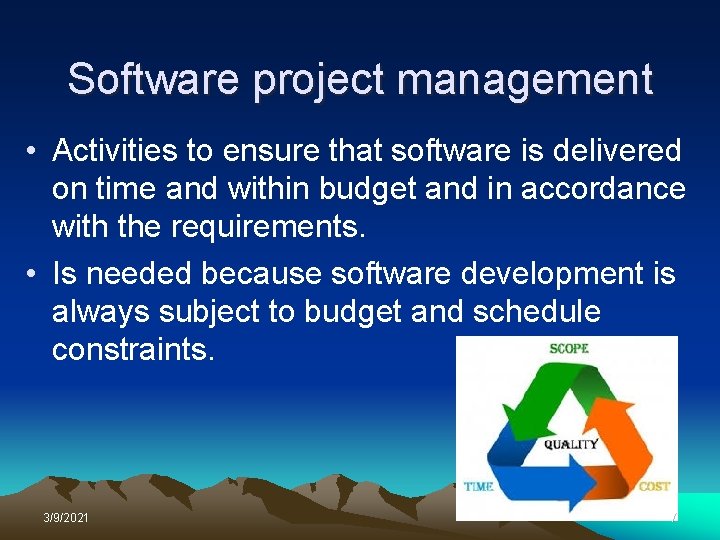
Software project management • Activities to ensure that software is delivered on time and within budget and in accordance with the requirements. • Is needed because software development is always subject to budget and schedule constraints. 3/9/2021 7
Success criteria • Deliver the software to the customer at the agreed time. • Keep overall costs within budget. • Deliver software that meets the customer’s expectations. • Maintain a happy and well-functioning development team. 3/9/2021 8
Software management distinctions • The product is intangible. – Software cannot be seen or touched. Software project managers cannot see progress by simply looking at the artifact that is being constructed. • Many software projects are 'one-off' projects. – Large software projects are usually different in some ways from previous projects. Even managers who have lots of previous experience may find it difficult to anticipate problems. • Software processes are variable and organization specific. – We still cannot reliably predict when a particular software process is likely to lead to development problems. 3/9/2021 9
Who do PM interact with? • Project Stakeholders – Project sponsor – Executives – Team – Customers – Contractors – Functional managers 3/9/2021 10
Management activities • Project planning – Project managers are responsible for planning, estimating and scheduling project development and assigning people to tasks. • Reporting – Project managers are responsible for reporting on the progress of a project to customers and to the higher level managers and executives. 3/9/2021 11
Management activities • People management – Choose people for their team and establish ways of working that leads to effective team performance • Proposal writing – The first stage in a software project may involve writing a proposal to win a contract to carry out an item of work. – The proposal describes the objectives of the project and how it will be carried out. 3/9/2021 12
Management activities • Risk management – Assess the risks that may affect a project, monitor these risks and take action when problems arise. 3/9/2021 13
Project staffing • May not be possible to appoint the ideal people to work on a project – Project budget may not allow for the use of highly-paid staff; – Staff with the appropriate experience may not be available; – An organisation may wish to develop employee skills on a software project. • Managers have to work within these constraints. 3/9/2021 14
3/9/2021 15
Managing people • People are an organisation’s most important assets. • The tasks of a manager are essentially people-oriented. • Poor people management is an important contributor to project failure. 3/9/2021 16
People management factors • Consistency – Team members should all be treated in a comparable way without favourites or discrimination. • Respect – Different team members have different skills and these differences should be respected. • Inclusion – Involve all team members and make sure that people’s views are considered. • Honesty – You should always be honest about what is going well and what is going badly in a project. 3/9/2021 17
Motivating people • Organizing the work and the working environment to encourage people to work effectively. – If people are not motivated, they will • • 3/9/2021 not be interested in what they are doing work slowly be more likely to make mistakes not contribute to the broader goals of the team or the organization 18
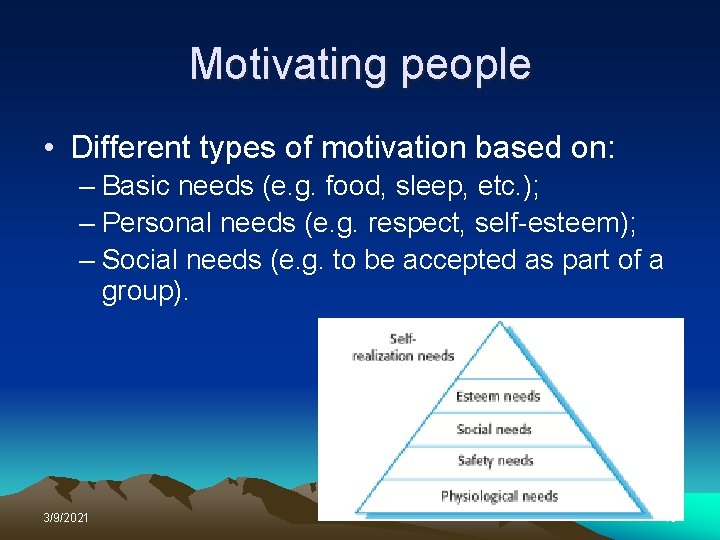
Motivating people • Different types of motivation based on: – Basic needs (e. g. food, sleep, etc. ); – Personal needs (e. g. respect, self-esteem); – Social needs (e. g. to be accepted as part of a group). 3/9/2021 19
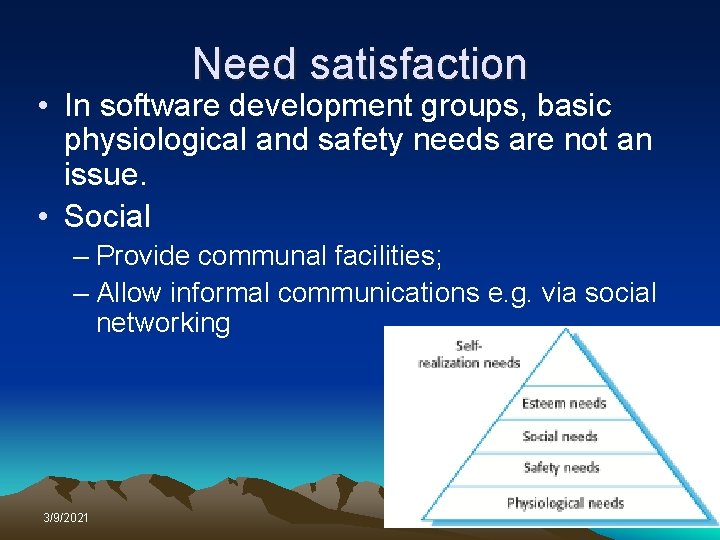
Need satisfaction • In software development groups, basic physiological and safety needs are not an issue. • Social – Provide communal facilities; – Allow informal communications e. g. via social networking 3/9/2021 20

Need satisfaction • Esteem – Recognition of achievements; – Appropriate rewards. • Self-realization – Training - people want to learn more; – Responsibility. 3/9/2021 21
Personality types • In practice, the needs hierarchy is an oversimplification. • Motivation should also take into account different personality types: – Task-oriented; – Self-oriented; – Interaction-oriented. 3/9/2021 22
Personality types • Task-oriented. – The motivation for doing the work is the work itself; • Self-oriented. – The work is a means to achieve individual goals - e. g. to get rich, to play tennis, to travel etc. ; • Interaction-oriented – The principal motivation is the presence and actions of co-workers. People go to work because they like to go to work. 3/9/2021 23
Motivation balance • Individual motivations are made up of elements of each class. • The balance can change depending on personal circumstances and external events. • People are also motivated by being part of a group and culture. • People go to work because they are motivated by the people that they work with. 3/9/2021 24
Teamwork • Most software engineering is a group activity • A good group is: – Cohesive (the success of the group + individual goals) – Has a team spirit (deliver high quality results and fix problems) – Knowledge is shared 3/9/2021 25
The effectiveness of a team • Flexibility in group composition is limited • A mixed personalities/skills of people • A group should be organized so that individuals can contribute to the best of their abilities • Good communications is essential. 3/9/2021 26
Group organization – Some key questions include: • Who will be involved in making critical technical decisions, and how will these be made? • How will interactions with external stakeholders and senior company management be handled? • How can knowledge be shared across the group? 3/9/2021 27
Group organization • Small groups are usually organised informally • For large projects, there may be a hierarchical structure where different groups are responsible for different sub-projects. • Agile development is always based around an informal group on the principle that formal structure inhibits information exchange 3/9/2021 28
Group communications • Good communications are essential for effective group working. • Information must be exchanged on the status of work, design decisions and changes to previous decisions. • Good communications also strengthens group cohesion as it promotes understanding. 3/9/2021 29
Factors affect group communications • Group size – The larger the group, the harder it is for people to communicate. • Group structure – Communication is better in informally structured groups than in hierarchically structured groups. • Group composition – Communication is better when there are different personality types in a group and when groups are mixed rather than single sex. • The physical work environment – Good workplace organisation can help encourage communications. 3/9/2021 30
3/9/2021 31
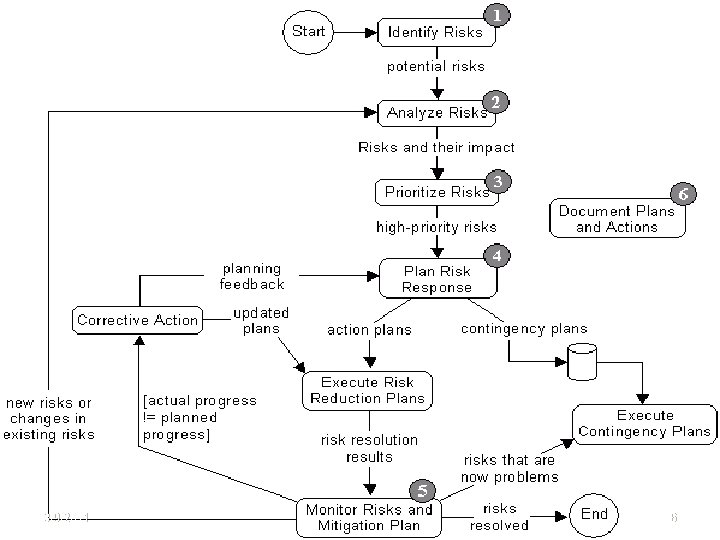
Risk management process • Risk identification – Identify project, product and business risks; • Risk analysis – Assess the likelihood and consequences of these risks; • Risk planning – Draw up plans to avoid or minimise the effects of the risk; • Risk monitoring – Monitor the risks throughout the project; 3/9/2021 32
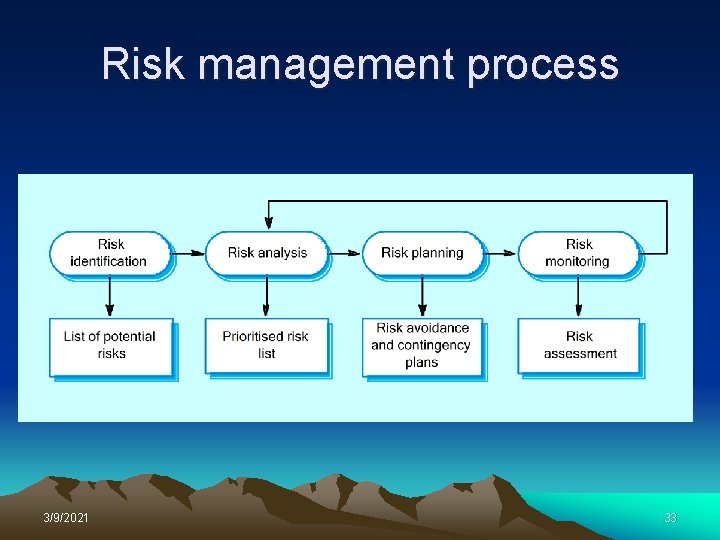
Risk management process 3/9/2021 33
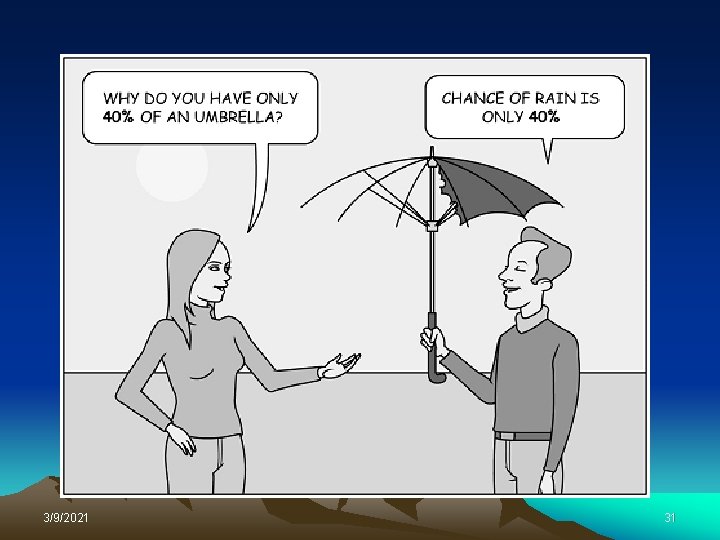
Risk management • A risk is a probability that some adverse circumstance will occur • Identify risks and draw up plans to minimise their effect. • Various risks may affect – schedule or resources – affect the quality or performance – affect the organisation 3/9/2021 34
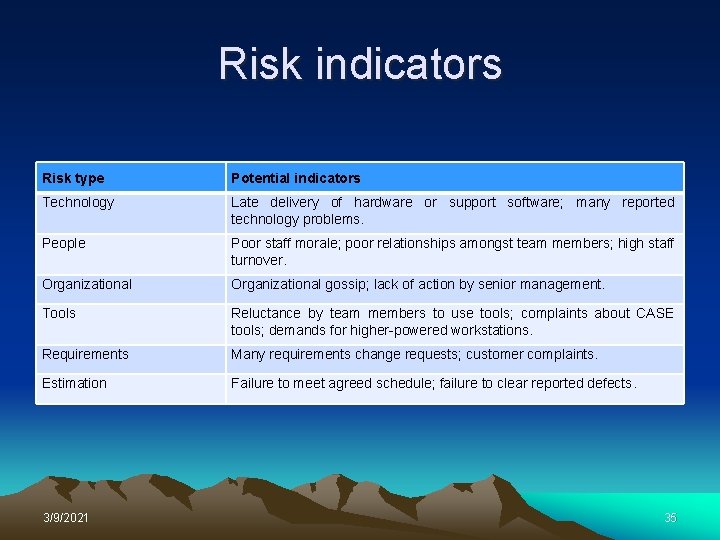
Risk indicators Risk type Potential indicators Technology Late delivery of hardware or support software; many reported technology problems. People Poor staff morale; poor relationships amongst team members; high staff turnover. Organizational gossip; lack of action by senior management. Tools Reluctance by team members to use tools; complaints about CASE tools; demands for higher-powered workstations. Requirements Many requirements change requests; customer complaints. Estimation Failure to meet agreed schedule; failure to clear reported defects. 3/9/2021 35
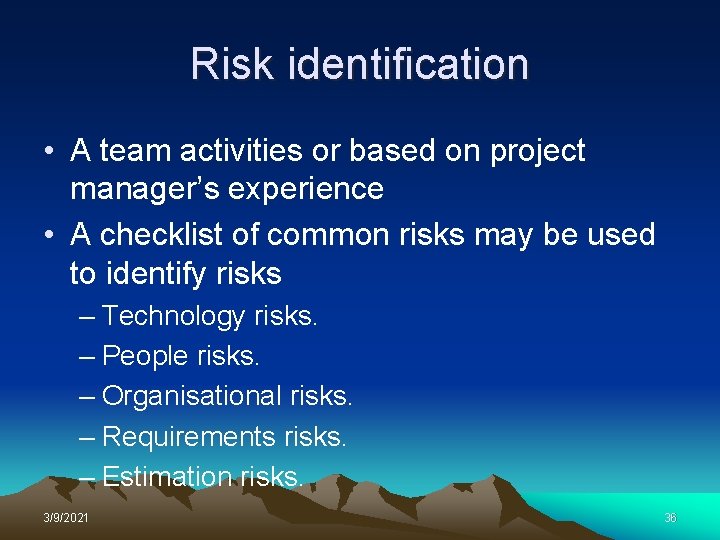
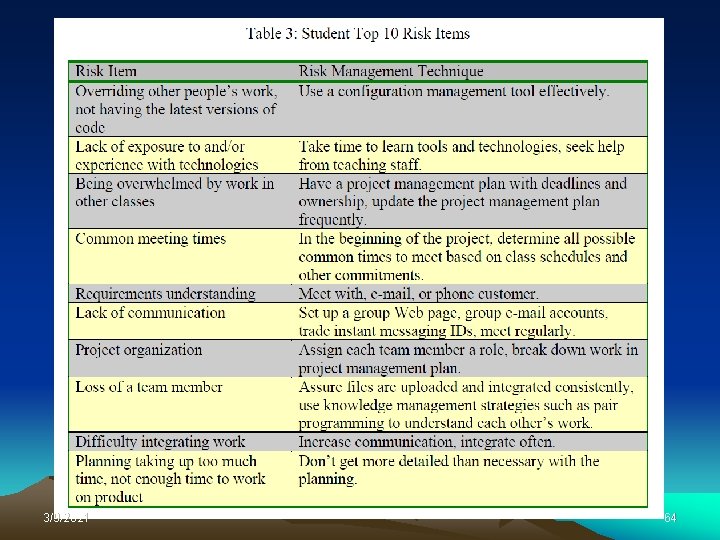
Risk identification • A team activities or based on project manager’s experience • A checklist of common risks may be used to identify risks – Technology risks. – People risks. – Organisational risks. – Requirements risks. – Estimation risks. 3/9/2021 36
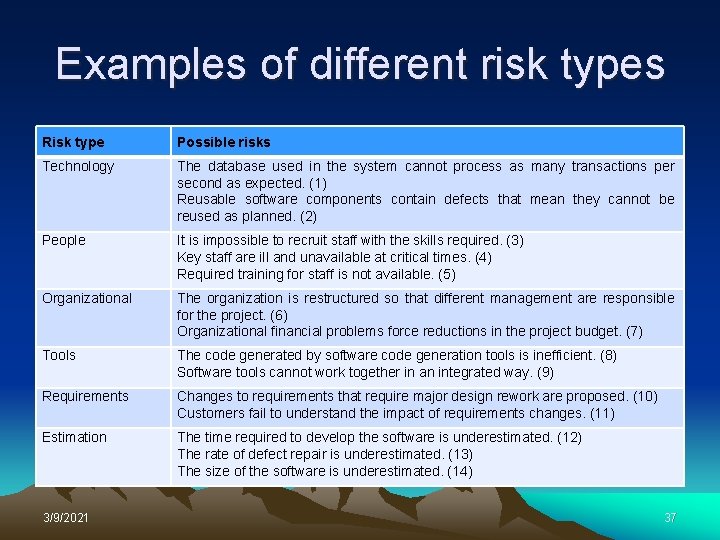
Examples of different risk types Risk type Possible risks Technology The database used in the system cannot process as many transactions per second as expected. (1) Reusable software components contain defects that mean they cannot be reused as planned. (2) People It is impossible to recruit staff with the skills required. (3) Key staff are ill and unavailable at critical times. (4) Required training for staff is not available. (5) Organizational The organization is restructured so that different management are responsible for the project. (6) Organizational financial problems force reductions in the project budget. (7) Tools The code generated by software code generation tools is inefficient. (8) Software tools cannot work together in an integrated way. (9) Requirements Changes to requirements that require major design rework are proposed. (10) Customers fail to understand the impact of requirements changes. (11) Estimation The time required to develop the software is underestimated. (12) The rate of defect repair is underestimated. (13) The size of the software is underestimated. (14) 3/9/2021 37
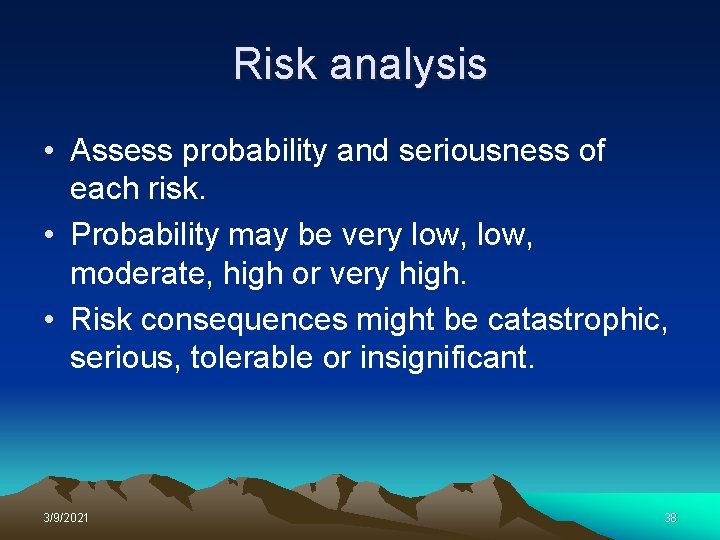
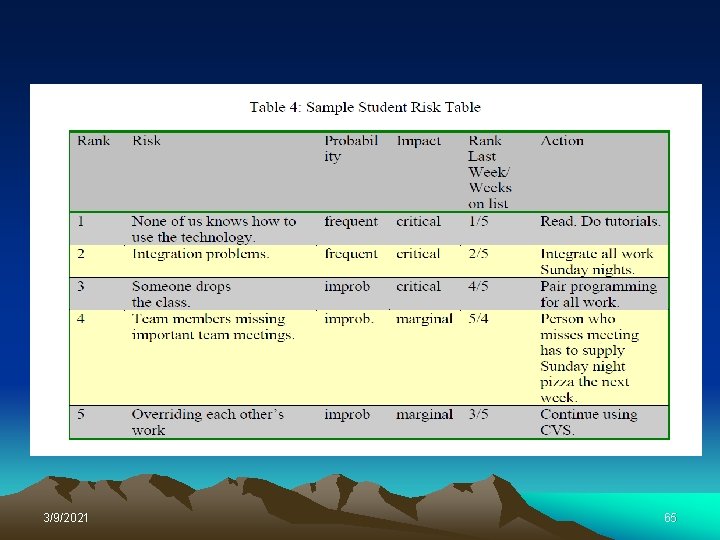
Risk analysis • Assess probability and seriousness of each risk. • Probability may be very low, moderate, high or very high. • Risk consequences might be catastrophic, serious, tolerable or insignificant. 3/9/2021 38
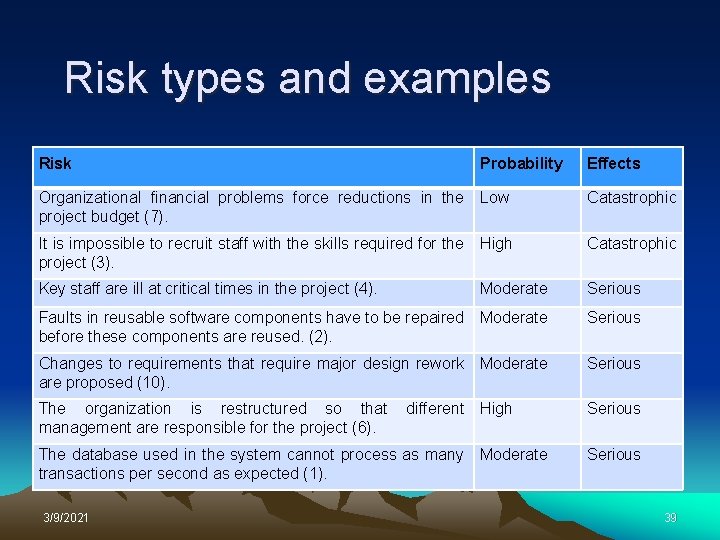
Risk types and examples Risk Probability Effects Organizational financial problems force reductions in the Low project budget (7). Catastrophic It is impossible to recruit staff with the skills required for the High project (3). Catastrophic Key staff are ill at critical times in the project (4). Moderate Serious Faults in reusable software components have to be repaired Moderate before these components are reused. (2). Serious Changes to requirements that require major design rework Moderate are proposed (10). Serious The organization is restructured so that different High management are responsible for the project (6). Serious The database used in the system cannot process as many Moderate transactions per second as expected (1). Serious 3/9/2021 39
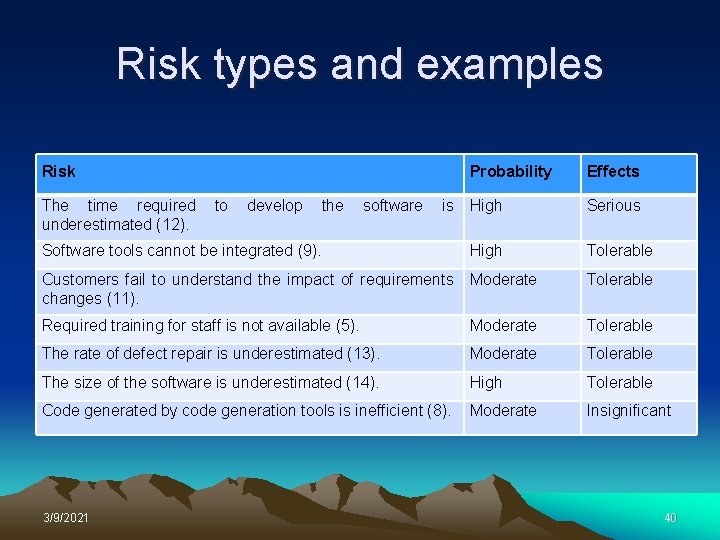
Risk types and examples Risk Probability Effects The time required to develop the software is High underestimated (12). Serious Software tools cannot be integrated (9). Tolerable High Customers fail to understand the impact of requirements Moderate changes (11). Tolerable Required training for staff is not available (5). Moderate Tolerable The rate of defect repair is underestimated (13). Moderate Tolerable The size of the software is underestimated (14). High Tolerable Code generated by code generation tools is inefficient (8). Moderate Insignificant 3/9/2021 40
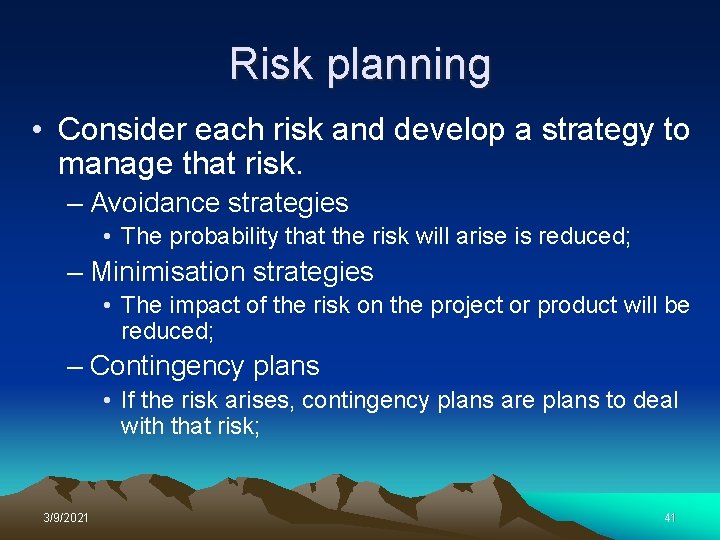
Risk planning • Consider each risk and develop a strategy to manage that risk. – Avoidance strategies • The probability that the risk will arise is reduced; – Minimisation strategies • The impact of the risk on the project or product will be reduced; – Contingency plans • If the risk arises, contingency plans are plans to deal with that risk; 3/9/2021 41
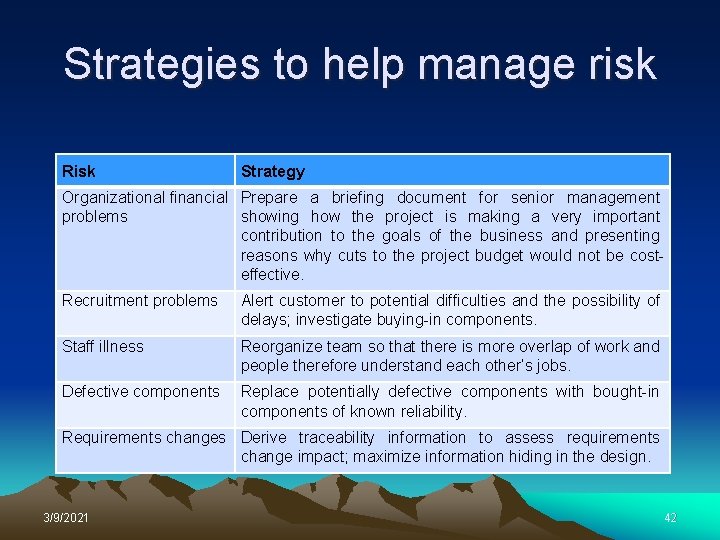
Strategies to help manage risk Risk Strategy Organizational financial Prepare a briefing document for senior management problems showing how the project is making a very important contribution to the goals of the business and presenting reasons why cuts to the project budget would not be costeffective. Recruitment problems Alert customer to potential difficulties and the possibility of delays; investigate buying-in components. Staff illness Reorganize team so that there is more overlap of work and people therefore understand each other’s jobs. Defective components Replace potentially defective components with bought-in components of known reliability. Requirements changes Derive traceability information to assess requirements change impact; maximize information hiding in the design. 3/9/2021 42
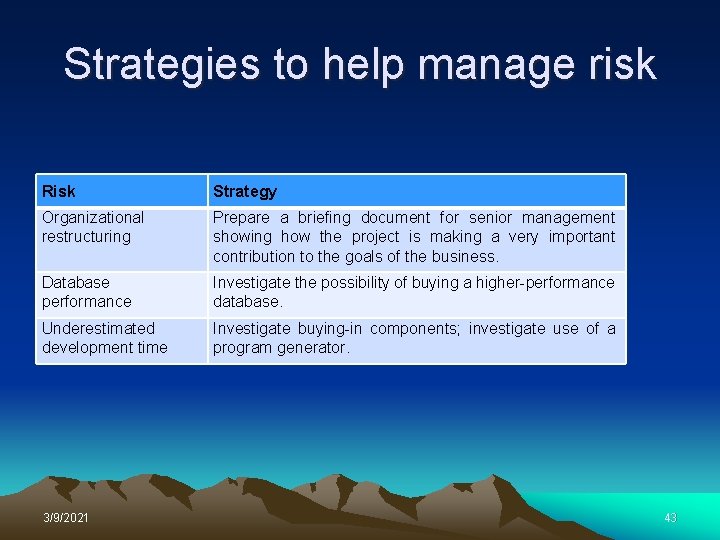
Strategies to help manage risk Risk Strategy Organizational restructuring Prepare a briefing document for senior management showing how the project is making a very important contribution to the goals of the business. Database performance Investigate the possibility of buying a higher-performance database. Underestimated development time Investigate buying-in components; investigate use of a program generator. 3/9/2021 43
Risk monitoring • Assess each identified risks regularly to decide whether or not it is becoming less or more probable. • Also assess whether the effects of the risk have changed. • Each key risk should be discussed at management progress meetings. 3/9/2021 44
Communicate • The developer must systematically and continually enumerate all the possible risks related to technical capability and making the schedule. • The manager must lead the team to follow the risk management process to proactively manage the project risks. • • The customer must participate in the continual identification of risks. 3/9/2021 45
3/9/2021 46
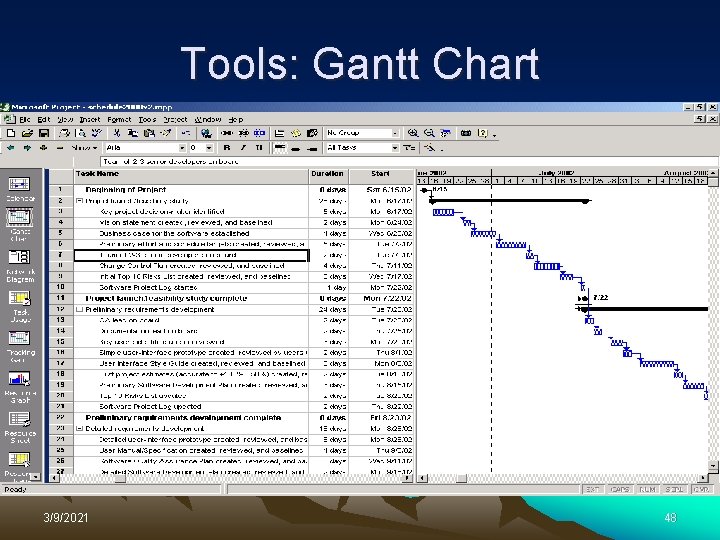
PM Tools: Software • . dot. Proj • MS Project • Primavera Project Manager 3/9/2021 47
Tools: Gantt Chart 3/9/2021 48
Key Points • The main tasks undertaken by project managers • Strategies to managing people • Risk management process • Be able to perform risk assessment and develop risk control strategies for a given scenario 3/9/2021 49
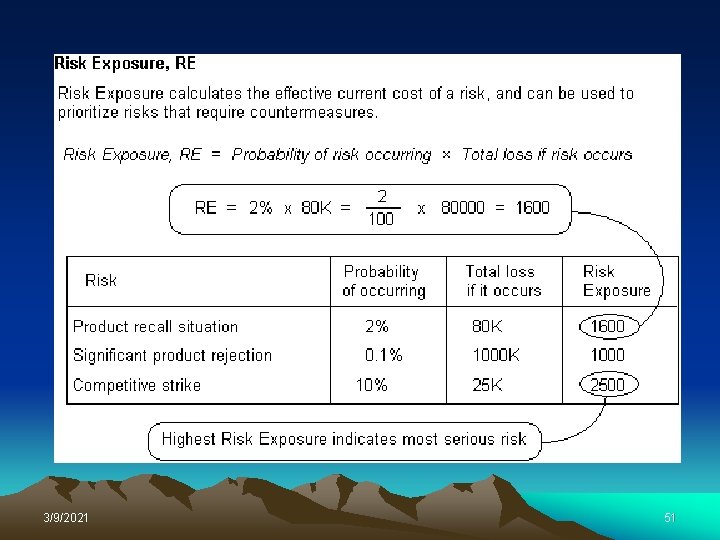
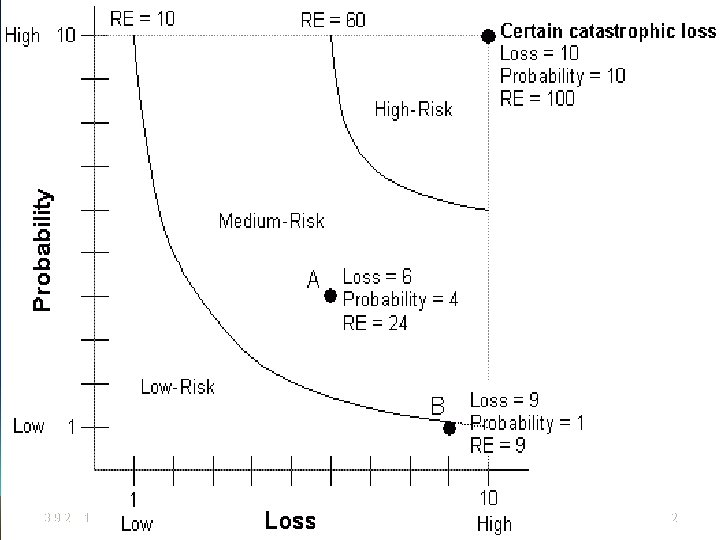
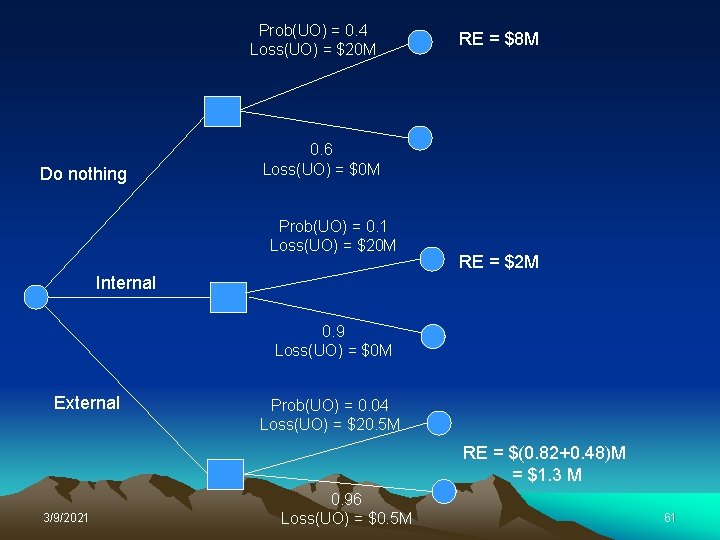
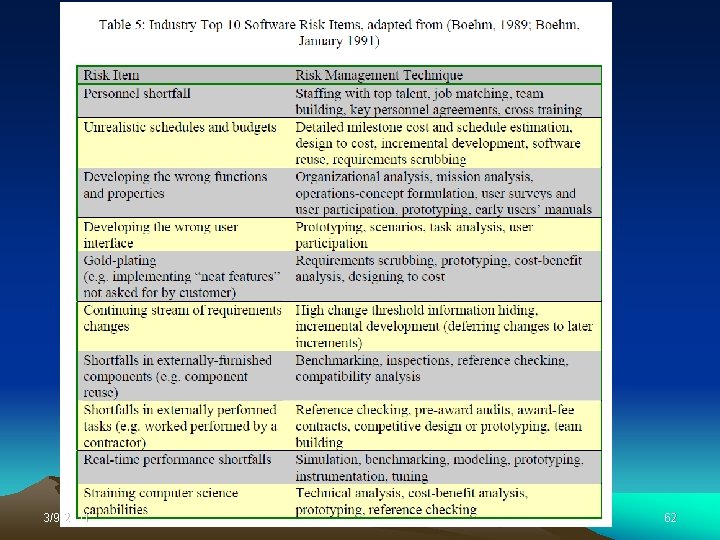
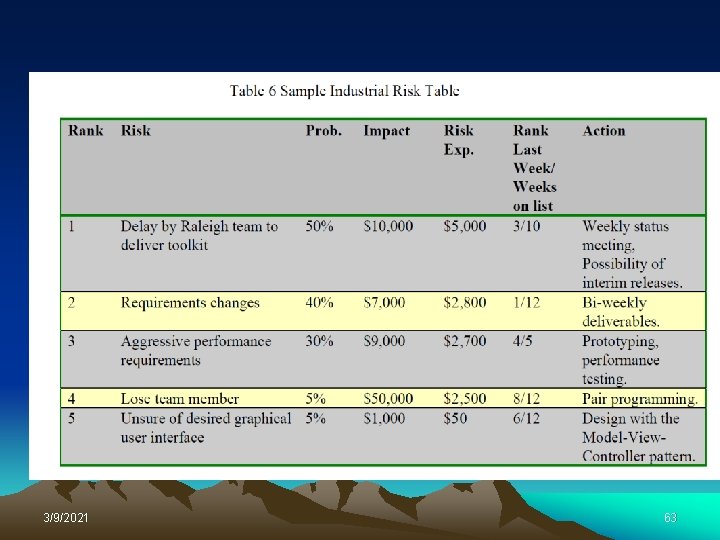
Risk Management Concepts and Metrics • Risk – the possibility of loss or injury • Risk exposure (RE) or risk impact (RI) – RE = Prob(UO) * Loss(UO) – Prob(UO) is the probability of an unsatisfactory outcome – Loss(UO) is the loss to the parties affected if the unsatisfactory outcome occurs. 3/9/2021 50
3/9/2021 51
3/9/2021 52
Risk Management Concepts • 3/9/2021 53

3/9/2021 54

3/9/2021 55

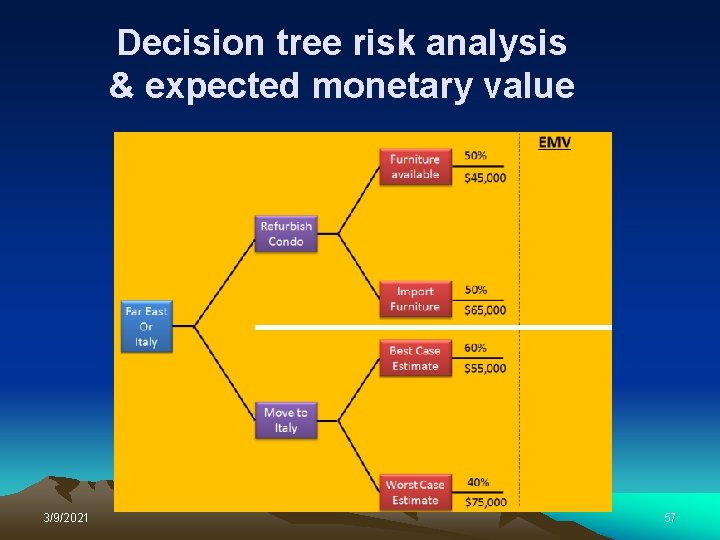
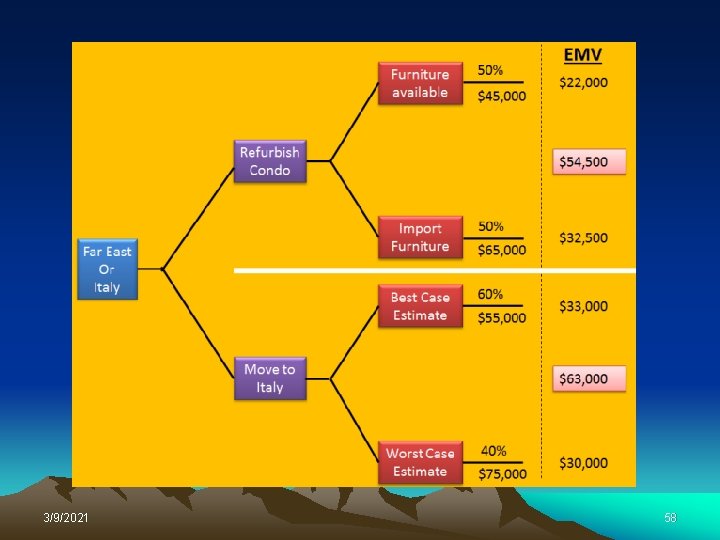
• Dave owns a condo in the Far East and is considering buying a new apartment in Italy, but his wife would rather spend the money on modernizing their current condo. • Dave had previously considered modernizing your condo, but purchasing or importing modern furniture in your city has been a problem in the Far East. • Remodelling costs of the condo if new furniture and fittings are available will cost $ 45, 000, but there is a 50/50 chance that the furniture is not available locally and will need to be imported which will then cost $65, 000. • Dave has found an old townhouse in Naples but it will need a lot of work to make it habitable. The price is $ 105, 000. He has found a local builder and he has given you a best case cost of $55, 000 and a worst case cost of $75, 000. The builder advises that the best case is 60% likely. • Dave expects to get $160, 000 for the sale of his condo, and now needs to discuss the possible outcomes with his wife. Draw a decision tree and calculate the Net Path Value (Expected Monetary Value). 3/9/2021 56
Decision tree risk analysis & expected monetary value 3/9/2021 57
3/9/2021 58
Scenario • The software will be developed by the experiment team. • The experiment team understands the experiment but is inexperienced in and somewhat casual about software development. • The manager has obtained an estimate that there is a probability of 0. 4 that the software will have a critical error (CE). • This CE will wipe out the entire experiment and cause an associated loss of $20 M. 3/9/2021 59
Two options for reducing risk • Convincing and helping the experiment team to apply better development methods. – This will incur no additional cost – This will reduce the CE probability to 0. 1 • Hiring a contractor to independently verify and validate the software. – This incurs a cost of $0. 5 M – This will reduce the CE probability to 0. 04 3/9/2021 60
Prob(UO) = 0. 4 Loss(UO) = $20 M Do nothing RE = $8 M 0. 6 Loss(UO) = $0 M Prob(UO) = 0. 1 Loss(UO) = $20 M RE = $2 M Internal 0. 9 Loss(UO) = $0 M External Prob(UO) = 0. 04 Loss(UO) = $20. 5 M RE = $(0. 82+0. 48)M = $1. 3 M 3/9/2021 0. 96 Loss(UO) = $0. 5 M 61
3/9/2021 62
3/9/2021 63
3/9/2021 64
3/9/2021 65
Risk Management Case Study 3/9/2021 66
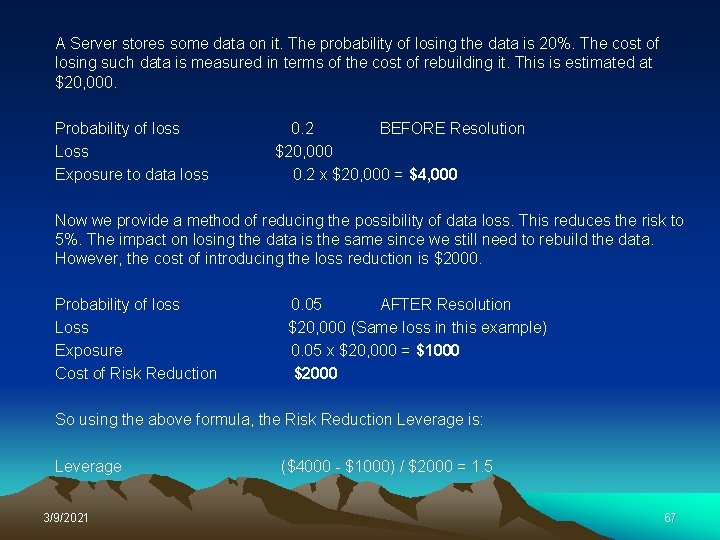
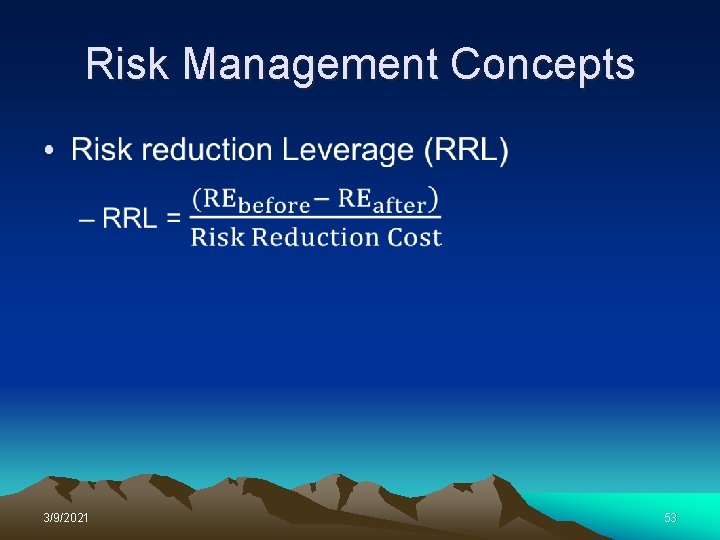
A Server stores some data on it. The probability of losing the data is 20%. The cost of losing such data is measured in terms of the cost of rebuilding it. This is estimated at $20, 000. Probability of loss 0. 2 BEFORE Resolution Loss $20, 000 Exposure to data loss 0. 2 x $20, 000 = $4, 000 Now we provide a method of reducing the possibility of data loss. This reduces the risk to 5%. The impact on losing the data is the same since we still need to rebuild the data. However, the cost of introducing the loss reduction is $2000. Probability of loss 0. 05 AFTER Resolution Loss $20, 000 (Same loss in this example) Exposure 0. 05 x $20, 000 = $1000 Cost of Risk Reduction $2000 So using the above formula, the Risk Reduction Leverage is: Leverage ($4000 - $1000) / $2000 = 1. 5 3/9/2021 67
- Slides: 67