STAKEHOLDE R MANAGEMEN T ETHICAL ENGAGEMEN T week




- Slides: 27
STAKEHOLDE R MANAGEMEN T & ETHICAL ENGAGEMEN T week 3 – MGB 310
Lecture learning objectives By the end of this lecture, you will be able to: 1. Describe and apply models for stakeholder management 2. Discuss the ‘difference’ between stakeholder management and stakeholder engagement approaches 3. Identify ethical approaches to stakeholder engagement
What is stakeholder • Covers the full range of an organisation’s efforts engagement? to understand involve stakeholders in its activities and decisions • Views the firm and its stakeholders as a valuebased network • Aims to maximise the value of the whole stakeholder system • Can help organisations meet tactical and strategic needs as well as proactively responding to stakeholder issues and concerns
IDENTIFY SUSTAINABILITY ISSUES UNDERSTAND STAKEHO IDENTIFY STAKEHOLDER S Responsibility Influence Proximity Dependency Representation
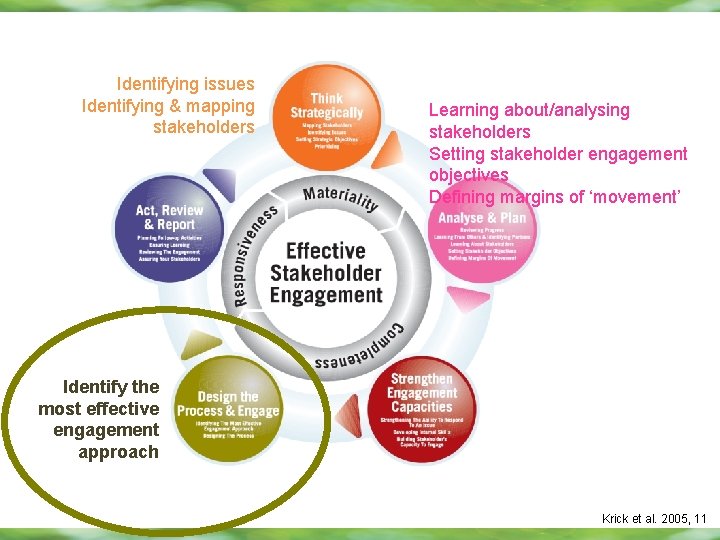
Identifying issues Identifying & mapping stakeholders Learning about/analysing stakeholders Setting stakeholder engagement objectives Defining margins of ‘movement’ Identify the most effective engagement approach Krick et al. 2005, 11
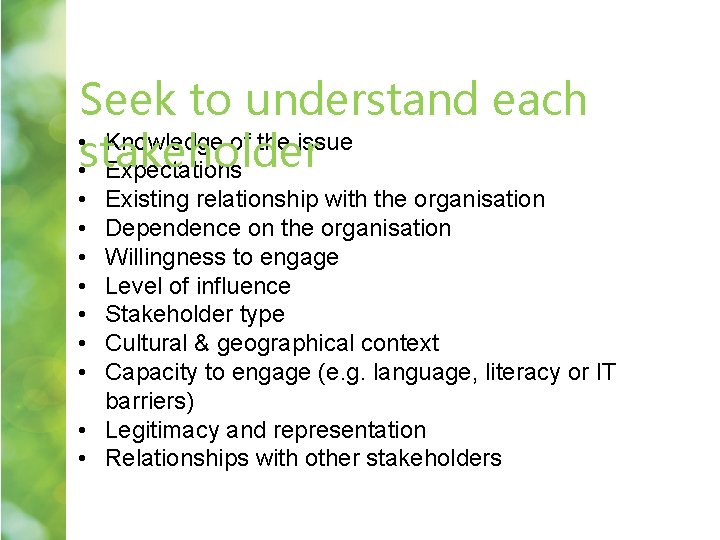
Seek to understand each • Knowledge of the issue • stakeholder Expectations • • Existing relationship with the organisation Dependence on the organisation Willingness to engage Level of influence Stakeholder type Cultural & geographical context Capacity to engage (e. g. language, literacy or IT barriers) • Legitimacy and representation • Relationships with other stakeholders
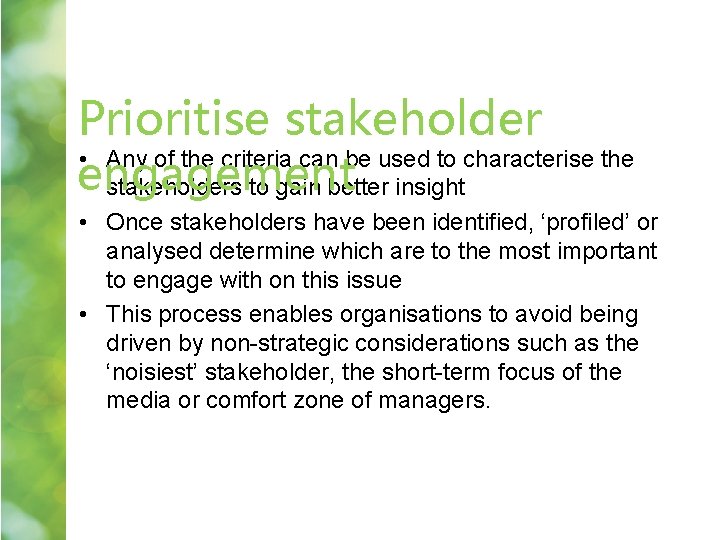
Prioritise stakeholder • Any of the criteria can be used to characterise the engagement stakeholders to gain better insight • Once stakeholders have been identified, ‘profiled’ or analysed determine which are to the most important to engage with on this issue • This process enables organisations to avoid being driven by non-strategic considerations such as the ‘noisiest’ stakeholder, the short-term focus of the media or comfort zone of managers.
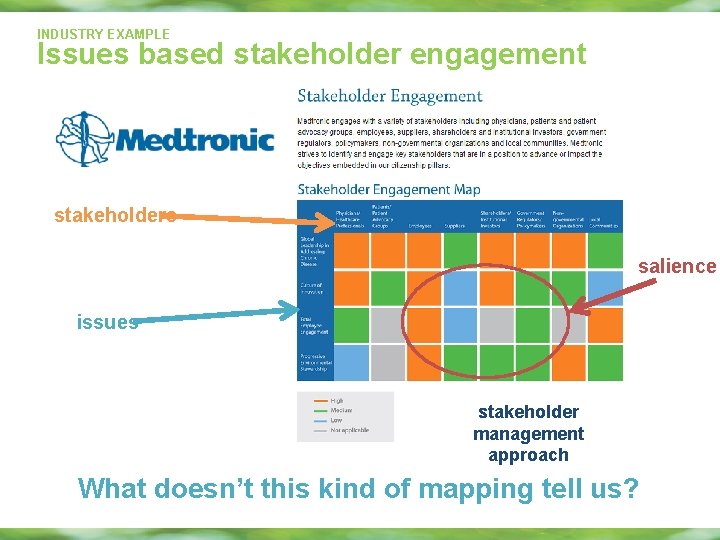
INDUSTRY EXAMPLE Issues based stakeholder engagement stakeholders salience issues stakeholder management approach What doesn’t this kind of mapping tell us?
Determine engagement levels & • What kind of stakeholder engagement strategy is methods • • required? What engagement approach is ethical and appropriate? The method of engagement should be selected to best meet the needs, capacity and expectations of relevant stakeholders More than one method may be selected or used concurrently or sequentially For some stakeholders collective or representative engagement is appropriate – for others it should be more individualised
Krick et al. 2005, 95
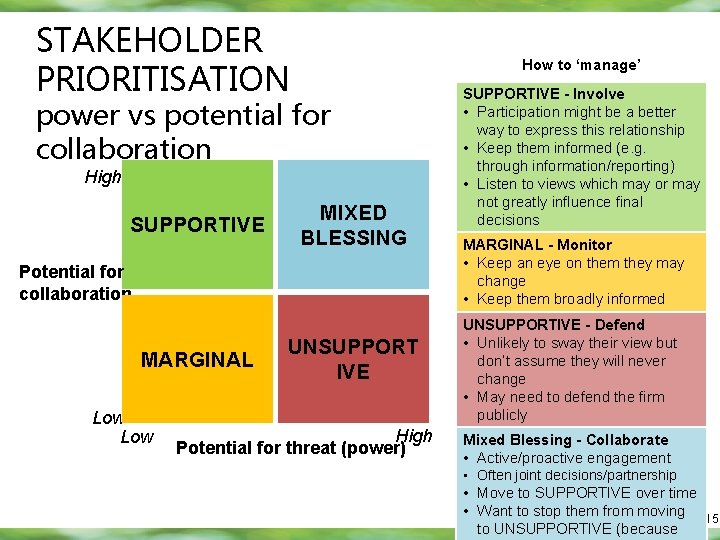
STAKEHOLDER PRIORITISATION How to ‘manage’ power vs potential for collaboration High SUPPORTIVE MIXED BLESSING Potential for collaboration MARGINAL Low UNSUPPORT IVE High Potential for threat (power) SUPPORTIVE - Involve • Participation might be a better way to express this relationship • Keep them informed (e. g. through information/reporting) • Listen to views which may or may not greatly influence final decisions MARGINAL - Monitor • Keep an eye on them they may change • Keep them broadly informed UNSUPPORTIVE - Defend • Unlikely to sway their view but don’t assume they will never change • May need to defend the firm publicly Mixed Blessing - Collaborate • Active/proactive engagement • Often joint decisions/partnership • Move to SUPPORTIVE over time • Want to stop them from moving Savage et al. 1993 p. 152 to UNSUPPORTIVE (because
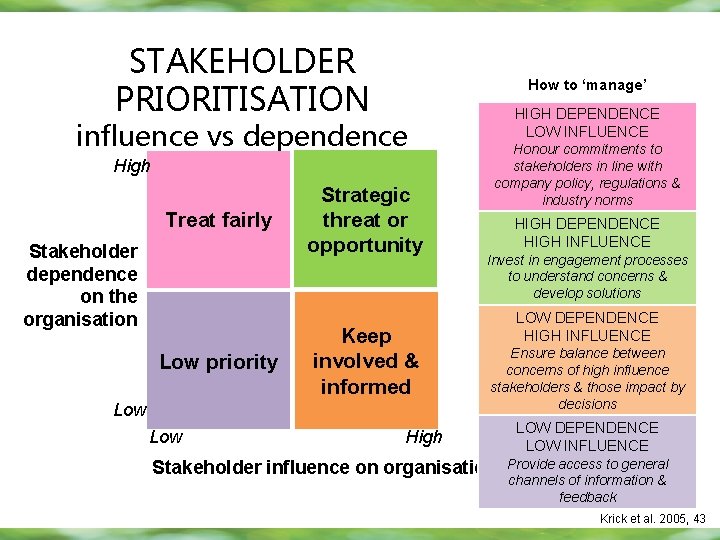
STAKEHOLDER PRIORITISATION How to ‘manage’ influence vs dependence High Treat fairly Stakeholder dependence on the organisation Low priority Strategic threat or opportunity Keep involved & informed Low HIGH DEPENDENCE LOW INFLUENCE Honour commitments to stakeholders in line with company policy, regulations & industry norms HIGH DEPENDENCE HIGH INFLUENCE Invest in engagement processes to understand concerns & develop solutions LOW DEPENDENCE HIGH INFLUENCE Ensure balance between concerns of high influence stakeholders & those impact by decisions High Stakeholder influence on organisation LOW DEPENDENCE LOW INFLUENCE Provide access to general channels of information & feedback Krick et al. 2005, 43
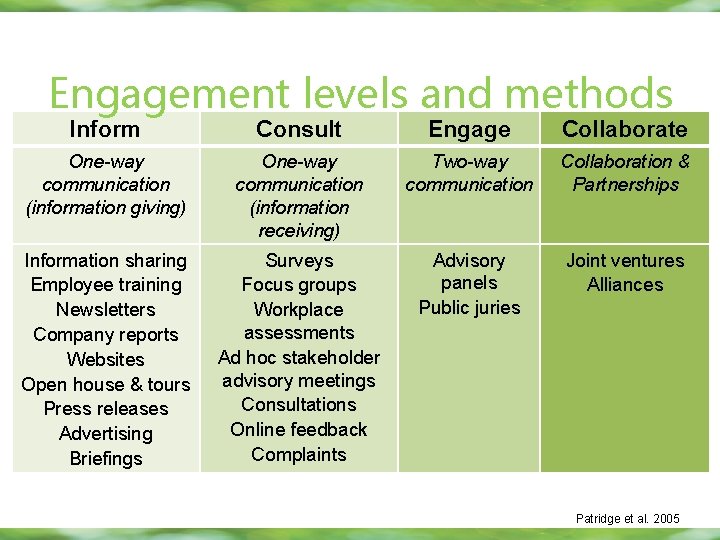
Engagement levels and methods Inform Consult Engage Collaborate One-way communication (information giving) One-way communication (information receiving) Two-way communication Collaboration & Partnerships Information sharing Employee training Newsletters Company reports Websites Open house & tours Press releases Advertising Briefings Surveys Focus groups Workplace assessments Ad hoc stakeholder advisory meetings Consultations Online feedback Complaints Advisory panels Public juries Joint ventures Alliances Patridge et al. 2005
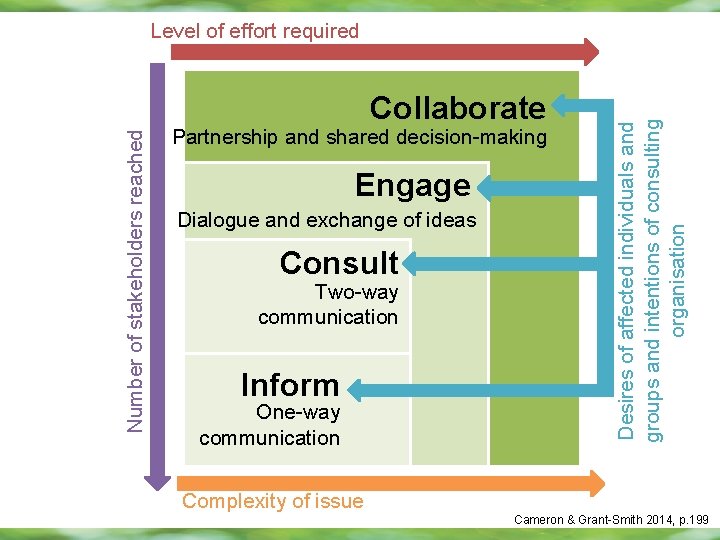
Number of stakeholders reached Collaborate Partnership and shared decision-making Engage Dialogue and exchange of ideas Consult Two-way communication Inform One-way communication Desires of affected individuals and groups and intentions of consulting organisation Level of effort required Complexity of issue Cameron & Grant-Smith 2014, p. 199
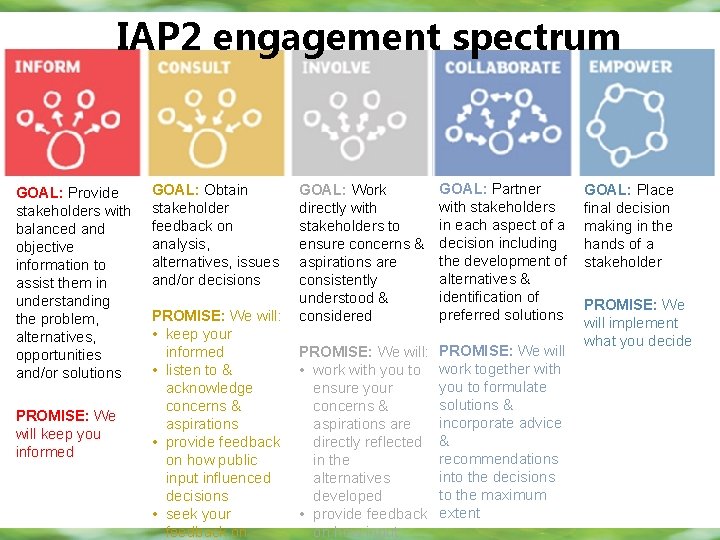
IAP 2 engagement spectrum GOAL: Provide stakeholders with balanced and objective information to assist them in understanding the problem, alternatives, opportunities and/or solutions PROMISE: We will keep you informed GOAL: Obtain stakeholder feedback on analysis, alternatives, issues and/or decisions PROMISE: We will: • keep your informed • listen to & acknowledge concerns & aspirations • provide feedback on how public input influenced decisions • seek your feedback on GOAL: Work directly with stakeholders to ensure concerns & aspirations are consistently understood & considered GOAL: Partner with stakeholders in each aspect of a decision including the development of alternatives & identification of preferred solutions PROMISE: We will: • work with you to ensure your concerns & aspirations are directly reflected in the alternatives developed • provide feedback on how input PROMISE: We will work together with you to formulate solutions & incorporate advice & recommendations into the decisions to the maximum extent GOAL: Place final decision making in the hands of a stakeholder PROMISE: We will implement what you decide
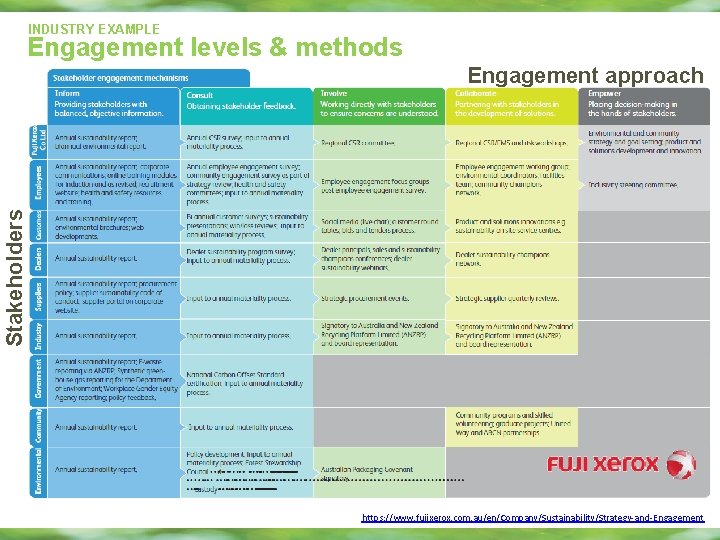
INDUSTRY EXAMPLE Engagement levels & methods Stakeholders Engagement approach https: //www. fujixerox. com. au/en/Company/Sustainability/Strategy-and-Engagement
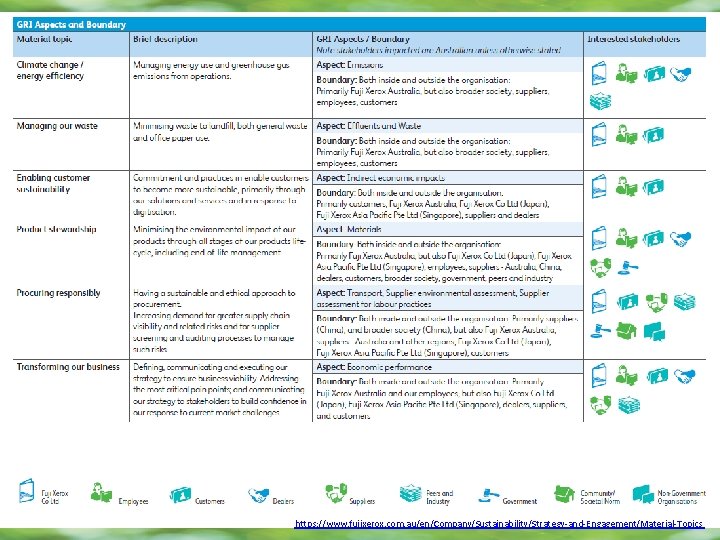
https: //www. fujixerox. com. au/en/Company/Sustainability/Strategy-and-Engagement/Material-Topics
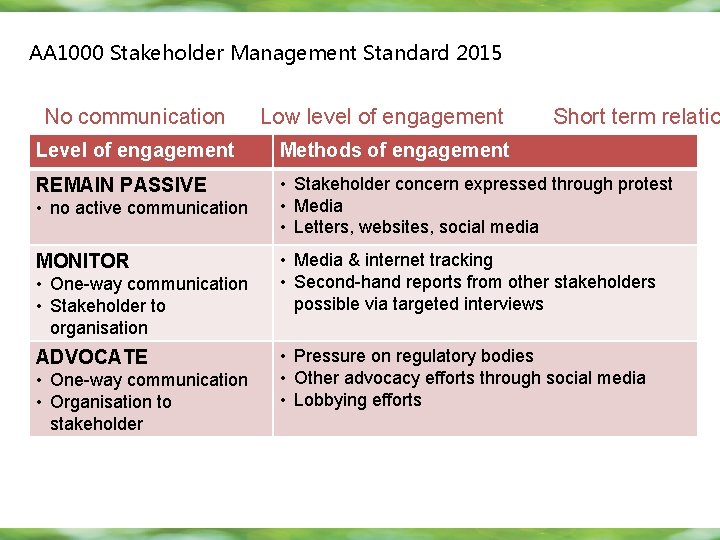
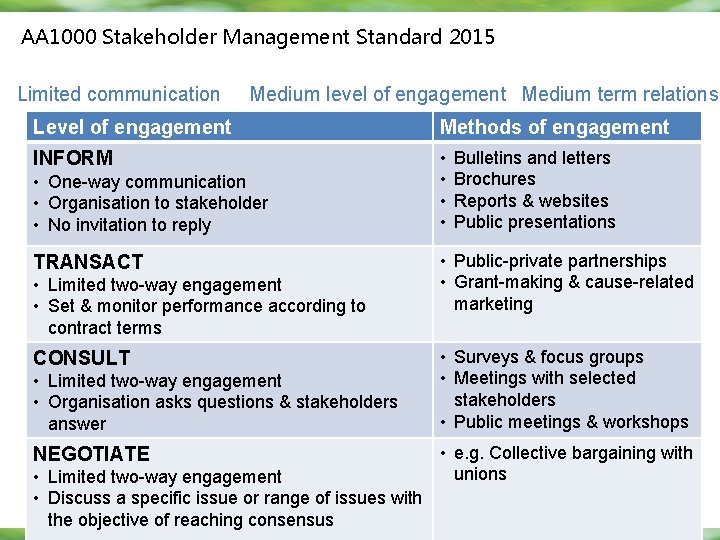
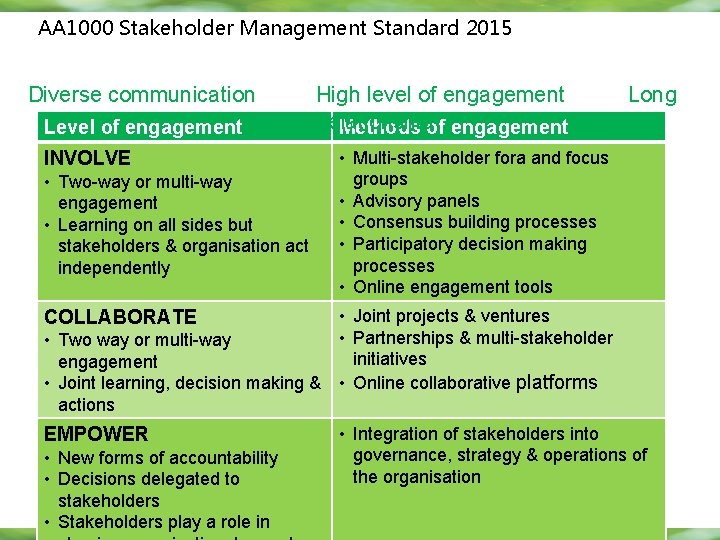
Empower Collaborate Involve Communication diverse Negotiate Consult Transact Inform limited medium term Advocate none Monitor Remain Passive low long term short term medium Nature of relationship AA 1000 Stakeholder Management Standard 2015 high Level of engagement
AA 1000 Stakeholder Management Standard 2015 No communication Low level of engagement Short term relatio Level of engagement Methods of engagement REMAIN PASSIVE • Stakeholder concern expressed through protest • Media • Letters, websites, social media • no active communication MONITOR • One-way communication • Stakeholder to organisation ADVOCATE • One-way communication • Organisation to stakeholder • Media & internet tracking • Second-hand reports from other stakeholders possible via targeted interviews • Pressure on regulatory bodies • Other advocacy efforts through social media • Lobbying efforts
AA 1000 Stakeholder Management Standard 2015 Limited communication Medium level of engagement Medium term relationsh Level of engagement Methods of engagement INFORM • • • One-way communication • Organisation to stakeholder • No invitation to reply TRANSACT • Limited two-way engagement • Set & monitor performance according to contract terms CONSULT • Limited two-way engagement • Organisation asks questions & stakeholders answer NEGOTIATE • Limited two-way engagement • Discuss a specific issue or range of issues with the objective of reaching consensus Bulletins and letters Brochures Reports & websites Public presentations • Public-private partnerships • Grant-making & cause-related marketing • Surveys & focus groups • Meetings with selected stakeholders • Public meetings & workshops • e. g. Collective bargaining with unions
AA 1000 Stakeholder Management Standard 2015 Diverse communication Level of engagement High level of engagement term relationship Methods of engagement INVOLVE • Two-way or multi-way engagement • Learning on all sides but stakeholders & organisation act independently Long • Multi-stakeholder fora and focus groups • Advisory panels • Consensus building processes • Participatory decision making processes • Online engagement tools • Joint projects & ventures • Partnerships & multi-stakeholder • Two way or multi-way initiatives engagement • Joint learning, decision making & • Online collaborative platforms actions COLLABORATE EMPOWER • New forms of accountability • Decisions delegated to stakeholders • Stakeholders play a role in • Integration of stakeholders into governance, strategy & operations of the organisation
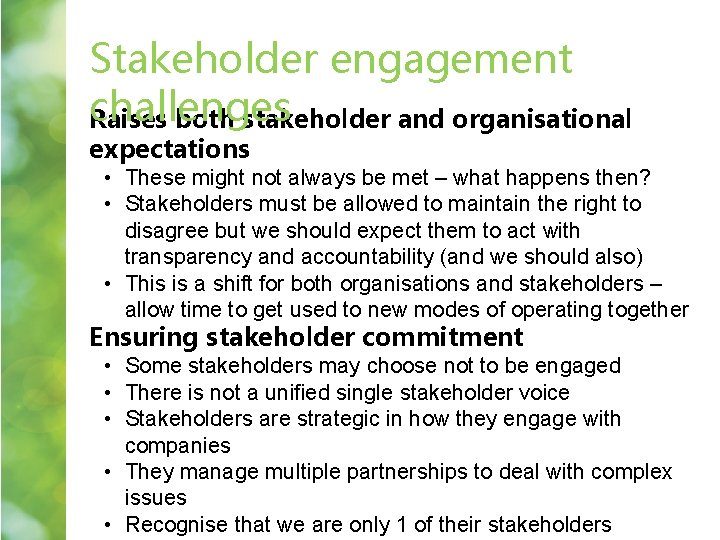
Stakeholder engagement challenges Raises both stakeholder and organisational expectations • These might not always be met – what happens then? • Stakeholders must be allowed to maintain the right to disagree but we should expect them to act with transparency and accountability (and we should also) • This is a shift for both organisations and stakeholders – allow time to get used to new modes of operating together Ensuring stakeholder commitment • Some stakeholders may choose not to be engaged • There is not a unified single stakeholder voice • Stakeholders are strategic in how they engage with companies • They manage multiple partnerships to deal with complex issues • Recognise that we are only 1 of their stakeholders
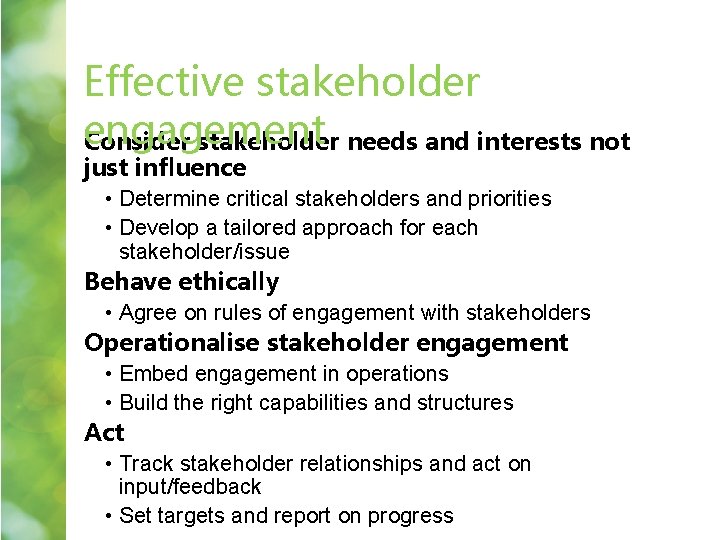
Effective stakeholder engagement Consider stakeholder needs and interests not just influence • Determine critical stakeholders and priorities • Develop a tailored approach for each stakeholder/issue Behave ethically • Agree on rules of engagement with stakeholders Operationalise stakeholder engagement • Embed engagement in operations • Build the right capabilities and structures Act • Track stakeholder relationships and act on input/feedback • Set targets and report on progress
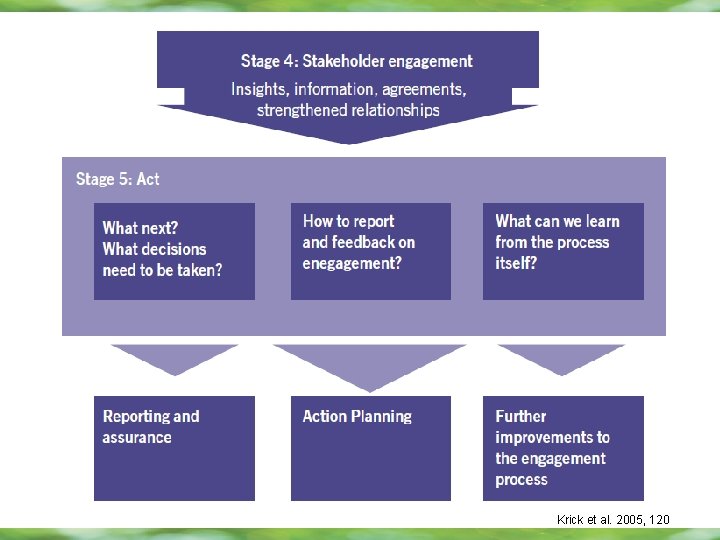
Krick et al. 2005, 120
The changing nature of relationships with stakeholders Who are your stakeholders? From traditional business interactions To broader groups Local communities, supply chain workers, employees’ families, NGOs Employees, customers, suppliers, investors, regulators What issues do you need to address with them? From legal & contractual issues Marketing, industrial relations, site selection, business planning, procurement To emerging issues & new responsibilities Corruption, human rights, health risks, economic development, supply chain labour conditions, environmental impacts Was is the focus? From stakeholder management • Reactive • Issues based • Short-term focus • Linear process • Emphasis on managing negative • • attitudes Management (control) of stakeholders ‘Buffering’ To stakeholder engagement • Proactive • Relationship based • Longer-term focus • Cyclical process • Focus on both positive and negative • • attitudes Partnership (collaboration) with stakeholders ‘Bridging’ How do you do it? Krick et al. 2005
Planning ahead Next lecture: • Week 4 Sustainability phases & drivers for change Next tutorial: • Week 4 Stakeholder identification & ethical engagement • Presentation week self-allocation closes Sunday night 11: 59 pm
Want more information? • Accountability (2015) AA 1000 Stakeholder Engagement Standard. www. accountability. org • Cameron J & Grant-Smith D (2014) Putting people in planning: participatory democracy, community building and social inclusion. In J Byrne, N Sipe & J Dodson (Eds) Australian Environmental Planning: Challenges & Future Prospects. Routledge. pp. 197 -205. • IAP 2 – International Association for Public Participation • Krick T, Forstater T, Monaghan P & Silanpää M (2005) The Stakeholder Engagement Manual: Volume 2 – The Practitioner’s Handbook on Stakeholder Engagement. Accountability, UNEP, & Stakeholder Research Associates Canada. https: //ccednet-rcdec. ca/en/toolbox/stakeholderengagement-manual-volume-2 -practitioners • Patridge K, Jacson C, Wheeler D & Zohar A (2005) The Stakeholder Engagement Manual: Volume 1 – The Guide to Practitioners’ Perspectives on Stakeholder Engagement. Ontario: Stakeholder Research Associates Canada, United Nations Environment Program, and Accountability. • Savage G, Nix T, Whitehead C & Blair J (1993) Strategies for assessing and managing organizational stakeholders. In M Baetz (Ed. ) Readings and Canadian cases in business, government and society (pp. 147 -158). Scarborough: Nelson Canada.