SPDcooling status Rosario Turrisi INFN Padova S Foreword




- Slides: 16
SPD-cooling status Rosario Turrisi INFN Padova S
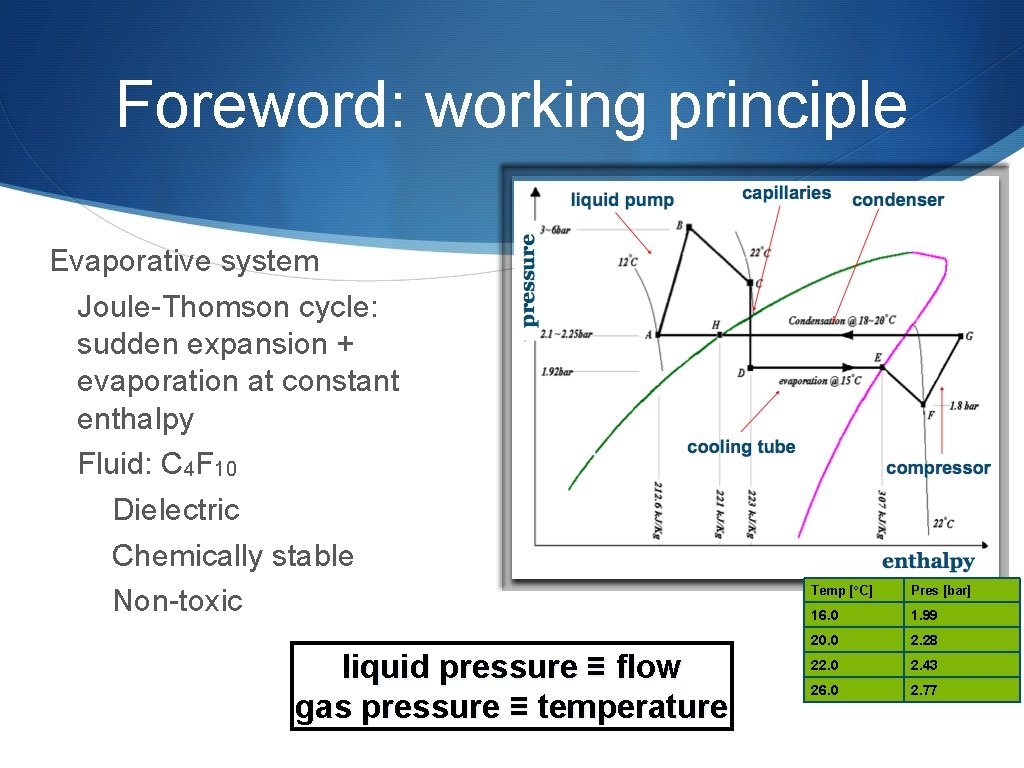
Foreword: working principle Evaporative system Joule-Thomson cycle: sudden expansion + evaporation at constant enthalpy Fluid: C 4 F 10 Dielectric Chemically stable Non-toxic liquid pressure ≡ flow gas pressure ≡ temperature Temp [°C] Pres [bar] 16. 0 1. 99 20. 0 2. 28 22. 0 2. 43 26. 0 2. 77
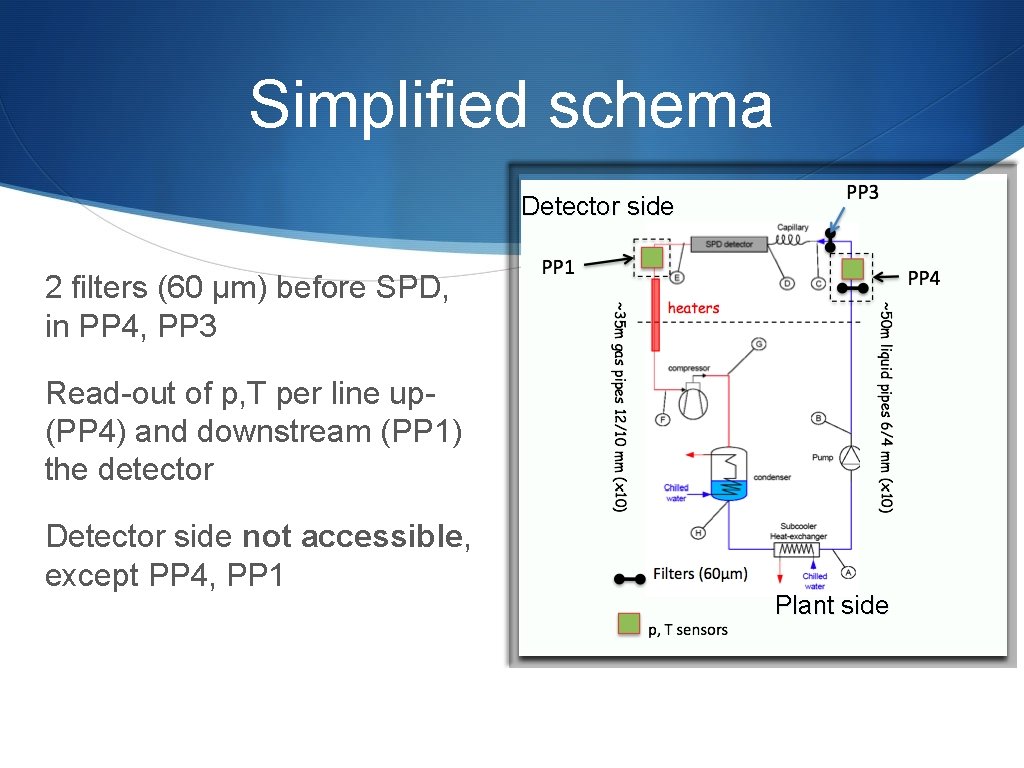
Simplified schema Detector side 2 filters (60 μm) before SPD, in PP 4, PP 3 Read-out of p, T per line up(PP 4) and downstream (PP 1) the detector Detector side not accessible, except PP 4, PP 1 Plant side
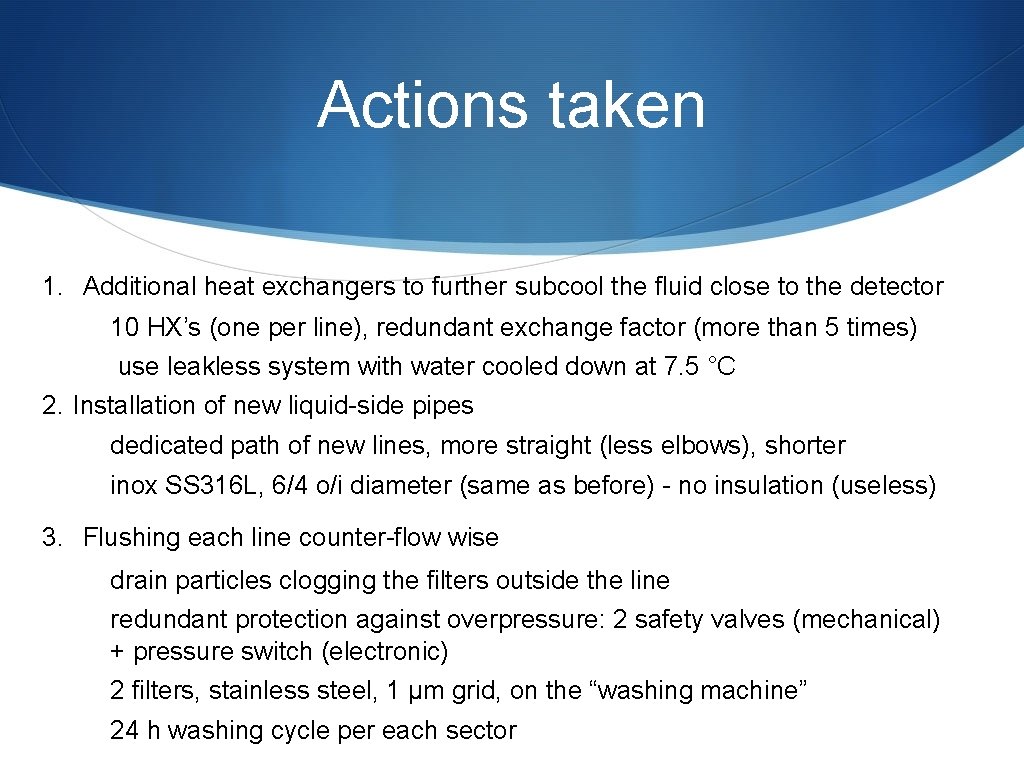
Actions taken 1. Additional heat exchangers to further subcool the fluid close to the detector • • 10 HX’s (one per line), redundant exchange factor (more than 5 times) use leakless system with water cooled down at 7. 5 °C 2. Installation of new liquid-side pipes • dedicated path of new lines, more straight (less elbows), shorter • inox SS 316 L, 6/4 o/i diameter (same as before) - no insulation (useless) 3. Flushing each line counter-flow wise • • drain particles clogging the filters outside the line • • 2 filters, stainless steel, 1 μm grid, on the “washing machine” redundant protection against overpressure: 2 safety valves (mechanical) + pressure switch (electronic) 24 h washing cycle per each sector
g n i t e e m 16 C r C e H b L m e m v o o r F N Room for improvement? Out of 10 “missing” 9 half-staves have cooling issues Beyond the number of hs, SPD needs also stability Following actions need to be taken on solid base, understanding the behaviour in running conditions (lots of variables play. . . ) Actions for the short term: remote control of water flow not needed installation of per-line flowmeters and pressure regulators repeat the cleaning on worse sectors (7, 9) for longer time The real schedule is of course dependent on when/how long we’ll have access to the experimental area. . .
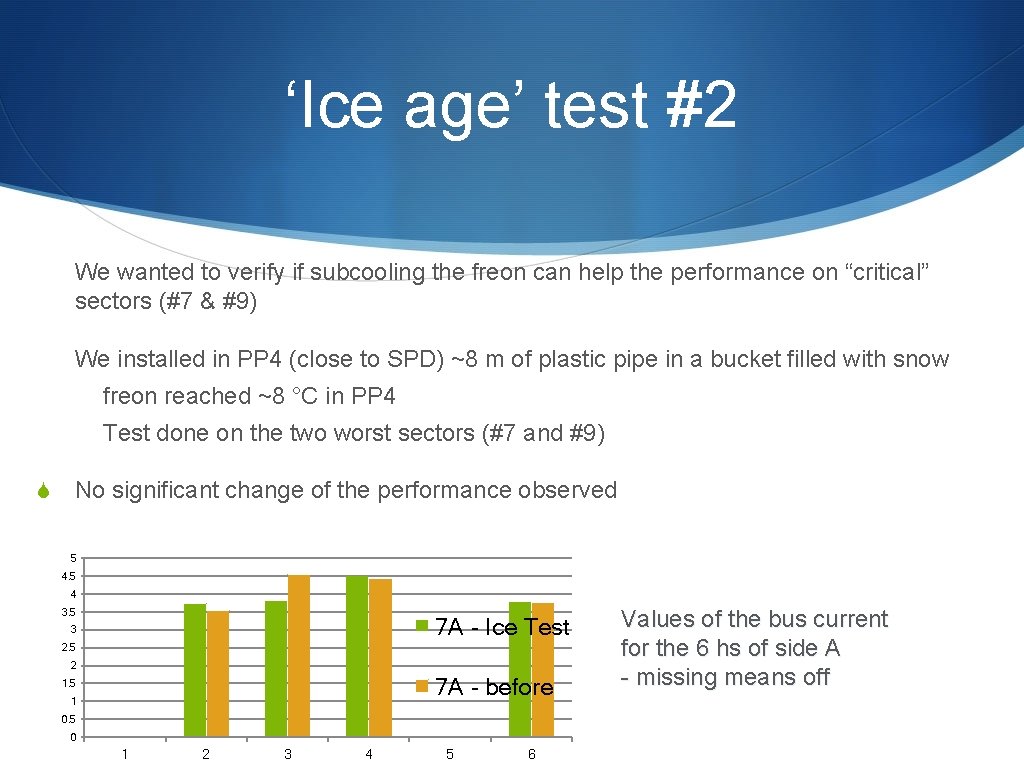
‘Ice age’ test #2 We wanted to verify if subcooling the freon can help the performance on “critical” sectors (#7 & #9) We installed in PP 4 (close to SPD) ~8 m of plastic pipe in a bucket filled with snow freon reached ~8 °C in PP 4 Test done on the two worst sectors (#7 and #9) S No significant change of the performance observed 5 4 3. 5 7 A - Ice Test 3 2. 5 2 7 A - before 1. 5 1 0. 5 0 1 2 3 4 5 6 Values of the bus current for the 6 hs of side A - missing means off
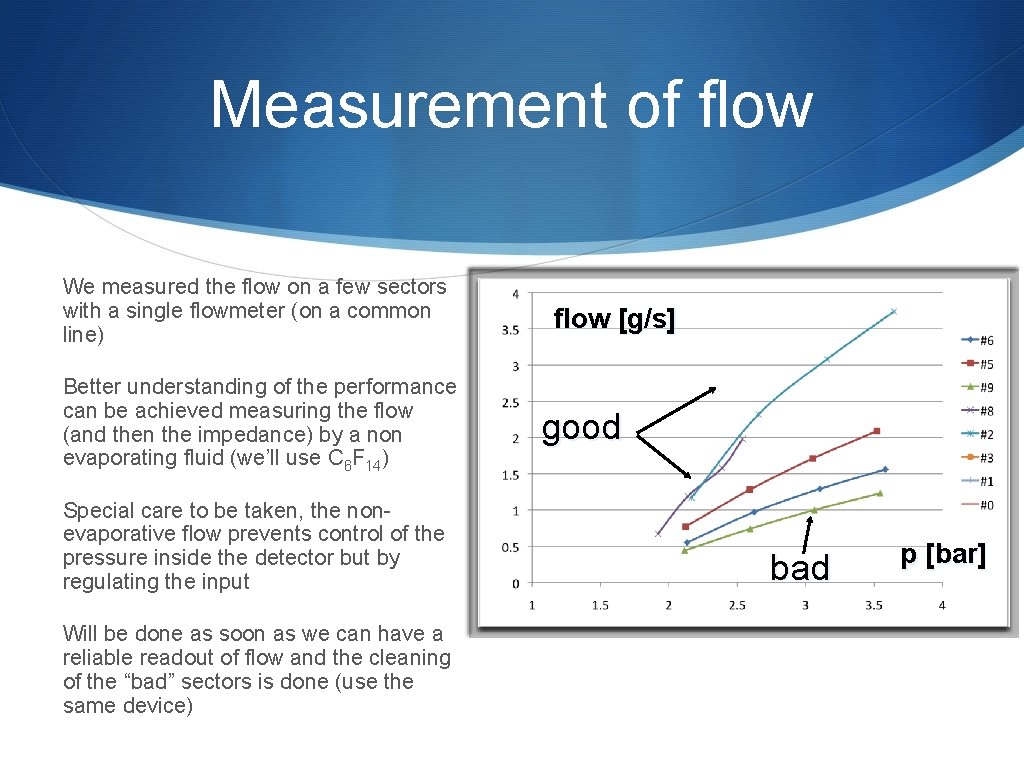
Measurement of flow We measured the flow on a few sectors with a single flowmeter (on a common line) Better understanding of the performance can be achieved measuring the flow (and then the impedance) by a non evaporating fluid (we’ll use C 6 F 14) Special care to be taken, the nonevaporative flow prevents control of the pressure inside the detector but by regulating the input Will be done as soon as we can have a reliable readout of flow and the cleaning of the “bad” sectors is done (use the same device) flow [g/s] good bad p [bar]
New hardware - 1 S Pressure regulator on each line: S allows a dedicated tuning of liquid pressure → flow S Flowmeter on each line: S allows the monitor of the flow → fundamental for performance monitoring along the lifetime of the system and debugging of possible problems S Hardware installation completed (sensors + cabling) S Readout system close to completion (next week), integrated in DCS
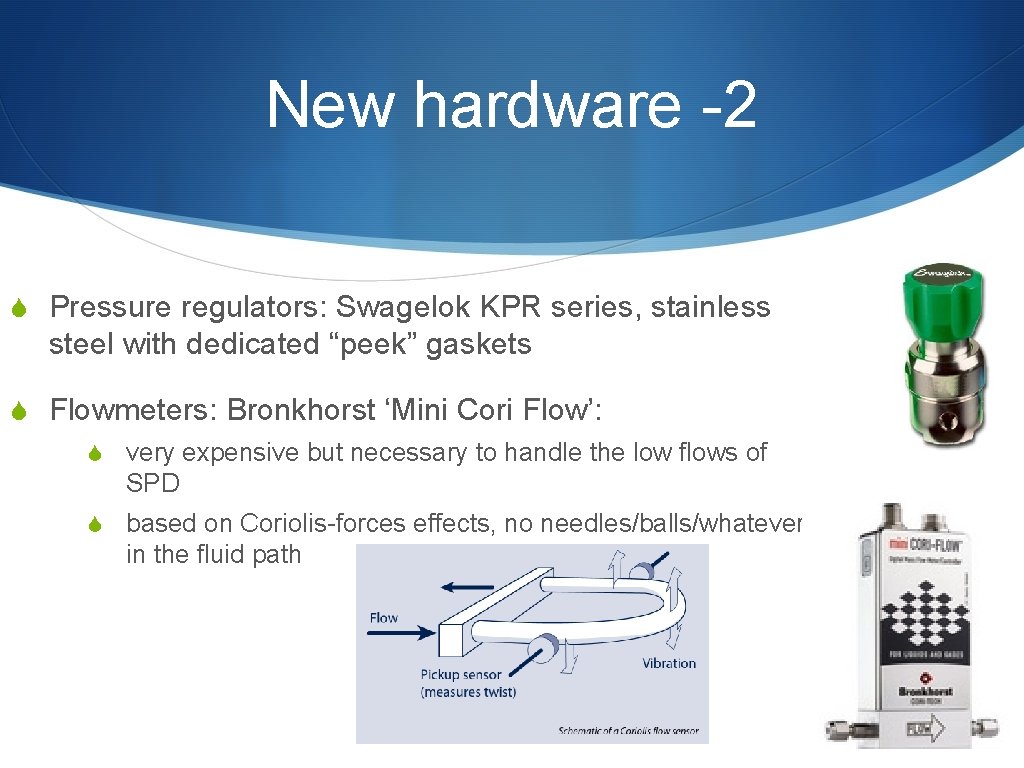
New hardware -2 S Pressure regulators: Swagelok KPR series, stainless steel with dedicated “peek” gaskets S Flowmeters: Bronkhorst ‘Mini Cori Flow’: S very expensive but necessary to handle the low flows of SPD S based on Coriolis-forces effects, no needles/balls/whatever in the fluid path
A few pictures. . .
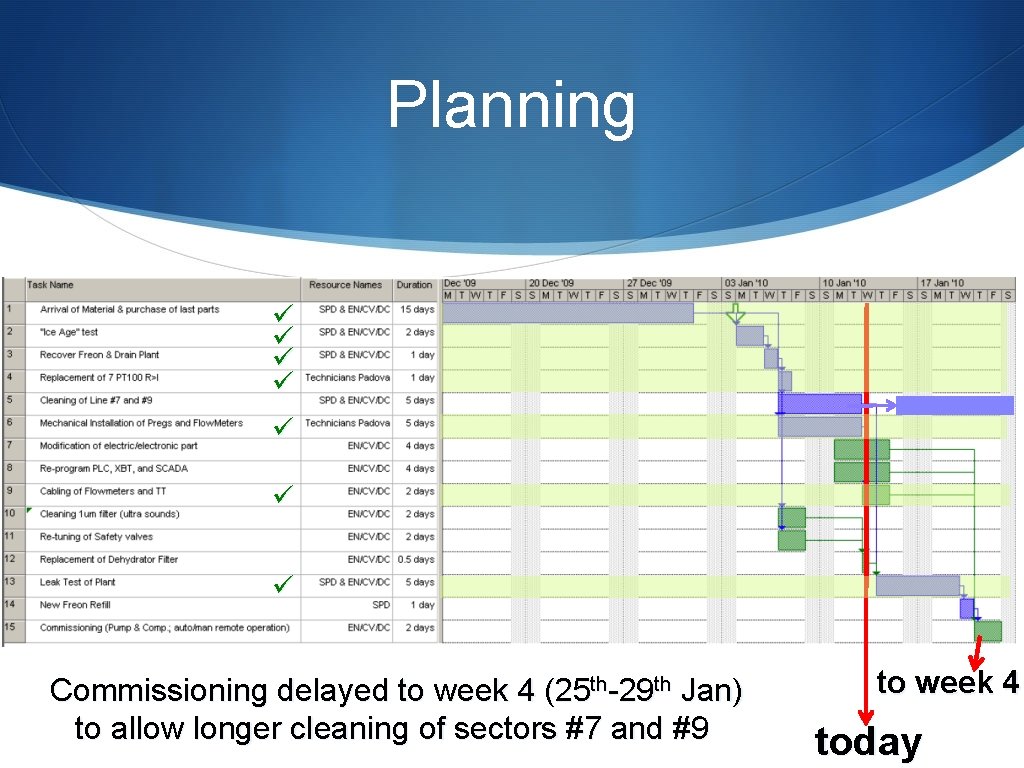
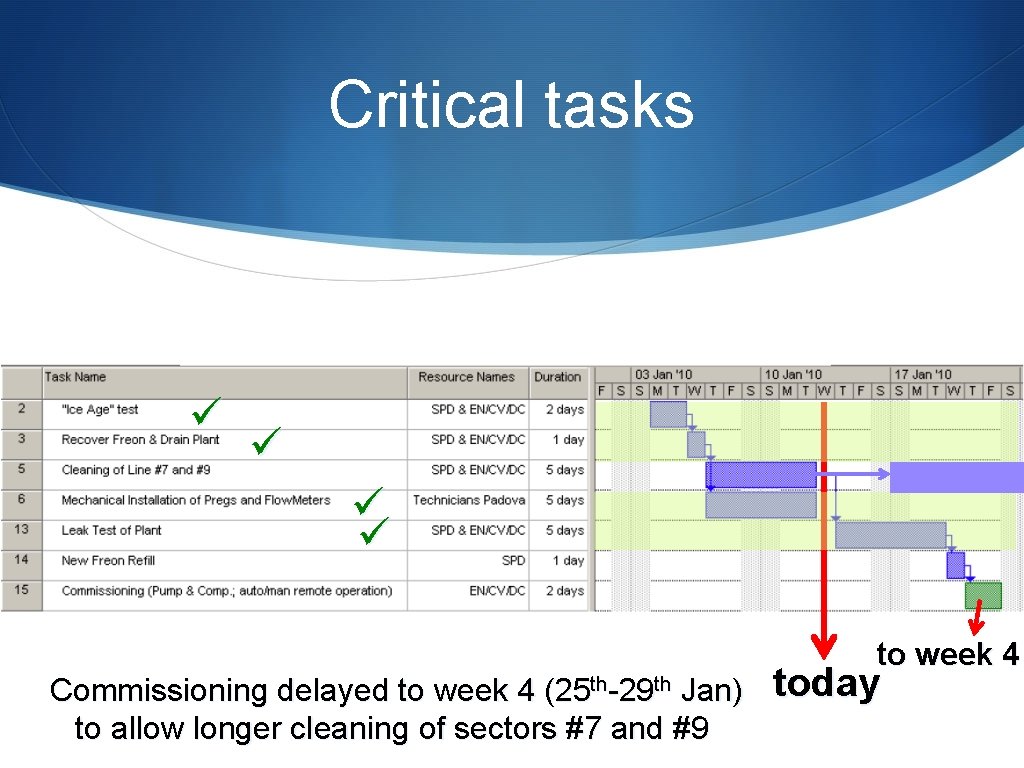
Planning ü ü ü ü Commissioning delayed to week 4 (25 th-29 th Jan) to allow longer cleaning of sectors #7 and #9 to week 4 today
Critical tasks ü ü Commissioning delayed to week 4 (25 th-29 th Jan) to allow longer cleaning of sectors #7 and #9 to week 4 today
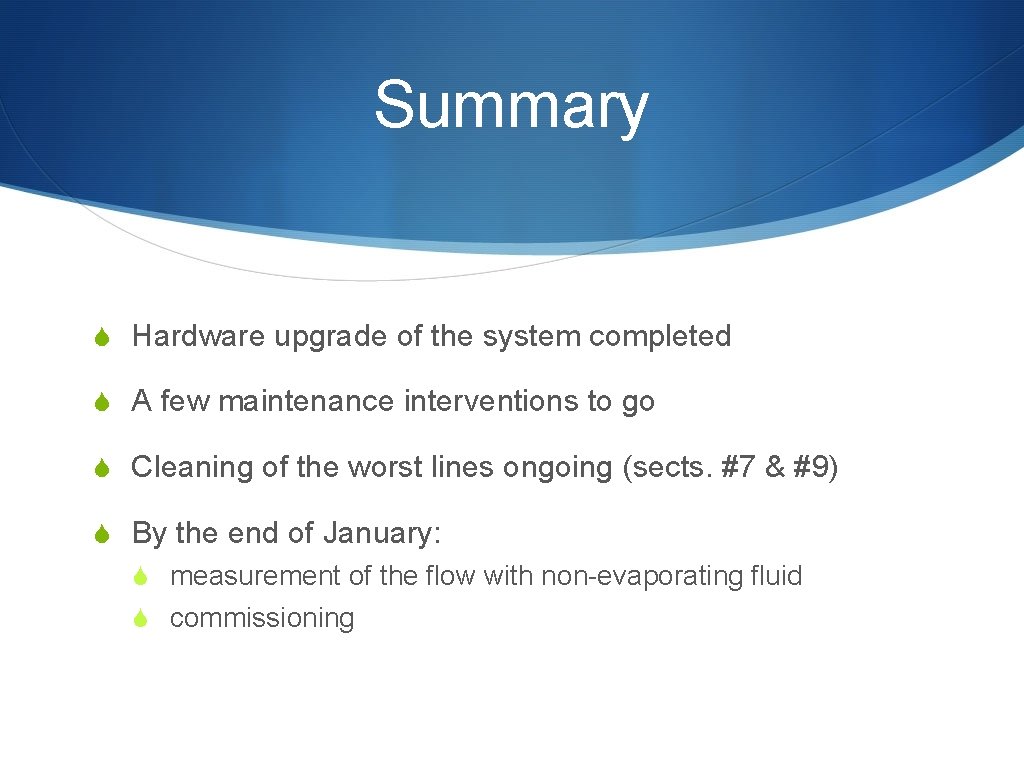
Summary S Hardware upgrade of the system completed S A few maintenance interventions to go S Cleaning of the worst lines ongoing (sects. #7 & #9) S By the end of January: S measurement of the flow with non-evaporating fluid S commissioning