South African Unit of the UNESCO International Network

- Slides: 12
South African Unit of the UNESCO International Network in Bioethics Medical Ethics Medico-Legal Summit (March 2015) Professor A Dhai Immediate Past-President SAMA Director: Steve Biko Centre for Bioethics Faculty of Health Sciences University of the Witwatersrand Johannesburg
INTRODUCTION • • Changing practitioner-patient relationship Core values in medical ethics Communication Competence Stress as a factor in litigation risk Implications of Increasing Litigation Recommendations
The changing practitioner-patient relationship • purpose of health care practice : – always to care for the sick and promote their health interests and well being. – health care practice - moral contract between the public and the profession – health care practitioners important agents through which scientific knowledge applied to human health. • attitudes and expectations of both public and practitioners undergone change: – traditional practitioner-centred approach to patient care transformed into the present day patient-centred approach, – legal influences having bearing on relationship - gradual transition of practice towards that of defensive medicine - ? the humanistically responsive practitioner may soon become a concept belonging to the past? – political, social and economic factors have introduced demands, anxieties and stresses in health care practice. • practitioners whose jobs in the past were clear and unequivocally well understood now face uncertainties and doubts as to their roles
Core values of Medical Ethics • WMA Core values of Medical Ethics: – Compassion • Understanding and concern for another person’s distress • Patients perception that concerns are appreciated and being treated rather than just the illness – Competence • High degree expected and required • Technical and ethical – Autonomy • Self-determination • Both physician and patient
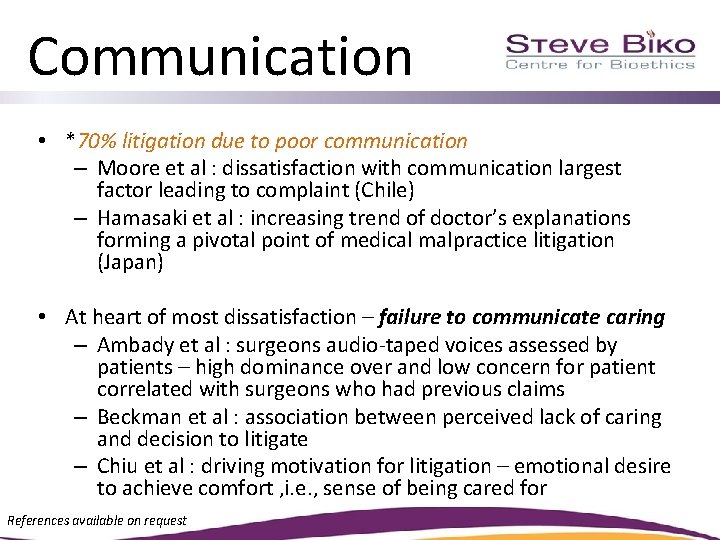
Communication • *70% litigation due to poor communication – Moore et al : dissatisfaction with communication largest factor leading to complaint (Chile) – Hamasaki et al : increasing trend of doctor’s explanations forming a pivotal point of medical malpractice litigation (Japan) • At heart of most dissatisfaction – failure to communicate caring – Ambady et al : surgeons audio-taped voices assessed by patients – high dominance over and low concern for patient correlated with surgeons who had previous claims – Beckman et al : association between perceived lack of caring and decision to litigate – Chiu et al : driving motivation for litigation – emotional desire to achieve comfort , i. e. , sense of being cared for References available on request
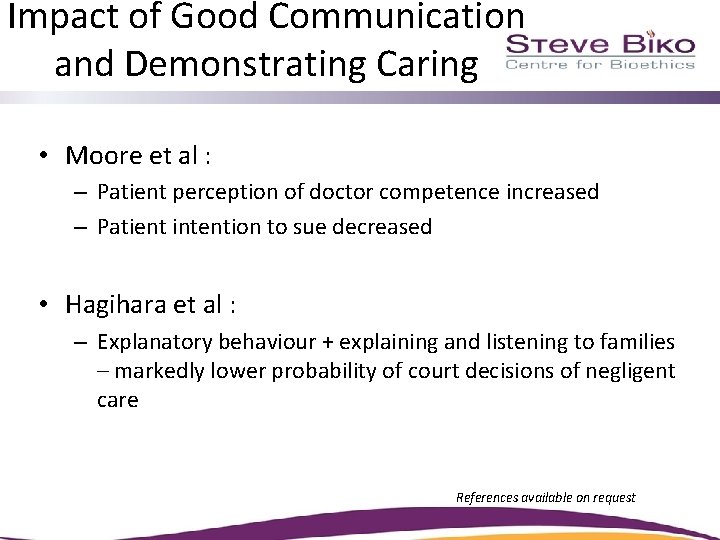
Impact of Good Communication and Demonstrating Caring • Moore et al : – Patient perception of doctor competence increased – Patient intention to sue decreased • Hagihara et al : – Explanatory behaviour + explaining and listening to families – markedly lower probability of court decisions of negligent care References available on request
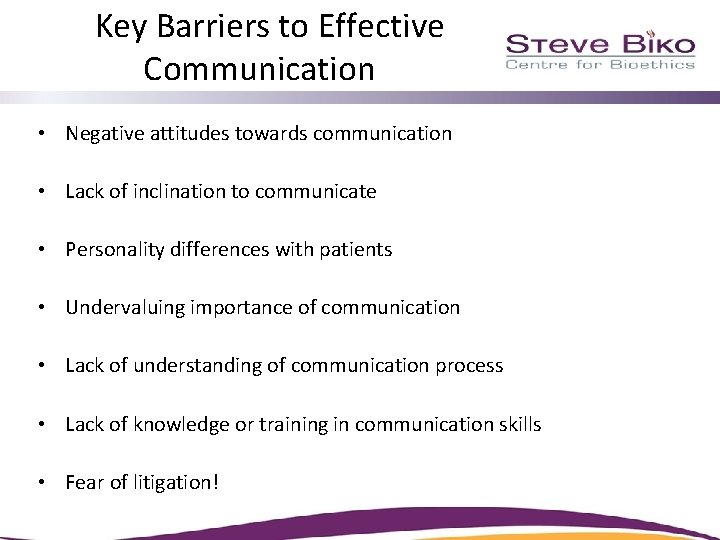
Key Barriers to Effective Communication • Negative attitudes towards communication • Lack of inclination to communicate • Personality differences with patients • Undervaluing importance of communication • Lack of understanding of communication process • Lack of knowledge or training in communication skills • Fear of litigation!
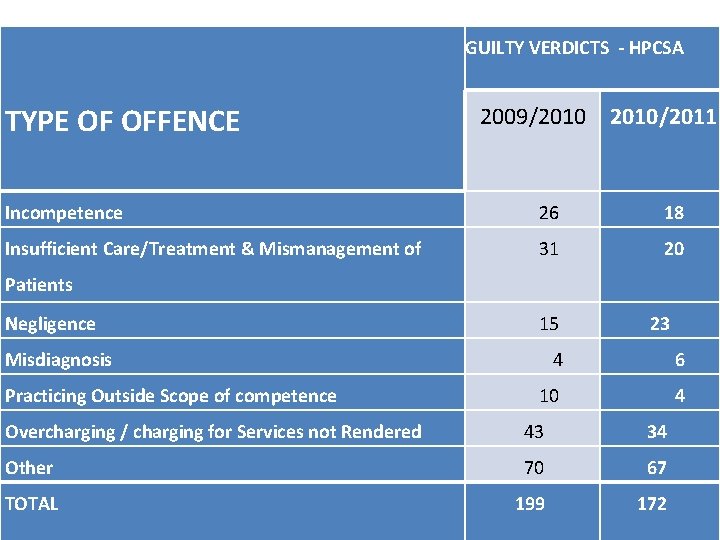
GUILTY VERDICTS - HPCSA TYPE OF OFFENCE 2009/2010/2011 Incompetence 26 18 Insufficient Care/Treatment & Mismanagement of 31 20 Patients Negligence 15 Misdiagnosis Practicing Outside Scope of competence 23 4 6 10 4 Overcharging / charging for Services not Rendered 43 34 Other 70 67 TOTAL 199 172
Stress • Higher levels of occupational stress (public sector) cf average working population: • • Understaffing Lack of resources Lack of control Difficult work schedules Inadequate security Poor career advancements Poor salaries Thomas LS, Valli A. Levels of occupational stress in doctors working in a South African public sector hospital. SAMJ(2006); 96: 1162 -1168 • RWOPS abuse
Implications of Increasing Medical Litigation • Serious concerns on sustainability of the current claims trajectory on practitioners, patients, wider healthcare economy. – snowballing cost of professional indemnity insurance, resulting in higher medical costs in the private sector. – public health institutions - affects the State’s ability to finance healthcare in the medium to long term, has a negative effect on service delivery • inevitably reduce quality of care in already resource-strapped setting. – healthcare practitioners, on a personal level - struggling to reconcile ethical duties towards patients : growing aversion to liability risk and the related fear of being sued. – anecdotal evidence – decreasing specialists in high risk disciplines overburdening public facilities
RECOMMENDATIONS • Urgent interventions are necessary to improve current situation. • This must be done responsibly and in line with justice in order to ensure that compensation where indicated, is fair. • Prevention is key and health administrators must work towards containing risks, defend claims which are defensible, and be accountable when paying out public money for settlement of claims, as monies paid out in this context are much needed financial resources lost to hospital services. • This can be achieved by means of promoting safe practice, efficient claimshandling and by rigorously endeavouring for systems and legal reform, without compromising the principle of fairness. • HPCSA processes and functioning urgently improved.
CONCLUSION The need for reform is urgent. However, legal reform must be preceded by effective and uniform systems reform. Any form of legal reform must be in keeping with the principles of justice as espoused in the Bill of Rights of the Constitution of South Africa and South Africa’s National Health Insurance. Moreover, any intervention must take into consideration that the National Health Insurance is on the verge of implementation.