SOCIAL PROCESS THEORY Criminality is a function of
- Slides: 33
SOCIAL PROCESS THEORY Criminality is a function of SOCIALIZATION
Social Process Theory All people regardless of class, gender, race, etc. have the potential to become criminals.
Social Process Theory Criminal attitude and behavior can be controlled with: Good Families Good Schools Peers Religion
Social Process Theory PARENTAL EFFICACY: Parents who are supportive and control their children in a NON COERSIVE manner.
Social Process Theory NEGATIVE FAMILY FACTORS INCLUDE: Poor supervision and discipline Lack of affection Parents with mental illness Drug abusing parents Abuse Severe Discipline
Social Process Theory Education: Children who do poorly in school or feel alienated are likely to engage in criminal behavior.
Social Process Theory Education cont. Minority groups, (Native American, Hispanics, African Americans): Have a 50% chance of getting their High School Diploma
Social Process Theory Education cont. School Violence: Bullying is a common experience. 16% report being bullied 1. 5 million violent incidents occur in elementary & High School each year
Social Process Theory Religion Attending church, as opposed to just having religious beliefs is a more significant inhibitor of crime.
Social Process Theory has 3 branches: 1. Social Learning Theory – Crime is learned 2. Social Control Theory – Crime is controlled by peoples bonds to society 3. Social Reaction (Labeling Theory) – People become criminals because they are labeled as criminals.
Social Process Theory Branch #1 Social Learning Theorists believe: Crime is a product of learning the norms, values and behavior associated with criminal activity.
Social Process Theory There are two forms of Social Learning Theory. 1. Differential Association Theory 2. Neutralization Theory
Social Process Theory Edwin Sutherland (1939) Differential Association Theory: Crime is a learning process that can affect any individual in any culture.
Social Process Theory Edwin Sutherland (1939) Differential Association Theory cont. Skills & motives to commit crimes are learned as a result of CONTACT with pro crime: VALUES, ATTITUDES & DEFINITIONS. –
Social Process Theory Differential Association Theory cont. CULTURAL CONFLICT: Result in opposing norms, attitudes & definitions of right and wrong, moral and immoral.
Social Process Theory Neutralization Theory - David Matza & Gresham Sykes (1964) Criminals must learn to neutralize conventional values & attitudes.
Social Process Theory Neutralization Theory - David Matza & Gresham Sykes (1964) cont. Drift Criminals DRIFT back & forth between criminal and conventional behavior.
Social Process Theory Neutralization Theory - David Matza & Gresham Sykes (1964) cont. Criminals do NOT commit crime all of the time.
Social Process Theory TECHNIQUES of Neutralization. 1. Denial of responsibility 2. Denial of injury 3. Denial of the victim
Social Process Theory TECHNIQUES of Neutralization. 4. Condemnation of the condemner's. (Police & judges are corrupt) 5. Appeal to higher loyalties. (The gang is more important)
Social Process Theory Branch # 2 Social Control Theory Social Control Theorists Believe: People obey laws because they are controlled by internal &
Social Process Theory Social Control Theory cont. SELF CONTROL A strong moral sense that renders a person INCAPABLE of hurting others or violating social norms.
Social Process Theory Social Control Theory cont. COMMITMENT TO CONFORMITY A strong personal investment in conventional institutions, individuals & processes that prevent people from engaging in behavior that could hurt their REPUTATION & achievement.
Social Process Theory Social Control Theory cont. Walter Reckless (1960’s) SELF IMAGE A strong self image deters crime.
Social Process Theory Social Control Theory cont. Travis Hirschi (1969) The DOMINANT version of Social Control Theory.
Social Process Theory Social Control Theory cont. (Travis Hirschi) Social bonds (ties) such as family, friends, neighbors, teachers, employers, keep people from criminal activity.
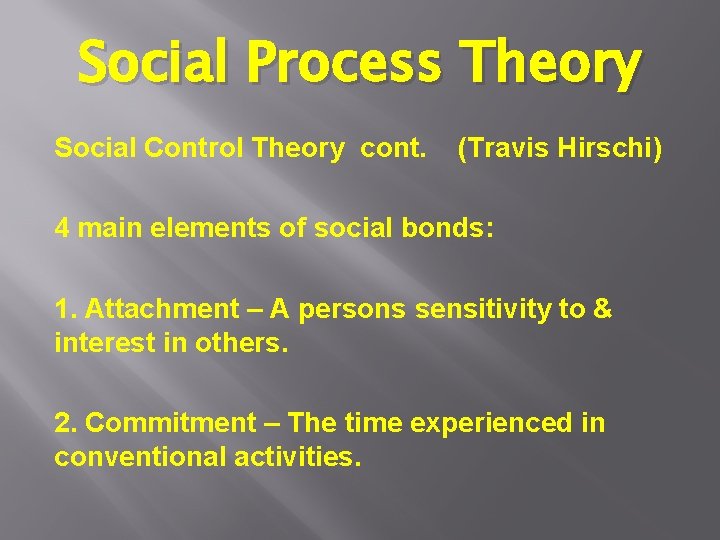
Social Process Theory Social Control Theory cont. (Travis Hirschi) 4 main elements of social bonds: 1. Attachment – A persons sensitivity to & interest in others. 2. Commitment – The time experienced in conventional activities.
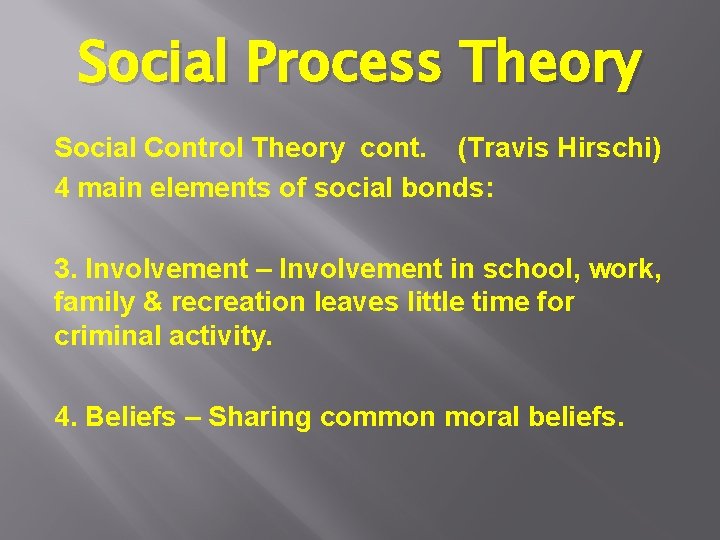
Social Process Theory Social Control Theory cont. (Travis Hirschi) 4 main elements of social bonds: 3. Involvement – Involvement in school, work, family & recreation leaves little time for criminal activity. 4. Beliefs – Sharing common moral beliefs.
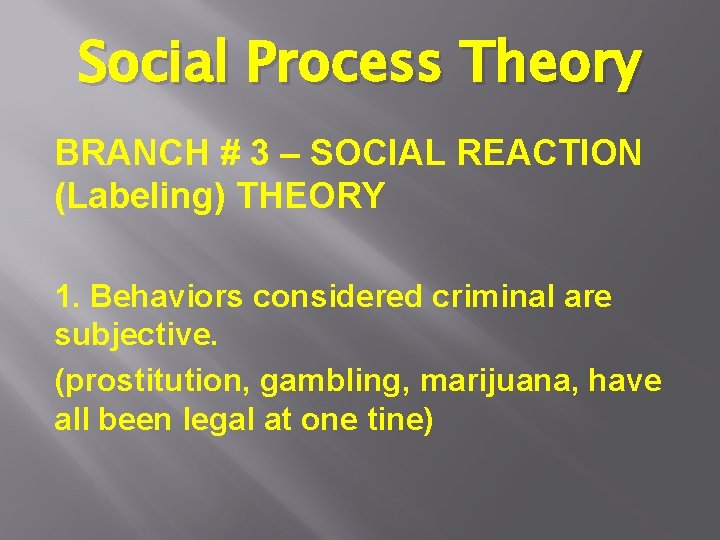
Social Process Theory BRANCH # 3 – SOCIAL REACTION (Labeling) THEORY 1. Behaviors considered criminal are subjective. (prostitution, gambling, marijuana, have all been legal at one tine)
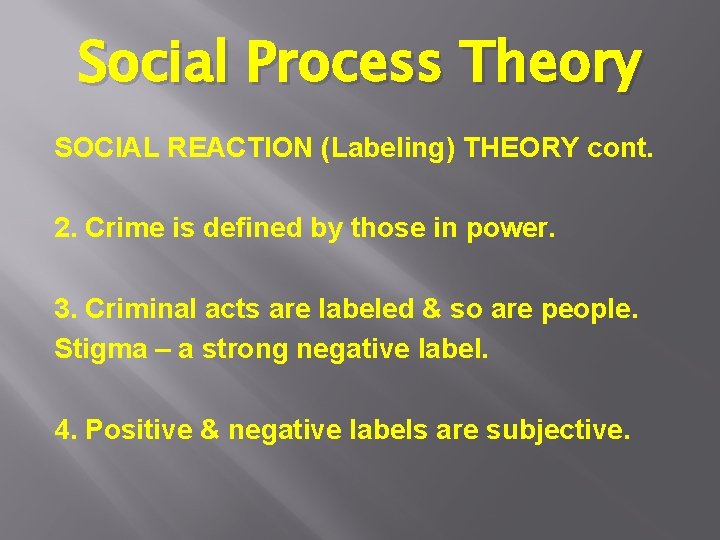
Social Process Theory SOCIAL REACTION (Labeling) THEORY cont. 2. Crime is defined by those in power. 3. Criminal acts are labeled & so are people. Stigma – a strong negative label. 4. Positive & negative labels are subjective.
Social Process Theory SOCIAL REACTION (Labeling) THEORY cont. Successful Degradation Ceremonies (Harold Garfinkel 1956) A public ceremony in which someone's identity is redefined & destroyed
Social Process Theory SOCIAL REACTION (Labeling) THEORY cont. Individuals often assume the identity & behavior of their label. Deviantly labeled often ban together. Retrospective Reading – The reassessment of a person to fit a current label.
Social Process Theory SOCIAL REACTION (Labeling) THEORY cont. Primary Deviance – A norm violation that has little influence on the actor. Secondary Deviance – A norm violation resulting in a label. Deviance Amplification – When a label pushes a person into an escalating cycle of deviance.