
HAY 140 Social Process Theories Dr Craig Mc
- Slides: 15
HAY 140 Social Process Theories Dr. Craig Mc. Intosh
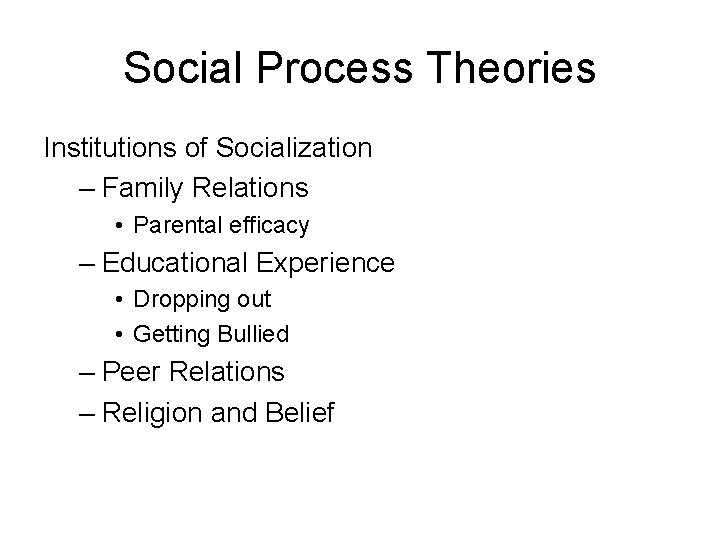
Social Process Theories Institutions of Socialization – Family Relations • Parental efficacy – Educational Experience • Dropping out • Getting Bullied – Peer Relations – Religion and Belief
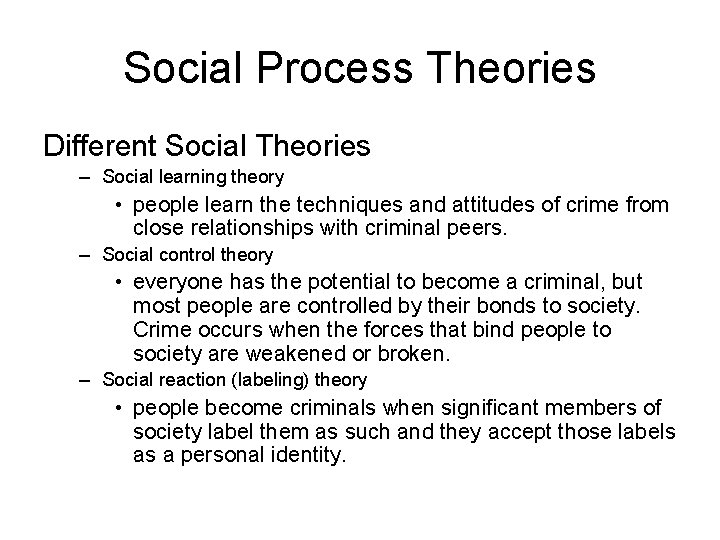
Social Process Theories Different Social Theories – Social learning theory • people learn the techniques and attitudes of crime from close relationships with criminal peers. – Social control theory • everyone has the potential to become a criminal, but most people are controlled by their bonds to society. Crime occurs when the forces that bind people to society are weakened or broken. – Social reaction (labeling) theory • people become criminals when significant members of society label them as such and they accept those labels as a personal identity.
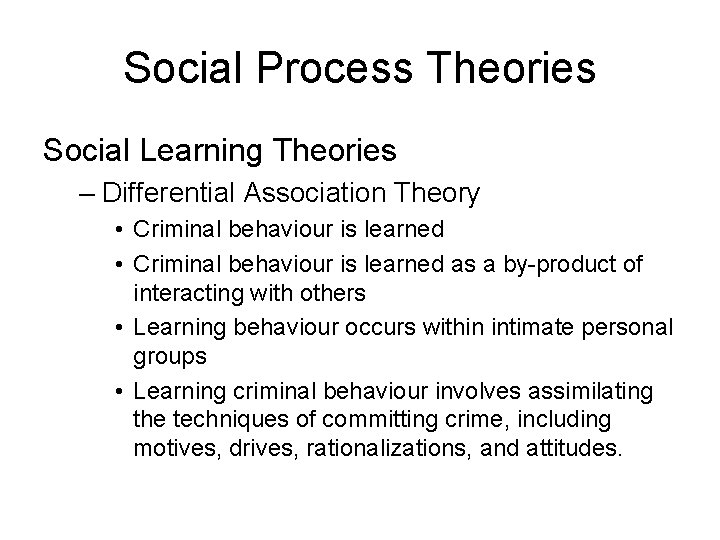
Social Process Theories Social Learning Theories – Differential Association Theory • Criminal behaviour is learned as a by-product of interacting with others • Learning behaviour occurs within intimate personal groups • Learning criminal behaviour involves assimilating the techniques of committing crime, including motives, drives, rationalizations, and attitudes.
Social Process Theories Social Learning Theories – Differential Association Theory • The specific direction of motives and drives is learned from perceptions of various aspects of the legal code as favorable or unfavorable • A person becomes a criminal when he or she perceives more favorable than unfavorable consequences to violating the law • Differential associations may vary in frequency, duration, priority, and intensity
Social Process Theories Social Learning Theories – Differential Association Theory • The process of learning criminal behavior by association with criminal and anti-criminal patterns involves all of the mechanisms that are involved in any other learning process • Although criminal behavior expresses general needs and values, it is not excused by those general needs and values, because noncriminal behavior expresses the same needs and values
Social Process Theories Social Learning Theories – Neutralization Theory • Neutralization techniques – – – Denial of responsibility Denial of injury Denial of the victim Condemnation of the condemners Appeal to higher loyalties – Evaluating Learning Theories
Social Process Theories Social Control Theory – Self-Control – Commitment to Conformity – Social Bonds
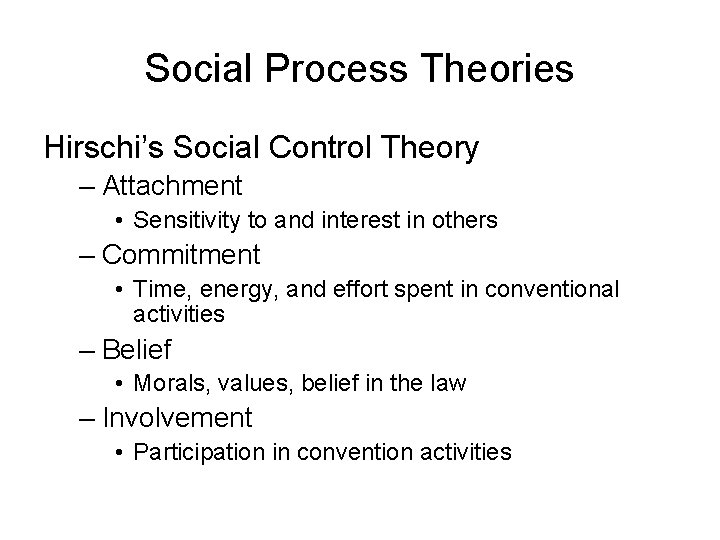
Social Process Theories Hirschi’s Social Control Theory – Attachment • Sensitivity to and interest in others – Commitment • Time, energy, and effort spent in conventional activities – Belief • Morals, values, belief in the law – Involvement • Participation in convention activities
Social Process Theories Hirschi’s Social Control Theory Testing Social Control Theory: Supportive Research • • Attachment Belief Commitment Involvement
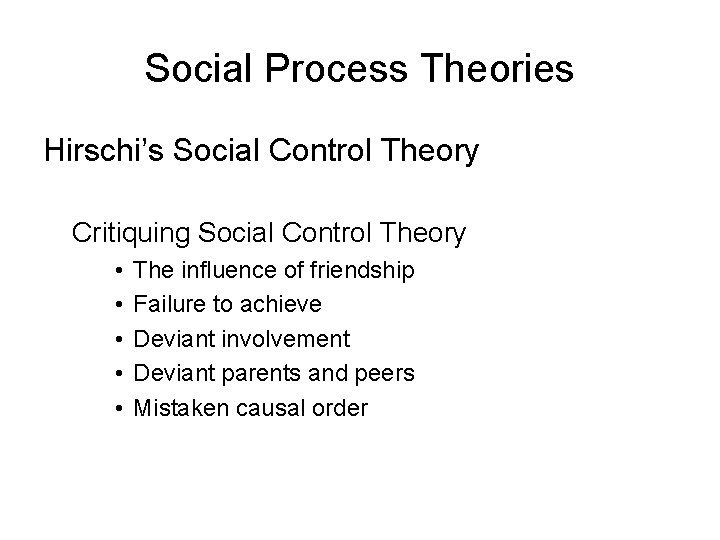
Social Process Theories Hirschi’s Social Control Theory Critiquing Social Control Theory • • • The influence of friendship Failure to achieve Deviant involvement Deviant parents and peers Mistaken causal order
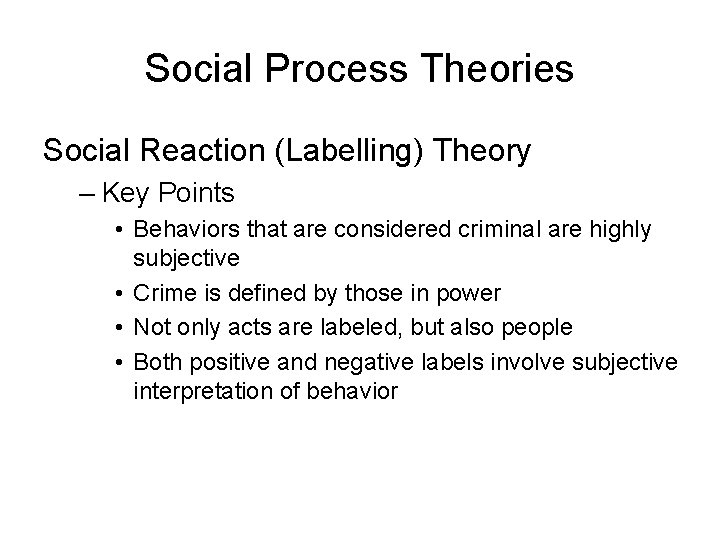
Social Process Theories Social Reaction (Labelling) Theory – Key Points • Behaviors that are considered criminal are highly subjective • Crime is defined by those in power • Not only acts are labeled, but also people • Both positive and negative labels involve subjective interpretation of behavior
Social Process Theories Social Reaction (Labelling) Theory – Consequences of Labeling • Self-labeling • Joining deviant cliques • Retrospective reading – Primary and Secondary Deviance – Crime and Labelling
Social Process Theories Social Reaction (Labelling) Theory – Differential Enforcement – Research on Social Reaction Theory • Targets of labeling • Effects of labelling – Is Labelling Theory Valid?
Social Process Theories Social Reaction (Labelling) Theory – Differential Enforcement – Research on Social Reaction Theory • Targets of labelling • Effects of labelling – Is Labelling Theory Valid?