Sentence Classification and Clause Detection for Croatian Kristina



- Slides: 10
Sentence Classification and Clause Detection for Croatian Kristina Vučković, Željko Agić, Marko Tadić Department of Information Sciences, Department of Linguistics Faculty of Humanities and Social Sceinces, University of Zagreb {kvuckovi, zagic, marko. tadic}@ffzg. hr FASSBL 7 Conference Dubrovnik, Croatia 2010 -10 -05
Overview § What? § classifying Croatian sentences by structure § detecting independent and dependent clauses § How? § implemented a prototype system in Noo. J § linked it with a morphosyntactic tagger § evaluated on a sample from Croatian corpora § Why? § rule-based chunking and shallow parsing
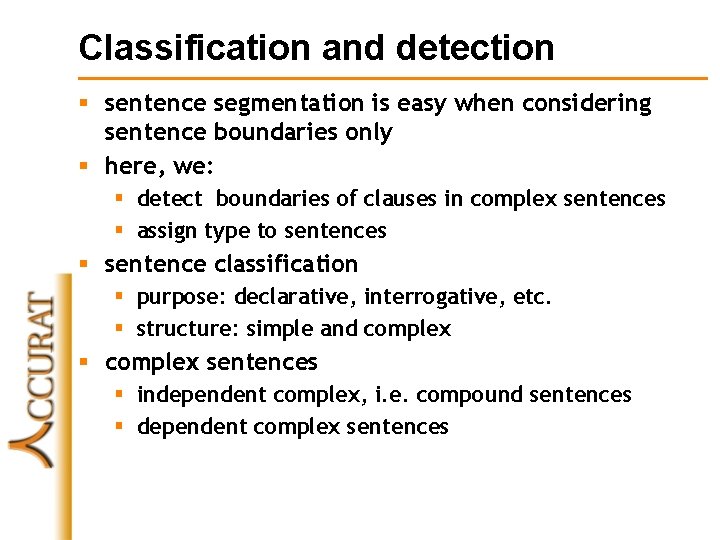
Classification and detection § sentence segmentation is easy when considering sentence boundaries only § here, we: § detect boundaries of clauses in complex sentences § assign type to sentences § sentence classification § purpose: declarative, interrogative, etc. § structure: simple and complex § complex sentences § independent complex, i. e. compound sentences § dependent complex sentences
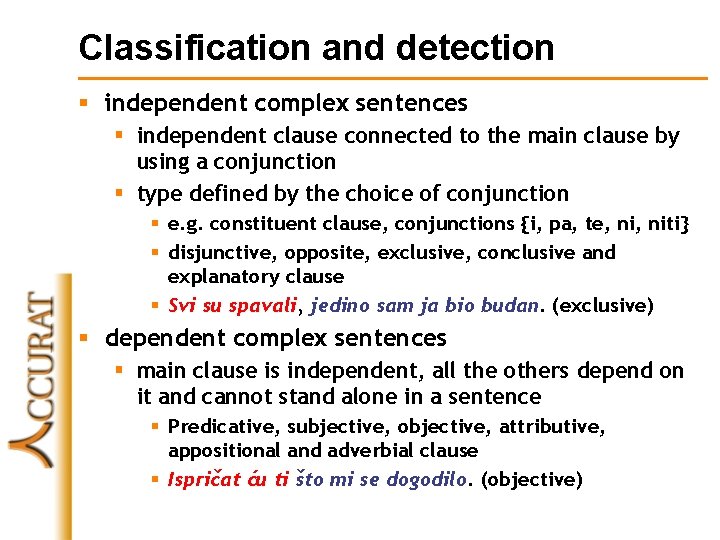
Classification and detection § independent complex sentences § independent clause connected to the main clause by using a conjunction § type defined by the choice of conjunction § e. g. constituent clause, conjunctions {i, pa, te, niti} § disjunctive, opposite, exclusive, conclusive and explanatory clause § Svi su spavali, jedino sam ja bio budan. (exclusive) § dependent complex sentences § main clause is independent, all the others depend on it and cannot stand alone in a sentence § Predicative, subjective, objective, attributive, appositional and adverbial clause § Ispričat ću ti što mi se dogodilo. (objective)
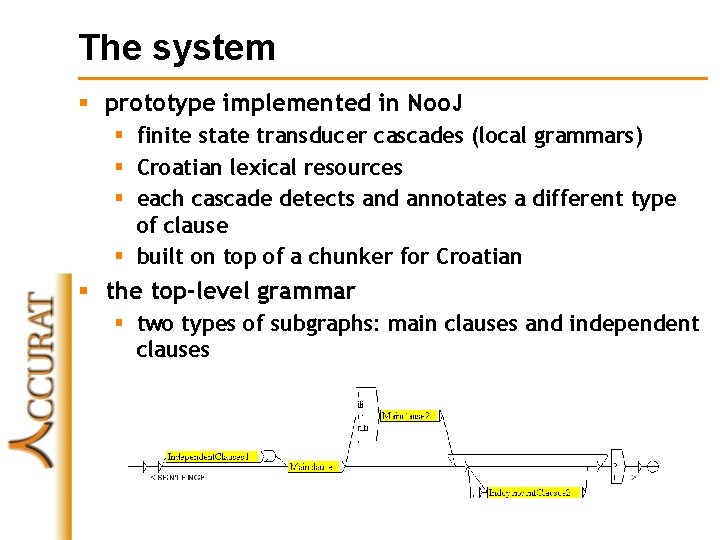
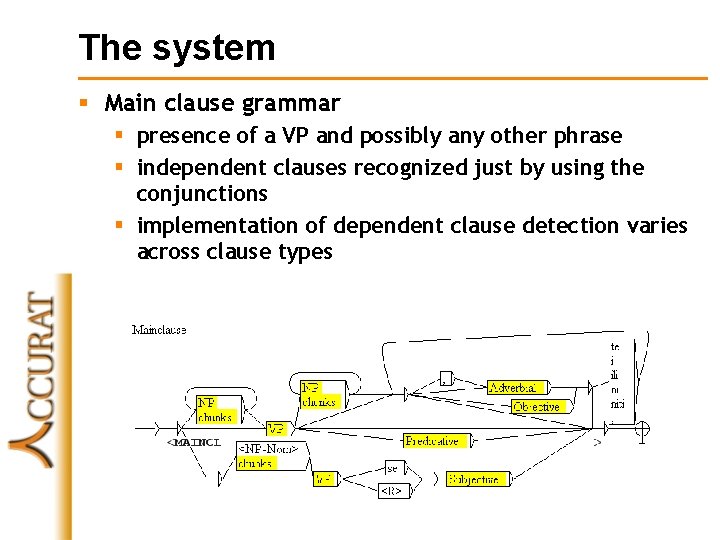
The system § prototype implemented in Noo. J § finite state transducer cascades (local grammars) § Croatian lexical resources § each cascade detects and annotates a different type of clause § built on top of a chunker for Croatian § the top-level grammar § two types of subgraphs: main clauses and independent clauses
The system § Main clause grammar § presence of a VP and possibly any other phrase § independent clauses recognized just by using the conjunctions § implementation of dependent clause detection varies across clause types
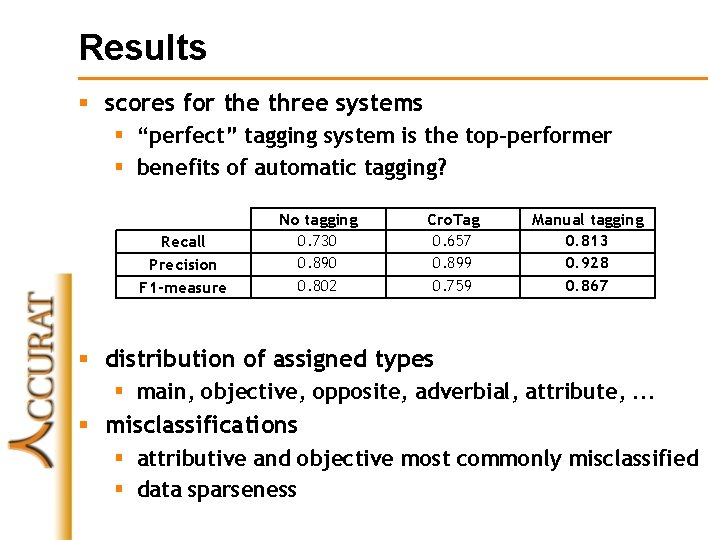
Experiment setup § used the CW 100 corpus § XCES-encoded to word level § sentence delimited, tokenized, manually lemmatized and MSD-annotated § 200 randomly selected sentences § 100 for the development and 100 for testing § utilized the Cro. Tag tagger § Noo. J input format allows external annotation § created three systems § no preprocessing § tagging input sentences with Cro. Tag (~85% accuracy) § using the manually assigned tags from CW 100 § recall, precision, F 1 -measure
Results § scores for the three systems § “perfect” tagging system is the top-performer § benefits of automatic tagging? Recall Precision F 1 -measure No tagging 0. 730 0. 890 0. 802 Cro. Tag 0. 657 0. 899 0. 759 Manual tagging 0. 813 0. 928 0. 867 § distribution of assigned types § main, objective, opposite, adverbial, attribute, . . . § misclassifications § attributive and objective most commonly misclassified § data sparseness
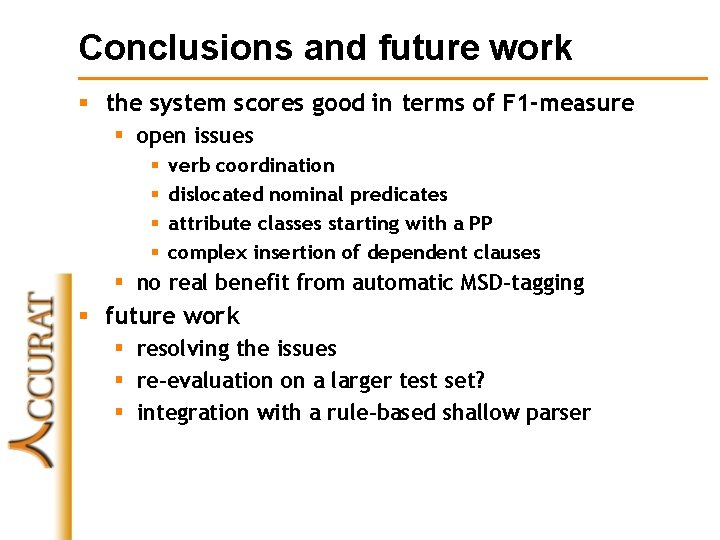
Conclusions and future work § the system scores good in terms of F 1 -measure § open issues § § verb coordination dislocated nominal predicates attribute classes starting with a PP complex insertion of dependent clauses § no real benefit from automatic MSD-tagging § future work § resolving the issues § re-evaluation on a larger test set? § integration with a rule-based shallow parser
Thank you for your attention. www. accurat-project. eu The research within the project ACCURAT leading to these results has received funding from the European Union Seventh Framework Programme (FP 7/20072013), grant agreement no 248347.