Section 6 1 Notes Operations on Functions Function


 and [g ○ f](x) for f(x) = x](https://slidetodoc.com/presentation_image_h/37caa28569364608d7de83976f1e63f1/image-16.jpg "Example 9: Find [f ○ g](x) and [g ○ f](x) for f(x) = x")
 and [g ○ f](x) for f(x) = x](https://slidetodoc.com/presentation_image_h/37caa28569364608d7de83976f1e63f1/image-17.jpg "Example 10: Find [f ○ g](x) and [g ○ f](x) for f(x) = x")
 and [g ○ f](x) for f(x) = 5](https://slidetodoc.com/presentation_image_h/37caa28569364608d7de83976f1e63f1/image-18.jpg "Example 11: Find [f ○ g](x) and [g ○ f](x) for f(x) = 5")
- Slides: 18
Section 6. 1 Notes: Operations on Functions
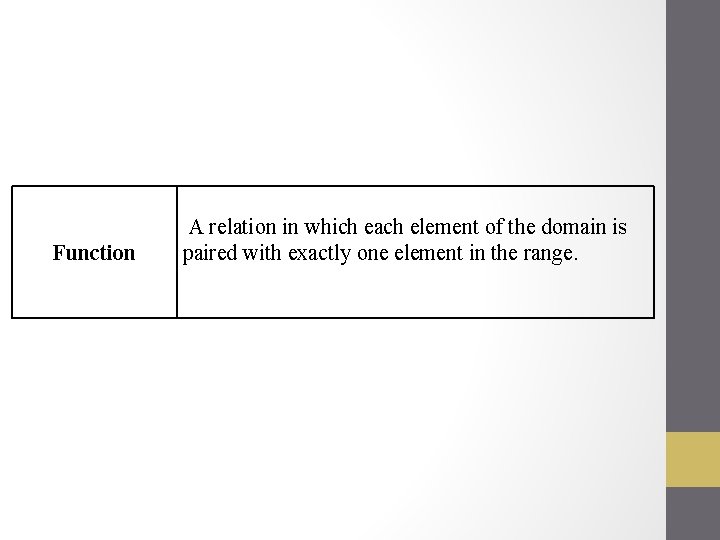
Function A relation in which each element of the domain is paired with exactly one element in the range.
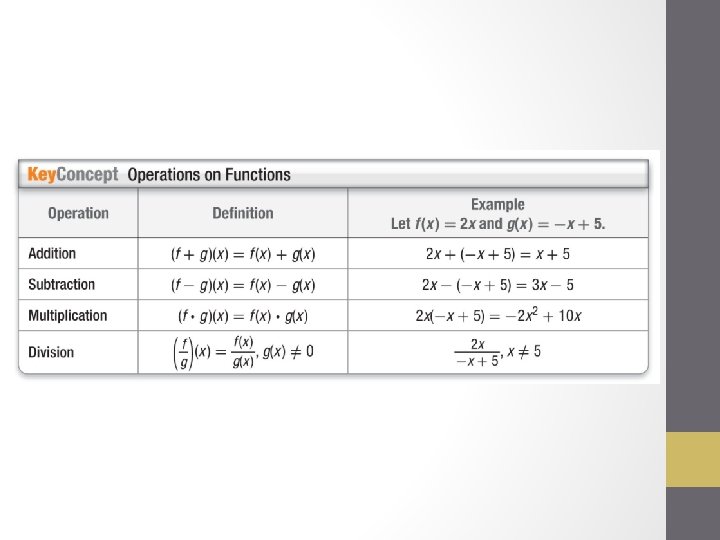
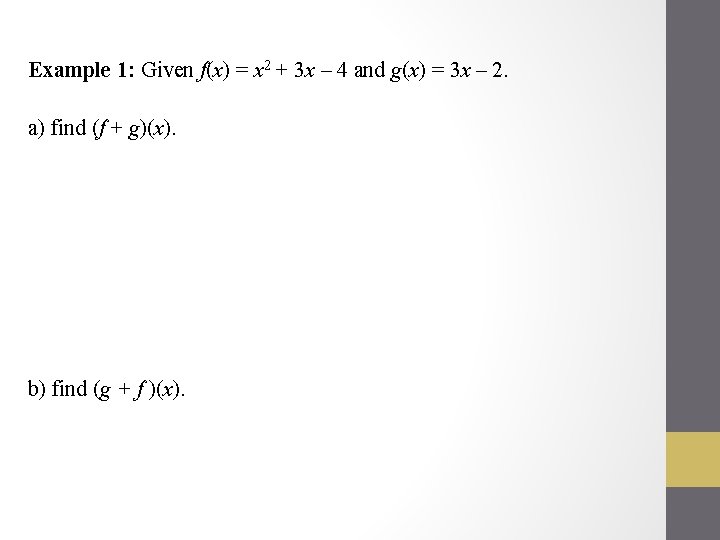
Example 1: Given f(x) = x 2 + 3 x – 4 and g(x) = 3 x – 2. a) find (f + g)(x). b) find (g + f )(x).
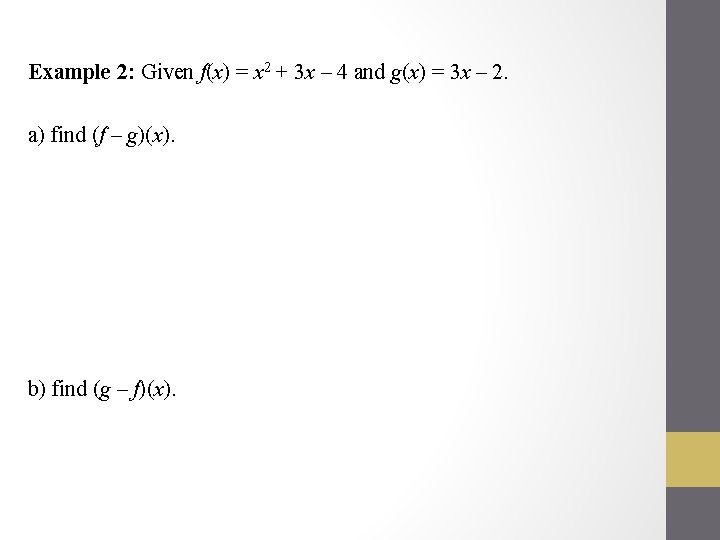
Example 2: Given f(x) = x 2 + 3 x – 4 and g(x) = 3 x – 2. a) find (f – g)(x). b) find (g – f)(x).
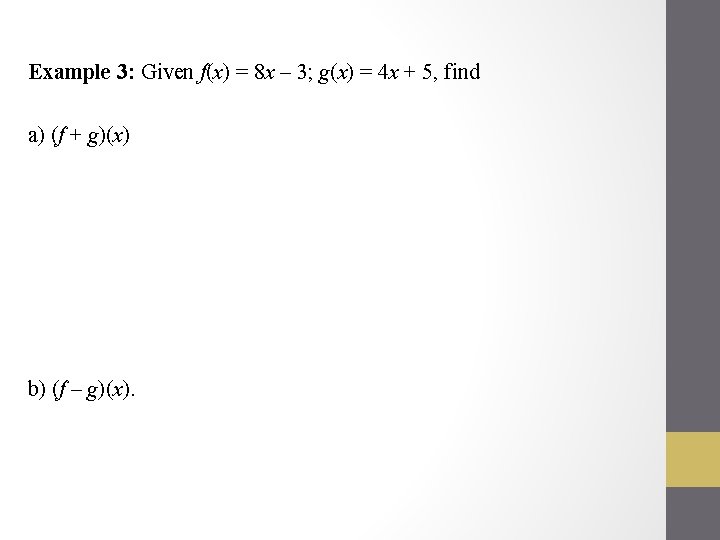
Example 3: Given f(x) = 8 x – 3; g(x) = 4 x + 5, find a) (f + g)(x) b) (f – g)(x).
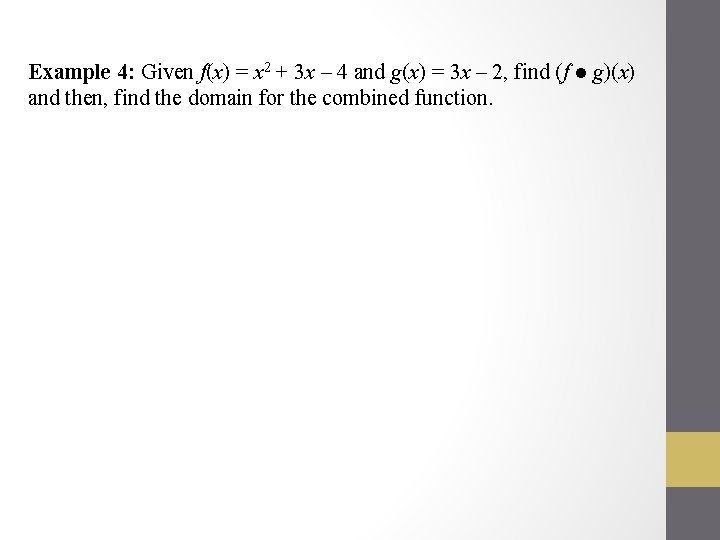
Example 4: Given f(x) = x 2 + 3 x – 4 and g(x) = 3 x – 2, find (f ● g)(x) and then, find the domain for the combined function.
Example 5: Given f(x) = 3 x 2 – 2 x + 1 and g(x) = x – 4, find (f ● g)(x) and then, find the domain for the combined function.
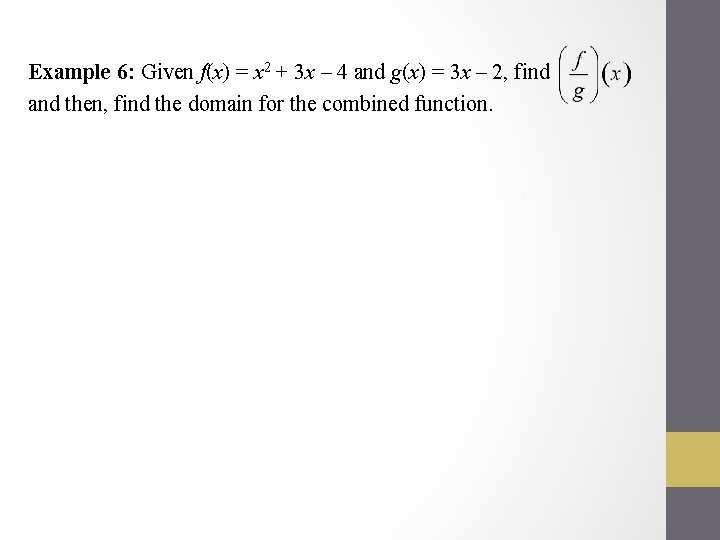
Example 6: Given f(x) = x 2 + 3 x – 4 and g(x) = 3 x – 2, find and then, find the domain for the combined function.
Example 7: Given f(x) = 2 x 2 + 3 x – 1 and g(x) = x + 2, find the following and then, find the domain for each combined function a) (f ● g)(x).
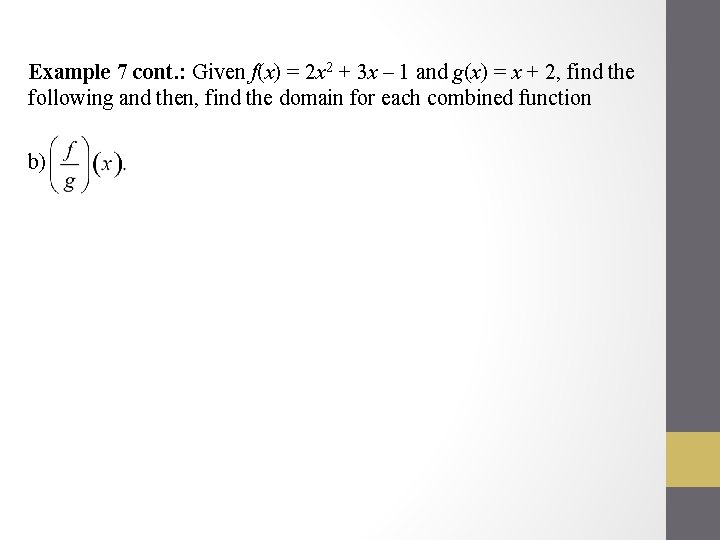
Example 7 cont. : Given f(x) = 2 x 2 + 3 x – 1 and g(x) = x + 2, find the following and then, find the domain for each combined function b)
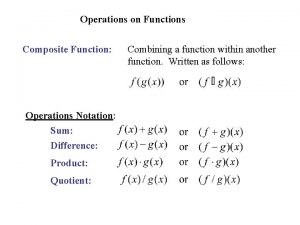
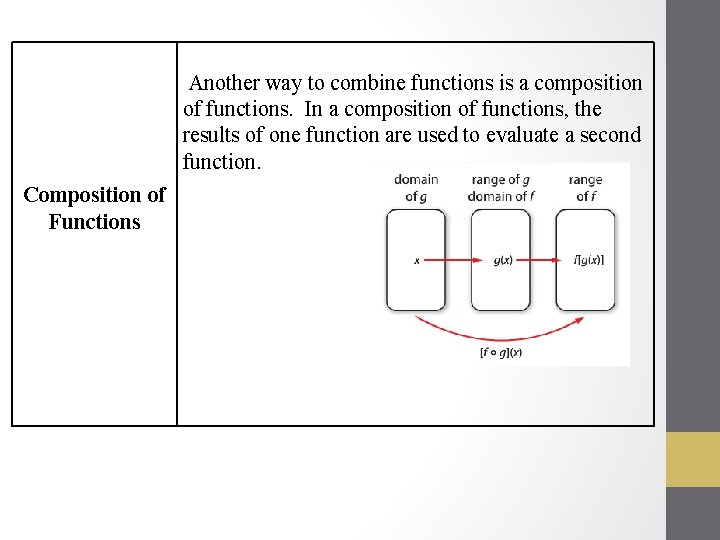
Another way to combine functions is a composition of functions. In a composition of functions, the results of one function are used to evaluate a second function. Composition of Functions
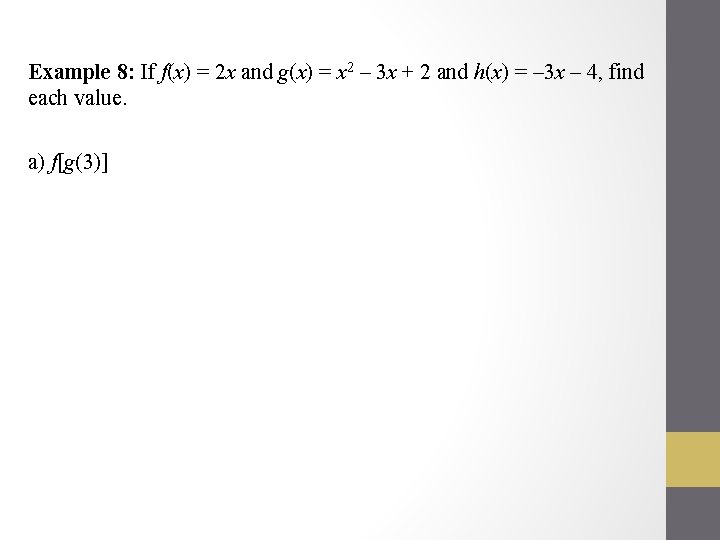
Example 8: If f(x) = 2 x and g(x) = x 2 – 3 x + 2 and h(x) = – 3 x – 4, find each value. a) f[g(3)]
Example 8 cont. : If f(x) = 2 x and g(x) = x 2 – 3 x + 2 and h(x) = – 3 x – 4, find each value. b) g[h(– 2)]
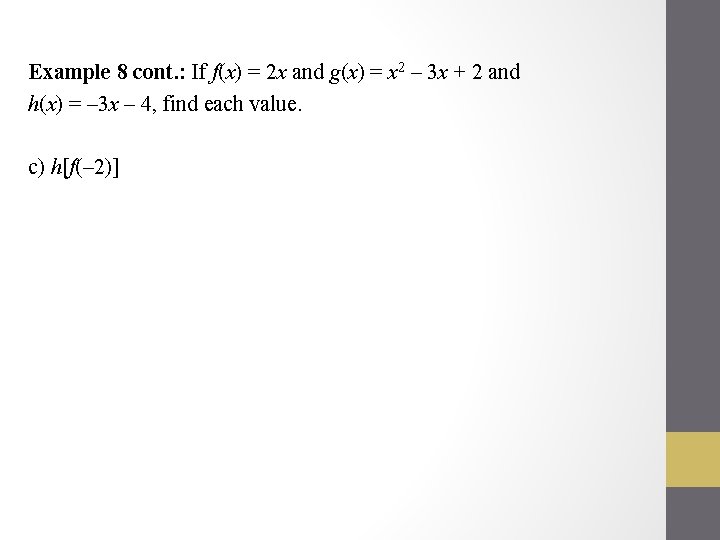
Example 8 cont. : If f(x) = 2 x and g(x) = x 2 – 3 x + 2 and h(x) = – 3 x – 4, find each value. c) h[f(– 2)]
Example 9: Find [f ○ g](x) and [g ○ f](x) for f(x) = x 2 – 1 and g(x) = – 4 x 2. State the domain for each combined function.
Example 10: Find [f ○ g](x) and [g ○ f](x) for f(x) = x 2 + 2 x and g(x) = x – 9. State the domain for each combined function.
Example 11: Find [f ○ g](x) and [g ○ f](x) for f(x) = 5 x + 4 and g(x) = 3 – x. State the domain for each combined function.