Sanjay Gandhi institute of dairy technology Name Nidhesh


- Slides: 13
Sanjay Gandhi institute of dairy technology
Name - Nidhesh Singh • Roll no. -SDT-14/218 • Topic -kefir & kumis • Prof. -Dr. Sonia ma'am
History Of Kefir • � Kefir is viscous, acidic and mildly alcoholic milk beverage ( <2%) • � The word kefir is said to have originated from the Turkish word "Keif" which means "good feeling“. • � Kefir dates back many centuries to the shepherds of the Caucasus Mountains who carried milk stored in leather pouches where it would ferment into fizzy sour yoghurt. • � Elie Metchnikoff, a Nobel-prize winning biologist at the Pasteur Institute, first suggested that lactobacilli might counteract the putrefactive effects of GI metabolism in 1908. • � He attributed the long and healthy life of the people of the Caucasus Mountains to their consumption of soured milk. � In modern times there's a great deal of interest and research into Probiotics and the health giving properties of
Kefir Grain • > Kefir grains are white or cream colored grains that look rather like cauliflower florets that ferments milk. • > The kefir grain is an inert polysaccharide matrix in which a relatively stable and specific microbial community species coexists in a complex symbiotic relationship. (more than 30 microflora) • > After the fermentation, the grain is recovered and can be reused. • > When culture ferments the milk these structures grow, creating new grains in the process • > Modern Kefir cultures have reduced the yeast fermentation, resulting in less CO 2, ethanol and foam, LAB ACB Yeast Fermented food and beverage of the world
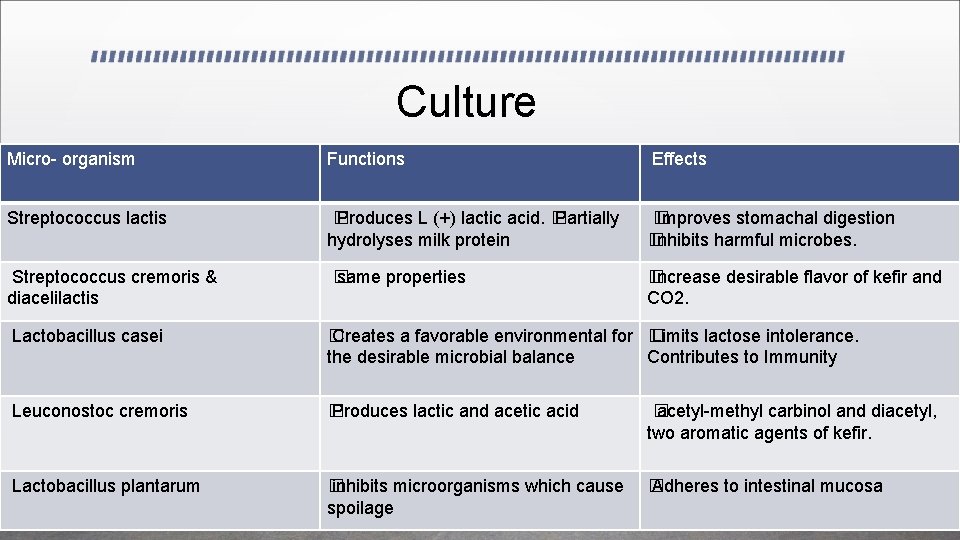
Culture Micro- organism Functions Effects Streptococcus lactis � Produces L (+) lactic acid. � Partially hydrolyses milk protein � Improves stomachal digestion � Inhibits harmful microbes. Streptococcus cremoris & diacelilactis � same properties � Increase desirable flavor of kefir and CO 2. Lactobacillus casei � Creates a favorable environmental for � Limits lactose intolerance. the desirable microbial balance Contributes to Immunity Leuconostoc cremoris � Produces lactic and acetic acid Lactobacillus plantarum � inhibits microorganisms which cause � Adheres to intestinal mucosa spoilage � acetyl-methyl carbinol and diacetyl, two aromatic agents of kefir.
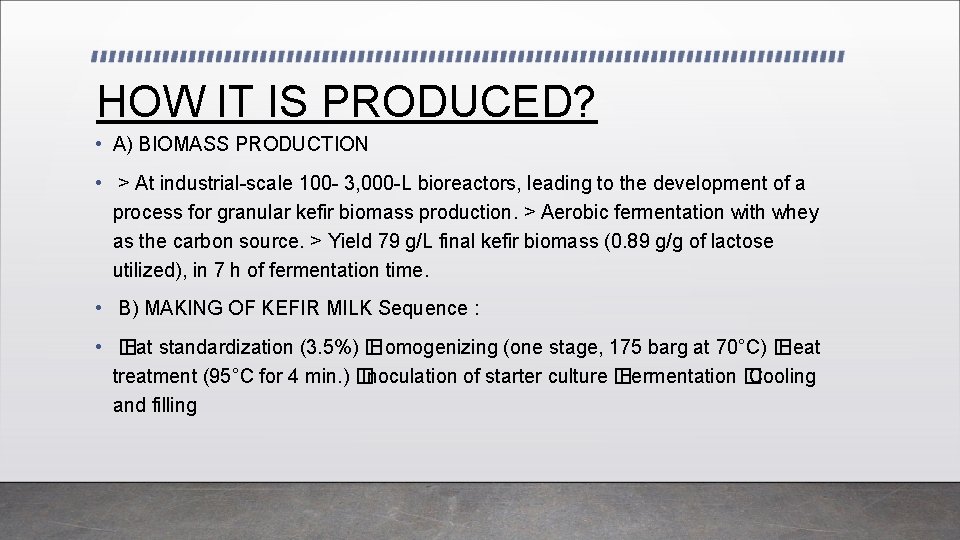
HOW IT IS PRODUCED? • A) BIOMASS PRODUCTION • > At industrial-scale 100 - 3, 000 -L bioreactors, leading to the development of a process for granular kefir biomass production. > Aerobic fermentation with whey as the carbon source. > Yield 79 g/L final kefir biomass (0. 89 g/g of lactose utilized), in 7 h of fermentation time. • B) MAKING OF KEFIR MILK Sequence : • � Fat standardization (3. 5%) � Homogenizing (one stage, 175 barg at 70°C) � Heat treatment (95°C for 4 min. ) � Inoculation of starter culture � Fermentation � Cooling and filling
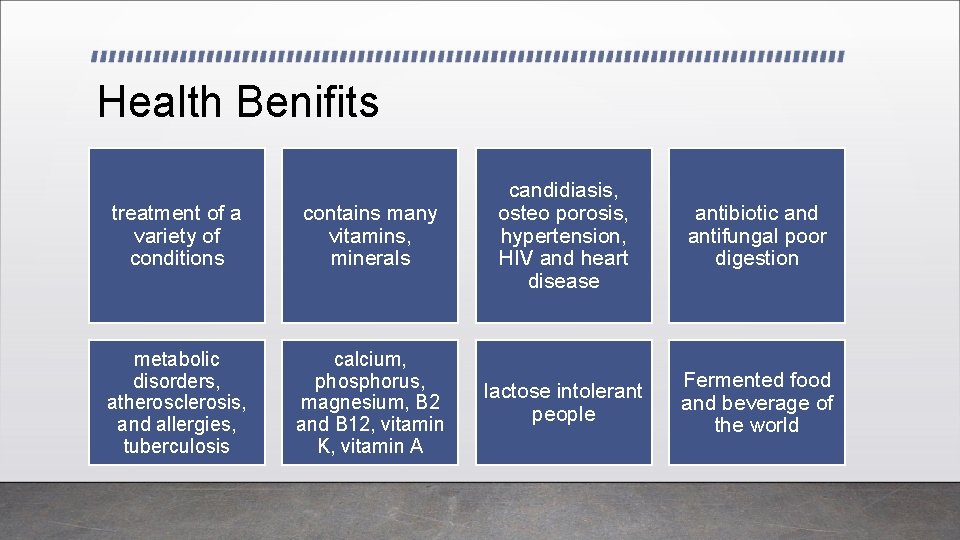
Health Benifits treatment of a variety of conditions contains many vitamins, minerals candidiasis, osteo porosis, hypertension, HIV and heart disease metabolic disorders, atherosclerosis, and allergies, tuberculosis calcium, phosphorus, magnesium, B 2 and B 12, vitamin K, vitamin A lactose intolerant people antibiotic and antifungal poor digestion Fermented food and beverage of the world
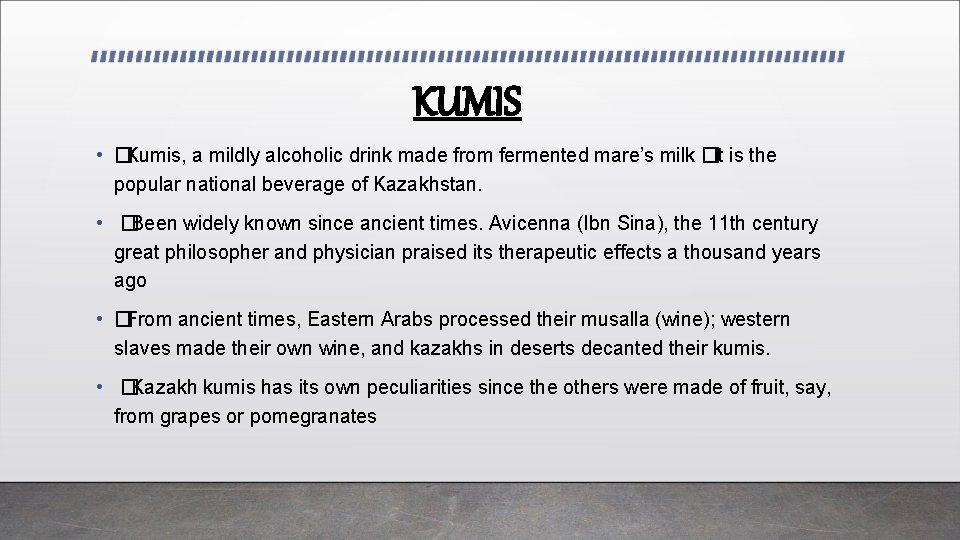
KUMIS • � Kumis, a mildly alcoholic drink made from fermented mare’s milk � It is the popular national beverage of Kazakhstan. • � Been widely known since ancient times. Avicenna (Ibn Sina), the 11 th century great philosopher and physician praised its therapeutic effects a thousand years ago • � From ancient times, Eastern Arabs processed their musalla (wine); western slaves made their own wine, and kazakhs in deserts decanted their kumis. • � Kazakh kumis has its own peculiarities since the others were made of fruit, say, from grapes or pomegranates
• > Mare’s milk contains less casein and fatty matter than cow’s milk. • > Kumis presents a dispersed coagulum giving the product a smoother taste as compared to kefir • > A higher alcohol content (up to 3%) than in kefir. • > Production of higher carbon dioxide levels is also a characteristic of kumis. • > Acetic acid bacteria are not found in kumis • > Kumis is dried and preserved for many seasons • . > In kumis distinctive starters are transferred from one generation to another within families for back-slopping. Fermented food and beverage of the world
Kumis Culture • > Unlike kefir, the culture exist in liquid state. • > It is made by adding the culture to mare's milk while stirring or churning. A) LAB • > Acidification and the final sensorial properties of the product (Ying et al. 2004, Watanabe et al. 2008, Wu et al. 2009) • B) YEAST • �Turn it into a carbonated and mildly alcoholic drink. (Ni et al. 2007, Watanabe et al. 2008). bulgaricum casei plantarumhelveticus S. unisporus K. marxianus S. lactis S. cerevisiae
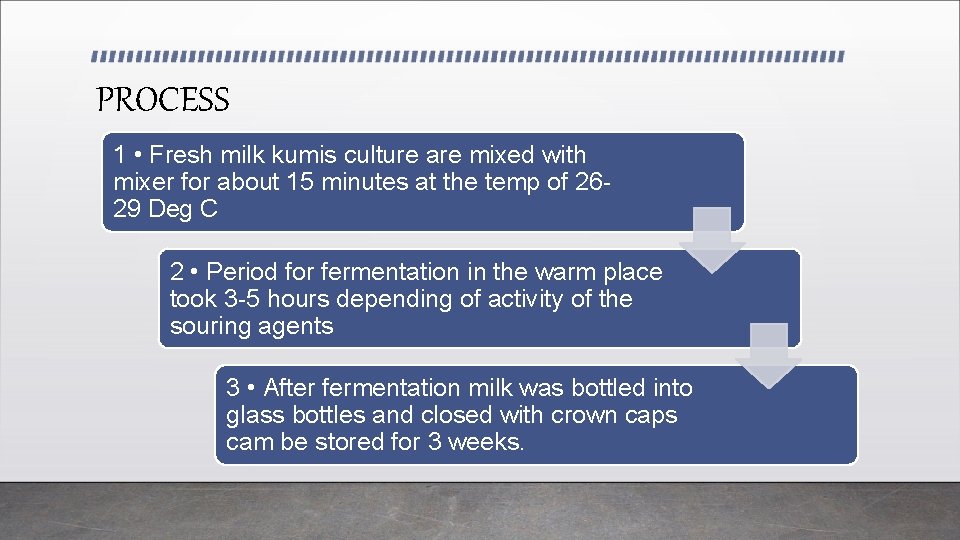
PROCESS 1 • Fresh milk kumis culture are mixed with mixer for about 15 minutes at the temp of 2629 Deg C 2 • Period for fermentation in the warm place took 3 -5 hours depending of activity of the souring agents 3 • After fermentation milk was bottled into glass bottles and closed with crown caps cam be stored for 3 weeks.
Benifits • rich in Antibiotics, vitamins A, B 1, B 2, B 13, D, E, C • Kumis is good in the case of emaciation and anemia. • develops immunity cardiovascular nervous systems • Influence on gastrointestinal tract kidney • beneficial for a range of chronic diseases
• Thanks