SALLE COLLEGE LITERACIES ELT CROSSWORD ACTIVITY INSTRUCTIONS Presented




- Slides: 15
SALLE COLLEGE LITERACIES & ELT CROSSWORD ACTIVITY INSTRUCTIONS. Presented by: Presented to: Jeison Torres. Juan Fernando López Páez. 2020 -1. Alberto Bautte. Daniel Angulo. Julio Cesar Ortiz.
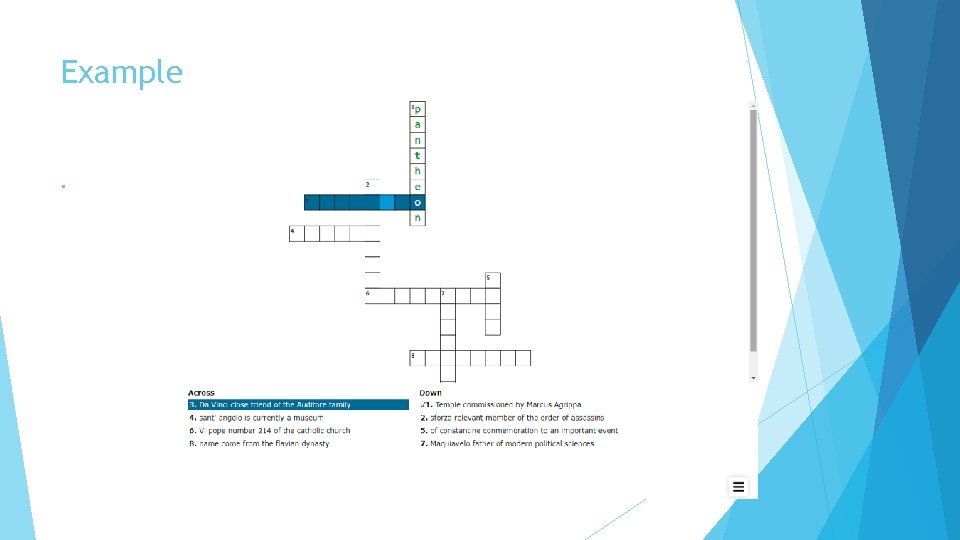
Example ▪
Objective of the activity ▪ To identify the different characters and places presented in the Assassin's Creed videogame in the social studies history class in fifth grade level.
Main Instructions to resolve a crossword online. 1. 2. 3. 4. 5. 6. 7. ▪ ▪ Click a cell on the crossword grid or click a clue. Click twice on a cell to toggle between across and down. The active cell is highlighted in blue. Start typing in the word. Hit enter when you are done typing in the word. The word will turn green or red if you got it right or wrong. You can use the tab and shift-tab keys to move around the crossword, and the arrow keys. Suggestion: Before to start resolving the crossword, please activate the “focus mode” that you will find next to the share button. Timing: 20 Minutes.
Game Context ● The context of this game is centered in the exact moment in which Desmond Miles and its partners achieve to escape from the attack of the templars at the final part of Assassin’s Creed II finding a new place to be safe, it was the Villa Auditore. After a long period of time, Ezio Auditore achieve to leave of the vault and scape of Rome with his uncle Mario Auditore and finally they arrive to Monteriggioni, place in which he is comforted taking into account that the days in which he was a murder have finally finished and because of that decision he decide to start fighting against the corruptions, due to the killers- an organisation in charge to fight against the corruption that perhaps all its experience, they weren't making much of a difference and because of that situation, Ezio achieved to convince Maquiavelo to be able to create a really strong brotherhood to fight against the templars and also with its new enemy: Mr. Cesar Borgia. Info recovered from: https: //es. wikipedia. org/wiki/Assassin%27 s_Creed: _Brotherhood
Real Characters Nicholas Machiavelli Diplomat, political philosopher and Italian writer, considered father of modern Political Science, known for his famous phrase "The end justifies the means", and for his book "The Prince", whose inspiration was born from the Politician Cesar de Borja, son of Pope Alexander VI, Rodrigo de Borja, in which he exposes the fundamental methods to found a State; seize power, or maintain it, oblivious to moral or religious considerations.
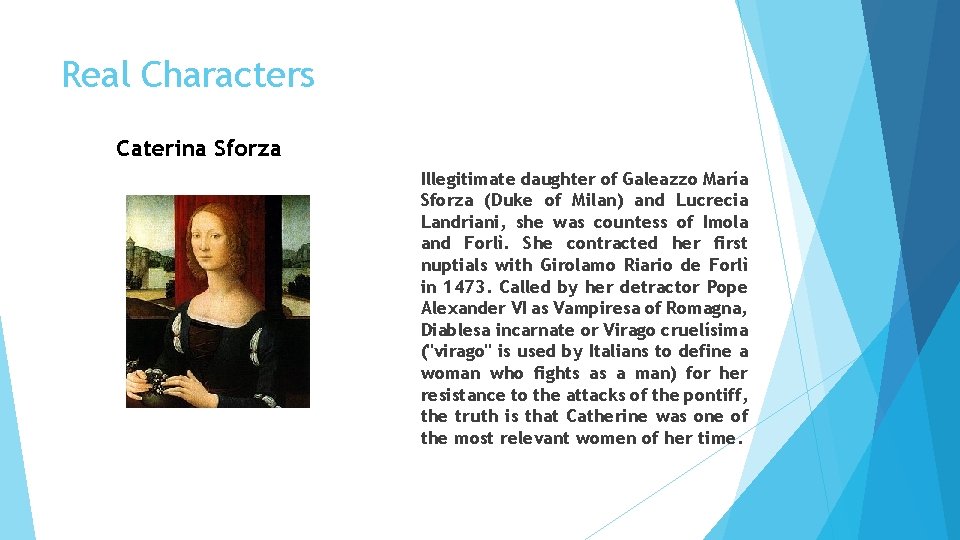
Real Characters Caterina Sforza Illegitimate daughter of Galeazzo María Sforza (Duke of Milan) and Lucrecia Landriani, she was countess of Imola and Forlì. She contracted her first nuptials with Girolamo Riario de Forlì in 1473. Called by her detractor Pope Alexander VI as Vampiresa of Romagna, Diablesa incarnate or Virago cruelísima ("virago" is used by Italians to define a woman who fights as a man) for her resistance to the attacks of the pontiff, the truth is that Catherine was one of the most relevant women of her time.
Real Characters Leonardo Da Vinci He was a Florentine polymath of the Italian Renaissance. He was at the same time a painter, anatomist, architect, paleontologist, artist, botanist, scientist, writer, sculptor, philosopher, engineer, inventor, musician, poet and urban planner. Frequently described as an archetype and symbol of Renaissance man, a universal genius, as well as a humanist philosopher whose infinite curiosity can only be matched by his inventive capacity, Leonardo da Vinci is considered one of the greatest painters of all time and probably the person with the highest number of talents in multiple disciplines that has ever existed.
Real Characters Alexander VI (Rodrigo de Borja) Alexander VI was the Pope No. 214 of the Catholic Church between 1492 and 1503. Rodrigo de Borja achieved power through nepotism and held it for several years, due to the simony he practiced (which is the claim of the purchase or sale of the spiritual by means of material goods); until in 1503 he dies, due to a possible poisoning that was not directed at him, planned by César, his son, to kill diners.
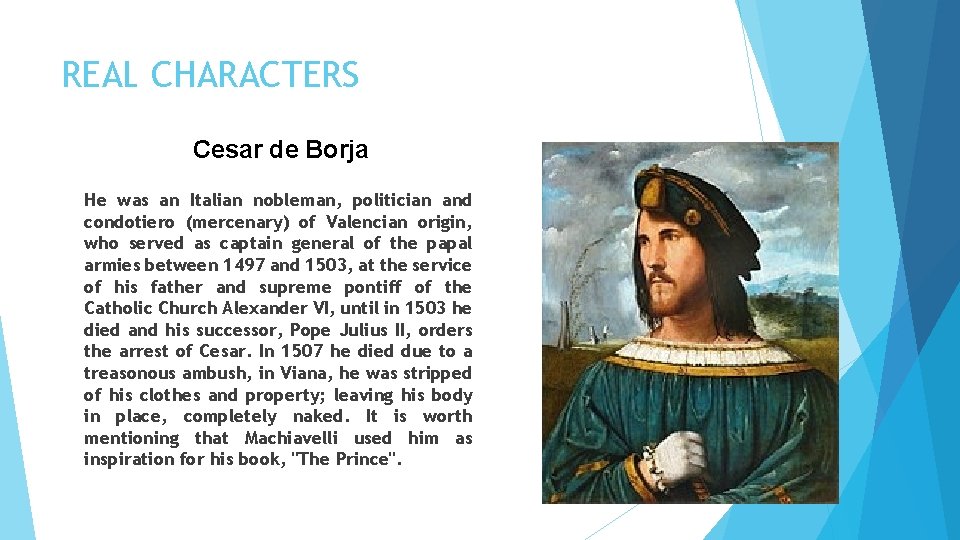
REAL CHARACTERS Cesar de Borja He was an Italian nobleman, politician and condotiero (mercenary) of Valencian origin, who served as captain general of the papal armies between 1497 and 1503, at the service of his father and supreme pontiff of the Catholic Church Alexander VI, until in 1503 he died and his successor, Pope Julius II, orders the arrest of Cesar. In 1507 he died due to a treasonous ambush, in Viana, he was stripped of his clothes and property; leaving his body in place, completely naked. It is worth mentioning that Machiavelli used him as inspiration for his book, "The Prince".
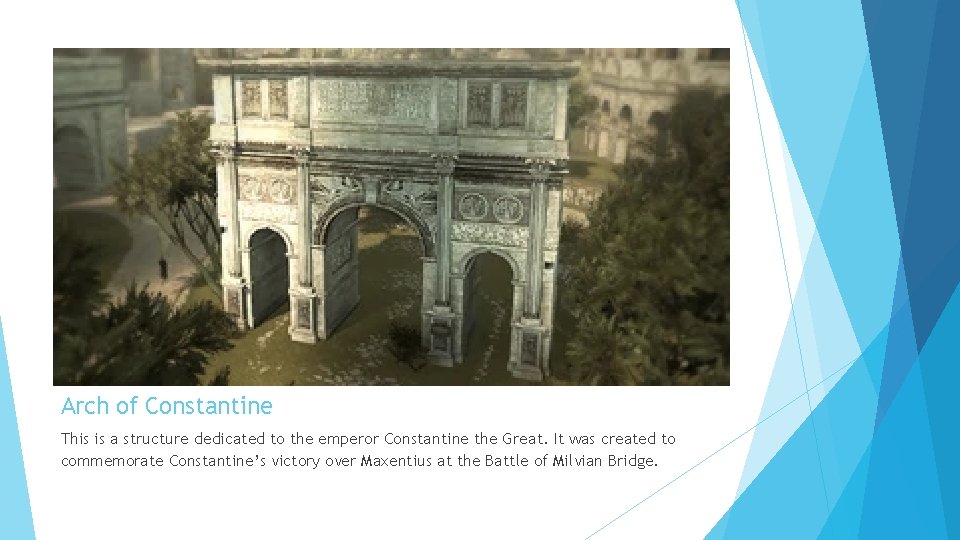
Arch of Constantine This is a structure dedicated to the emperor Constantine the Great. It was created to commemorate Constantine’s victory over Maxentius at the Battle of Milvian Bridge.
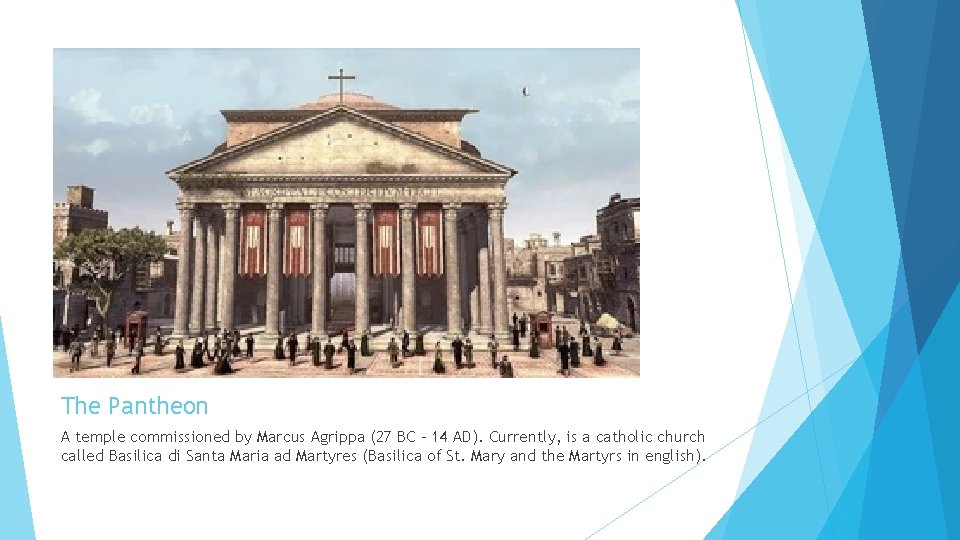
The Pantheon A temple commissioned by Marcus Agrippa (27 BC – 14 AD). Currently, is a catholic church called Basilica di Santa Maria ad Martyres (Basilica of St. Mary and the Martyrs in english).
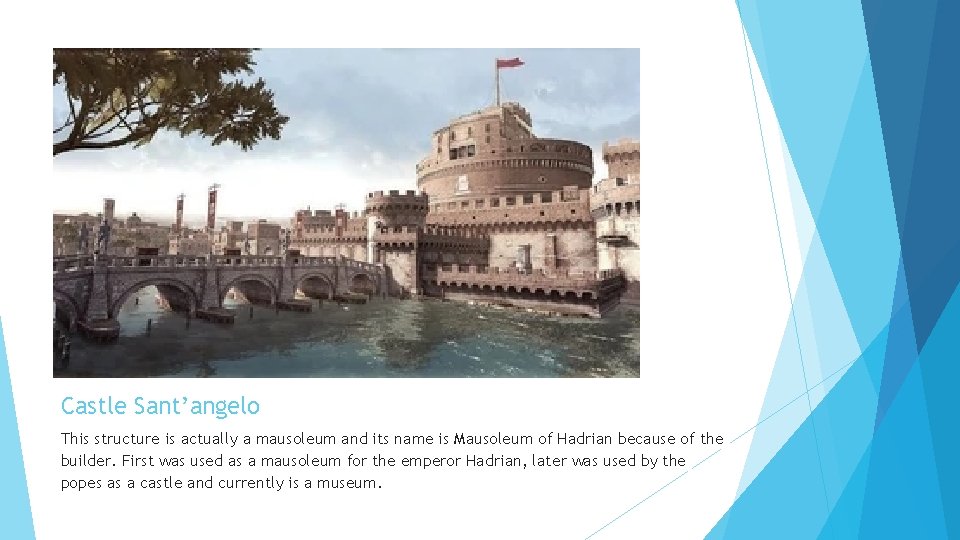
Castle Sant’angelo This structure is actually a mausoleum and its name is Mausoleum of Hadrian because of the builder. First was used as a mausoleum for the emperor Hadrian, later was used by the popes as a castle and currently is a museum.
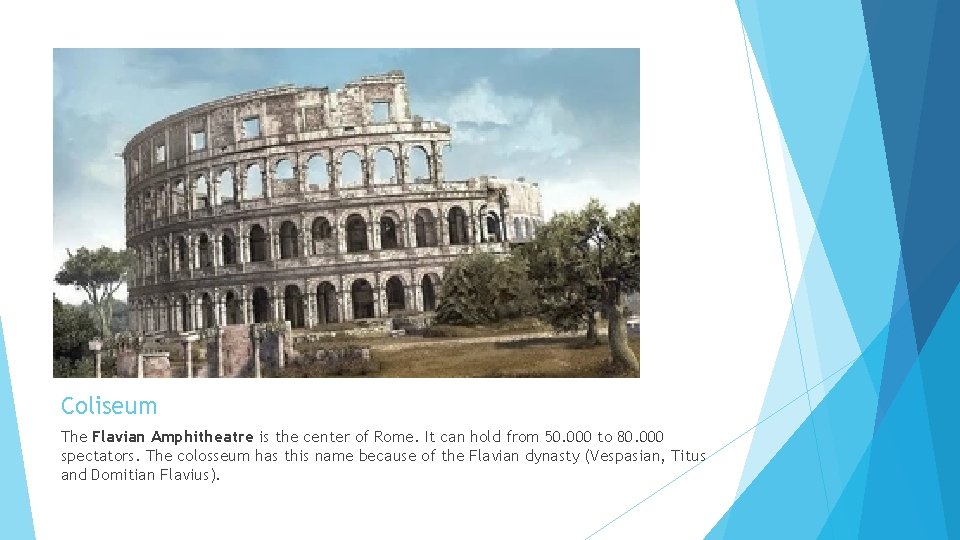
Coliseum The Flavian Amphitheatre is the center of Rome. It can hold from 50. 000 to 80. 000 spectators. The colosseum has this name because of the Flavian dynasty (Vespasian, Titus and Domitian Flavius).