RMIT Classification Trusted Decisionmaking with data Week 2



- Slides: 25
RMIT Classification: Trusted — Decision-making with data Week 2 Additional information to go here
RMIT Classification: Trusted What did we learn last week? • Information is the outcome of data collection and analysis. • Business analytics is an approach to decisionmaking that is informed by analysis of quantitative data
RMIT Classification: Trusted — Learning Objective — • • • Examine the importance of decision making for managers at each of the three primary organization levels along with the associated decision characteristics To learn how to make the best use of data, analysis and systematic reasoning to make better business decisions. To identify the hidden traps that typically prevent us from making good decisions. To learn how to frame a problem To reflect on the data-driven decision-making processes
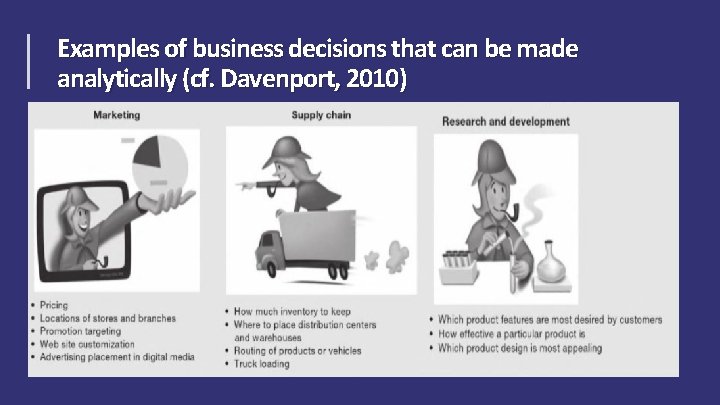
RMIT Classification: Trusted Examples of business decisions that can be made analytically (cf. Davenport, 2010)
RMIT Classification: Trusted Decision and intuition • • • It’s not uncommon for managers to rely on intuition and ‘golden gut’ to make decisions. Research suggests that 40% of major decisions are based on manager’s gut (and not facts)! “the unexamined decision isn’t worth making” (Davenport et al. , 2010, p 2)
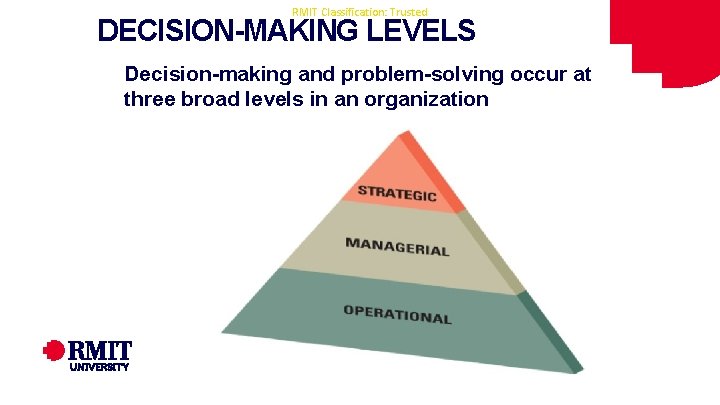
RMIT Classification: Trusted DECISION-MAKING LEVELS Decision-making and problem-solving occur at three broad levels in an organization
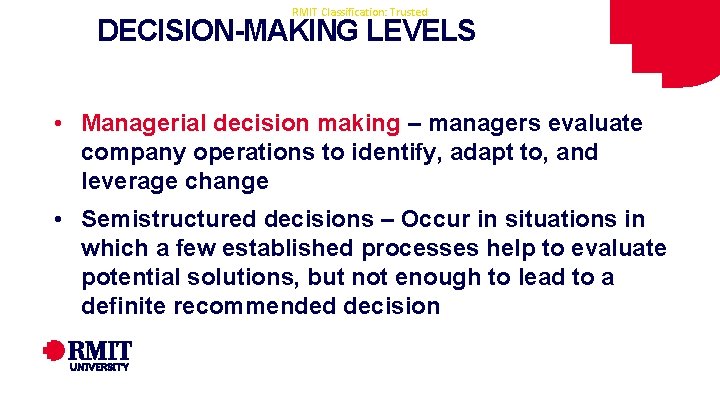
RMIT Classification: Trusted DECISION-MAKING LEVELS • Strategic decision making – Managers develop overall strategies, goals, and objectives • Unstructured decisions – Occurs in situations in which no procedures or rules exist to guide decision makers toward the correct choice
RMIT Classification: Trusted Watch the video clip: https: //youtu. be/sngng. UJBQSA
RMIT Classification: Trusted DECISION-MAKING LEVELS • Managerial decision making – managers evaluate company operations to identify, adapt to, and leverage change • Semistructured decisions – Occur in situations in which a few established processes help to evaluate potential solutions, but not enough to lead to a definite recommended decision
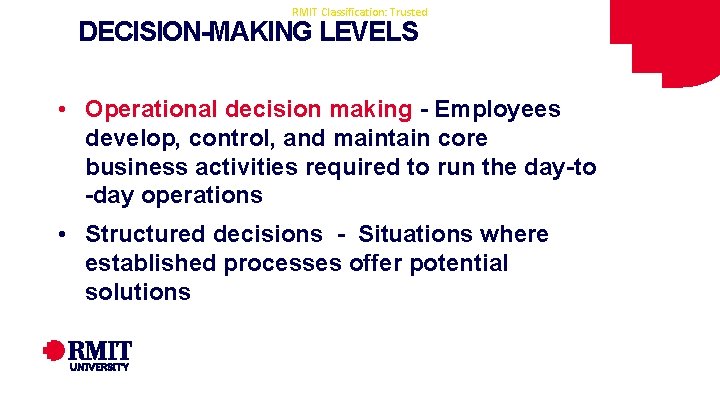
RMIT Classification: Trusted DECISION-MAKING LEVELS • Operational decision making - Employees develop, control, and maintain core business activities required to run the day-to -day operations • Structured decisions - Situations where established processes offer potential solutions
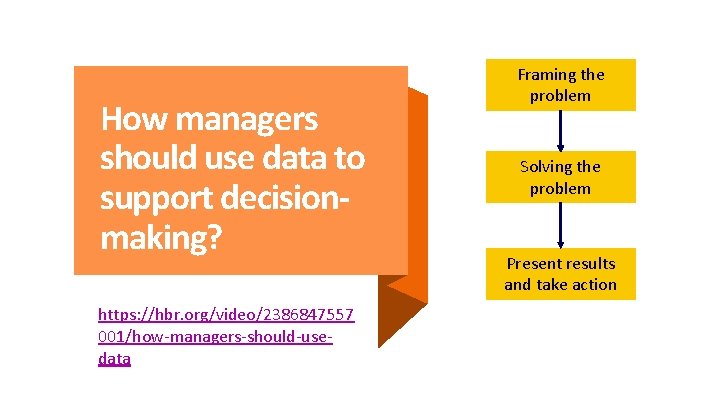
RMIT Classification: Trusted How managers should use data to support decisionmaking? https: //hbr. org/video/2386847557 001/how-managers-should-usedata Framing the problem Solving the problem Present results and take action
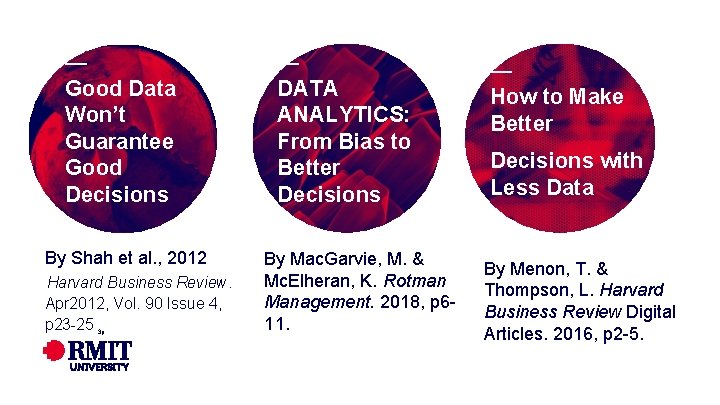
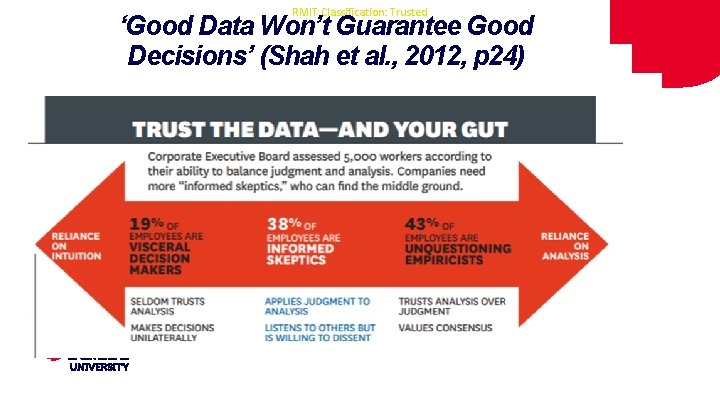
RMIT Classification: Trusted — Good Data Won’t Guarantee Good Decisions By Shah et al. , 2012 Harvard Business Review. . Apr 2012, Vol. 90 Issue 4, p 23 -25. 3 p. — DATA ANALYTICS: From Bias to Better Decisions By Mac. Garvie, M. & Mc. Elheran, K. Rotman Management. 2018, p 611. — How to Make Better Decisions with Less Data By Menon, T. & Thompson, L. Harvard Business Review Digital Articles. 2016, p 2 -5.
RMIT Classification: Trusted ‘Good Data Won’t Guarantee Good Decisions’ (Shah et al. , 2012, p 24)
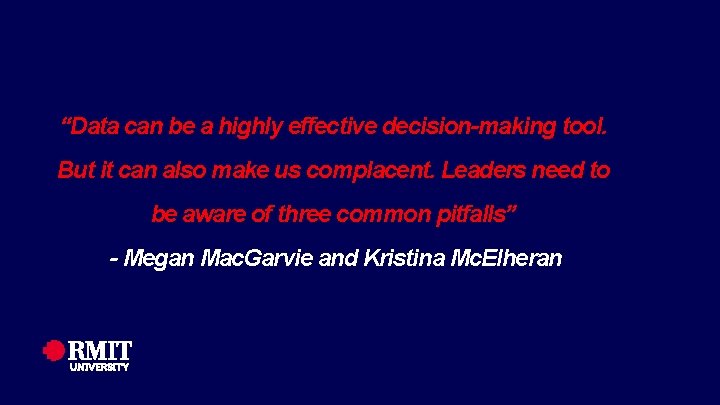
RMIT Classification: Trusted “Data can be a highly effective decision-making tool. But it can also make us complacent. Leaders need to be aware of three common pitfalls” - Megan Mac. Garvie and Kristina Mc. Elheran
RMIT Classification: Trusted The hidden traps in decision-making • • For executives, success often depends on the many decisions they make. Whilst data analytics support business decision making, the main obstacle for good decision making could be that people are unaware of their own biases. Remember the best defence is always awareness. What are some of the most common decision traps that as humans we are likely to fall into?
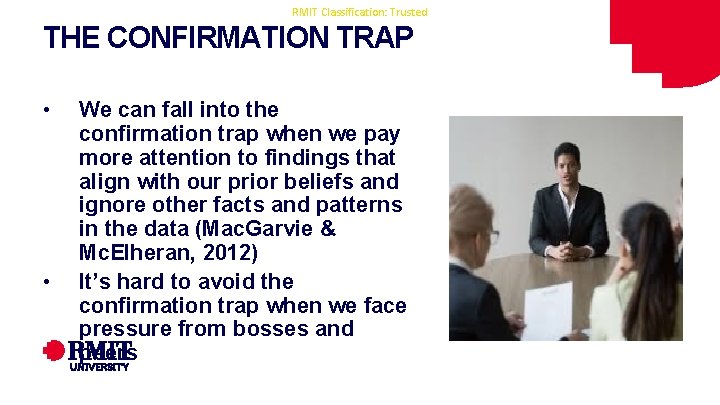
RMIT Classification: Trusted THE CONFIRMATION TRAP • • We can fall into the confirmation trap when we pay more attention to findings that align with our prior beliefs and ignore other facts and patterns in the data (Mac. Garvie & Mc. Elheran, 2012) It’s hard to avoid the confirmation trap when we face pressure from bosses and peers
RMIT Classification: Trusted HOW TO AVOID THE CONFIRMATION TRAP? • • List out all the reasons that support your case and then imagine each one of them is wrong Seek help from peers/colleagues Find a devil’s advocate. Frame your ideas in a different way to help you disapprove them.
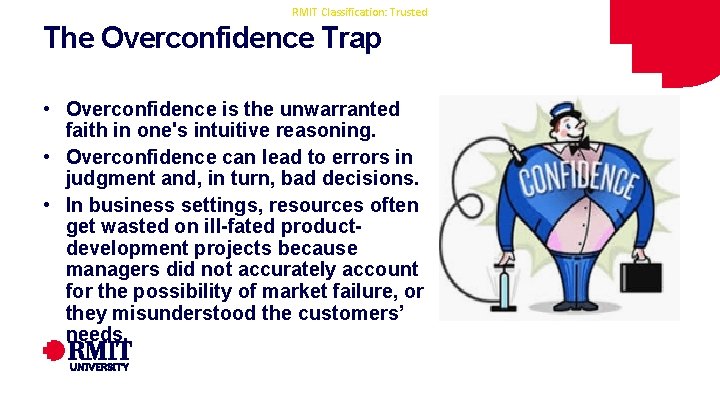
RMIT Classification: Trusted The Overconfidence Trap • Overconfidence is the unwarranted faith in one's intuitive reasoning. • Overconfidence can lead to errors in judgment and, in turn, bad decisions. • In business settings, resources often get wasted on ill-fated productdevelopment projects because managers did not accurately account for the possibility of market failure, or they misunderstood the customers’ needs.
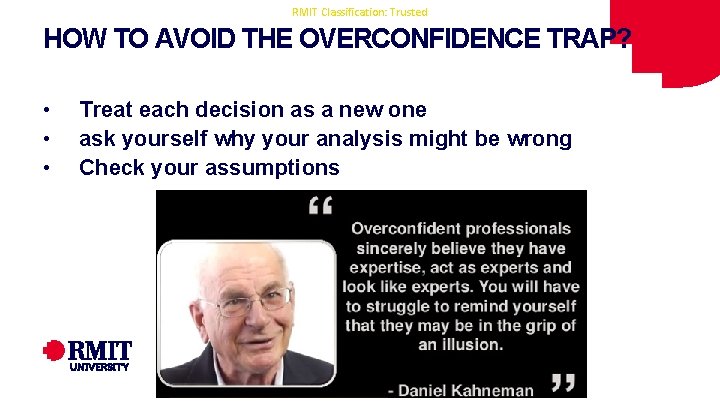
RMIT Classification: Trusted HOW TO AVOID THE OVERCONFIDENCE TRAP? • • • Treat each decision as a new one ask yourself why your analysis might be wrong Check your assumptions
RMIT Classification: Trusted Availability Bias • The availability heuristic is a mental shortcut that happens when people make judgments about the probability of events by how easy it is to think of examples. • A reason for availability bias: Recalling positive feedback is easier than negative feedback.
RMIT Classification: Trusted HOW TO AVOID FALLING INTO THE AVAILABILITY TRAP? • • • Think about why Be sure you do your research Look for contrary examples Ask for opinions Be wary of the media
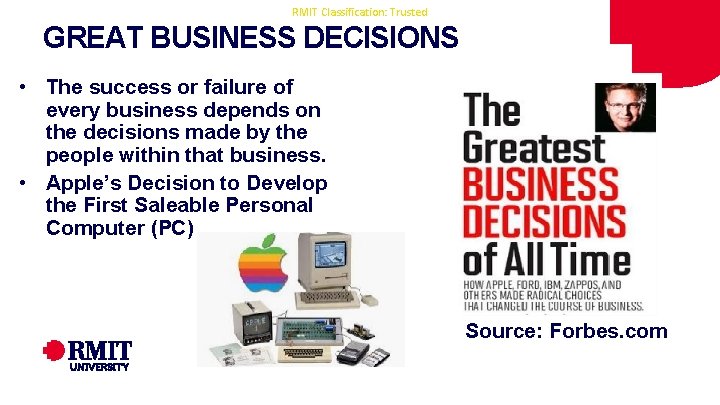
RMIT Classification: Trusted GREAT BUSINESS DECISIONS • The success or failure of every business depends on the decisions made by the people within that business. • Apple’s Decision to Develop the First Saleable Personal Computer (PC) Source: Forbes. com
RMIT Classification: Trusted ‘How to Make Better Decisions with Less Data? ’ • • • Menon and Thompson (2016) asked 83 executives how much they estimated that their companies wasted on relentless analytics on a daily basis. They reported a whopping $7, 731 per day — $2, 822, 117 per year! Employees fall into the “garbage-can decision making” !
RMIT Classification: Trusted Use Data DIET approach to curb garbagecan decision making • • Define - the problem (without proposing solutions) from different perspectives — the customer, the supplier, and the competitor, Integrate - analyze how your problem and data � together, break down your hidden assumptions. Explore – engage in a collaborative exploration process, Test - design tests to see if your plan forward will work.
RMIT Classification: Trusted Data-driven decisions “to frame the decision, asking questions about the data and the methodology, working to understand the results, and using them to improve outcomes for your organization. ” ― Davenport, Thomas H. Next week: we’ll examine business research in more detail