
Illuminating the Dark Metabolome Associate Professor Oliver A
Illuminating the Dark Metabolome Associate Professor Oliver A. H. Jones RMIT University
What is the Dark Metabolome • “all the metabolites present in a system that are either not extracted and/or not seen using standard analytical methods, or are lost/transformed during extraction”.
Why do you think we don’t see metabolites? Metabolite Numbers • The latest version of the Human Metabolome Database (version 4. 0) lists 114, 100 individual entries (~threefold increase from version 3. 0. • Includes large quantities of predicted MS/MS and GC-MS reference spectral data as well as predicted (physiologically feasible) metabolite structures. • Actual number of human metabolites could be higher. • Not counting anthropogenic compounds (e. g. pollutants) • How many do you identify in your metabolomics studies?
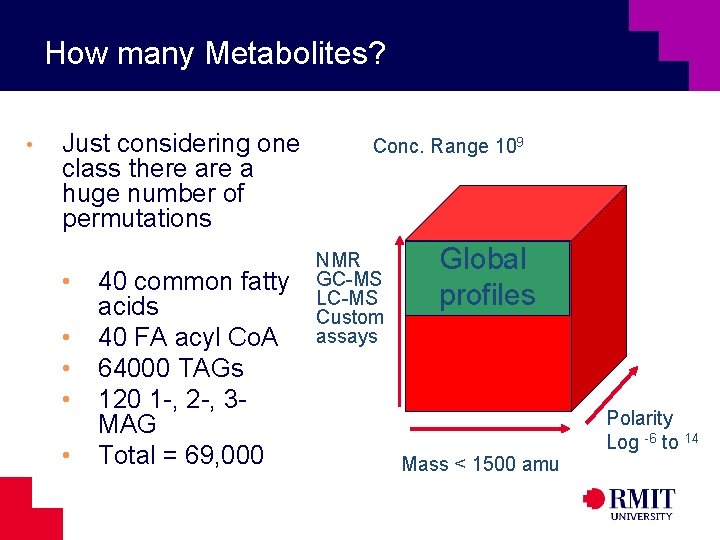
How many Metabolites? • Just considering one class there a huge number of permutations • • • 40 common fatty acids 40 FA acyl Co. A 64000 TAGs 120 1 -, 2 -, 3 - MAG Total = 69, 000 Conc. Range 109 NMR GC-MS LC-MS Custom assays Global profiles Mass < 1500 amu Polarity Log -6 to 14
Why do you think we don’t see metabolites? Metabolite Extraction • Do we extract all metabolites present? • Do we see and/or identify all the metabolites that we extract? – Some metabolites transformed in extraction • “What happens to metabolites bound to proteins or lipids, or those that are sensitive to light, heat or organic solvents? ”
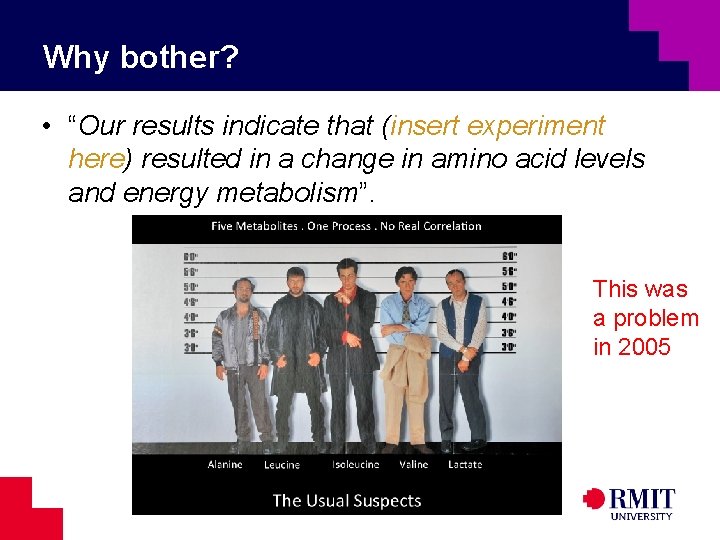
Why bother? • “Our results indicate that (insert experiment here) resulted in a change in amino acid levels and energy metabolism”. This was a problem in 2005
So we need to extract and identify more metabolites and we need to do it without altering them. How?
Reinvigorate old technology • NMR is a main stay of Metabolomics but has sensitivity issues • Dynamic Nuclear Polarization (DNP) is technique that can be used to enhance the sensitivity of NMR by combining electron paramagnetic resonance phenomena with NMR experiments
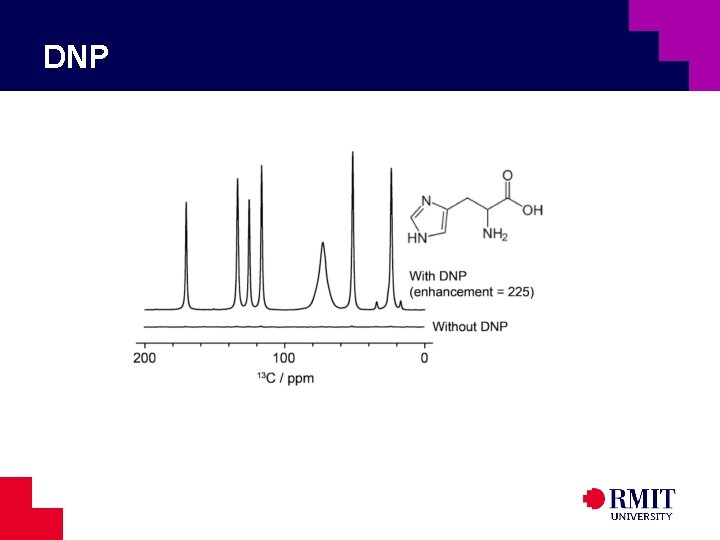
DNP
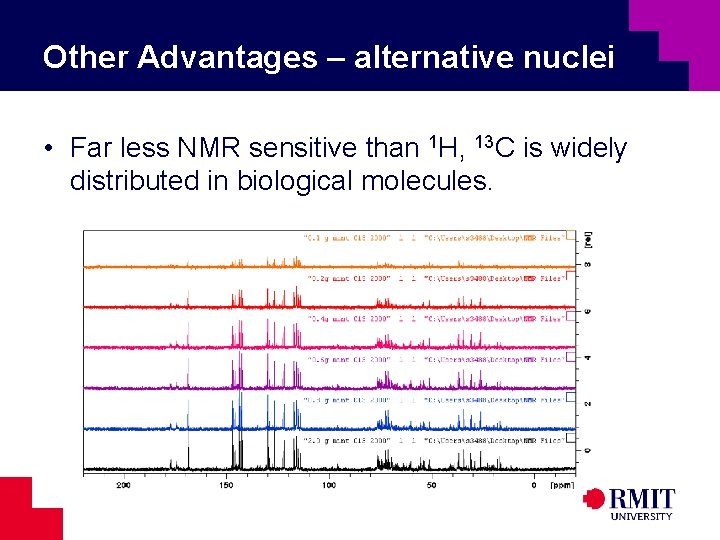
Other Advantages – alternative nuclei • Far less NMR sensitive than 1 H, 13 C is widely distributed in biological molecules.
31 P • Less NMR sensitive than the hydrogen and fluorine nuclei but more sensitive than 13 C. • Phosphorus is well distributed in biological systems and plays a role in several important biological processes, including energy metabolism, • 31 P NMR yields sharp lines and has a wide chemical shift range and thus has featured in some metabolism studies, for example environmental toxicology.
Problems • DNP is carried out at very low temperatures (100 K or -173. 15 o. C) • Relies on the use of polarising agents such as 1(TEMPO-4 -oxy)-3 -(TEMPO-4 -amino)propan-2 -ol (TOTAPOL) as a source of unpaired electrons • But increasingly it is being carried out cheaply and at higher temperatures
Problems • Another option is to create new polarising agents. • New lipophilic biradicals based on a cholesterol scaffold could be used, for example, to obtain homogenous DNP enhancement throughout a lipid bilayer and any metabolites attached to it in situ.
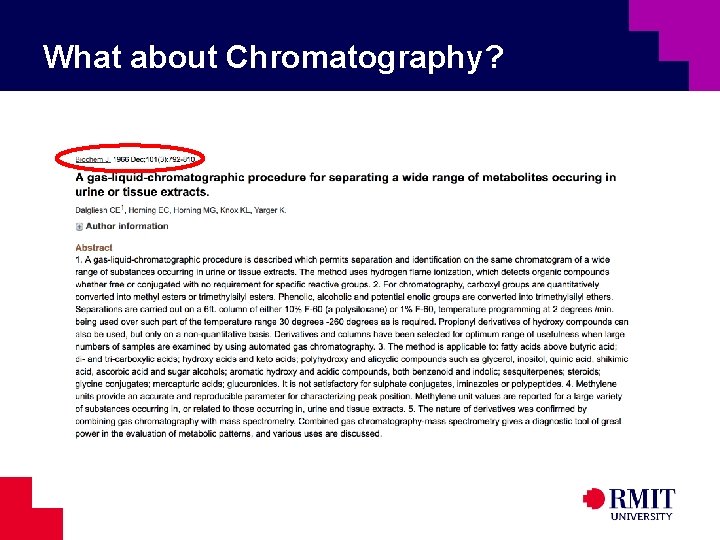
What about Chromatography?
What about HPLC • Liquid chromatography, with the detection of over 1000 compounds being reported in certain sample types. • The theoretical maximum peak capacity for conventional liquid chromatography is ~1500 • The use of very long columns is also required for such detailed analysis, long run times of hours or even days are often required.
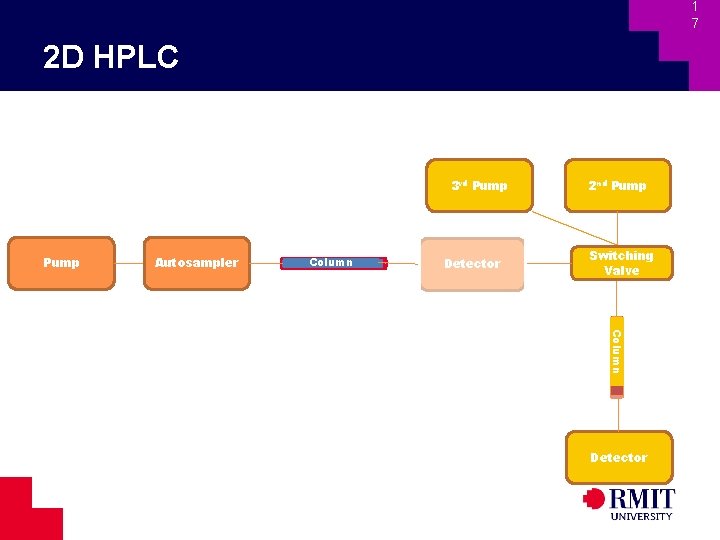
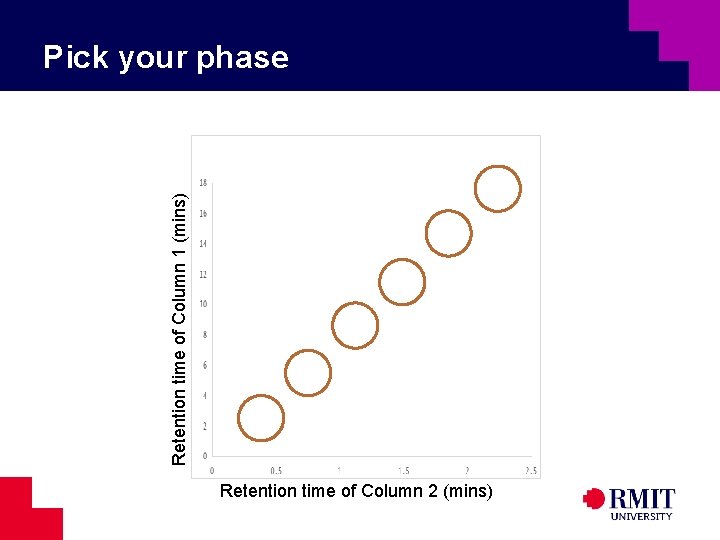
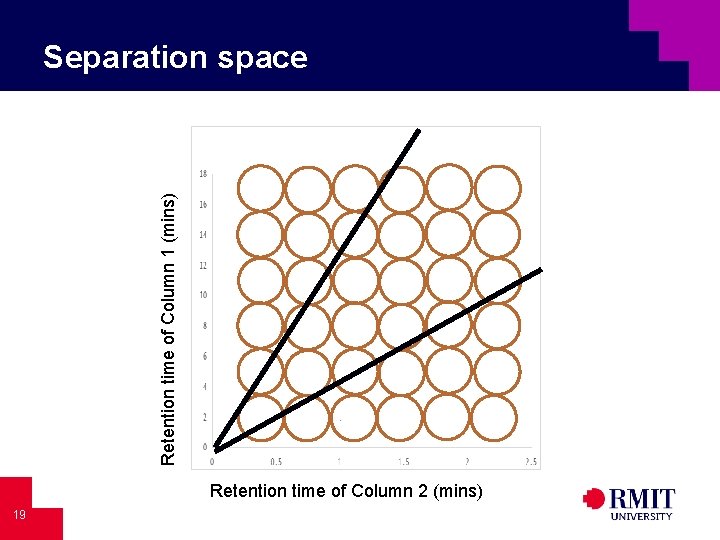
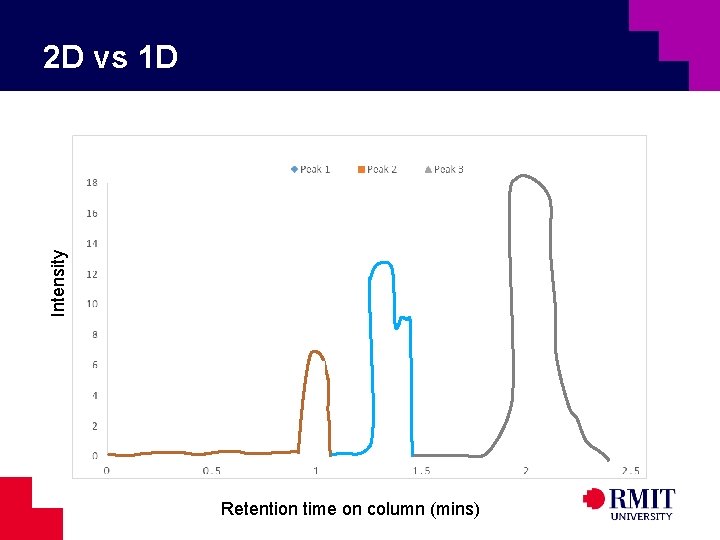
What else could be used? • 2 D HPLC involves coupling two columns, with uncorrelated retention mechanisms (orthogonal), in series • During the analysis fractions are collected from the first dimension and injected in the second dimension • The total peak capacity of the system is thus the product of the peak capacity of each dimension (almost) • Can heart-cut specific fractions of interest
1 7 2 D HPLC 3 rd Pump Autosampler Column Detector 2 nd Pump Switching Valve Column Detector
Retention time of Column 1 (mins) Pick your phase Retention time of Column 2 (mins)
Retention time of Column 1 (mins) Separation space Retention time of Column 2 (mins) 19
Intensity 2 D vs 1 D Retention time on column (mins)
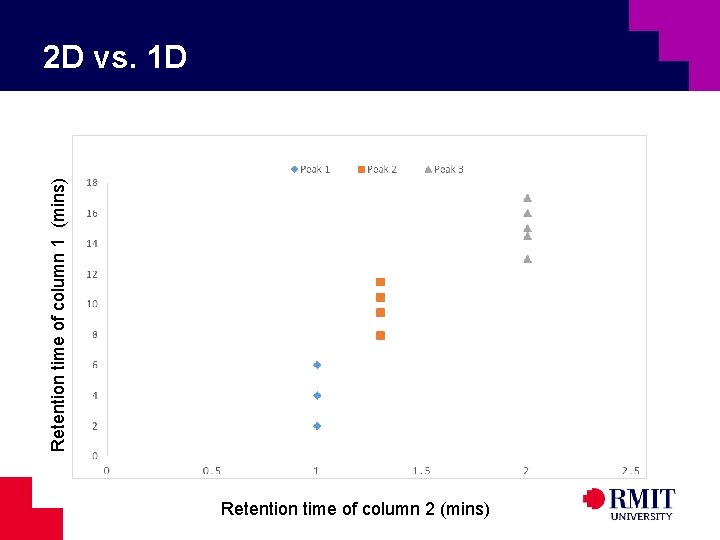
Retention time of column 1 (mins) 2 D vs. 1 D Retention time of column 2 (mins)
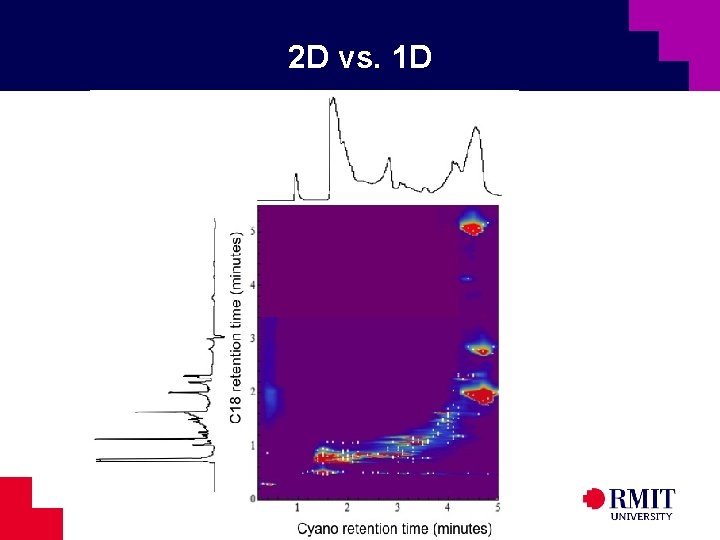
2 D vs. 1 D
Advantages of 2 D HPLC • Increase separation space • Increase in total peak capacity (1500*1500 = 225, 000 - 114, 100 = 110, 900 ‘spare’ capacity) • Increase in efficiency and resolution • Can we predict structure from retention time • Interesting chemistry to be explored
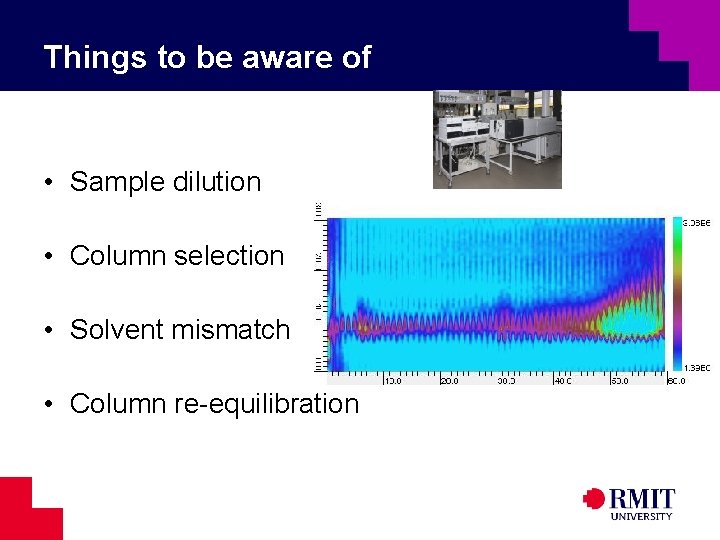
Things to be aware of • Sample dilution • Column selection • Solvent mismatch • Column re-equilibration
Other Options • Commercial libraries have been complemented by extensive open-access databases, such as mz. Cloud and the Human Metabolome Database, containing hundreds of thousands of spectra. • The creation of in house libraries of pure compounds may be of help but, of course, there can be no in- house libraries made of, as yet, unknown metabolites. • In-silico predictive tools • Mining existing data – e. g. Metabo. Lights

Acknowledgements Ph. D Students • Lydon Alexandrou • Christine Close • Jake Collie • Asal Hajnajafi • Stuart Hombsch • Will Mc. Cance • Hugh Mc. Keown • Tim Ong • Elvina Parlindungan • Lada Staskova Postdocs • Dr Yu. Fei Wang Others • Dr Jess Pandohee • Dr Paul Stevenson
Thank you for listening For further information oliver. jones@rmit. edu. au @dr_oli_jones
- Slides: 27