Restriction Enzyme Digestion Timothy G Standish Ph D
- Slides: 12
Restriction Enzyme Digestion Timothy G. Standish, Ph. D. © 2000 Timothy G. Standish
� The Enzymes are the Tools of DNA Technology tools of DNA technology are the same enzymes used by cells to modify their own DNA: – DNA Polymerases – DNA Ligase � One special class of enzyme is pivotal to the cloning of DNA and many other techniques used in DNA Technology � These enzymes are the restriction endonucleases – Restriction - Because for the way they work, they restrict bacteriophages to only one host bacterial strain. They are also restricted to acting on only specific DNA sequences – Endonuclease - They cut nucleic acids in the middle, not just the ends © 2000 Timothy G. Standish
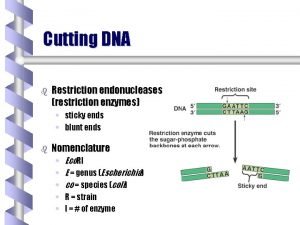
Restriction Endonucleases � There a number of different subclasses of restriction endonucleases – Type I - Recognize specific sequences and cut DNA at a nonspecific site > than 1, 000 bp away – Type II - Recognize palindromic sequences and cut within the palindrome – Type III - Recognize specific 5 -7 bp sequences and cut 24 -27 bp downstream of the site. � Type II restriction endonucleases are the most useful class as they recognize specific palindromic sequences in DNA and cut the sugar phosphate backbone within the palindrome © 2000 Timothy G. Standish
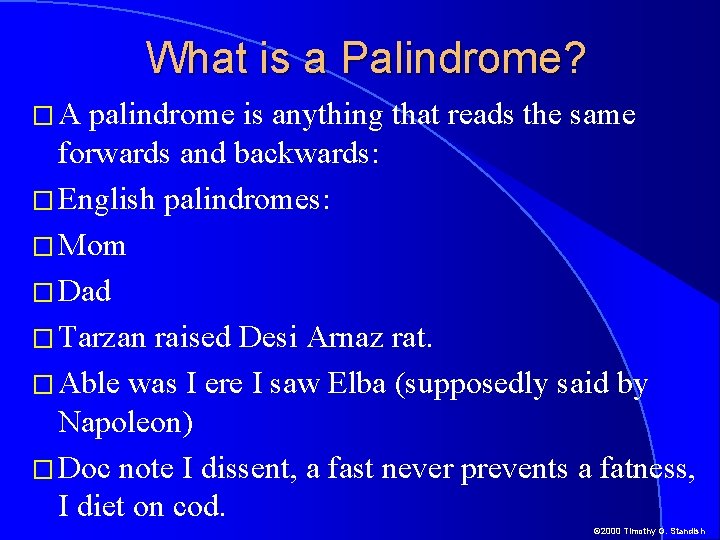
What is a Palindrome? �A palindrome is anything that reads the same forwards and backwards: � English palindromes: � Mom � Dad � Tarzan raised Desi Arnaz rat. � Able was I ere I saw Elba (supposedly said by Napoleon) � Doc note I dissent, a fast never prevents a fatness, I diet on cod. © 2000 Timothy G. Standish
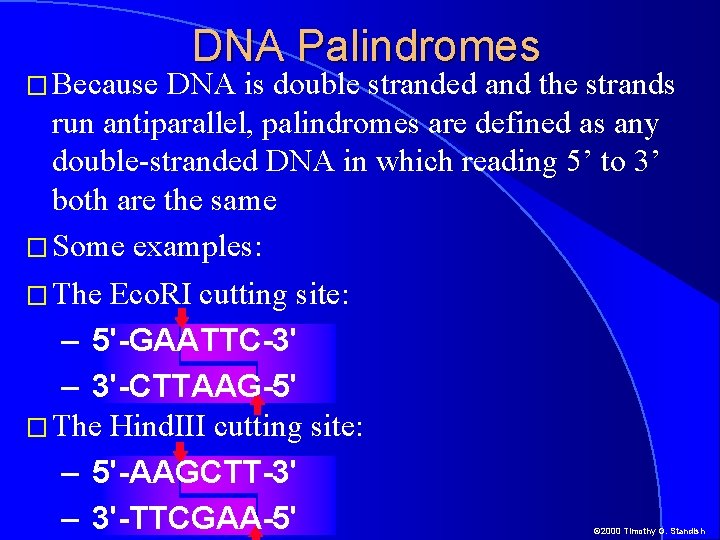
� Because DNA Palindromes DNA is double stranded and the strands run antiparallel, palindromes are defined as any double-stranded DNA in which reading 5’ to 3’ both are the same � Some examples: � The Eco. RI cutting site: – 5'-GAATTC-3' – 3'-CTTAAG-5' � The Hind. III cutting site: – 5'-AAGCTT-3' – 3'-TTCGAA-5' © 2000 Timothy G. Standish
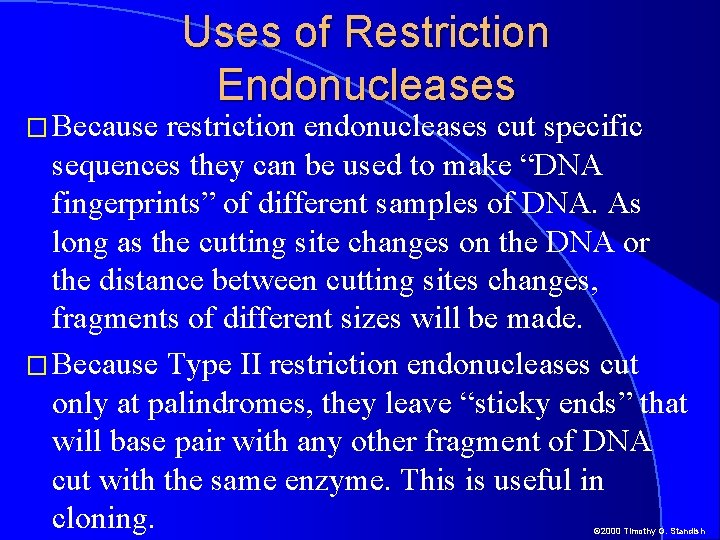
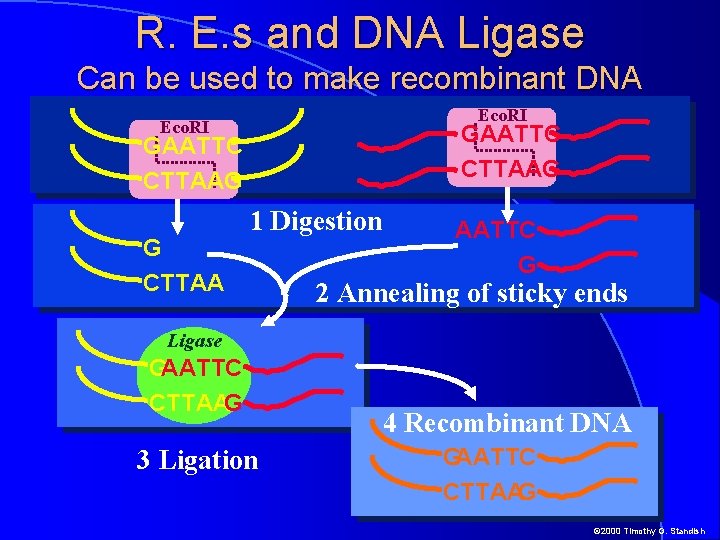
� Because Uses of Restriction Endonucleases restriction endonucleases cut specific sequences they can be used to make “DNA fingerprints” of different samples of DNA. As long as the cutting site changes on the DNA or the distance between cutting sites changes, fragments of different sizes will be made. � Because Type II restriction endonucleases cut only at palindromes, they leave “sticky ends” that will base pair with any other fragment of DNA cut with the same enzyme. This is useful in cloning. © 2000 Timothy G. Standish
R. E. s and DNA Ligase Can be used to make recombinant DNA Eco. RI GAATTC CTTAAG G CTTAA 1 Digestion AATTC G 2 Annealing of sticky ends Ligase GAATTC CTTAAG 3 Ligation 4 Recombinant DNA GAATTC CTTAAG © 2000 Timothy G. Standish
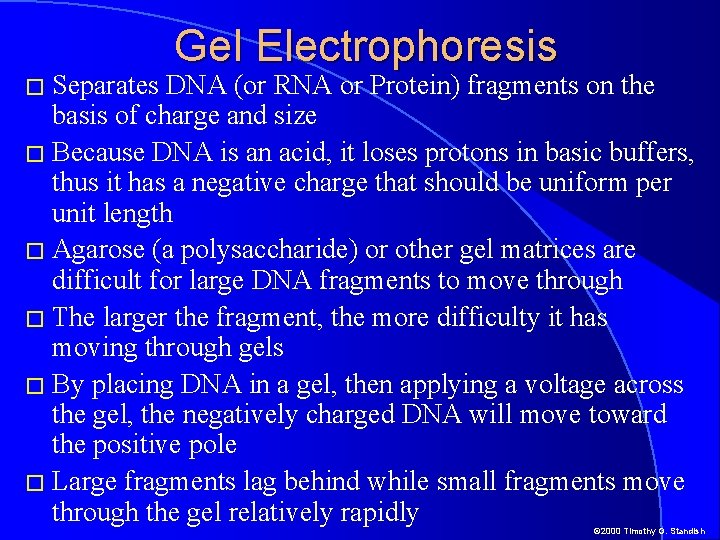
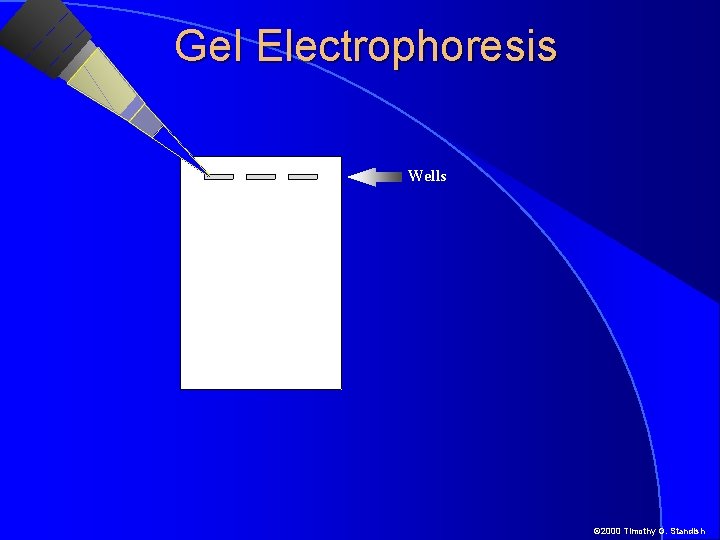
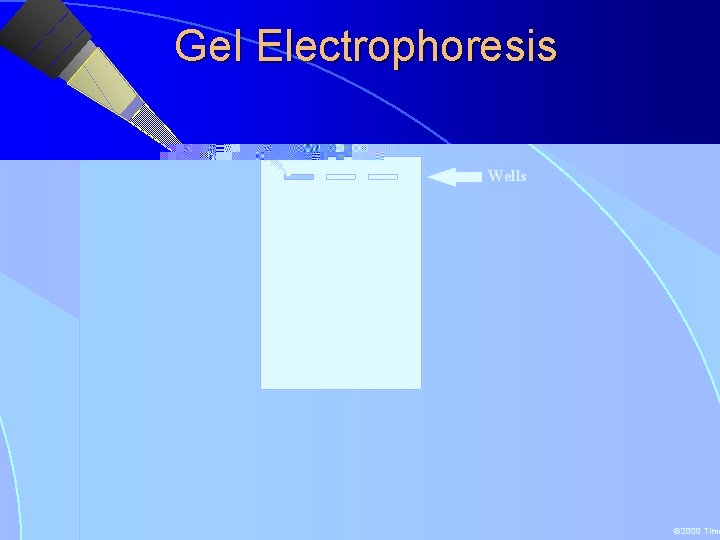
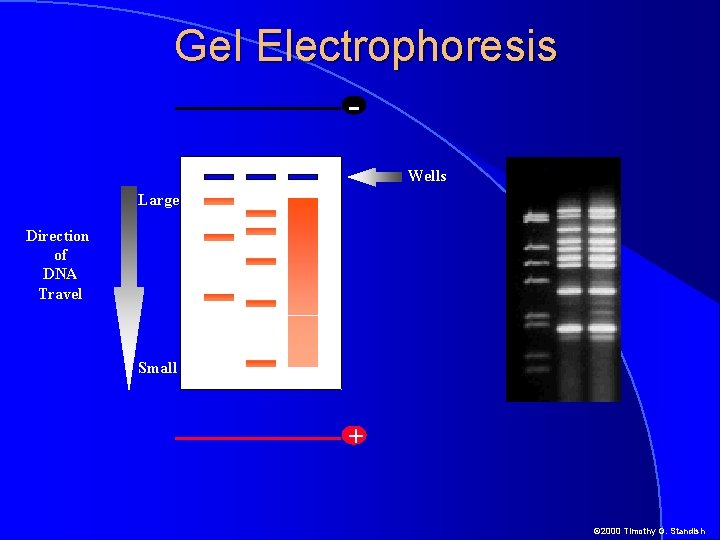
� Separates Gel Electrophoresis DNA (or RNA or Protein) fragments on the basis of charge and size � Because DNA is an acid, it loses protons in basic buffers, thus it has a negative charge that should be uniform per unit length � Agarose (a polysaccharide) or other gel matrices are difficult for large DNA fragments to move through � The larger the fragment, the more difficulty it has moving through gels � By placing DNA in a gel, then applying a voltage across the gel, the negatively charged DNA will move toward the positive pole � Large fragments lag behind while small fragments move through the gel relatively rapidly © 2000 Timothy G. Standish
Gel Electrophoresis Wells © 2000 Timothy G. Standish
Gel Electrophoresis Wells © 2000 Timothy G. Standish
Gel Electrophoresis Wells Large Direction of DNA Travel Small + © 2000 Timothy G. Standish
© 2000 Timothy G. Standish