Replacement Analysis Lecture No 46 Chapter 14 Contemporary

- Slides: 19
Replacement Analysis Lecture No. 46 Chapter 14 Contemporary Engineering Economics Copyright © 2010 Contemporary Engineering Economics, 5 th edition, © 2010
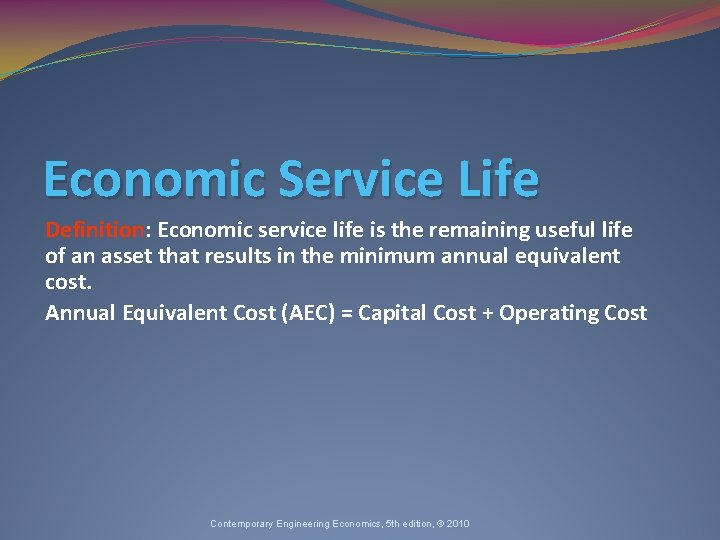
Economic Service Life Definition: Economic service life is the remaining useful life of an asset that results in the minimum annual equivalent cost. Annual Equivalent Cost (AEC) = Capital Cost + Operating Cost Contemporary Engineering Economics, 5 th edition, © 2010
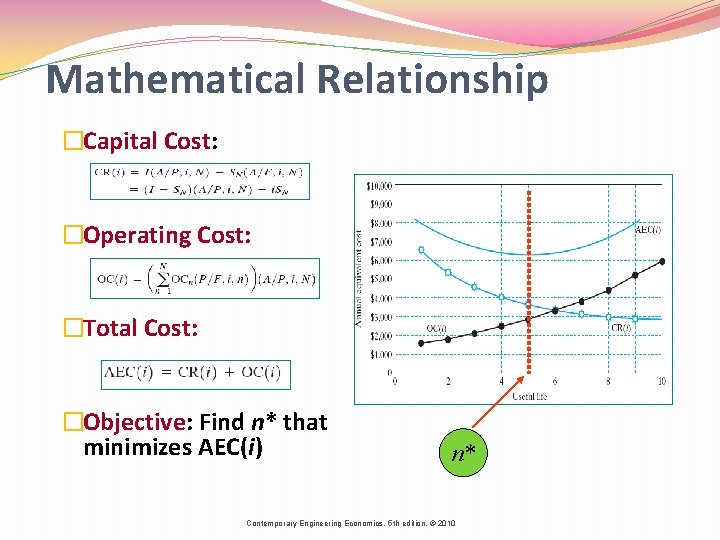
Mathematical Relationship �Capital Cost: �Operating Cost: �Total Cost: �Objective: Find n* that minimizes AEC(i) n* Contemporary Engineering Economics, 5 th edition, © 2010
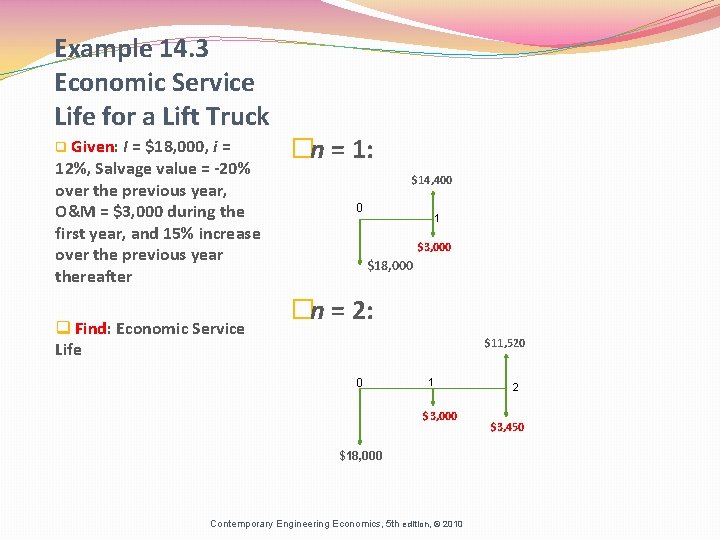
Example 14. 3 Economic Service Life for a Lift Truck q Given: I = $18, 000, i= 12%, Salvage value = -20% over the previous year, O&M = $3, 000 during the first year, and 15% increase over the previous year thereafter q Find: Economic Service Life �n = 1: $14, 400 0 1 $3, 000 $18, 000 �n = 2: $11, 520 0 1 $3, 000 $18, 000 Contemporary Engineering Economics, 5 th edition, © 2010 2 $3, 450
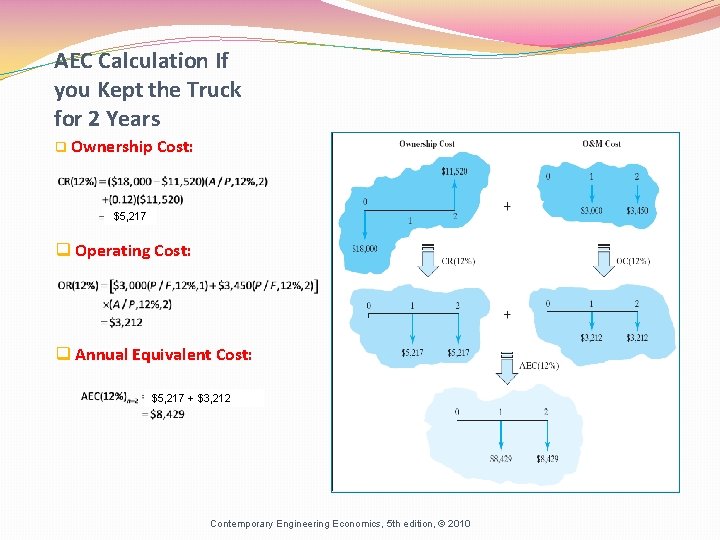
AEC Calculation If you Kept the Truck for 2 Years q Ownership Cost: $5, 217 q Operating Cost: q Annual Equivalent Cost: $5, 217 + $3, 212 Contemporary Engineering Economics, 5 th edition, © 2010
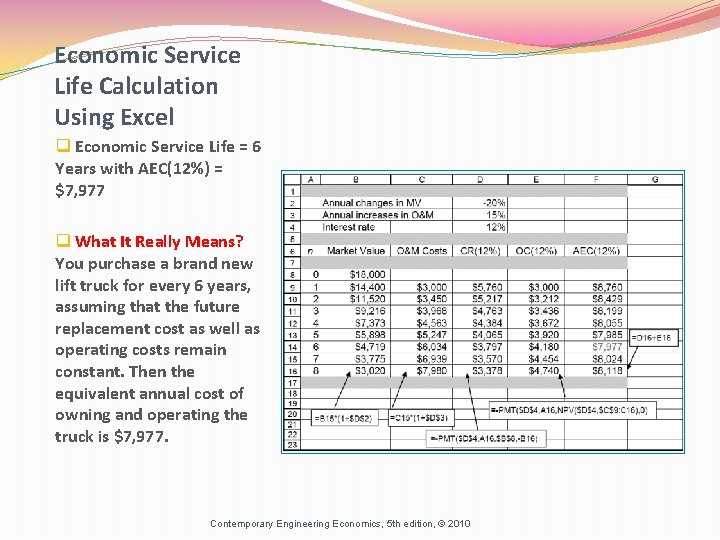
Economic Service Life Calculation Using Excel q Economic Service Life = 6 Years with AEC(12%) = $7, 977 q What It Really Means? You purchase a brand new lift truck for every 6 years, assuming that the future replacement cost as well as operating costs remain constant. Then the equivalent annual cost of owning and operating the truck is $7, 977. Contemporary Engineering Economics, 5 th edition, © 2010
Sensitivity of Economic Service Life r. For an asset with non-increasing operating cost, keep the asset as long as it lasts. r. If everything remains the same, a higher interest rate will tend to extend the economic service life (or defer the replacement decision). Contemporary Engineering Economics, 5 th edition, © 2010
Replacement Decisions �Defender: an old machine �Challenger: a new machine �Current market value: selling price of the defender in the market place Contemporary Engineering Economics, 5 th edition, © 2010
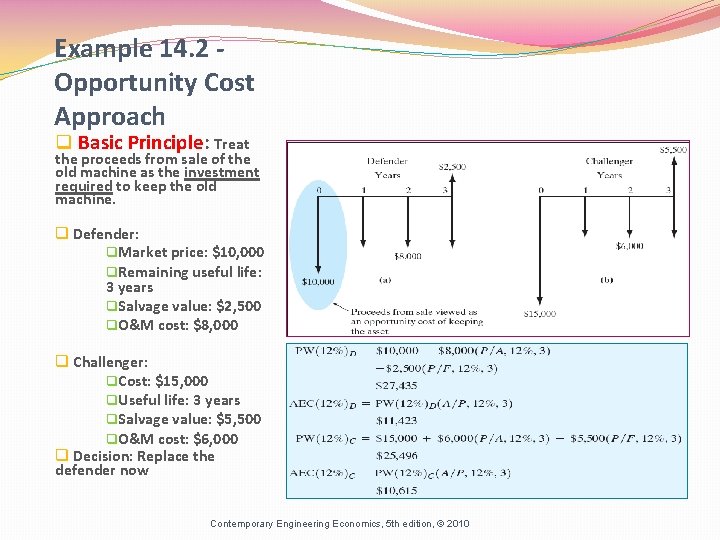
Example 14. 2 Opportunity Cost Approach q Basic Principle: Treat the proceeds from sale of the old machine as the investment required to keep the old machine. q Defender: q. Market price: $10, 000 q. Remaining useful life: 3 years q. Salvage value: $2, 500 q. O&M cost: $8, 000 q Challenger: q. Cost: $15, 000 q. Useful life: 3 years q. Salvage value: $5, 500 q. O&M cost: $6, 000 q Decision: Replace the defender now Contemporary Engineering Economics, 5 th edition, © 2010
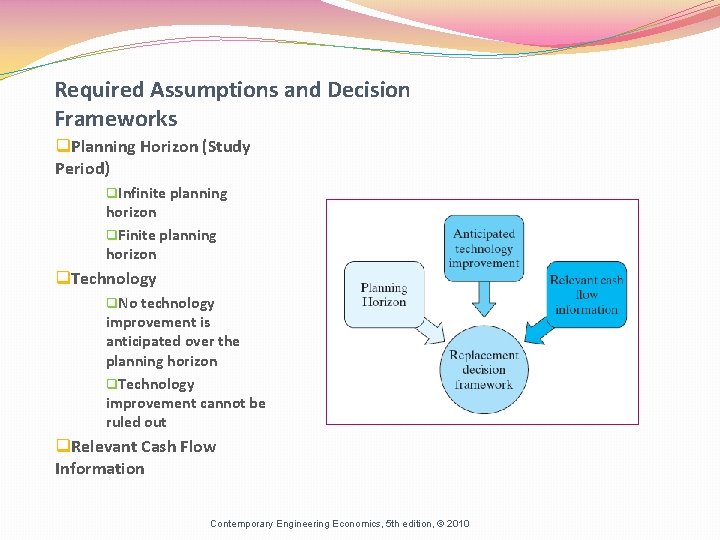
Required Assumptions and Decision Frameworks q. Planning Horizon (Study Period) q. Infinite planning horizon q. Finite planning horizon q. Technology q. No technology improvement is anticipated over the planning horizon q. Technology improvement cannot be ruled out q. Relevant Cash Flow Information Contemporary Engineering Economics, 5 th edition, © 2010
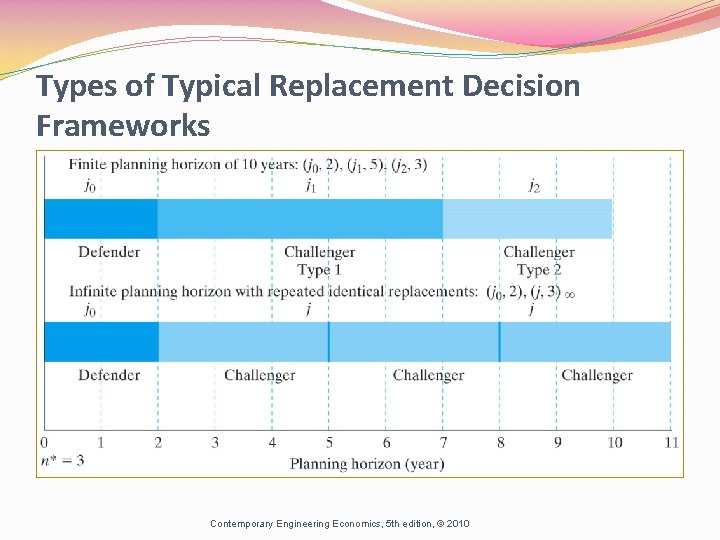
Types of Typical Replacement Decision Frameworks Contemporary Engineering Economics, 5 th edition, © 2010
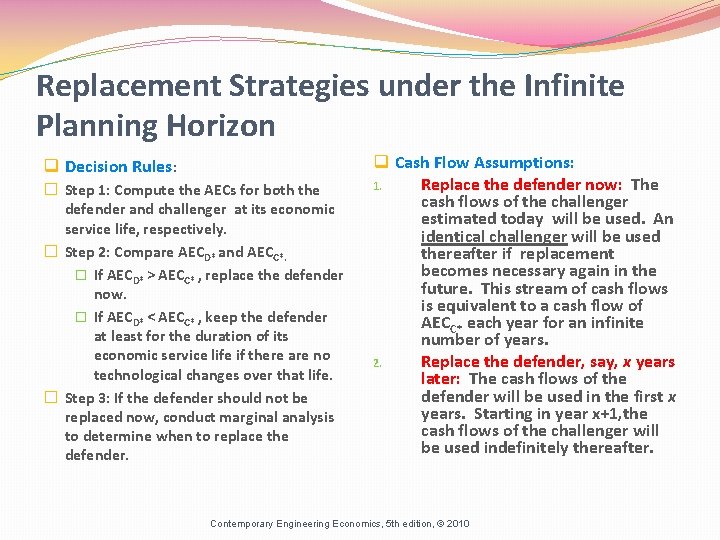
Replacement Strategies under the Infinite Planning Horizon q Decision Rules: � Step 1: Compute the AECs for both the defender and challenger at its economic service life, respectively. � Step 2: Compare AECD* and AECC*. � If AECD* > AECC* , replace the defender now. � If AECD* < AECC* , keep the defender at least for the duration of its economic service life if there are no technological changes over that life. � Step 3: If the defender should not be replaced now, conduct marginal analysis to determine when to replace the defender. q Cash Flow Assumptions: 1. Replace the defender now: The cash flows of the challenger estimated today will be used. An identical challenger will be used thereafter if replacement becomes necessary again in the future. This stream of cash flows is equivalent to a cash flow of AECC* each year for an infinite number of years. 2. Replace the defender, say, x years later: The cash flows of the defender will be used in the first x years. Starting in year x+1, the cash flows of the challenger will be used indefinitely thereafter. Contemporary Engineering Economics, 5 th edition, © 2010
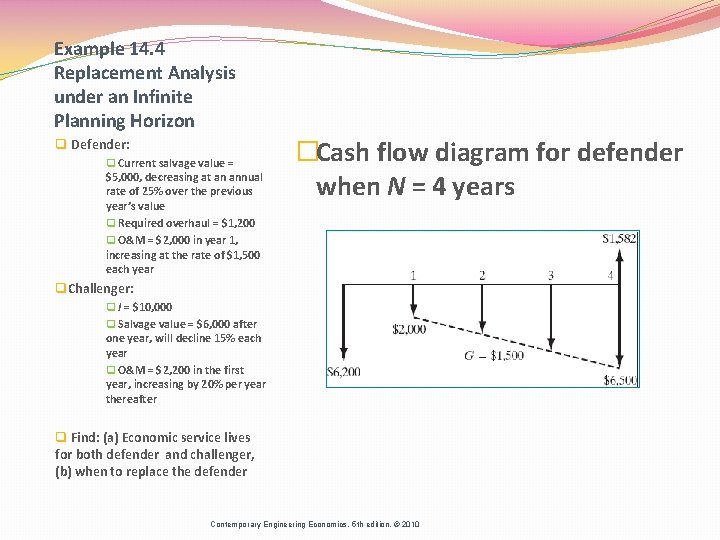
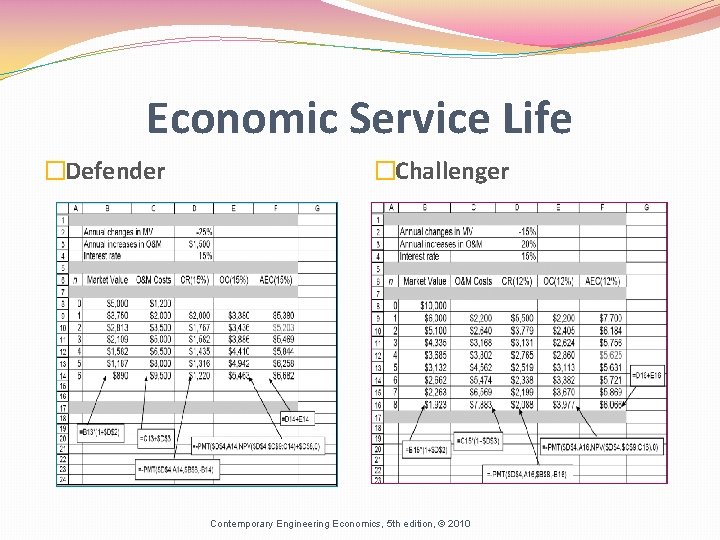
Example 14. 4 Replacement Analysis under an Infinite Planning Horizon q Defender: q Current salvage value = $5, 000, decreasing at an annual rate of 25% over the previous year’s value q Required overhaul = $1, 200 q O&M = $2, 000 in year 1, increasing at the rate of $1, 500 each year �Cash flow diagram for defender when N = 4 years q. Challenger: q I = $10, 000 q Salvage value = $6, 000 after one year, will decline 15% each year q O&M = $2, 200 in the first year, increasing by 20% per year thereafter q Find: (a) Economic service lives for both defender and challenger, (b) when to replace the defender Contemporary Engineering Economics, 5 th edition, © 2010
Economic Service Life �Defender �Challenger Contemporary Engineering Economics, 5 th edition, © 2010
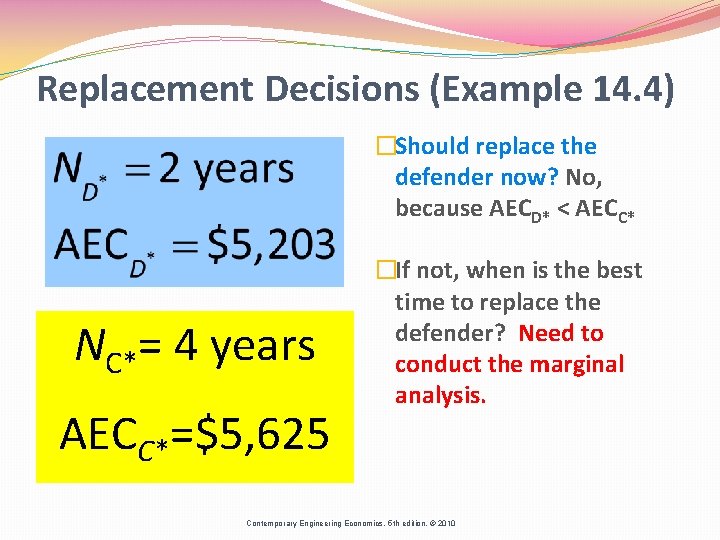
Replacement Decisions (Example 14. 4) �Should replace the defender now? No, because AECD* < AECC* NC*= 4 years AECC*=$5, 625 �If not, when is the best time to replace the defender? Need to conduct the marginal analysis. Contemporary Engineering Economics, 5 th edition, © 2010
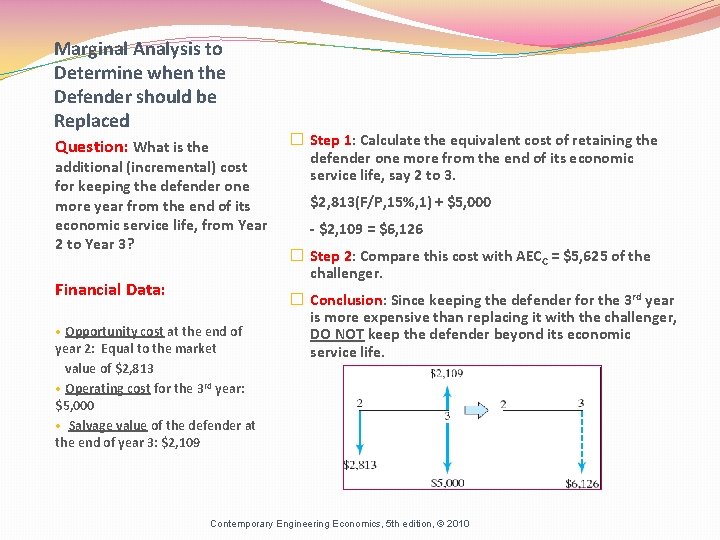
Marginal Analysis to Determine when the Defender should be Replaced Question: What is the additional (incremental) cost for keeping the defender one more year from the end of its economic service life, from Year 2 to Year 3? Financial Data: • Opportunity cost at the end of year 2: Equal to the market value of $2, 813 • Operating cost for the 3 rd year: $5, 000 • Salvage value of the defender at the end of year 3: $2, 109 � Step 1: Calculate the equivalent cost of retaining the defender one more from the end of its economic service life, say 2 to 3. $2, 813(F/P, 15%, 1) + $5, 000 - $2, 109 = $6, 126 � Step 2: Compare this cost with AECC = $5, 625 of the challenger. � Conclusion: Since keeping the defender for the 3 rd year is more expensive than replacing it with the challenger, DO NOT keep the defender beyond its economic service life. Contemporary Engineering Economics, 5 th edition, © 2010
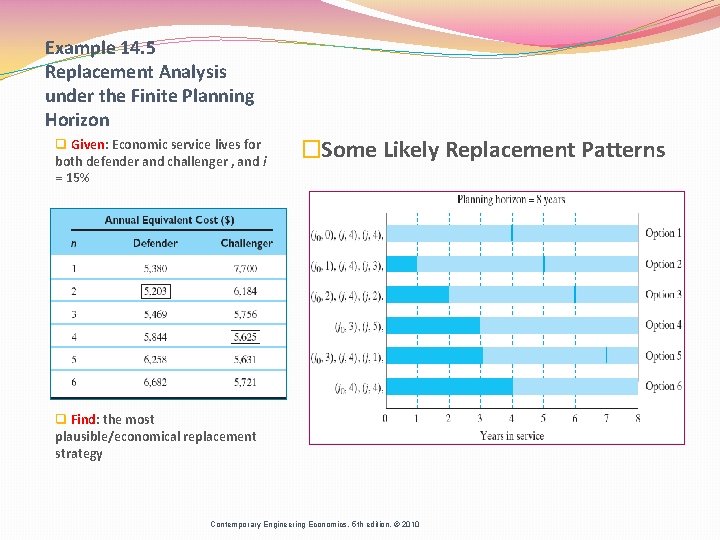
Example 14. 5 Replacement Analysis under the Finite Planning Horizon q Given: Economic service lives for both defender and challenger , and i = 15% �Some Likely Replacement Patterns q Find: the most plausible/economical replacement strategy Contemporary Engineering Economics, 5 th edition, © 2010
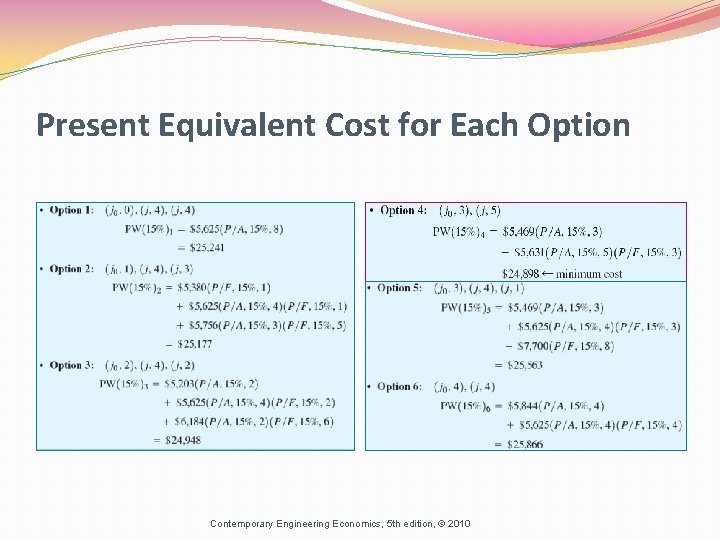
Present Equivalent Cost for Each Option Contemporary Engineering Economics, 5 th edition, © 2010
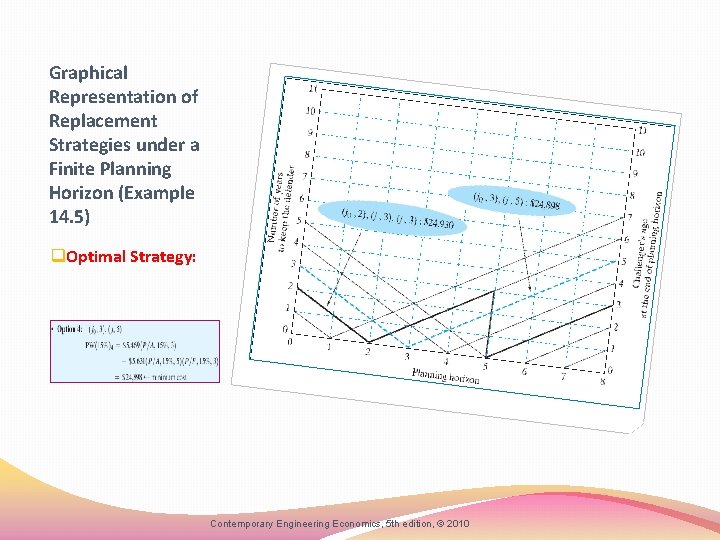
Graphical Representation of Replacement Strategies under a Finite Planning Horizon (Example 14. 5) q. Optimal Strategy: Contemporary Engineering Economics, 5 th edition, © 2010