Relocation and outsourcing of services activities to Hungary

- Slides: 18
Relocation and outsourcing of services activities to Hungary Magdolna Sass Institute of Economics of the Hungarian Academy of Sciences and ICEG EC 10 th EACES Conference, Moscow, 28 -30 August, 2008 1
Outline of the presentation 1. What is BPO? What are its main characteristics? 2. Hungary as a host to BPO 3. Research on: location advantages and impact on the host economy 4. Relocation 5. Conclusion Research on BPO in ECE is based on company interviews Presentation based on the project „"Foreign Direct Investment in Central and Eastern Europe: What Kind of Competitiveness for the Visegrad Four? " and OTKA no. 10 th EACES Conference, 2 68435 (Hungarian research fund). Moscow, 28 -30 August, 2008
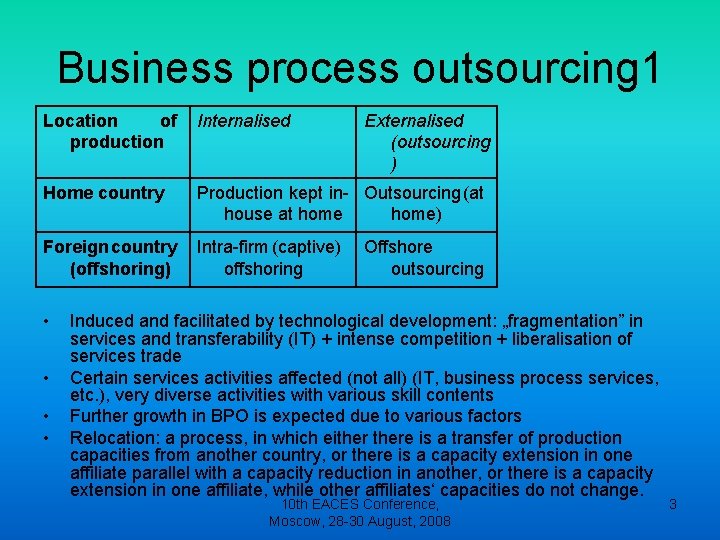
Business process outsourcing 1 Location of production Internalised Home country Production kept in- Outsourcing (at house at home) Foreign country (offshoring) Intra-firm (captive) offshoring • • Externalised (outsourcing ) Offshore outsourcing Induced and facilitated by technological development: „fragmentation” in services and transferability (IT) + intense competition + liberalisation of services trade Certain services activities affected (not all) (IT, business process services, etc. ), very diverse activities with various skill contents Further growth in BPO is expected due to various factors Relocation: a process, in which eithere is a transfer of production capacities from another country, or there is a capacity extension in one affiliate parallel with a capacity reduction in another, or there is a capacity extension in one affiliate, while other affiliates‘ capacities do not change. 10 th EACES Conference, Moscow, 28 -30 August, 2008 3
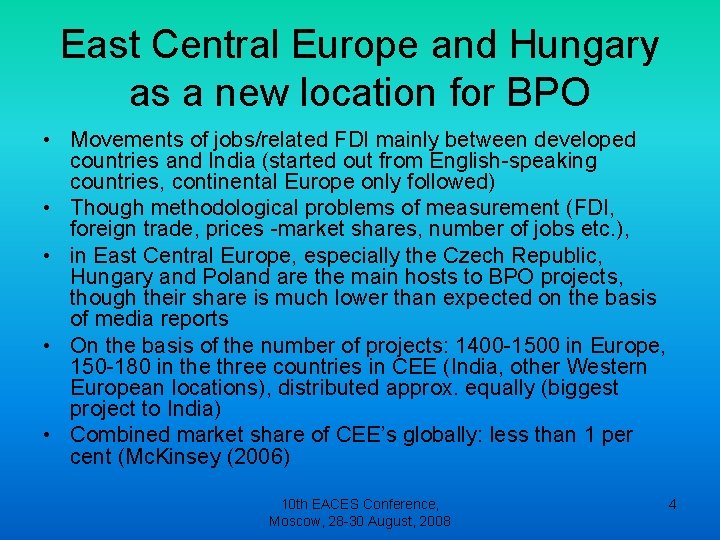
East Central Europe and Hungary as a new location for BPO • Movements of jobs/related FDI mainly between developed countries and India (started out from English-speaking countries, continental Europe only followed) • Though methodological problems of measurement (FDI, foreign trade, prices -market shares, number of jobs etc. ), • in East Central Europe, especially the Czech Republic, Hungary and Poland are the main hosts to BPO projects, though their share is much lower than expected on the basis of media reports • On the basis of the number of projects: 1400 -1500 in Europe, 150 -180 in the three countries in CEE (India, other Western European locations), distributed approx. equally (biggest project to India) • Combined market share of CEE’s globally: less than 1 per cent (Mc. Kinsey (2006) 10 th EACES Conference, Moscow, 28 -30 August, 2008 4
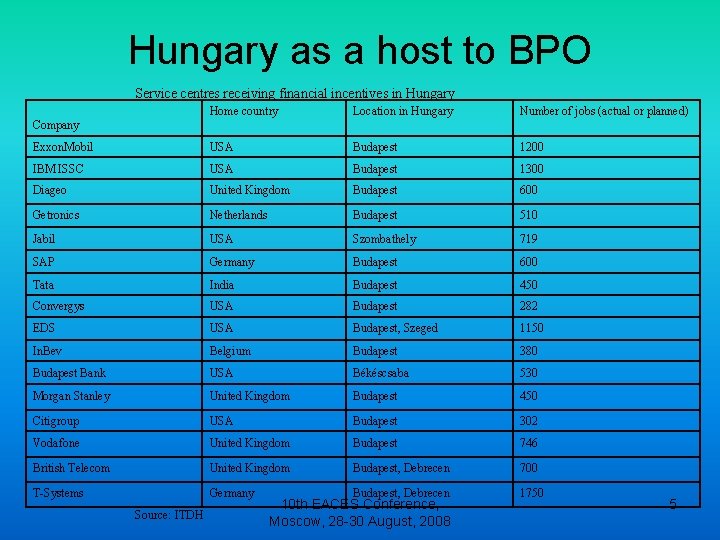
Hungary as a host to BPO Service centres receiving financial incentives in Hungary Home country Location in Hungary Number of jobs (actual or planned) Exxon. Mobil USA Budapest 1200 IBM ISSC USA Budapest 1300 Diageo United Kingdom Budapest 600 Getronics Netherlands Budapest 510 Jabil USA Szombathely 719 SAP Germany Budapest 600 Tata India Budapest 450 Convergys USA Budapest 282 EDS USA Budapest, Szeged 1150 In. Bev Belgium Budapest 380 Budapest Bank USA Békéscsaba 530 Morgan Stanley United Kingdom Budapest 450 Citigroup USA Budapest 302 Vodafone United Kingdom Budapest 746 British Telecom United Kingdom Budapest, Debrecen 700 T-Systems Germany Budapest, Debrecen 1750 Company Source: ITDH 10 th EACES Conference, Moscow, 28 -30 August, 2008 5
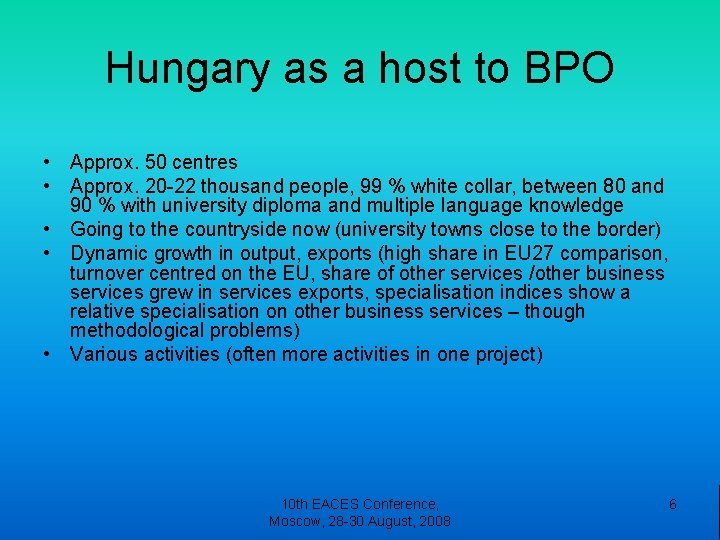
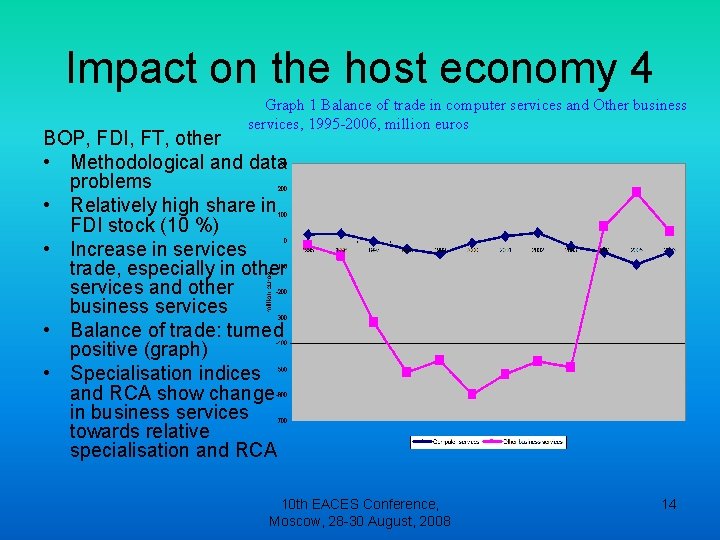
Hungary as a host to BPO • Approx. 50 centres • Approx. 20 -22 thousand people, 99 % white collar, between 80 and 90 % with university diploma and multiple language knowledge • Going to the countryside now (university towns close to the border) • Dynamic growth in output, exports (high share in EU 27 comparison, turnover centred on the EU, share of other services /other business services grew in services exports, specialisation indices show a relative specialisation on other business services – though methodological problems) • Various activities (often more activities in one project) 10 th EACES Conference, Moscow, 28 -30 August, 2008 6
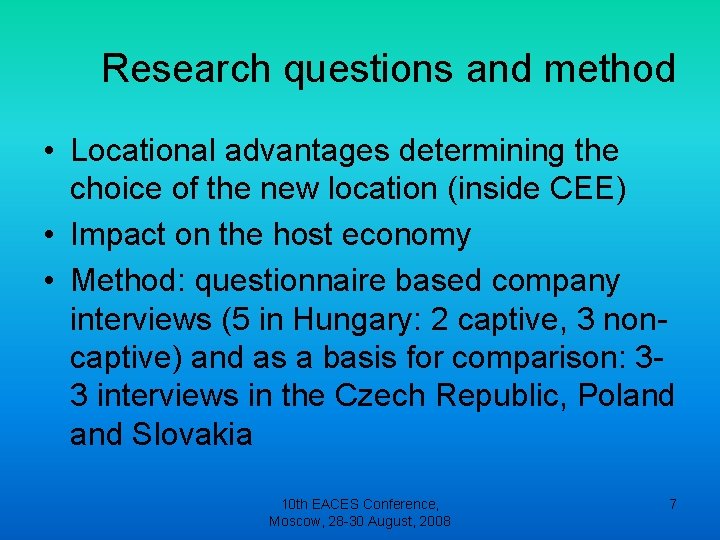
Research questions and method • Locational advantages determining the choice of the new location (inside CEE) • Impact on the host economy • Method: questionnaire based company interviews (5 in Hungary: 2 captive, 3 noncaptive) and as a basis for comparison: 33 interviews in the Czech Republic, Poland Slovakia 10 th EACES Conference, Moscow, 28 -30 August, 2008 7
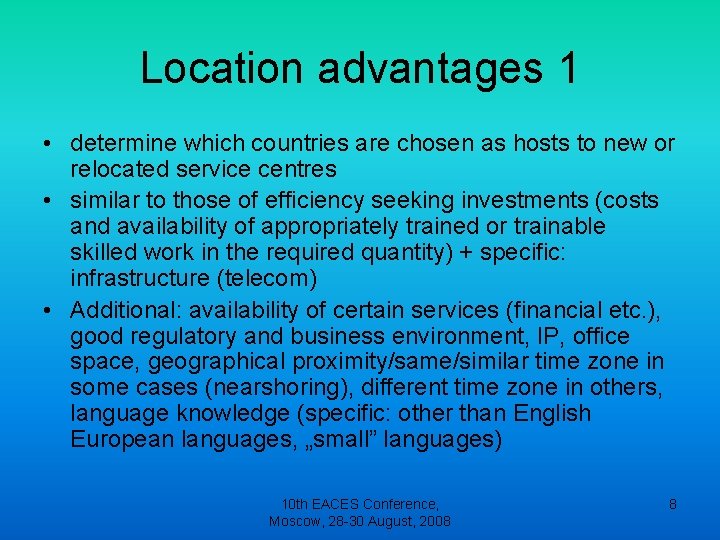
Location advantages 1 • determine which countries are chosen as hosts to new or relocated service centres • similar to those of efficiency seeking investments (costs and availability of appropriately trained or trainable skilled work in the required quantity) + specific: infrastructure (telecom) • Additional: availability of certain services (financial etc. ), good regulatory and business environment, IP, office space, geographical proximity/same/similar time zone in some cases (nearshoring), different time zone in others, language knowledge (specific: other than English European languages, „small” languages) 10 th EACES Conference, Moscow, 28 -30 August, 2008 8
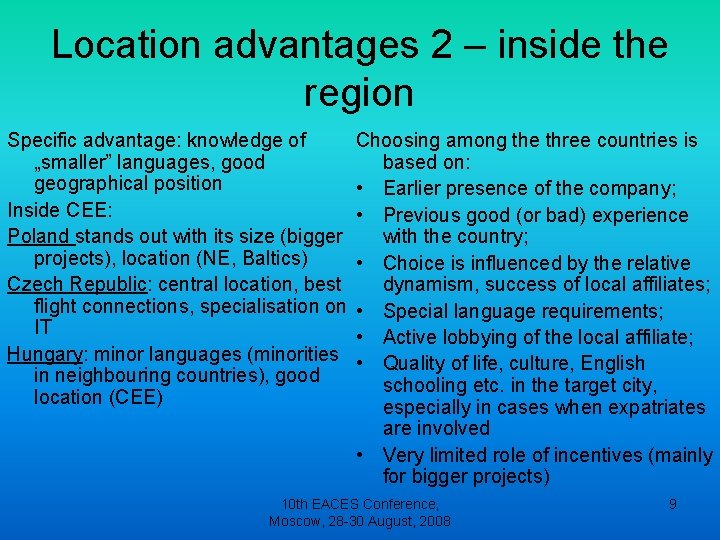
Location advantages 2 – inside the region Specific advantage: knowledge of „smaller” languages, good geographical position Inside CEE: Poland stands out with its size (bigger projects), location (NE, Baltics) Czech Republic: central location, best flight connections, specialisation on IT Hungary: minor languages (minorities in neighbouring countries), good location (CEE) Choosing among the three countries is based on: • Earlier presence of the company; • Previous good (or bad) experience with the country; • Choice is influenced by the relative dynamism, success of local affiliates; • Special language requirements; • Active lobbying of the local affiliate; • Quality of life, culture, English schooling etc. in the target city, especially in cases when expatriates are involved • Very limited role of incentives (mainly for bigger projects) 10 th EACES Conference, Moscow, 28 -30 August, 2008 9
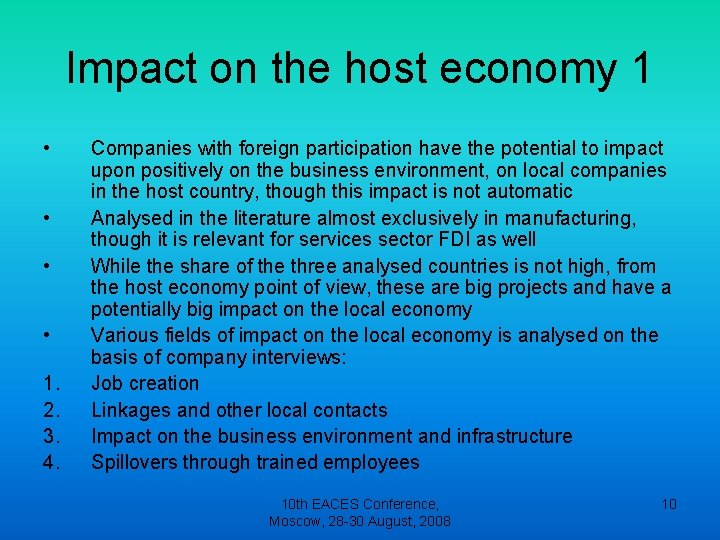
Impact on the host economy 1 • • 1. 2. 3. 4. Companies with foreign participation have the potential to impact upon positively on the business environment, on local companies in the host country, though this impact is not automatic Analysed in the literature almost exclusively in manufacturing, though it is relevant for services sector FDI as well While the share of the three analysed countries is not high, from the host economy point of view, these are big projects and have a potentially big impact on the local economy Various fields of impact on the local economy is analysed on the basis of company interviews: Job creation Linkages and other local contacts Impact on the business environment and infrastructure Spillovers through trained employees 10 th EACES Conference, Moscow, 28 -30 August, 2008 10
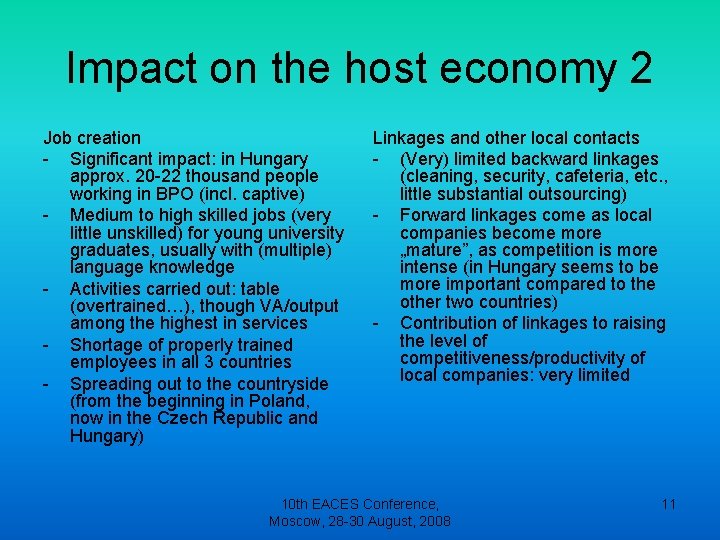
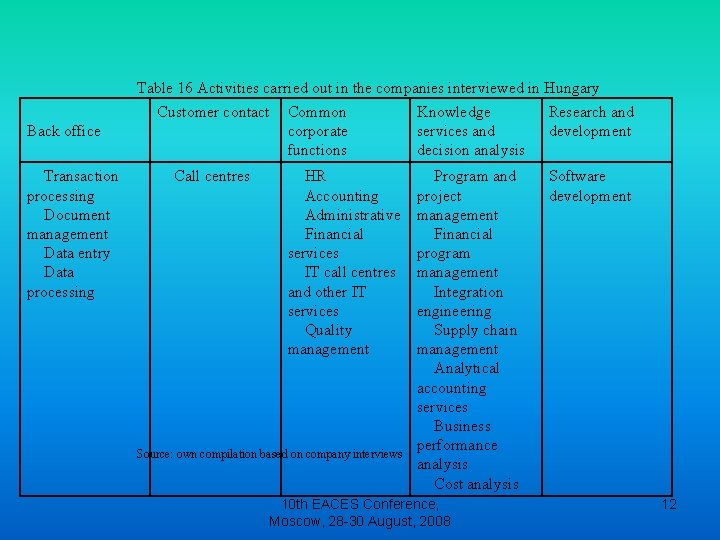
Impact on the host economy 2 Job creation - Significant impact: in Hungary approx. 20 -22 thousand people working in BPO (incl. captive) - Medium to high skilled jobs (very little unskilled) for young university graduates, usually with (multiple) language knowledge - Activities carried out: table (overtrained…), though VA/output among the highest in services - Shortage of properly trained employees in all 3 countries - Spreading out to the countryside (from the beginning in Poland, now in the Czech Republic and Hungary) Linkages and other local contacts - (Very) limited backward linkages (cleaning, security, cafeteria, etc. , little substantial outsourcing) - Forward linkages come as local companies become more „mature”, as competition is more intense (in Hungary seems to be more important compared to the other two countries) - Contribution of linkages to raising the level of competitiveness/productivity of local companies: very limited 10 th EACES Conference, Moscow, 28 -30 August, 2008 11
Back office Transaction processing Document management Data entry Data processing Table 16 Activities carried out in the companies interviewed in Hungary Customer contact Common Knowledge Research and corporate services and development functions decision analysis Call centres HR Accounting Administrative Financial services IT call centres and other IT services Quality management Source: own compilation based on company interviews Program and project management Financial program management Integration engineering Supply chain management Analytical accounting services Business performance analysis Cost analysis 10 th EACES Conference, Moscow, 28 -30 August, 2008 Software development 12
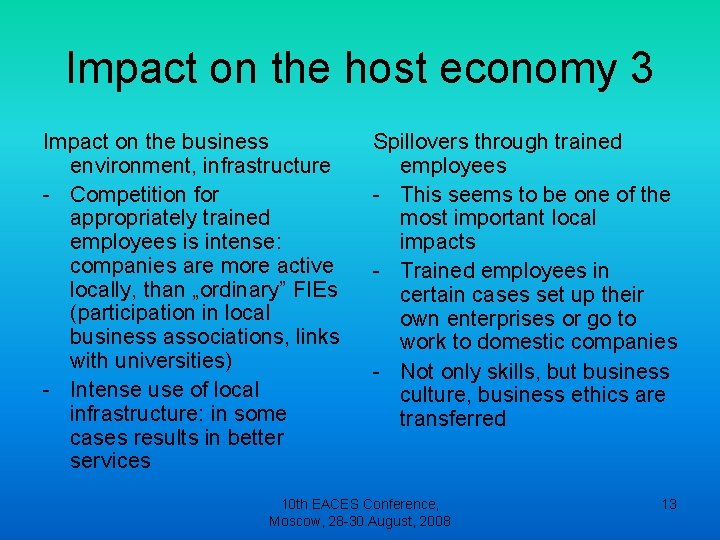
Impact on the host economy 3 Impact on the business environment, infrastructure - Competition for appropriately trained employees is intense: companies are more active locally, than „ordinary” FIEs (participation in local business associations, links with universities) - Intense use of local infrastructure: in some cases results in better services Spillovers through trained employees - This seems to be one of the most important local impacts - Trained employees in certain cases set up their own enterprises or go to work to domestic companies - Not only skills, but business culture, business ethics are transferred 10 th EACES Conference, Moscow, 28 -30 August, 2008 13
Impact on the host economy 4 Graph 1 Balance of trade in computer services and Other business services, 1995 -2006, million euros BOP, FDI, FT, other • Methodological and data problems • Relatively high share in FDI stock (10 %) • Increase in services trade, especially in other services and other business services • Balance of trade: turned positive (graph) • Specialisation indices and RCA show change in business services towards relative specialisation and RCA 10 th EACES Conference, Moscow, 28 -30 August, 2008 14
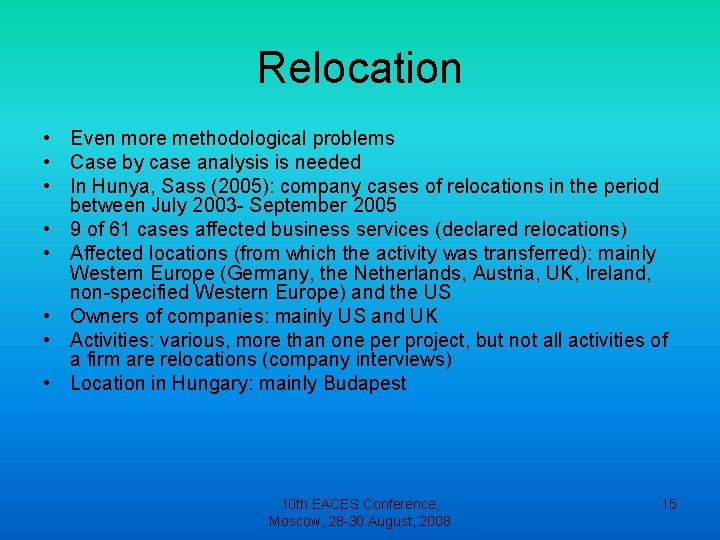
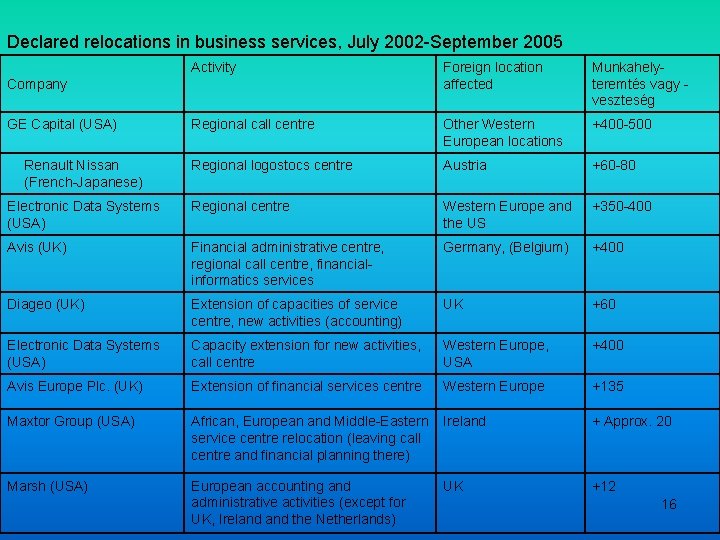
Relocation • Even more methodological problems • Case by case analysis is needed • In Hunya, Sass (2005): company cases of relocations in the period between July 2003 - September 2005 • 9 of 61 cases affected business services (declared relocations) • Affected locations (from which the activity was transferred): mainly Western Europe (Germany, the Netherlands, Austria, UK, Ireland, non-specified Western Europe) and the US • Owners of companies: mainly US and UK • Activities: various, more than one per project, but not all activities of a firm are relocations (company interviews) • Location in Hungary: mainly Budapest 10 th EACES Conference, Moscow, 28 -30 August, 2008 15
Declared relocations in business services, July 2002 -September 2005 Activity Foreign location affected Munkahelyteremtés vagy veszteség Regional call centre Other Western European locations +400 -500 Regional logostocs centre Austria +60 -80 Electronic Data Systems (USA) Regional centre Western Europe and the US +350 -400 Avis (UK) Financial administrative centre, regional call centre, financialinformatics services Germany, (Belgium) +400 Diageo (UK) Extension of capacities of service centre, new activities (accounting) UK +60 Electronic Data Systems (USA) Capacity extension for new activities, call centre Western Europe, USA +400 Avis Europe Plc. (UK) Extension of financial services centre Western Europe +135 Maxtor Group (USA) African, European and Middle-Eastern service centre relocation (leaving call centre and financial planning there) Ireland + Approx. 20 Marsh (USA) European accounting and administrative activities (except for UK, Ireland the Netherlands) UK +12 Company GE Capital (USA) Renault Nissan (French-Japanese) 16
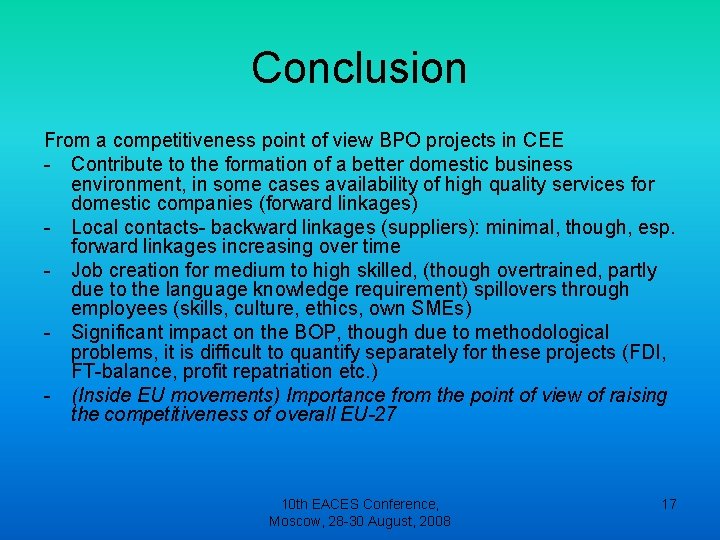
Conclusion From a competitiveness point of view BPO projects in CEE - Contribute to the formation of a better domestic business environment, in some cases availability of high quality services for domestic companies (forward linkages) - Local contacts- backward linkages (suppliers): minimal, though, esp. forward linkages increasing over time - Job creation for medium to high skilled, (though overtrained, partly due to the language knowledge requirement) spillovers through employees (skills, culture, ethics, own SMEs) - Significant impact on the BOP, though due to methodological problems, it is difficult to quantify separately for these projects (FDI, FT-balance, profit repatriation etc. ) - (Inside EU movements) Importance from the point of view of raising the competitiveness of overall EU-27 10 th EACES Conference, Moscow, 28 -30 August, 2008 17
Thank you for your attention! 10 th EACES Conference, Moscow, 28 -30 August, 2008 18