Regional innovation policies opportunities and pitfalls Elvira Uyarra

- Slides: 25
Regional innovation policies: opportunities and pitfalls Elvira Uyarra Research Fellow, NESTA and Institute of Innovation research (Manchester Business School)
regional innovation policies: challenges and pitfalls • • Introduction What shapes policy? Explaining rationales Key pitfalls of regional innovation policies What can be done? (I): improving coordination of policy mix • What can be done? (II): demand-side measures • summary
Introduction • Innovation is becoming more complex – Globalisation – Complexity of knowledge basis – Open innovation • Innovation policy is also becoming more complex and also distributed – Wide range of tools and policies – Multi-level governance of science and innovation policies – Multi-actor participation in science and innovation policies
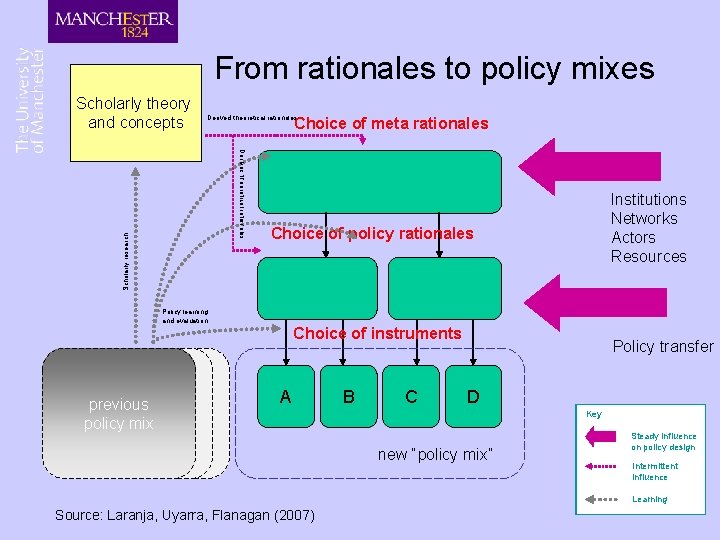
What shapes policy? • Policy as an explicit or implicit theory or basis for action – “rationale” • What are rationales? – theoretical rationales – Meta (governance) rationales – policy rationales • In real policy making, we will find specific blends of justifications and policy rationales, often in tension with each other • Why is this important? – dominant narrative – evaluation – identify contradictions – Learn from experience
From rationales to policy mixes Scholarly theory and concepts Derived theoretical rationales Choice of meta rationales Scholarly research Derived theoretical rationales Institutions Networks Actors Resources Choice of policy rationales Policy learning and evaluation Choice of instruments Previous previous policy mixmix policy mix A B C Policy transfer D Key new “policy mix” Steady influence on policy design Intermittent influence Learning Source: Laranja, Uyarra, Flanagan (2007)
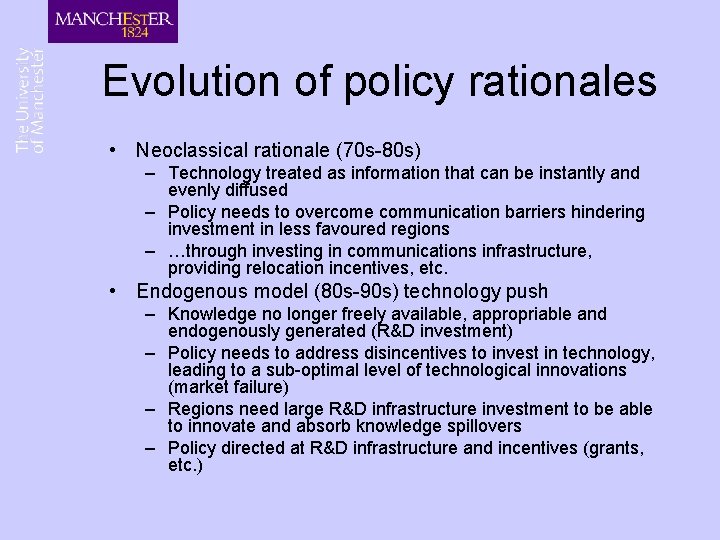
Evolution of policy rationales • Neoclassical rationale (70 s-80 s) – Technology treated as information that can be instantly and evenly diffused – Policy needs to overcome communication barriers hindering investment in less favoured regions – …through investing in communications infrastructure, providing relocation incentives, etc. • Endogenous model (80 s-90 s) technology push – Knowledge no longer freely available, appropriable and endogenously generated (R&D investment) – Policy needs to address disincentives to invest in technology, leading to a sub-optimal level of technological innovations (market failure) – Regions need large R&D infrastructure investment to be able to innovate and absorb knowledge spillovers – Policy directed at R&D infrastructure and incentives (grants, etc. )
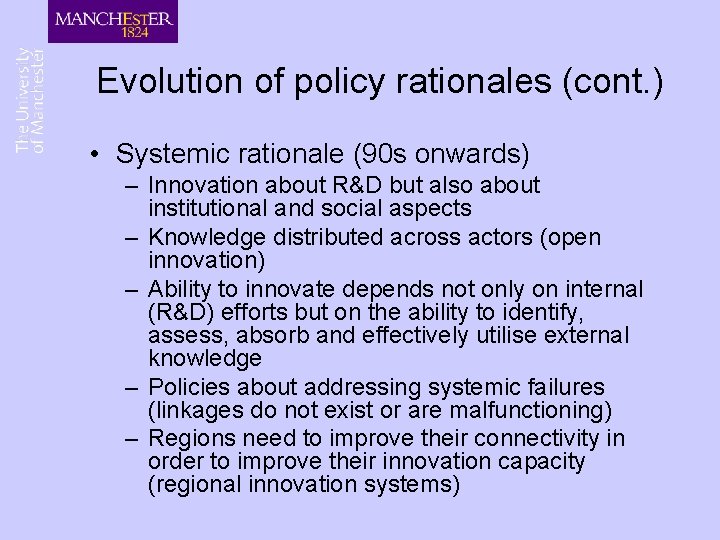
Evolution of policy rationales (cont. ) • Systemic rationale (90 s onwards) – Innovation about R&D but also about institutional and social aspects – Knowledge distributed across actors (open innovation) – Ability to innovate depends not only on internal (R&D) efforts but on the ability to identify, assess, absorb and effectively utilise external knowledge – Policies about addressing systemic failures (linkages do not exist or are malfunctioning) – Regions need to improve their connectivity in order to improve their innovation capacity (regional innovation systems)
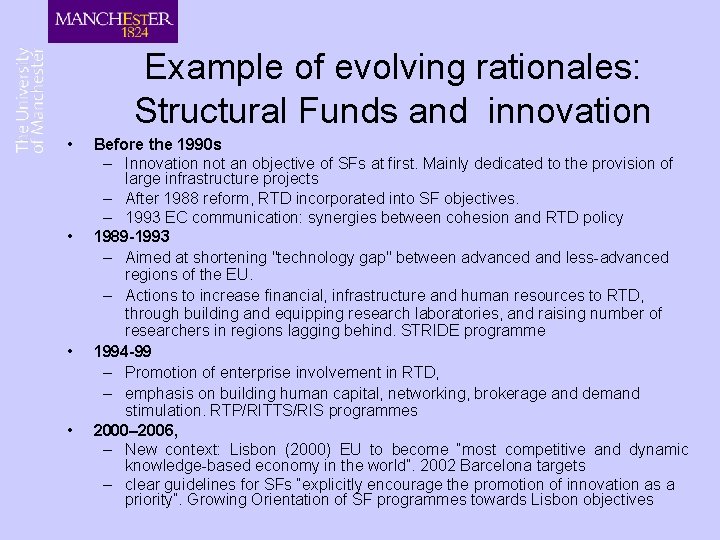
Example of evolving rationales: Structural Funds and innovation • • Before the 1990 s – Innovation not an objective of SFs at first. Mainly dedicated to the provision of large infrastructure projects – After 1988 reform, RTD incorporated into SF objectives. – 1993 EC communication: synergies between cohesion and RTD policy 1989 -1993 – Aimed at shortening "technology gap" between advanced and less-advanced regions of the EU. – Actions to increase financial, infrastructure and human resources to RTD, through building and equipping research laboratories, and raising number of researchers in regions lagging behind. STRIDE programme 1994 -99 – Promotion of enterprise involvement in RTD, – emphasis on building human capital, networking, brokerage and demand stimulation. RTP/RITTS/RIS programmes 2000– 2006, – New context: Lisbon (2000) EU to become “most competitive and dynamic knowledge-based economy in the world”. 2002 Barcelona targets – clear guidelines for SFs “explicitly encourage the promotion of innovation as a priority”. Growing Orientation of SF programmes towards Lisbon objectives
Regional innovation systems as policy framework • The innovation system of a specific territory consists of a geographically defined, administratively supported arrangement of innovative networks and institutions that interact regularly and strongly to enhance the innovative outputs of firms in the region (Cooke and Schienstock, 2000: 273) • Comprises – A set of components (such as research institutes, universities, technology transfer agencies, chambers of commerce, banks, investors, government departments, individual firms ) – A set of functions they undertake (such as supply of technical services, knowledge diffusion, testing, advice, scientific knowledge creation, etc. ) – A set of knowledge sharing linkages among them
Regional innovation policies: common pitfalls • Focus on components rather than the functions they undertake and the linkages between them • Consensus building but conservative approach to policies • ‘Inward looking’ : regions as ‘islands’. But most linkages necessarily extra regional • Capacity gap of policy makers to manage regional innovation policies • Tendency to copy success cases: ‘do all regions need a biotech cluster? ’ • Lack of coordination of the policy mix • Supply-side bias. Lack of adaptation to private sector needs
What can be done? (I): improving coordination of policy mix
Coordination of the ‘policy mix’ • The policy mixes at the regional level are becoming more complex in terms of the combination of policy instruments and objectives, which need to be coordinated and aligned • Need to coordinate actions across a wide range of policy domains, such as education and research policy • the mix of policy instruments interact to influence the extent to which the goals of innovation policy are achieved (innovation outcomes). Need to be seen as a ‘system’
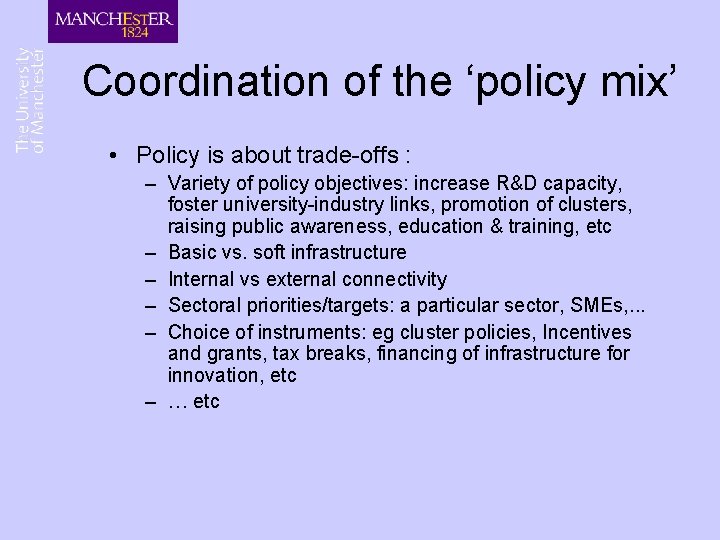
Coordination of the ‘policy mix’ • Policy is about trade-offs : – Variety of policy objectives: increase R&D capacity, foster university-industry links, promotion of clusters, raising public awareness, education & training, etc – Basic vs. soft infrastructure – Internal vs external connectivity – Sectoral priorities/targets: a particular sector, SMEs, . . . – Choice of instruments: eg cluster policies, Incentives and grants, tax breaks, financing of infrastructure for innovation, etc – … etc
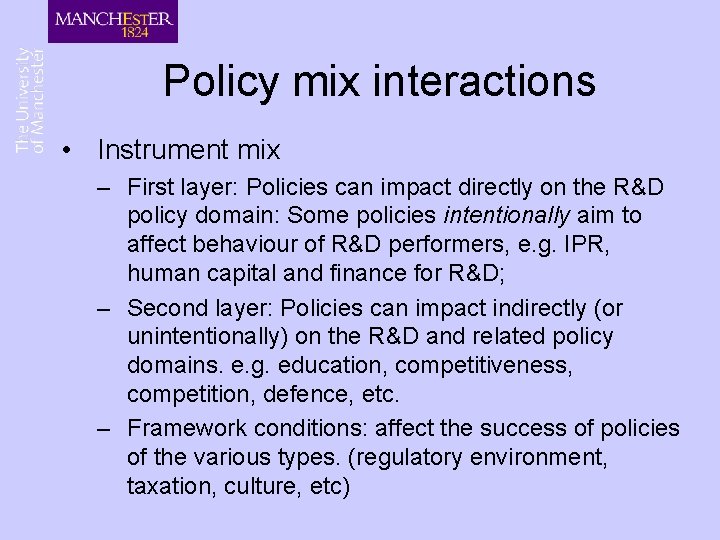
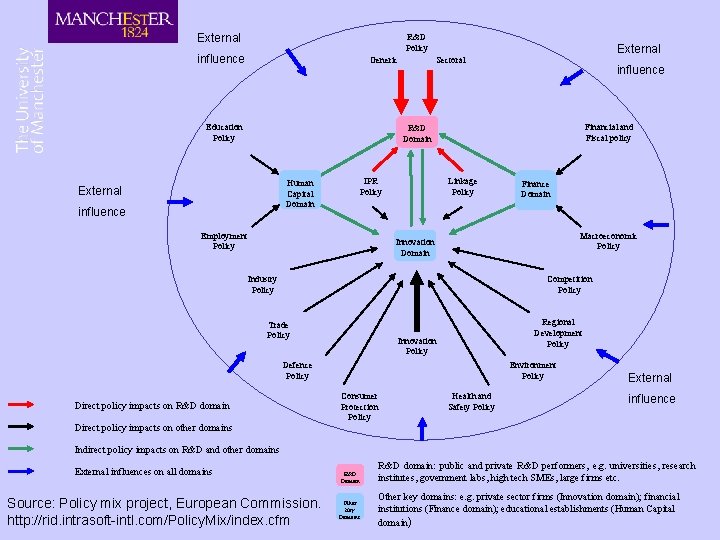
Policy mix interactions • Instrument mix – First layer: Policies can impact directly on the R&D policy domain: Some policies intentionally aim to affect behaviour of R&D performers, e. g. IPR, human capital and finance for R&D; – Second layer: Policies can impact indirectly (or unintentionally) on the R&D and related policy domains. e. g. education, competitiveness, competition, defence, etc. – Framework conditions: affect the success of policies of the various types. (regulatory environment, taxation, culture, etc)
External R&D Policy influence Generic Education Policy External Sectoral influence Financial and Fiscal policy R&D Domain Human Capital Domain External influence IPR Policy Employment Policy Linkage Policy Finance Domain Macroeconomic Policy Innovation Domain Industry Policy Competition Policy Trade Policy Regional Development Policy Innovation Policy Defence Policy Direct policy impacts on R&D domain Direct policy impacts on other domains Environment Policy Consumer Protection Policy Health and Safety Policy External influence Indirect policy impacts on R&D and other domains External influences on all domains Source: Policy mix project, European Commission. http: //rid. intrasoft-intl. com/Policy. Mix/index. cfm R&D Domain Other Key Domains R&D domain: public and private R&D performers, e. g. universities, research institutes, government labs, high tech SMEs, large firms etc. Other key domains: e. g. private sector firms (Innovation domain); financial institutions (Finance domain); educational establishments (Human Capital domain)
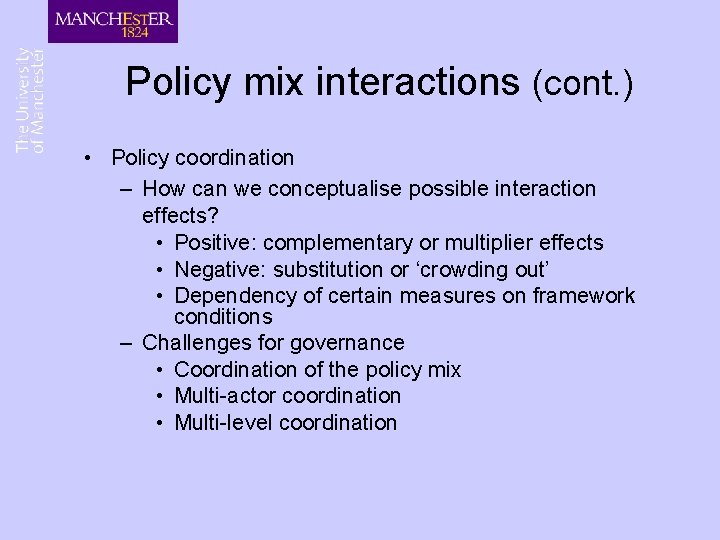
Policy mix interactions (cont. ) • Policy coordination – How can we conceptualise possible interaction effects? • Positive: complementary or multiplier effects • Negative: substitution or ‘crowding out’ • Dependency of certain measures on framework conditions – Challenges for governance • Coordination of the policy mix • Multi-actor coordination • Multi-level coordination
What can be done? (II): demand-side measures
supply side-bias despite demand-side rhetoric – policies • Not well suited to provide incentives for innovation • tend to focus on the supply side: funding of science, fiscal incentives for R&D, etc • Only one third of Structural funds objective 1 expenditure (35% in obj. 2) on innovation focused on establishing innovation networks, technology transfer, etc in 2006. Rest is infrastructure
Demand-side measures (Cont. ) • But stimulating demand is important…. – The UK Lambert review of Business-University Collaboration identified the demand side as key challenge for businessuniversity collaboration. – The Aho Group report (2006) Creating an Innovative Europe recognised that the principal barrier to investment in Europe is the lack of an innovation friendly market – The DTI’s 2003 Innovation Report noted that the UK’s innovation performance was perceived as being constrained by lack of demand for innovative products and services. – A recent study on innovation in services (Howells and Tether, 2004) concluded that the lack of demanding and noveltyseeking customers is a major barrier in service sector
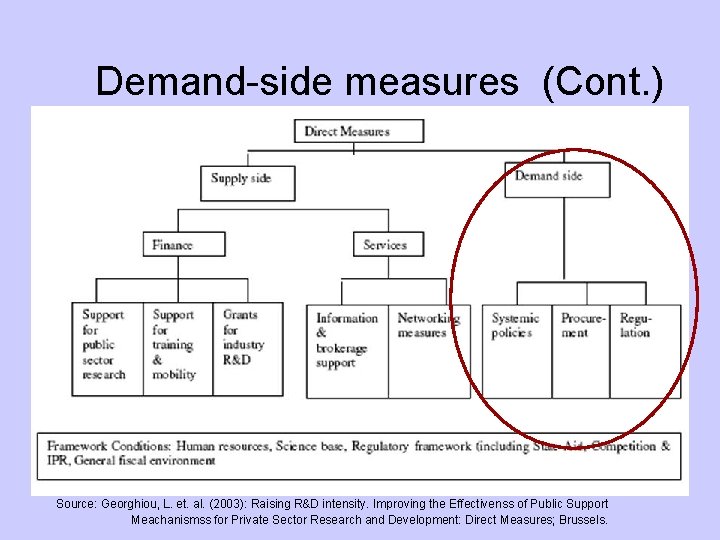
Demand-side measures (Cont. ) Source: Georghiou, L. et. al. (2003): Raising R&D intensity. Improving the Effectivenss of Public Support Meachanismss for Private Sector Research and Development: Direct Measures; Brussels.
Demand-side measures (Cont. ) Renewed interest of procurement as leverage for innovation • Barcelona/Lisbon-Strategy • EU-Expert group on „Public Procurement - Private R&D and Innovation“, • International Benchmark of innovative procurement (Edquist et. al. late 1990 s) • Procurement as part of 3% action plan • Kok-Report (2004) on progress of Lisbon Strategy, recognised the importance of procurement • Aho Report (2006) Creating an innovative Europe • Introduction of new EU procurement directives that allow the possibility for innovation • Policy developments in UK, Germany, etc
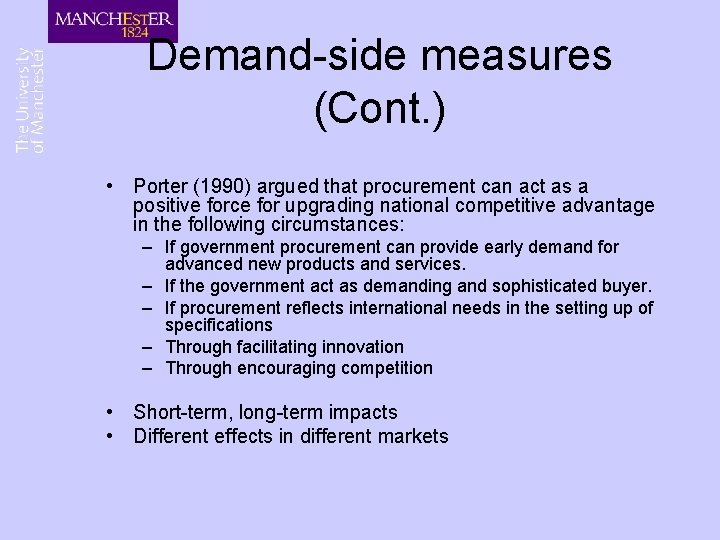
Demand-side measures (Cont. ) • Porter (1990) argued that procurement can act as a positive force for upgrading national competitive advantage in the following circumstances: – If government procurement can provide early demand for advanced new products and services. – If the government act as demanding and sophisticated buyer. – If procurement reflects international needs in the setting up of specifications – Through facilitating innovation – Through encouraging competition • Short-term, long-term impacts • Different effects in different markets
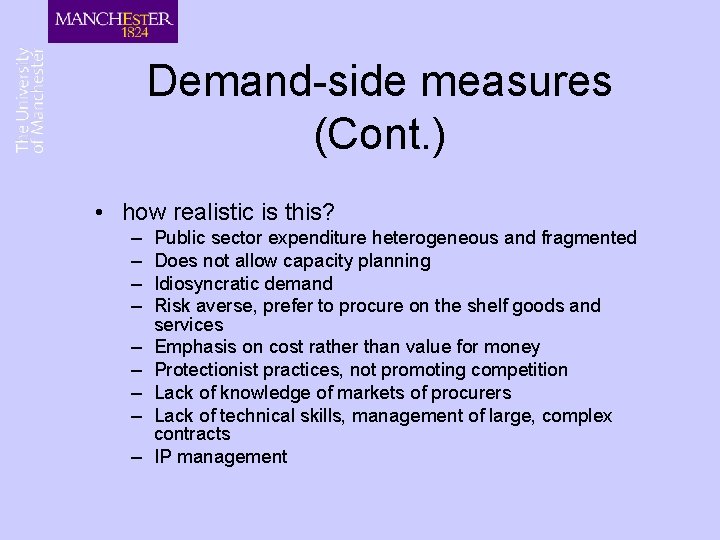
Demand-side measures (Cont. ) • how realistic is this? – – – – – Public sector expenditure heterogeneous and fragmented Does not allow capacity planning Idiosyncratic demand Risk averse, prefer to procure on the shelf goods and services Emphasis on cost rather than value for money Protectionist practices, not promoting competition Lack of knowledge of markets of procurers Lack of technical skills, management of large, complex contracts IP management
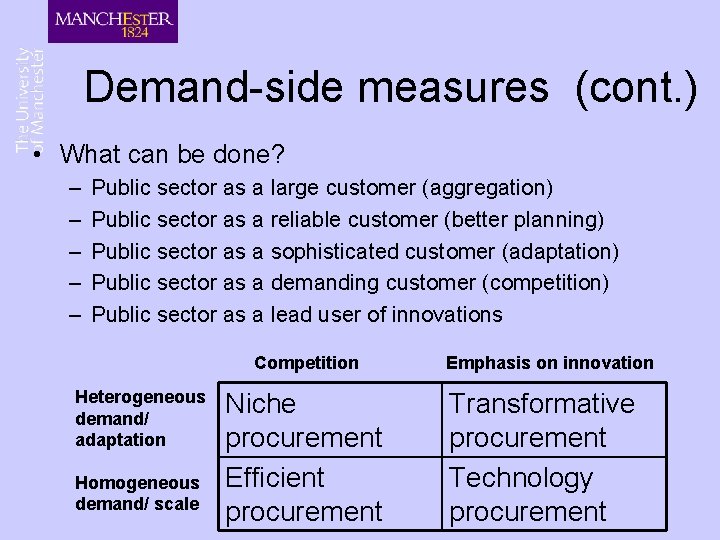
Demand-side measures (cont. ) • What can be done? – – – Public sector as a large customer (aggregation) Public sector as a reliable customer (better planning) Public sector as a sophisticated customer (adaptation) Public sector as a demanding customer (competition) Public sector as a lead user of innovations Competition Heterogeneous demand/ adaptation Homogeneous demand/ scale Niche procurement Efficient procurement Emphasis on innovation Transformative procurement Technology procurement
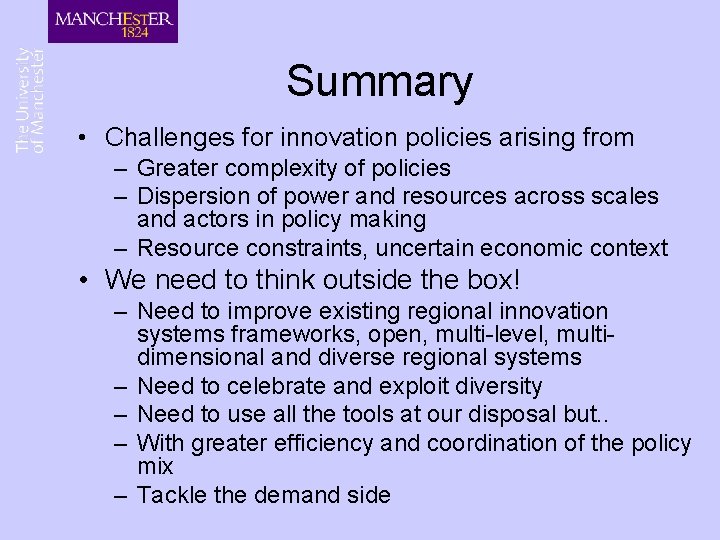
Summary • Challenges for innovation policies arising from – Greater complexity of policies – Dispersion of power and resources across scales and actors in policy making – Resource constraints, uncertain economic context • We need to think outside the box! – Need to improve existing regional innovation systems frameworks, open, multi-level, multidimensional and diverse regional systems – Need to celebrate and exploit diversity – Need to use all the tools at our disposal but. . – With greater efficiency and coordination of the policy mix – Tackle the demand side